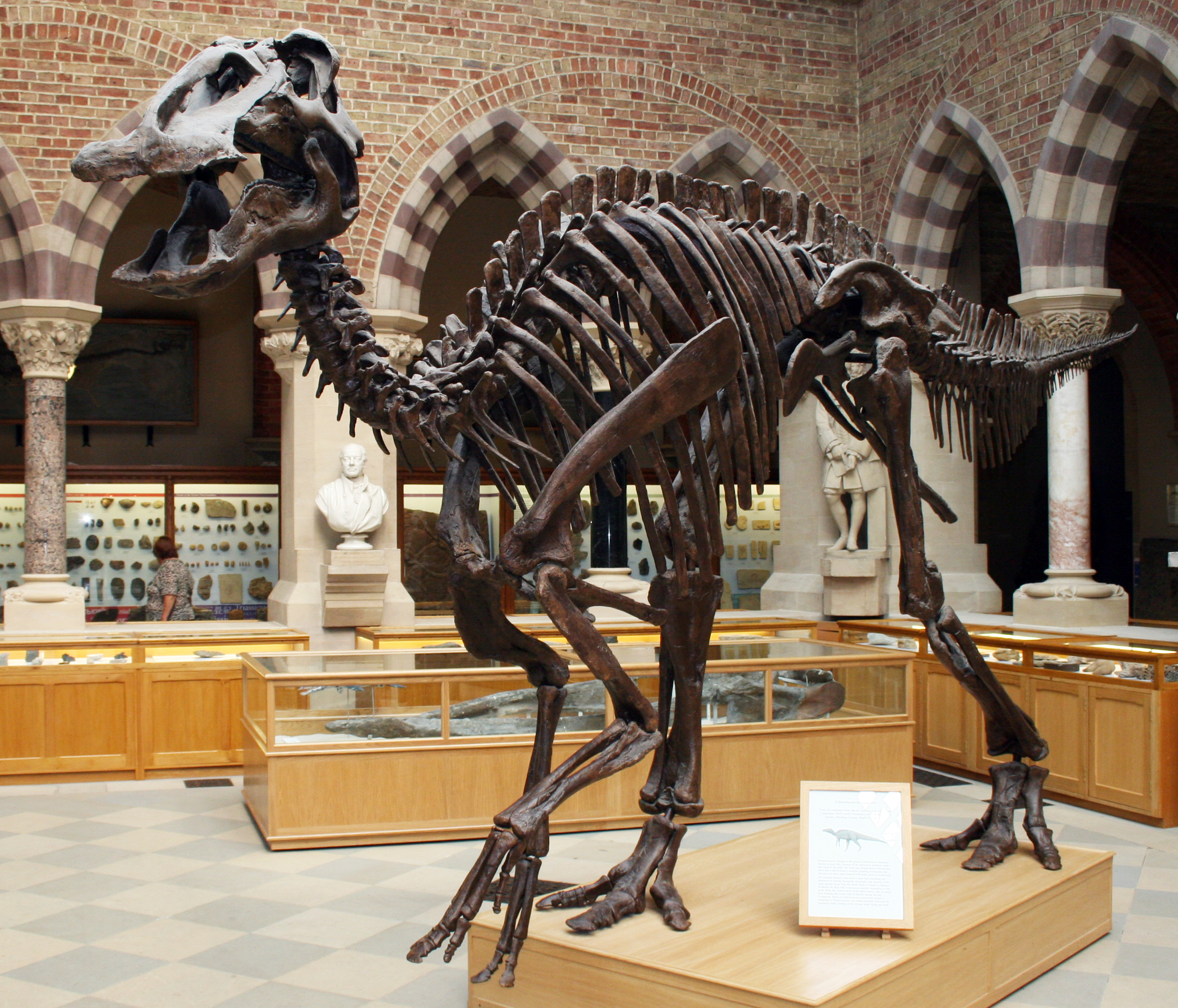
Classification
Dinosauria
Clade non classé
›
Ornithischia
Clade non classé
›
Neornithischia
Clade non classé
›
Pyrodontia
Clade non classé
›
Cerapoda
Clade non classé
›
Ornithopoda
Sous-ordre
›
Iguanodontia
Infraordre
›
Euiguanodontia
Clade non classé
›
Dryomorpha
Clade non classé
›
Ankylopollexia
Clade non classé
›
Styracosterna
Clade non classé
›
Hadrosauriformes
Clade non classé
›
Hadrosauroidea
Clade non classé
›
Hadrosauridae
Famille
›
Hadrosaurinae
Sous-famille
›
Saurolophini
Tribu
Sites de découverte 56 sites géolocalisés
Répartition
Principaux pays
Formations géologiques
Distribution temporelle
Maastrichtien
(72.2–66 Ma)
34
Campanien
(83.6–72.2 Ma)
22
Images 1
Bibliographie
Description originale
P. Godefroit, Y. L. Bolotsky, and P. Lauters. 2012. A new saurolophine dinosaur from the latest Cretaceous of far eastern Russia. PLoS ONE 7(5):e36849:1-22
DOI ↗
Bibliographie (31)
Y. Lee, L. L. Jacobs, and P. J. Currie, R. Barsbold. 2023. Narrative of the Korea-Mongolian International Dinosaur expeditions (KID) 2006–2010 with scientific results. Windows into Sauropsid and Synapsid Evolution: Essays in Honor of Louis L. Jacobs
E. T. Drysdale, F. Therrien, and D. K. Zelenitsky, D. B. Weishampel, D. C. Evans. 2019. Description of juvenile specimens of Prosaurolophus maximus (Hadrosauridae: Saurolophinae) from the Upper Cretaceous Bearpaw Formation of southern Alberta, Canada, reveals ontogenetic changes in crest morphology. Journal of Vertebrate Paleontology 38(6):e1547310:1-20
DOI ↗
R. C. McKellar, E. Jones, and M. S. Engel, R. Tappert, A. P. Wolfe, K. Muehlenbachs, P. Cockx, E. B. Koppelhus, P. J. Currie. 2019. A direct association between amber and dinosaur remains provides paleoecological insights. Scientific Reports 9(17916):1-7
DOI ↗
P. Cruzado-Caballero and J. E. Powell. 2017. Bonapartesaurus rionegrensis, a new hadrosaurine dinosaur from South America: implications for phylogenetic and biogeographic relations with North America. Journal of Vertebrate Paleontology 37(2):e1289381:1-16
DOI ↗
P. J. Currie. 2016. Dinosaurs of the Gobi: Following in the footsteps of the Polish-Mongolian Expeditions. Palaeontologia Polonica 67:83-100
DOI ↗
D. C. Evans, C. T. McGarrity, and M. J. Ryan. 2014. A skull of Prosaurolophus maximus from southeastern Alberta and the spatiotemporal distribution of faunal zones in the Dinosaur Park Formation. Hadrosaurs
A. Prieto-Marquez and J. R. Wagner. 2013. A new species of saurolophine hadrosaurid dinosaur from the Late Cretaceous of the Pacific Coast of North America. Acta Palaeontologica Polonica 58(2):255-268
P. R. Bell. 2012. Standardized terminology and potential taxonomic utility for hadrosaurid skin impressions: a case study for Saurolophus from Canada and Mongolia. PLoS One 7(2):e31295:1-12
DOI ↗
B. Kremer, K. Owocki, and A. Królikowska, B. Wrzosek, J. Kazmierczak. 2012. Mineral microbial structures in a bone of the Late Cretaceous dinosaur Saurolophus angustirostris from the Gobi Desert, Mongolia—a Raman spectroscopy study. Palaeogeography, Palaeoclimatology, Palaeoecology 358–360:51-61
DOI ↗
M. Watabe, S. Suzuki, and K. Tsogtbaatar, T. Tsubamoto, M. Saneyoshi. 2010. Report of the HMNS-MPC Joint Paleontological Expedition in 2006. Hayashibara Museum of Natural Sciences Research Bulletin 3:11-18
T. A. Gates and A. A. Farke. 2009. Biostratigraphic and biogeographic implications of a hadrosaurid (Ornithopoda: Dinosauria) from the Upper Cretaceous Almond Formation of Wyoming, USA. Cretaceous Research 30:1157-1163
DOI ↗
S. Ishigaki, M. Watabe, and K. Tsogtbaatar, M. Saneyoshi. 2009. Dinosaur footprints from the Upper Cretaceous of Mongolia. Geological Quarterly 53(4):449-460
P. Bell. 2007. The Danek Bonebed: an unusual dinosaur assemblage from the Horseshoe Canyon Formation, Edmonton, Alberta. Journal of Vertebrate Paleontology 27(3, suppl.):46A
K. Tsogtbaatar and T. Chinzorig. 2007. Mongolian hadrosaurids: paleobiogeography, dispersal and environmental relationships. The Korean Journal of Quaternary Research 21(2):49-53
M. T. Carrano. 2006. Fossil Vertebrate Collections, Museum of the Rockies
Y. Matsumoto, R. Hashimoto, and T. Sonoda. 2000. Report of preparation works for Mongolian specimens in HMNS from March 1994 to December 1998. Hayashibara Museum of Natural Sciences Research Bulletin 1:113-127
S. Suzuki and M. Watabe. 2000. Report on the Japan–Mongolia Joint Paleontological Expedition to the Gobi desert, 1998. Hayashibara Museum of Natural Sciences Research Bulletin 1:83-98
W. Watabe and S. Suzuki. 2000. Report on the Japan–Mongolia Joint Paleontological Expedition to the Gobi desert, 1994. Hayashibara Museum of Natural Sciences Research Bulletin 1:30-44
S. M. Kurzanov. 1993. Novaya nakhodka otpechatka kozhi zavrolofa [New find of Saurolophus skin impression]. Sledy Zhiznedeyatelbnosti Drevnikh Organizmov [Trace Fossils of Extinct Organisms]
D. J. Varricchio. 1993. Taphonomy of Jack's Birthday site, a diverse dinosaur bone bed. Journal of Vertebrate Paleontology 13(3, suppl.):61A
R. R. Rogers. 1991. Taphonomy of three dinosaur bone beds in the Upper Cretaceous Two Medicine Formation of Northwestern Monana: evidence for drought-related mortality. Palaios 5:394-413
DOI ↗
J. Danis. 1986. Quarries of Dinosaur Provincial Park. In B. G. Naylor (ed.), Field Trip Guidebook to Dinosaur Provincial Park, 2 June 1986. Dinosaur Systematics Symposium, Tyrrell Museum of Palaeontology, Drumheller, Alberta
P. J. Currie. 1980. Mesozoic vertebrate life in Alberta and British Columbia. Mesozoic Vertebrate Life 1:27-40
R. Gradzinski, Z. Kielan-Jaworowska, and T. Maryanska. 1977. Upper Cretaceous Djadokhta, Barun Goyot and Nemegt formations of Mongolia, including remarks on previous subdivisions. Acta Geologica Polonica 27(3):281-318
R. Gradzinski and T. Jerzykiewicz. 1972. Additional geographical and geological data from the Polish-Mongolian Palaeontological Expeditions. Palaeontologia Polonica 27:17-306
Z. Kielan-Jaworowska and R. Barsbold. 1972. Narrative of the Polish-Mongolian Palaeontological Expeditions 1967-1971. Palaeontologia Polonica 27:5-136
A. K. Rozhdestvensky. 1952. Novyi predstavitel' utkonosykh dinozavrov iz verkhnemelovykh otlozhenii Mongolii [A new representative of the duck-billed dinosaurs from the Upper Cretaceous of Mongolia]. Doklady Akademii Nauk SSSR 86(2):405-408
C. M. Sternberg. 1950. Notes and annotated list of quarries. Map 969A. Steveville, west of fourth meridian, Alberta. Canada Department of Mines and Technical Surveys, Geological Survey of Canada, Ottawa
R. S. Lull and N. E. Wright. 1942. Hadrosaurian dinosaurs of North America. Geological Society of America Special Paper 40:1-242
DOI ↗
B. Brown. 1916. A new crested trachodont dinosaur, Prosaurolophus maximus. Bulletin of the American Museum of Natural History 35(37):701-708
B. Brown. 1913. The skeleton of Saurolophus, a crested duck-billed dinosaur from the Edmonton Cretaceous. Bulletin of the American Museum of Natural History 32(19):387-393