The history of life on Earth is not a steady accumulation of species. It is punctuated by sudden crises, in which a large share of biodiversity disappears in a geologically very short time. Five of these episodes stand out for their scale: the “Big Five”. One of them, 66 million years ago, ended the reign of the non-avian dinosaurs. These crises shed light on a central question for dinosaur paleontology: why did the group rise at one particular moment, and die out at another?
The concept of the “Big Five”
The idea of a small number of exceptional extinctions comes from a statistical study. In 1982, Raup and Sepkoski showed that, on several occasions during the Phanerozoic, extinction among marine families departed significantly from the background extinction rate, the normal, ongoing rate at which species disappear [1]. Four peaks stand out clearly in their data: the end of the Ordovician, the Permian, the Triassic and the Cretaceous. A fifth, in the Devonian, was less clear statistically at the time. It was later literature that enshrined these five episodes as the “Big Five”. The concept is therefore a statistical construct based on marine families, not a fixed threshold expressed as a percentage of species. The percentages quoted today come from later estimates.
~445 Ma: the Ordovician-Silurian extinction
About 85% of marine species disappeared. It is the second most severe extinction in Earth's history, and it struck a world where life was still essentially marine, long before land vertebrates appeared. High-precision dating distinguishes two phases: the first lasted about 340,000 years, the second barely 60,000 years, with a much higher extinction rate [2]. The best-established mechanism is a rapid glaciation of the supercontinent Gondwana. Sea level fell and shallow coastal habitats shrank. Glaciation is not the ultimate cause, however: it was itself the result of a drop in atmospheric CO₂ whose origin is still debated [5]. The second phase is linked to widespread ocean anoxia during deglaciation. Anoxia is when water loses so much oxygen that most animals can no longer breathe. Brachiopods, trilobites, graptolites and conodonts were severely decimated.

Source: Wikimedia Commons, James St. John, CC BY 2.0.

A more speculative hypothesis was proposed in 2004: a gamma-ray burst from space could have destroyed part of the ozone layer and exposed the surface to harmful UV radiation for several years [3]. This idea remains a minority view with no direct evidence, unlike the glaciation hypothesis, which is much better supported by geological data.
- Extinct: trinucleid trilobites and Isotelus, most graptolite lineages, many brachiopods, bryozoans and conodonts.
- Survived: nautiloids, eurypterids (sea scorpions), jawless fish, corals, some graptolites (ancestors of the Silurian forms).
~372-359 Ma: the Late Devonian extinction
This crisis consists of two distinct episodes about 13 million years apart. The first is the Kellwasser event, at the Frasnian-Famennian boundary, dated to 371.87 ± 0.11 Ma [4]. This precision comes from radioisotopic geochronology, which measures the decay of radioactive elements trapped in minerals in volcanic ash. The second is the Hangenberg event, which marks the very end of the Devonian. Stromatoporoid reefs and tropical coral reefs collapsed. Placoderms, jawed fish covered in bony plates, disappeared entirely, as did most armored jawless fish. The best-supported cause is prolonged ocean anoxia, but the relative roles of climatic cooling and anoxia are still debated. No solid evidence of an extraterrestrial cause has been linked to either episode [5].

Source: Wikimedia Commons, LadyofHats (public domain).

- Extinct: placoderms (Dunkleosteus), most armored jawless fish, stromatoporoid reefs, most trilobite orders, early tetrapods such as Ichthyostega and Acanthostega.
- Survived: sharks, ray-finned bony fish, some tetrapod lineages (ancestors of land vertebrates), proetid trilobites.
~252 Ma: the Permian-Triassic extinction, “the great extinction”
It is by far the most severe of the five. More than 90% of marine species disappeared, and on land about 78% of vertebrate genera, according to the authors of a 2012 study [29] [V2]. Most of the extinction took place within about 60,000 years [6]. The favored cause today is the massive volcanism of the Siberian Traps. Their CO₂ outgassing was both rapid and enormous, causing global warming and ocean acidification [7]. More recent work points to a specific trigger: magma intrusions (sills) cut through sedimentary rocks rich in coal and evaporites, releasing huge additional amounts of gas [8].

Source: Wikimedia Commons, James St. John, CC BY 2.0.

The recovery of biodiversity was unusually slow, and very uneven across groups and environments. It took several million years for marine ecosystems. Among land vertebrates, family diversity took about thirty million years to return to its pre-crisis level [9]. This delay left an unusually empty ecological space, in which the archosaurs — the group dinosaurs arose from — diversified.
- Extinct: the last trilobites, eurypterids, rugose and tabulate corals, fusulinids, gorgonopsians (Inostrancevia), pareiasaurs (Scutosaurus).
- Survived: Lystrosaurus, cynodonts (ancestors of mammals), early archosauromorphs (Proterosuchus), some ammonoid and crinoid lineages, temnospondyls.
~201 Ma: the Triassic-Jurassic extinction, the door opens for dinosaurs
This crisis is linked to the breakup of Pangaea and the emplacement of the Central Atlantic Magmatic Province (CAMP). High-precision uranium-lead (U-Pb) dating of zircon crystals places the start of this volcanism at 201.564 million years ago, at the same time as the extinction [10]. The proposed mechanisms are massive CO₂ outgassing and the release of toxic mercury into the environment [11]. A more recent study highlights another factor: harsh volcanic winters, caused by sulfur aerosols, would have hit reptiles without thermal insulation hard [12].
The large non-dinosaur archosaurs that dominated the Triassic (phytosaurs, aetosaurs, rauisuchians) almost all died out at this boundary. Dinosaurs, pterosaurs and crocodylomorphs survived. Why did dinosaurs then take over? The answer is counterintuitive. A key study shows that Late Triassic dinosaurs did not evolve any faster than their rivals on the crocodile line (crurotarsans), and that the latter even had twice the morphological disparity, that is, diversity of body forms [13]. So it was not obvious competitive superiority that explains the rise of the dinosaurs. Above all, the crisis freed up ecological niches — ways of living and feeding left vacant when their occupants disappeared. Dinosaurs were able to fill them during the Jurassic. This takeover was gradual, spread over several million years, not immediate. Their survival itself was probably due to several factors: their biological traits, their geographic distribution and an element of chance. Biologists call this historical contingency: a lineage's success also depends on circumstances.

Source: Wikimedia Commons, Eden, Janine and Jim, CC BY 2.0.

Was it simply luck? The question remains open. According to the team that identified the volcanic winters, dinosaurs probably had an insulating covering (feathers or filaments) from the start. They had already colonized cold, high-latitude regions, which would have prepared them for these winters [12]. Chance or head start, dinosaurs were in any case favored by a series of upheavals: the Permian-Triassic crisis, the Carnian Pluvial Episode (a smaller crisis, described below) and the Triassic-Jurassic extinction. None of them alone explains their success. Each opened up opportunities that other lineages could have seized.
- Extinct: phytosaurs (Smilosuchus), aetosaurs, rauisuchians (Postosuchus), placodonts, conodonts, large temnospondyls (Metoposaurus), most ammonoids.
- Survived: dinosaurs, pterosaurs, crocodylomorphs, early mammaliaforms, turtles, ichthyosaurs, plesiosaurs.
~66 Ma: Cretaceous-Paleogene, beyond the asteroid
The asteroid impact hypothesis, put forward by the Alvarez team in 1980 and confirmed by the discovery of the Chicxulub crater, is already covered in detail in the article A brief history of dinosaur paleontology. What is worth adding here is the ongoing debate over a possible aggravating factor: the volcanism of the Deccan Traps in India. Two dating studies published the same year in Science reach different conclusions. The first, using the argon-argon method, places most of the erupted volume after the impact [14]. The second, using uranium-lead dating of zircons, identifies four eruptive pulses, the first of which came before the impact [15]. Dating cannot yet settle the timing of the eruptions or their relative weight. The best-supported interpretation is still the impact as the main cause, with the Deccan at most acting as a pre-existing stress.

Source: Wikimedia Commons, BasaltWeaver, CC BY 4.0.

The extinction went far beyond the non-avian dinosaurs. Ammonites disappeared, along with mosasaurs and plesiosaurs, and tropical coral reefs collapsed. By contrast, crocodylians, turtles, amphibians and small mammals came through relatively well. Why this selectivity? Two factors come up often: small size, and a diet able to exploit durable resources (seeds, detritus) after plant production collapsed. Birds are a good example. All Cretaceous lineages of tree-dwelling birds died out with the worldwide collapse of forests, and modern birds are thought to descend from ground-dwelling ancestors [16]. Another study shows that lineages with toothless, seed-adapted beaks survived, while toothed birds disappeared [17].
- Extinct: non-avian dinosaurs (Tyrannosaurus, Triceratops), pterosaurs (Quetzalcoatlus), mosasaurs, plesiosaurs, ammonites, belemnites, rudists, enantiornith birds.
- Survived: modern birds, mammals, crocodylians, turtles, lizards and snakes, amphibians, sharks, nautiluses.
What links the great crises
Of the five mass extinctions, four coincide with the emplacement of a large igneous province (LIP): gigantic outpourings of lava able to cover millions of square kilometers in a few hundred thousand years. The Late Devonian matches the Viluy Traps, the Permian-Triassic the Siberian Traps, the Triassic-Jurassic the CAMP and the Cretaceous-Paleogene the Deccan Traps. Smaller crises follow the same pattern, such as the end-Guadalupian (Emeishan Traps) and the early Toarcian (Karoo-Ferrar), described below [18][5]. Coincidence does not prove causation, however. Several large igneous provinces caused no notable extinction. And for the K-Pg, the impact, not volcanism, remains the main explanation. A recent review nevertheless identifies a recurring pattern: rapid global warming, then ocean anoxia and acidification, most often triggered by large-scale volcanism [5]. The link is not automatic. The effect of an eruption depends on how fast gases are released, what they are, which rocks the magma passes through and the state of ecosystems at the time.
Minor crises
The Big Five are not the only crises in the history of life. To understand the rise and fall of the great reptiles, we also need to look at smaller ones. Between the mass extinctions lie many lesser episodes. They did not reach the thresholds of the great extinctions, but they reshaped the ecosystems of their time. Several played a direct role in the history of the great reptiles.
~260 Ma: the end-Guadalupian crisis
About eight million years before the great Permian extinction, an earlier crisis struck the tropical seas, in the Capitanian. Fusulinids (giant foraminifera), calcareous algae and many reef builders declined sharply. In South China, lavas of the Emeishan Traps are interbedded with marine limestones, so the timing of eruptions and extinctions can be compared directly in the field: the two coincide [19]. The cause-and-effect link is still debated, however, because some outcrops leave open the possibility that volcanism slightly postdated the crisis.

Source: Wikimedia Commons, James St. John, CC BY 2.0.

- Extinct: large fusulinids (Yabeina), giant alatoconchid bivalves, many corals and reef brachiopods.
- Survived: small fusulinids, gorgonopsians, dicynodonts and other therapsids, until the next crisis.
~232 Ma: the Carnian Pluvial Episode
This is probably the most important minor crisis in dinosaur history. Around 234-232 Ma, the Carnian climate switched to a very humid phase for one or two million years before turning arid again. This Carnian Pluvial Episode came with a major turnover of fauna and flora. Dinosaurs, which had appeared some 10 million years earlier, had remained inconspicuous until then. Well-dated fossil footprints from the Dolomites in Italy show that they diversified suddenly at the end of this episode [20].

Source: Wikimedia Commons, Ninjatacoshell, CC BY-SA 3.0.

- Declined: rhynchosaurs (Hyperodapedon), dicynodonts, many ammonoids and crinoids.
- Thrived: dinosaurs (Herrerasaurus, Eoraptor), modern conifers, scleractinian corals.
~183 Ma: the Toarcian anoxic event
In the Early Jurassic, the Karoo-Ferrar igneous province formed in southern Africa and Antarctica. It caused sudden warming and widespread ocean anoxia. Ammonites and other marine invertebrates suffered a multi-phase extinction, recorded in the same way in three separate ocean basins [21]. On land, the crisis also affected dinosaurs. In Patagonia, early sauropodomorphs adapted to soft vegetation disappeared. True sauropods, with sturdier teeth, replaced them: they could eat the tough plants that dominated the flora in this greenhouse climate. It was after this crisis that sauropods became the dominant large herbivores [22].

Source: Wikimedia Commons, Didier Descouens, CC BY-SA 4.0.

- Extinct: early sauropodomorphs (Massospondylus-type), spiriferinid brachiopods, many ammonite species.
- Survived: sauropods (Bagualia), ichthyosaurs (Temnodontosaurus, Stenopterygius), plesiosaurs, marine crocodylomorphs.
~94 Ma: the end of ichthyosaurs in the Cenomanian
At the end of the Cenomanian, another oceanic anoxic event struck the world's seas. It was during this period that the ichthyosaurs, present since the Early Triassic, finally disappeared. Their extinction was not a sudden collapse: it happened in two steps during the Cenomanian, against a background of strong environmental instability, at a time when the group's rate of evolution had slowed markedly [23].

Source: Wikimedia Commons, Richard N Horne, CC BY-SA 4.0.

- Extinct: the last ichthyosaurs (Platypterygius), planktonic foraminifera of the genus Rotalipora, many ammonites.
- Survived: mosasaurs (which took over from ichthyosaurs), plesiosaurs, elasmosaurs, sea turtles, sharks.
~56 Ma: the Paleocene-Eocene thermal maximum
Ten million years after the non-avian dinosaurs disappeared, a massive injection of carbon into the ocean and atmosphere caused abrupt warming. In the deep sea, 30 to 50% of benthic foraminifera species died out — the largest extinction in this group in 100 million years [24]. In surface waters and on land, by contrast, most groups came through. This thermal maximum is now closely studied as a possible analog of present-day warming.
- Extinct: 30 to 50% of deep-sea foraminifera (including Stensioeina beccariiformis).
- Thrived: the first modern primates, the first horses (Sifrhippus), artiodactyls and perissodactyls, which then spread across the continents.
The “sixth extinction”?
The phrase, popularized by the journalist Elizabeth Kolbert in a 2014 book [V1], refers to the possibility that human activity has set off a new mass extinction. The figures are serious. The current extinction rate is estimated to be far higher than the natural background rate [25]. A 2015 study of vertebrates confirms this, even under the most conservative assumptions [26]. A broader review, which also includes the often-overlooked invertebrates, concludes that Earth has already lost 7.5% to 13% of known species since the year 1500 [27]. At the level of land vertebrate genera, the rate of loss since 1500 is thought to be 35 times the background rate [28].

Source: Wikimedia Commons, Roelant Savery (public domain).

But should we speak of a mass extinction in the strict sense, comparable to the Big Five? Caution is needed. Kolbert herself acknowledges that it is still too early to say for sure [V1]. A landmark 2011 study concludes that current losses, while serious, have not yet reached the threshold of the great crises of the past, defined as more than 75% of species lost. It notes, however, that this threshold would be reached within a few centuries if the species now threatened were to disappear [25]. The comparison also runs into a timescale problem. The Big Five played out over tens of thousands to a few million years; the current crisis over only about five centuries. Nor are the data of the same kind. The Big Five are measured in the fossil record, which mostly preserves organisms with skeletons. Recent extinctions are measured by direct observation, and many go unnoticed, especially among invertebrates. A direct comparison therefore remains methodologically tricky [27].
- Extinct since 1500: dodo, Steller's sea cow, great auk, passenger pigeon, thylacine, golden toad of Costa Rica.
Outlook
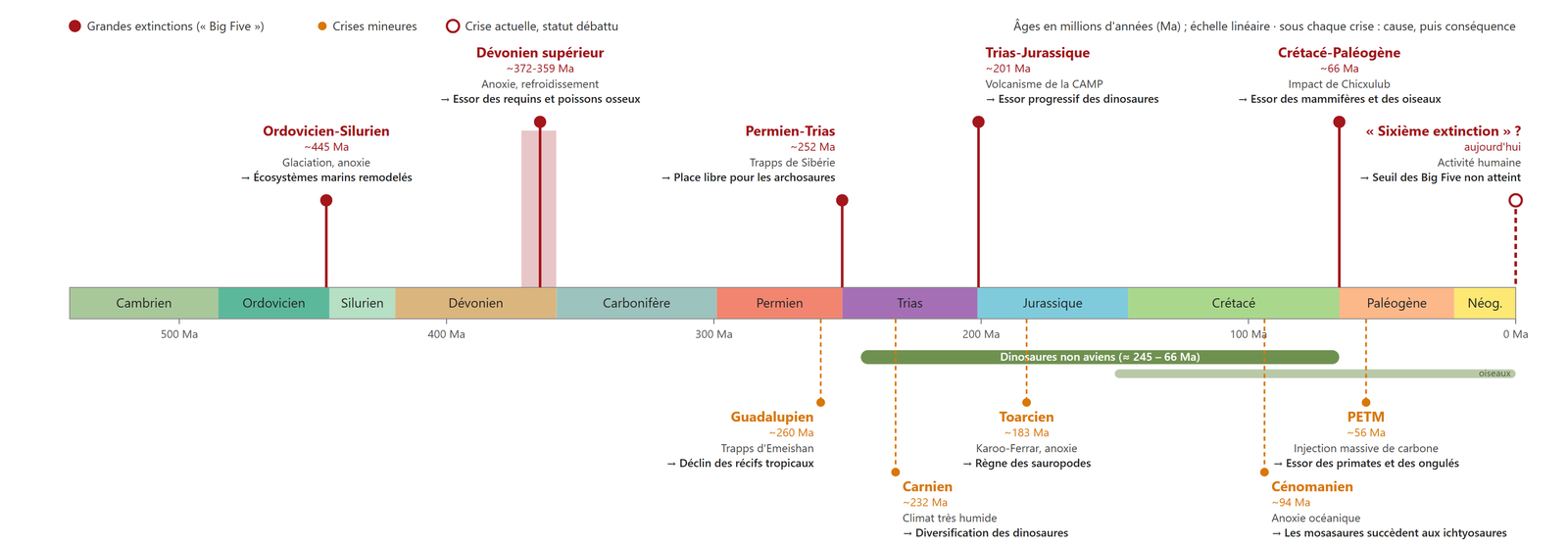
Dinopedia diagram generated with AI, based on the dates and data in the table below.
The table below summarizes, in chronological order, the five great crises and the minor crises covered in this article, with their causes and their evolutionary consequences. For the Big Five, the percentages of species lost are the estimates compiled by Barnosky and colleagues [25]. They rely mostly on marine fossils, which are far more abundant. Figures for life on land, where they exist, usually concern genera or a particular group, so they cannot be compared directly with the marine ones. The minor crises are rarely quantified in a comparable way.
| Crisis | Magnitude | Species lost (estimate) | Main cause | Groups hit hardest | Evolutionary consequence |
|---|---|---|---|---|---|
| Ordovician-Silurian (~445 Ma) | Big Five | 86% (mostly from marine fossils) | Glaciation, sea-level fall, anoxia | Trilobites, brachiopods, graptolites | Reshaping of marine ecosystems |
| Late Devonian (~372-359 Ma) | Big Five | 75% (mostly from marine fossils) | Ocean anoxia, cooling (relative roles debated) | Placoderms, stromatoporoid reefs, armored jawless fish | Diversification of sharks and bony fish |
| End-Guadalupian (~260 Ma) | Minor | Not quantified | Emeishan Traps (causal link debated) | Large fusulinids, alatoconchid bivalves, corals and reef brachiopods | Decline of tropical reefs, before the Permian crisis |
| Permian-Triassic (~252 Ma) | Big Five | 96% (mostly from marine fossils); on land, about 78% of vertebrate genera [29] [V2] | Siberian Traps: CO₂, warming, acidification | Last trilobites, gorgonopsians, pareiasaurs | Ecological space opens up for archosaurs |
| Carnian Pluvial Episode (~232 Ma) | Minor | Not quantified | Switch to a very humid climate for one to two million years | Rhynchosaurs, dicynodonts, ammonoids, crinoids | Sudden diversification of dinosaurs |
| Triassic-Jurassic (~201 Ma) | Big Five | 80% (mostly from marine fossils); on land, about 96% of the genera studied [30] | CAMP: CO₂, sulfur aerosols, mercury | Phytosaurs, aetosaurs, rauisuchians | Gradual rise of dinosaurs in the Jurassic |
| Toarcian (~183 Ma) | Minor | Not quantified | Karoo-Ferrar: sudden warming, ocean anoxia | Ammonites, early sauropodomorphs | Sauropods become the dominant large herbivores |
| End of the Cenomanian (~94 Ma) | Minor | Not quantified | Oceanic anoxic event | Last ichthyosaurs, foraminifera Rotalipora, ammonites | Mosasaurs take over from ichthyosaurs |
| Cretaceous-Paleogene (~66 Ma) | Big Five | 76% (mostly from marine fossils); on land, 100% of non-avian dinosaurs and 83% of lizard and snake species [31] | Chicxulub impact, debated role of the Deccan | Non-avian dinosaurs, ammonites, mosasaurs | Expansion of modern mammals and birds |
| Paleocene-Eocene thermal maximum (~56 Ma) | Minor | 30 to 50% of deep-sea foraminifera; on land, most groups survive | Massive carbon injection, abrupt warming | Deep-sea benthic foraminifera | Spread of the first modern primates, horses and other hoofed mammals |
The great crises of the past share a recurring mechanism: rapid warming, anoxia, acidification. But each has its own trigger, its own signature and its own survivors. The history of the dinosaurs shows with particular clarity that these crises are not only episodes of destruction. They reshuffle the evolutionary deck, open up empty niches and let previously marginal lineages flourish. Dinosaurs owed their rise to several crises, and their end to another.
The past also offers lessons for the current crisis. The speed of climate change matters as much as its scale: at the end of the Ordovician, the fastest phase was the deadliest [2]. Extinct species do not come back, and recovery takes millions of years. Finally, according to Barnosky and colleagues, the mass extinction threshold has not yet been crossed [25]. Cutting emissions and protecting habitats and threatened species can therefore still change the outcome.