Greenland

Country

3 image(s) · 1 News

Image gallery

Greenlandite (fuchsite-quartz gneiss) (2.7 cm across at its widest) from the Precambrian of southwestern Greenland.  Green = fuchsite; gray = quartz; a few small, scattered pyrite crystals (brassy gold-colored) are also visible.


Attractive greenish-colored gneisses in southwestern Greenland that contain the minerals fuchsite (green) and quartz (gray) have been informally called greenlandite.  Fuchsite is a chromian muscovite mica (K(Al,Cr)2AlSi3O10(OH,F)2 - potassium chromium hydroxy-fluoro-aluminosilicate); it is typically encountered in schistose rocks.
Greenland greenlandite is part of a 3.8 billion year old, highly metamorphosed succession of rocks.  These represent the oldest known supracrustal rocks on Earth (the oldest crustal Earth rocks include 4.03 billion year old Acasta Gneiss, 4.28 b.y. rocks from the eastern Hudson Bay area, and 4.45-4.55 b.y. rocks in the subsurface of Baffin Island, Canada).
Locality: undisclosed locality in the Godthåbsfjord area or Nuuk area, southwestern Greenland.

Age: Eoarchean boundary, 3.8 billion years.
Intervals Eoarchean

Greenlandite (fuchsite-quartz gneiss) (2.7 cm across at its widest) from the Precambrian of southwestern Greenland. Green = fuchsite; gray = quartz; a few small, scattered pyrite crystals (brassy gold-colored) are also visible. Attractive greenish-colored gneisses in southwestern Greenland that contain the minerals fuchsite (green) and quartz (gray) have been informally called greenlandite. Fuchsite is a chromian muscovite mica (K(Al,Cr)2AlSi3O10(OH,F)2 - potassium chromium hydroxy-fluoro-aluminosilicate); it is typically encountered in schistose rocks. Greenland greenlandite is part of a 3.8 billion year old, highly metamorphosed succession of rocks. These represent the oldest known supracrustal rocks on Earth (the oldest crustal Earth rocks include 4.03 billion year old Acasta Gneiss, 4.28 b.y. rocks from the eastern Hudson Bay area, and 4.45-4.55 b.y. rocks in the subsurface of Baffin Island, Canada). Locality: undisclosed locality in the Godthåbsfjord area or Nuuk area, southwestern Greenland. Age: Eoarchean boundary, 3.8 billion years.

Canada Greenland Eoarchean
Greenlandite (fuchsite-quartz gneiss) (2.7 cm across at its widest) from the Precambrian of southwestern Greenland.  Green = fuchsite; gray = quartz; a few small, scattered pyrite crystals (brassy gold-colored) are also visible.


Attractive greenish-colored gneisses in southwestern Greenland that contain the minerals fuchsite (green) and quartz (gray) have been informally called greenlandite.  Fuchsite is a chromian muscovite mica (K(Al,Cr)2AlSi3O10(OH,F)2 - potassium chromium hydroxy-fluoro-aluminosilicate); it is typically encountered in schistose rocks.
Greenland greenlandite is part of a 3.8 billion year old, highly metamorphosed succession of rocks.  These represent the oldest known supracrustal rocks on Earth (the oldest crustal Earth rocks include 4.03 billion year old Acasta Gneiss, 4.28 b.y. rocks from the eastern Hudson Bay area, and 4.45-4.55 b.y. rocks in the subsurface of Baffin Island, Canada).
Locality: undisclosed locality in the Godthåbsfjord area or Nuuk area, southwestern Greenland.

Age: Eoarchean boundary, 3.8 billion years.

Greenlandite (fuchsite-quartz gneiss) (2.7 cm across at its widest) from the Precambrian of southwestern Greenland. Green = fuchsite; gray = quartz; a few small, scattered pyrite crystals (brassy gold-colored) are also visible. Attractive greenish-colored gneisses in southwestern Greenland that contain the minerals fuchsite (green) and quartz (gray) have been informally called greenlandite. Fuchsite is a chromian muscovite mica (K(Al,Cr)2AlSi3O10(OH,F)2 - potassium chromium hydroxy-fluoro-aluminosilicate); it is typically encountered in schistose rocks. Greenland greenlandite is part of a 3.8 billion year old, highly metamorphosed succession of rocks. These represent the oldest known supracrustal rocks on Earth (the oldest crustal Earth rocks include 4.03 billion year old Acasta Gneiss, 4.28 b.y. rocks from the eastern Hudson Bay area, and 4.45-4.55 b.y. rocks in the subsurface of Baffin Island, Canada). Locality: undisclosed locality in the Godthåbsfjord area or Nuuk area, southwestern Greenland. Age: Eoarchean boundary, 3.8 billion years.

Canada Greenland
Original figure caption: Trackway S1 (Eosauropus sp.), here attributed to a sauropod trackmaker based on pedal synapomorphies; trackmaker is moving towards the south-west. Two consequtive pes impressions of a tridactyl Grallator [i.e. a theropod] trackway can be seen left to the S1 trackway.
Note: The tracks are preserved on a bedding plane of a thin siltstone bed of the Late Triassic Fleming Fjord Formation of East Greenland. A) shows a photograph of the trackway(s) as preserved on the bedding plane (i.e. as concave epireliefs); B) shows a color shaded relief map based on a high-resolution photogrammetric 3D-model of the bedding plane; C) is an interpretative outline drawing of the S1 trackway; abbreviations: LM = left manus (i.e. forefoot), LP = left pes (i.e. hindfoot), RM = right manus, RP = right pes, numbers increase in walking direction.

Original figure caption: Trackway S1 (Eosauropus sp.), here attributed to a sauropod trackmaker based on pedal synapomorphies; trackmaker is moving towards the south-west. Two consequtive pes impressions of a tridactyl Grallator [i.e. a theropod] trackway can be seen left to the S1 trackway. Note: The tracks are preserved on a bedding plane of a thin siltstone bed of the Late Triassic Fleming Fjord Formation of East Greenland. A) shows a photograph of the trackway(s) as preserved on the bedding plane (i.e. as concave epireliefs); B) shows a color shaded relief map based on a high-resolution photogrammetric 3D-model of the bedding plane; C) is an interpretative outline drawing of the S1 trackway; abbreviations: LM = left manus (i.e. forefoot), LP = left pes (i.e. hindfoot), RM = right manus, RP = right pes, numbers increase in walking direction.

drawing Greenland Late Triassic Triassic +4

News

Ces narvals ont plongé là où aucun navire ne pouvait aller et révélé ce qui atteint les glaciers du Groenland
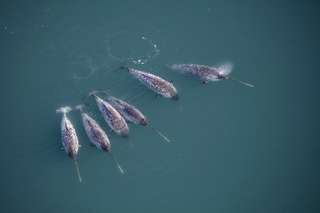
These narwhals dove where no ship could go and revealed what reaches Greenland's glaciers
Greenland
They are able to dive where ships cannot go. Equipped with sensors, six narwhals transformed themselves into oceanographers in spite of themselves and thus made it possible to explore the depths of Greenland's fjords to bring back previously unpublished data. Their dives reveal the progression...
29/08/2026 futura-terre ⚙ Auto-translated