Classification
Dinosauria
Clade non classé
›
Ornithischia
Clade non classé
›
Neornithischia
Clade non classé
›
Pyrodontia
Clade non classé
›
Cerapoda
Clade non classé
›
Ornithopoda
Sous-ordre
›
Iguanodontia
Infraordre
›
Euiguanodontia
Clade non classé
›
Dryomorpha
Clade non classé
›
Ankylopollexia
Clade non classé
›
Styracosterna
Clade non classé
›
Hadrosauriformes
Clade non classé
›
Hadrosauroidea
Clade non classé
›
Hadrosauridae
Famille
›
Hadrosaurinae
Sous-famille
›
Saurolophini
Tribu
›
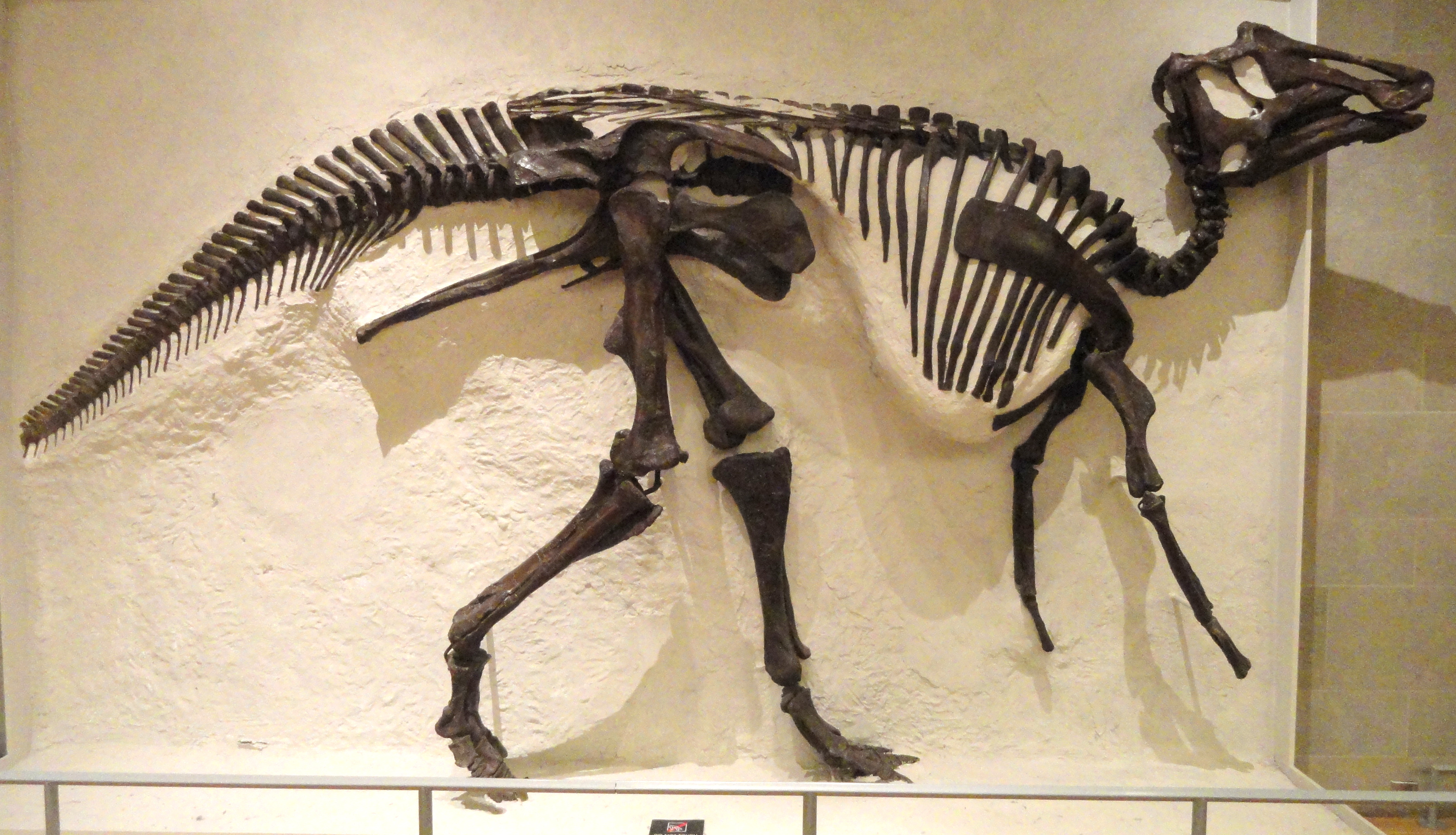
Prosaurolophus
Genre
Mesures
Longueur
7,6 m ⓘ
9,3 m ⓘ
Prosaurolophus maximus
Masse
3 500 kg ⓘ
Prosaurolophus maximus
Sites de découverte 15 sites géolocalisés
Répartition
Espèces (2)
Prosaurolophus maximus
84 Ma
Images 2
Bibliographie
Description originale
B. Brown. 1916. A new crested trachodont dinosaur, Prosaurolophus maximus. Bulletin of the American Museum of Natural History 35(37):701-708
Bibliographie (11)
E. T. Drysdale, F. Therrien, and D. K. Zelenitsky, D. B. Weishampel, D. C. Evans. 2019. Description of juvenile specimens of Prosaurolophus maximus (Hadrosauridae: Saurolophinae) from the Upper Cretaceous Bearpaw Formation of southern Alberta, Canada, reveals ontogenetic changes in crest morphology. Journal of Vertebrate Paleontology 38(6):e1547310:1-20
DOI ↗
R. C. McKellar, E. Jones, and M. S. Engel, R. Tappert, A. P. Wolfe, K. Muehlenbachs, P. Cockx, E. B. Koppelhus, P. J. Currie. 2019. A direct association between amber and dinosaur remains provides paleoecological insights. Scientific Reports 9(17916):1-7
DOI ↗
D. C. Evans, C. T. McGarrity, and M. J. Ryan. 2014. A skull of Prosaurolophus maximus from southeastern Alberta and the spatiotemporal distribution of faunal zones in the Dinosaur Park Formation. Hadrosaurs
M. T. Carrano. 2006. Fossil Vertebrate Collections, Museum of the Rockies
D. J. Varricchio. 1993. Taphonomy of Jack's Birthday site, a diverse dinosaur bone bed. Journal of Vertebrate Paleontology 13(3, suppl.):61A
R. R. Rogers. 1991. Taphonomy of three dinosaur bone beds in the Upper Cretaceous Two Medicine Formation of Northwestern Monana: evidence for drought-related mortality. Palaios 5:394-413
DOI ↗
J. Danis. 1986. Quarries of Dinosaur Provincial Park. In B. G. Naylor (ed.), Field Trip Guidebook to Dinosaur Provincial Park, 2 June 1986. Dinosaur Systematics Symposium, Tyrrell Museum of Palaeontology, Drumheller, Alberta
P. J. Currie. 1980. Mesozoic vertebrate life in Alberta and British Columbia. Mesozoic Vertebrate Life 1:27-40
C. M. Sternberg. 1950. Notes and annotated list of quarries. Map 969A. Steveville, west of fourth meridian, Alberta. Canada Department of Mines and Technical Surveys, Geological Survey of Canada, Ottawa
R. S. Lull and N. E. Wright. 1942. Hadrosaurian dinosaurs of North America. Geological Society of America Special Paper 40:1-242
DOI ↗
B. Brown. 1916. A new crested trachodont dinosaur, Prosaurolophus maximus. Bulletin of the American Museum of Natural History 35(37):701-708