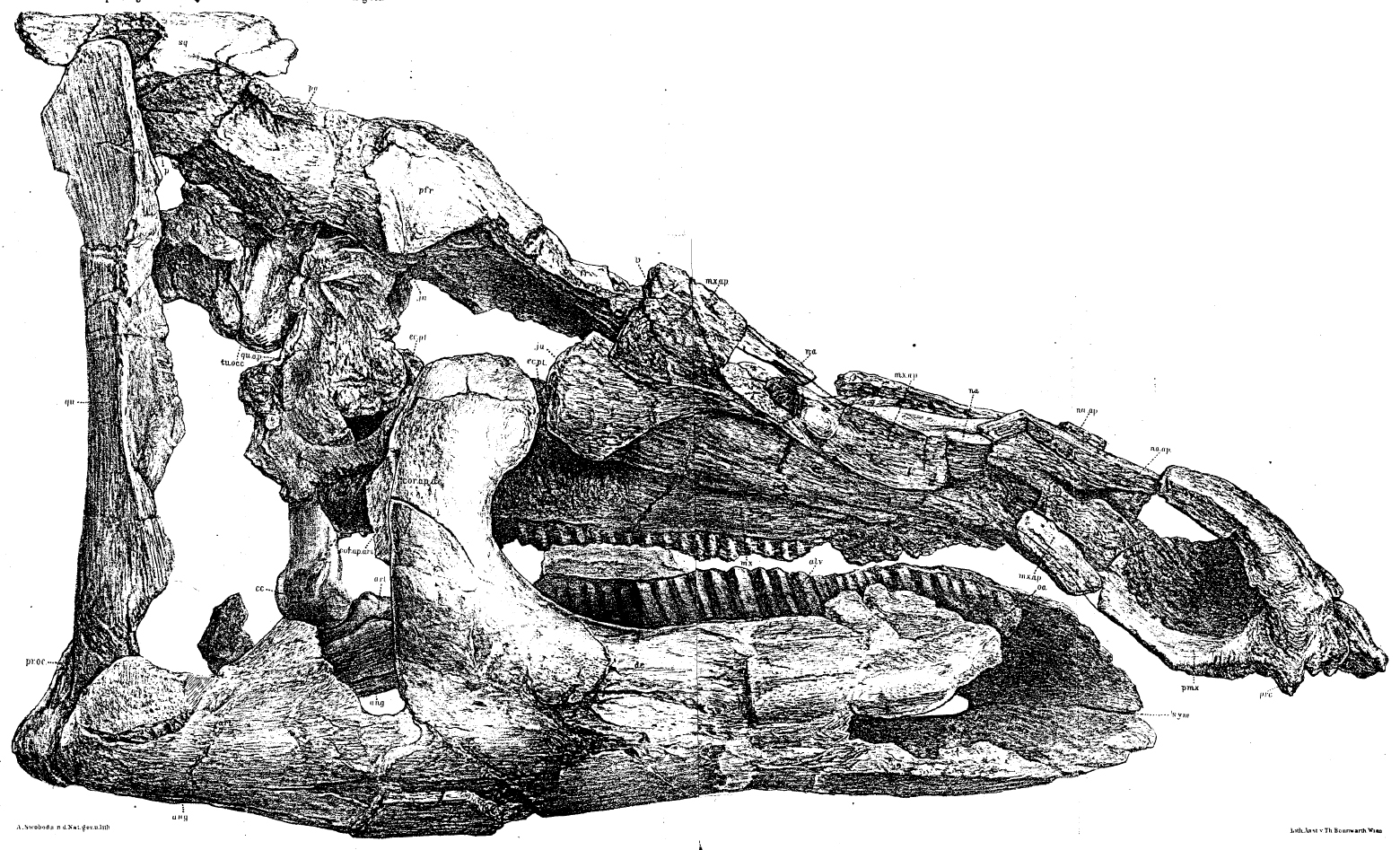
Classification
Dinosauria
Unranked clade
›
Ornithischia
Unranked clade
›
Neornithischia
Unranked clade
›
Pyrodontia
Unranked clade
›
Cerapoda
Unranked clade
›
Ornithopoda
Suborder
›
Iguanodontia
Infraorder
›
Euiguanodontia
Unranked clade
›
Dryomorpha
Unranked clade
›
Ankylopollexia
Unranked clade
›
Styracosterna
Unranked clade
›
Hadrosauriformes
Unranked clade
›
Hadrosauroidea
Unranked clade
›
Telmatosauridae
Family
›
Telmatosaurus
Genus
Measurements
Length
5 m ⓘ
Fossil sites 23 geolocated sites
Distribution
Top countries
Geological formations
Temporal distribution
Maastrichtian
(72.2–66 Ma)
22
Campanian
(83.6–72.2 Ma)
1
Species (1)
Synonyms (2)
Hecatasaurus
subjective synonym of Telmatosaurus
Limnosaurus
replaced by Telmatosaurus
Images 1
Bibliography
Original description
B. F. Nopcsa. 1903. Telmatosaurus, new name for the dinosaur Limnosaurus. Geological Magazine, decade 4 10:94-95
Bibliography (15)
G. Botfalvai, Z. Csiki-Sava, and L. Kocsis, G. Albert, J. Magyar, E. R. Bodor, D. Tabără, A. Ulyanov, L. Makádi. 2021. ‘X’ marks the spot! Sedimentological, geochemical and palaeontological investigations of upper Cretaceous (Maastrichtian) vertebrate fossil localities from the Vălioara valley (Densuş-Ciula Formation, Hațeg basin, Romania). Cretaceous Research
DOI ↗
F. M. Dalla Vecchia. 2020. The unusual tail of Tethyshadros insularis (Dinosauria, Hadrosauroidea) from the Adriatic Island of the European archipelago. Rivista Italiana di Paleontologia e Stratigrafia 126(3):583-628
Z. Csiki-Sava, M. Vremir, and S. Vasile, S. L. Brusatte, G. Dyke, D. Naish, M. A. Norell, R. Totoianu. 2016. The East Side Story – The Transylvanian latest Cretaceous continental vertebrate record and its implications for understanding Cretaceous–Paleogene boundary events. Cretaceous Research 57:662-698
DOI ↗
A. Solomon and V. Codrea. 2015. Some Maastrichtian vertebrates from fluvial channel fill deposits at Pui (Haţeg Basin). Oltenia studii şi comunicări Ştiinţele Naturii 31(2):26-36
F. M. Dalla Vecchia. 2014. An overview of the latest Cretaceous hadrosauroid record in Europe. Hadrosaurs
S. Brusatte, M. Vremir, and A. Watanabe, Z. Csiki-Sava, D. Naish, G. J. Dyke, G. M. Erickson, M. A. Norell. 2013. An infant ornithopod dinosaur tibia from the Late Cretaceous of Sebes, Romania. Terra Sebus. Acta Musei Sabesiensis 5:627-644
A.-V. Bojar, Z. Ciski, and D. Grigorescu. 2010. Stable isotope distribution in Maastrichtian vertebrates and paleosols from the Hateg Basin, South Carpathians. Palaeogeography, Palaeoclimatology, Palaeoecology 239:329-342
DOI ↗
V. Codrea, M. Vremir, and C. Jipa, P. Godefroit, Z. Csiki, T. Smith, C. Farcas. 2010. More than just Nopcsa's Transylvanian dinosaurs: A look outside the Hateg Basin. Palaeogeography, Palaeoclimatology, Palaeoecology 293:391-405
DOI ↗
Z. Csiki, D. Grigorescu, and V. Codrea, F. Therrien. 2010. Taphonomic modes in the Maastrichtian continental deposits of the Haţeg Basin, Romania—palaeoecological and palaeobiological inferences. Palaeogeography, Palaeoclimatology, Palaeoecology 293(3-4):375-390
DOI ↗
M. Vremir. 2010. New faunal elements from the Late Cretaceous (Maastrichtian) continental deposits of Sebeş area (Transylvania). Terra Sebus. Acta Musei Sabesiensis 2010(2):635-684
Z. Csiki, A. Ionescu, and D. Grigorescu. 2008. The Budurone microvertebrate site from the Maastrichtian of the Hateg Basin – flora, fauna, taphonomy and paleoenvironment. Acta Palaeontologica Romaniae 6:49-66
M. Delfino, V. Codrea, and A. Folie, P. Dica, P. Godefroit, T. Smith. 2008. A complete skull of Allodaposuchus precedens Nopcsa, 1928 (Eusuchia) and a reassessment of the morphology of the taxon based on the Romanian remains. Journal of Vertebrate Paleontology 28(1):111-122
DOI ↗
D. Grigorescu. 2006. Hatchlings of Telmatosaurus transsylvanicus (Ornithischia, Hadrosauridae) associated with megaloolithid eggs in the Tustea nesting site (Hateg Basin, Romania)
. III International Symposium on Dinosaur Eggs, Babies, and Developmental Biology. Ameghiniana 43(4 (suppl.)):18R
A. F. d. Lapparent. 1947. Les dinosauriens du Crétacé Supérieur du Midi de la France [The dinosaurs of the Upper Cretaceous of the south of France]. Mémoires de la Société Géologique de France, Nouvelle Série 56:1-54
B. F. Nopcsa. 1900. Dinosaurierreste aus Siebenbürgen (Schädel von Limnosaurus transsylvanicus nov. gen. et spec.) [Dinosaur remains from Transylvania (skull of Limnosaurus transsylvanicus nov. gen. et spec.)]. Denkschriften der Kaiserlichen Akademie der Wissenschaften. Mathematisch-Naturwissenschaftliche Classe 68:555-591