Genus
Valid Extinct

Montanoceratops

Sternberg 1951
Etymology Tête cornue du Montana

Montanoceratops is an extinct genus of small ceratopsian dinosaur that lived approximately 70 million years ago during the latter part of the Cretaceous Period in what is now Montana and Alberta. Montanoceratops was a small sized, moderately-built, ground-dwelling, quadrupedal herbivore, that could grow up to an estimated 2.5 m (8.2 ft) in length and 170 kg (370 lb) in body mass.

Temporal range
Triassic
Jurassic
Cretaceous
Paleogene
Neogene
252 201 145 66 0 Ma
PBDB occurrences
3
Group
Dinosaures
Herbivore Ground dwelling Terrestrial
Montanoceratops
click to enlarge
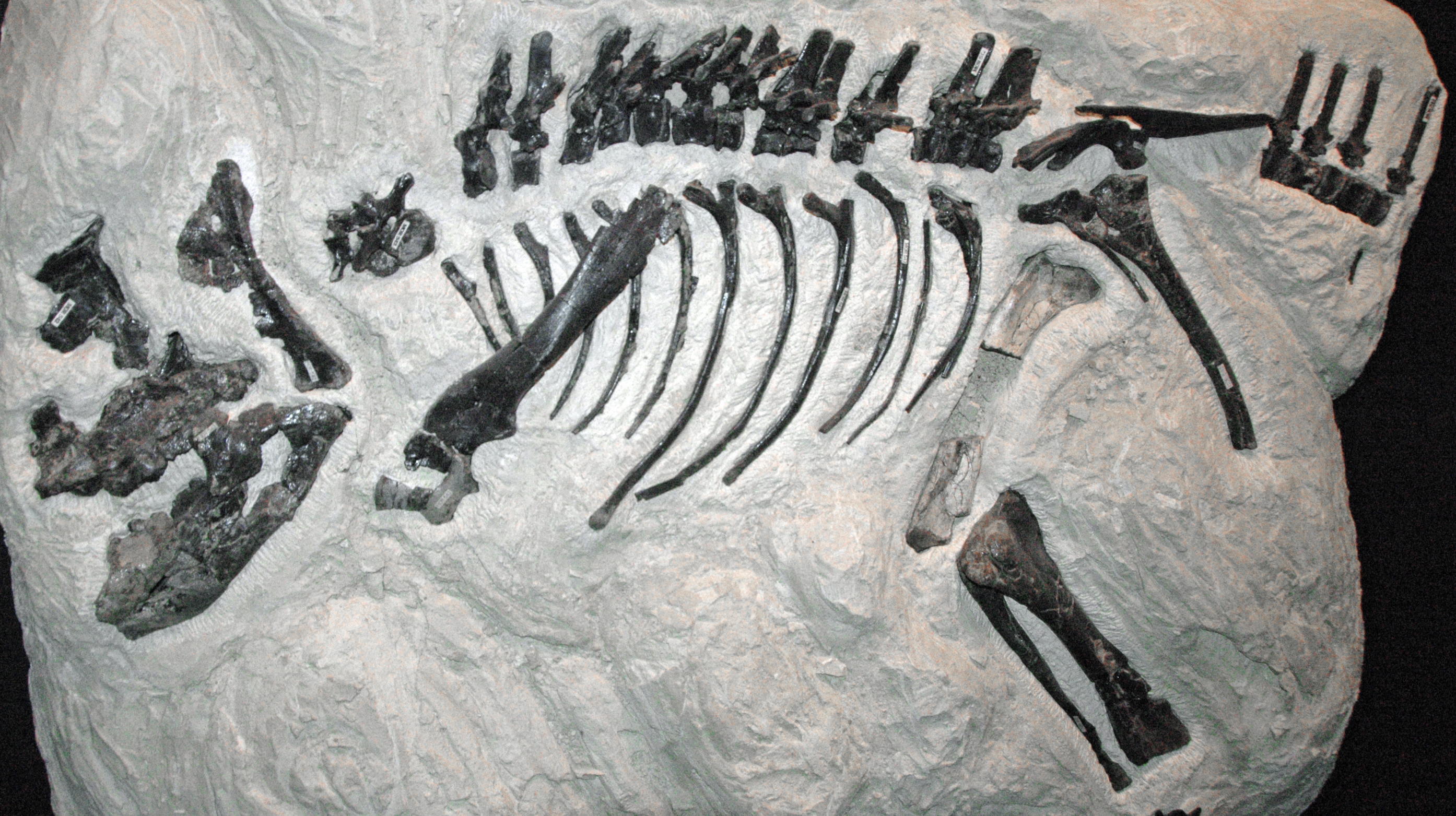
Montanoceratops cerorhynchus (Brown & Schlaikjer, 1942) - fossil ceratopsian dinosaur skeleton from the Cretaceous of Montana, USA. (MOR 542, Museum of the Rockies, Bozeman, Montana, USA) The species name is sometimes incorrectly spelled "cerorhynchos". The original publication spells it "cerorhynchus". The genus name is sometimes incorrectly spelled "Montanaceratops". Ceratopsians are the "horned dinosaurs". They were large, quadrupedal, herbivorous dinosaurs having a beaked skull and a frill - an extension of bone behind the skull that partially covered the neck. Ceratopsian dinosaurs are known from the Jurassic and Cretaceous. The last members of the group died out at the Cretaceous-Tertiary boundary, 65 million years ago. This is a partial skeleton of a juvenile Montanoceratops, a ceratopsian from the near-latest Cretaceous of western North America. This type of ceratopsian lacked facial horns. From exhibit signage: Sixty-eight million years ago, when the horned dinosaurs Triceratops and Torosaurus inhabited the coastal plain near the inland ocean, primitive "horned" dinosaurs named Montanoceratops lived in uplands near the young Rocky Mountains. These little protoceratopsians fed on plants with slicing teeth and narrow beaks similar to their giant three-horned relatives. Classification: Animalia, Chordata, Vertebrata, Reptilia, Archosauria, Dinosauria, Ornithischia, Marginocephalia, Ceratopsia, Leptoceratopsidae Stratigraphy: St. Mary River Formation, Maastrichtian Stage, Upper Cretaceous Locality: Little Rocky Coulee, north of the town of Cut Bank, eastern Glacier County, northwestern Montana, USA Info. at: en.wikipedia.org/wiki/Montanoceratops © James St. John · CC BY 2.0 · Wikimedia
PBDB Wikipedia
Classification
Dinosauria Unranked clade
Ornithischia Unranked clade
Neornithischia Unranked clade
Pyrodontia Unranked clade
Cerapoda Unranked clade
Marginocephalia Unranked clade
Ceratopsia Suborder
Neoceratopsia Infraorder
Leptoceratopsidae Family
Montanoceratops Genus
Measurements
Length
2,8 m
Montanoceratops cerorhynchus
3 m
Mass
230 kg
Montanoceratops cerorhynchus
Fossil sites 3 geolocated sites
Distribution
Top countries
🇺🇸 United States
2
🇨🇦 Canada
1
Geological formations
St. Mary River
2
Temporal distribution
Maastrichtian (72.2–66 Ma)
2
Campanian (83.6–72.2 Ma)
1
Species (1)
Montanoceratops cerorhynchus 84 Ma
Images 4
Bibliography
Original description
C. M. Sternberg. 1951. Complete skeleton of Leptoceratops gracilis Brown from the Upper Edmonton Member on Red Deer River, Alberta. National Museum of Canada Bulletin 123:225-255 DOI ↗
Bibliography (3)
P. J. Makovicky. 2001. A Montanoceratops cerorhynchus (Dinosauria: Ceratopsia) braincase from the Horseshoe Canyon Formation of Alberta. Mesozoic Vertebrate Life, D. H. Tanke and K. Carpenter (eds.), Indiana University Press, Bloomington
B. J. Chinnery and D. B. Weishampel. 1998. Montanoceratops cerorhynchus (Dinosauria: Ceratopsia) and relationships among basal neoceratopsians. Journal of Vertebrate Paleontology 18(3):569-585 DOI ↗
B. Brown and E. M. Schlaikjer. 1942. The skeleton of Leptoceratops with the description of a new species. American Museum Novitates 1169:1-15