News

Latest palaeontology news

All FR EN everythingdinosaur futura-terre palaeocast prehistoricbeastoftheweek sci-news sciencedaily sciencedaily-fossils sciencedaily-human-evo sciencedaily-paleo sciencesetavenir
These tiny dinosaur fossils fooled scientists for 20 years
armor bone growth fossil Ankylosauria Dinosauria discovery
Tiny dinosaur fossils that puzzled scientists for over 20 years have finally revealed their true identity. Rather than belonging to a miniature species, they are actually baby ankylosaurs—some less than a year old, including a possible hatchling. By studying bone growth patterns, researchers confirmed these young dinosaurs hadn’t yet developed into full-sized adults. The discovery sheds new light on how ankylosaurs grew, showing they began developing armor surprisingly early.
21/04/2026 sciencedaily
Museum Fossil Reveals Triassic Crocodile Cousin with Powerful Jaws
jaw museum Late Triassic Triassic fossil specimen CT-scan new species
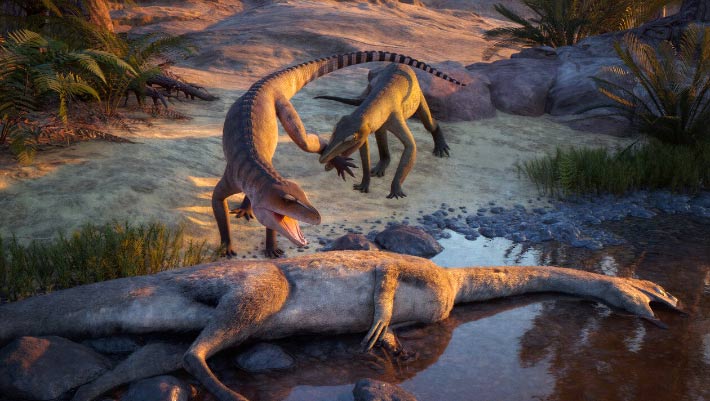
CT scans of a decades-old specimen from the Yale Peabody Museum of Natural History show a new species of short-snouted crocodylomorph with unusually strong jaws, offering a rare snapshot of ecological specialization in the Late Triassic epoch. The post Museum Fossil Reveals Triassic Crocodile Cousin with Powerful Jaws appeared first on Sci.News: Breaking Science News.
20/04/2026 sci-news
After 200 years scientists finally crack the “dolomite problem”
growth discovery
After two centuries of failed attempts, scientists have finally grown dolomite in the lab, cracking a long-standing geological puzzle. They discovered that the mineral’s growth stalls because of tiny defects—but in nature, those flaws get washed away over time. By mimicking this process with precise simulations and electron beam pulses, the team achieved record-breaking crystal growth. The finding could reshape how high-tech materials are made.
20/04/2026 sciencedaily-paleo
Peloroplites: Beast of the Week
United States Cedar Mountain Lance Cretaceous Dinosauria Peloroplites
 This week we will be checking out a large tank dinosaur.  Enter Peloroplites cedrimontanus!Peloroplites was a plant-eating dinosaur that lived in what is now Utah, USA, during the Cretaceous period, between 98 and 93 million years ago.  From snout to tail it would have measured about 20 feet (6m) long.  It's genus name translates to "Giant Hoplite" in reference to hoplites, the ancient Greek soldiers who famously carried spears and large shields.  The species name translates to "Cedar Mountain"
19/04/2026 prehistoricbeastoftheweek
New Triassic Dinosaur Species Identified in New Mexico
Mexico United States Triassic Dinosauria new species skull
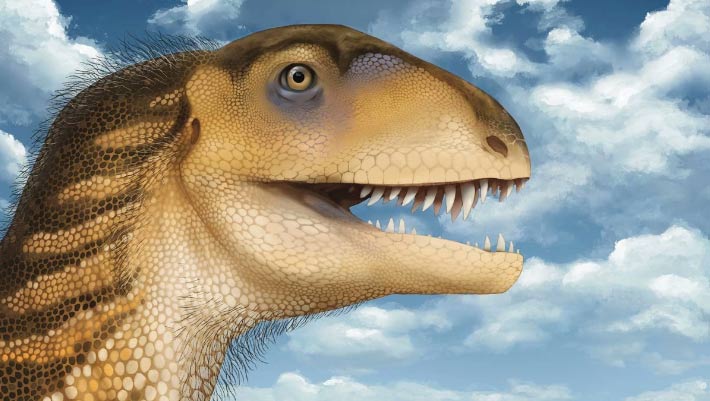
A new genus and species of carnivorous herrerasaurian dinosaur has been described from an incomplete but well-preserved skull found in northern New Mexico, the United States. The post New Triassic Dinosaur Species Identified in New Mexico appeared first on Sci.News: Breaking Science News.
17/04/2026 sci-news
Scientists thought this was a young T. rex. They were wrong
bone growth predator fossil juvenile Dinosauria Nanotyrannus
A long-running dinosaur mystery may finally be solved: Nanotyrannus, once dismissed as just a teenage T. rex, appears to have been its own distinct species after all. Scientists analyzed a tiny throat bone from the original fossil and discovered growth patterns showing the animal was already mature, not a juvenile giant-in-the-making. This smaller predator—about half the size of a full-grown T. rex—likely roamed alongside its famous cousin, adding a new layer of complexity to prehistoric ecosyst
16/04/2026 sciencedaily
Episode 174: A History of Dinosaurs in 50 Fossils
museum fossil specimen Dinosauria
Prof. Paul Barrett of the Natural History Museum, London, recently authored A History of Dinosaurs in 50 Fossils. We took this as an opportunity to get an overview of what we really know about dinosaurs and how it’s even possible to tell their story with just 50 specimens. In this episode, Paul discusses the history [&hellip
15/04/2026 palaeocast
A crushed fossil revealed a dinosaur that shouldn’t have existed
Triassic fossil Dinosauria discovery extinction new species skull
A badly mangled dinosaur skull, once forgotten in a drawer, turned out to be a rare and important discovery. Reconstructed by a Virginia Tech student, it revealed a new species of early carnivorous dinosaur with unusual features never seen before. The fossil suggests some dinosaur groups were wiped out during the end-Triassic extinction, not just their rivals. It may represent one of the last survivors of an ancient dinosaur lineage.
15/04/2026 sciencedaily
This 31-foot “terror croc” ate dinosaurs. Now it’s back
predator museum United States Dinosauria skeleton
A massive, bus-sized “terror croc” that once preyed on dinosaurs has been brought back to life in stunning detail with the first scientifically accurate full skeleton of Deinosuchus schwimmeri. Stretching over 30 feet long, this ancient apex predator ruled the southeastern U.S. more than 75 million years ago—and now visitors can see it up close at the Tellus Science Museum, the only place in the world with this replica.
15/04/2026 sciencedaily
Scientists just solved a 160-million-year fossil mystery “I’ve never seen anything like it”
fossil discovery evolution
A rare fossil discovery is shedding light on the “missing years” of early sponge evolution. Scientists found a 550-million-year-old sponge that likely lacked hard skeletal parts, explaining why earlier fossils are so scarce. This supports the idea that the earliest sponges were soft-bodied and rarely preserved. The finding changes how researchers hunt for the origins of animal life.
15/04/2026 sciencedaily
Mammal ancestors laid eggs, and this 250-million-year-old fossil finally proves it
fossil discovery extinction mammals
In the aftermath of Earth’s most catastrophic extinction event, one unlikely survivor rose to dominate a shattered world: Lystrosaurus. Now, a stunning fossil discovery—an ancient egg containing a curled-up embryo—has finally answered a decades-old mystery about whether mammal ancestors laid eggs. Using advanced imaging technology, scientists confirmed that these resilient creatures did reproduce this way, likely producing large, soft-shelled eggs packed with nutrients.
14/04/2026 sciencedaily
Diamantinasaurus: Beast of the Week
Australia Cretaceous Diamantinasauria Dinosauria
This week we'll be learning about a beast that greatly helps us understand how sauropod dinosaurs ("long-necks") looked and lived.  Check out Diamantinasaurus matildae!Diamantinasaurus lived in what is now Queensland, Australia during the middle Cretaceous period, between 95 and 92 million years ago.  It's considered medium-sized for a sauropod, and would have measured about 52 feet (16m) long from snout to tail. (Yes. 52 feet is only medium for sauropods!) Like all sauropods it would have eaten
12/04/2026 prehistoricbeastoftheweek
110,000-year-old discovery rewrites human history: Neanderthals and Homo sapiens worked together
discovery Homo sapiens
The first-ever published research on Tinshemet Cave reveals that Neanderthals and Homo sapiens in the mid-Middle Paleolithic Levant not only coexisted but actively interacted, sharing technology, lifestyles, and burial customs. These interactions fostered cultural exchange, social complexity, and behavioral innovations, such as formal burial practices and the symbolic use of ochre for decoration. The findings suggest that human connections, rather than isolation, were key drivers of technologica
12/04/2026 sciencedaily-fossils
Neanderthals may have hunted and eaten outsiders, chilling cannibalism study finds
bone prey Belgium behavior discovery study
A cave in Belgium has revealed unsettling evidence that Neanderthals selectively cannibalized outsiders, focusing on women and children. The victims weren’t from the local group and appear to have been treated like prey, with bones butchered for meat and marrow. This suggests the behavior wasn’t ritual, but practical—or possibly linked to intergroup conflict. The discovery paints a darker, more complex picture of Neandertal life during their final millennia.
11/04/2026 sciencedaily-fossils
Humans reached Australia 60,000 years ago, new DNA study reveals
DNA migration Australia Guinea study
Scientists have uncovered compelling evidence that humans reached New Guinea and Australia around 60,000 years ago—earlier than some recent theories suggested. By tracing maternal DNA lineages, the team discovered that these early travelers likely used at least two different migration routes through Southeast Asia. This points to sophisticated navigation and seafaring skills far earlier than once believed. The research helps clarify a long-standing mystery about how humans spread across the glob
09/04/2026 sciencedaily-fossils
The world’s “oldest octopus” was never an octopus
tooth fossil discovery evolution
A famous “oldest octopus” fossil has been exposed as a case of mistaken identity. Advanced imaging revealed hidden teeth showing it was actually related to a nautilus, not an octopus. The confusion came from decay that altered its shape before fossilization. This discovery rewrites part of evolutionary history, pushing the true origin of octopuses much later in time.
07/04/2026 sciencedaily
Daemonosaurus: Beast of the Week
Mexico United States Late Triassic Triassic Daemonosaurus Dinosauria skull
 This week we will be checking out a unique looking early dinosaur with a very cool name.  Meet Daemonosaurus chaoliodus!Daemonosaurus was a small meat-eating dinosaur that lived in what is now New Mexico, United States, during the late Triassic period, roughly between 205 and 200 million years ago.  From nose to tail it is estimated to have measured roughly 5 to 7 feet (1.5-2.2m).  These are estimates based on the fact that only the skull and neck were found.  The genus name translates to "Demo
05/04/2026 prehistoricbeastoftheweek
Buried Roman sanctuary discovered beneath Frankfurt hints at shocking rituals
A hidden Roman sanctuary discovered beneath Frankfurt is offering rare clues about ancient rituals, including possible human sacrifice. With major funding secured, scientists are now racing to uncover how this mysterious, multi-god cult site operated.
05/04/2026 sciencedaily-fossils
This tiny claw in a 500-million-year-old fossil just rewrote the origin of spiders
claw Cambrian fossil specimen
What started as routine fossil cleaning turned into a major scientific surprise when researchers uncovered a tiny claw in a 500-million-year-old specimen where no claw should exist. That detail revealed Megachelicerax cousteaui, the oldest known relative of spiders, pushing the origins of this group back by 20 million years. The fossil shows that key features of modern spiders and horseshoe crabs were already emerging during the Cambrian Explosion.
03/04/2026 sciencedaily
Ancient bees found nesting inside fossil bones in rare cave discovery
bone jaw nest prey fossil discovery
Thousands of years ago in a cave on Hispaniola, an unusual chain of events left behind a rare scientific treasure: bees nesting inside fossilized bones. After giant barn owls repeatedly brought prey like hutias into the cave, their remains accumulated in silt-rich chambers—creating a strange underground environment. Later, burrowing bees took advantage of the soft sediment and even reused tiny cavities in fossilized jaws and bones as ready-made nests, coating them with a smooth, waterproof linin
03/04/2026 sciencedaily
1 2 3 4 5 6 7 8 9 10 11 12 13 14 15 16 17 18 19 20 21 22 23 24 25 26 27 28 29