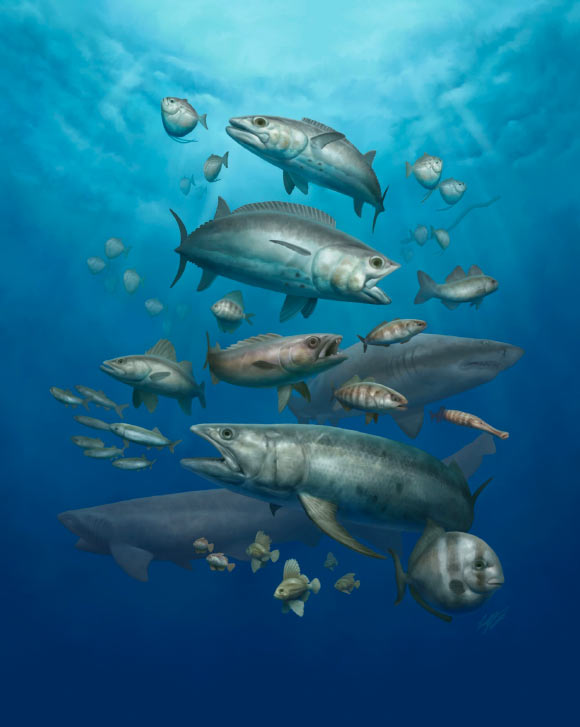
Des fossiles de poissons du début du Paléocène comblent un écart de 10 millions d'années après l'extinction des dinosaures
Les paléontologues ont décrit un assemblage de fossiles de poissons marins provenant du site de Qreiya 3, vieux de 62,2 millions d'années, dans le désert oriental d'Égypte, ouvrant ainsi une fenêtre sur cette transition. L'article Les fossiles de poissons du début du Paléocène comblent un écart de 10 millions d'années après l'extinction des dinosaures est apparu en premier sur Sci.News : Breaking Science News.
05/06/2026
sci-news
⚙ Traduction automatique
![“Golden spike” at the GSSP of the Selandian stage (lower Upper Paleocene) at Zumaia section, Spanish Basque Country. The spike sits on the top plane of the uppermost limestone bed of the Aitzgorri Limestone Formation which is identical to the basal plane of the overlying red marls of the lowest part of the Itzurun Formation (right-hand outside the picture).[1]](https://upload.wikimedia.org/wikipedia/commons/thumb/a/ad/GSSP_Golden_spike_Itzurun%2C_Zumaia%2C_Basque_Country_%2802%29.jpg/960px-GSSP_Golden_spike_Itzurun%2C_Zumaia%2C_Basque_Country_%2802%29.jpg)
![Information sign for the GSSP of the Seelandian stage (lower Upper Paleocene) at Zumaia section, Spanish Basque Country. The sign is mounted near the “golden spike” on the top plane of the uppermost limestone bed of the Aitzgorri Limestone Formation which is identical to the basal plane of the overlying red marls of the lowest part of the Itzurun Formation (right-hand outside the picture).[1]](https://upload.wikimedia.org/wikipedia/commons/thumb/d/d1/GSSP_Golden_spike_Itzurun%2C_Zumaia%2C_Basque_Country_%2801%29.jpg/960px-GSSP_Golden_spike_Itzurun%2C_Zumaia%2C_Basque_Country_%2801%29.jpg)