←

Crétacé

Intervalle géologique

163 image(s) · 58 Actualités

Voir la fiche

Galerie d'images

Restoration of Zuoyunlong huangi from the Late Cretaceous of China
Taxons Zuoyunlong

Restoration of Zuoyunlong huangi from the Late Cretaceous of China

Chine Crétacé Crétacé supérieur Zuoyunlong
Kayrasaurus is a therizinosaurian dinosaur that lived during the Early Cretaceous period in what is now China. At an estimated 3.6 m in total body length, it is the largest therizinosaur known from the Jehol Biota. Like other therizinosaurs, Kayrasaurus was a bipedal herbivore with large curved claws on each hand.
Taxons Kayrasaurus

Kayrasaurus is a therizinosaurian dinosaur that lived during the Early Cretaceous period in what is now China. At an estimated 3.6 m in total body length, it is the largest therizinosaur known from the Jehol Biota. Like other therizinosaurs, Kayrasaurus was a bipedal herbivore with large curved claws on each hand.

griffe Chine Crétacé Crétacé inférieur +2
Muttaburrasaurus
The plants, animals and climate of the Australian continent have changed dramatically over long periods of time. Imagine this giant creature roaming the luxuriant wet forests that covered parts of the continent in the Cretaceous period, about 100-110 million years ago. The Muttaburrasaurus ambled along on all four legs or stood on its hind legs. Its large teeth were well adapted to eat tough vegetation such as the leathery foliage of the evergreen forests of Araucaria trees, ancient relatives of the bunya pine of south-eastern Queensland.
In 1963, grazier Doug Langdon discovered the fossilised bones of a dinosaur on his property near Muttaburra in central-west Queensland. It was one of the most complete dinosaur skeletons found in Australia. The bones belonged to a new species of ornithopod and palaeontologists named it Muttaburrasaurus langdoni.

Cast of Muttaburresaurus langdoni 1987 made by Queensland Museum, Brisbane National Museum of Australia
Taxons Muttaburrasaurus

Muttaburrasaurus The plants, animals and climate of the Australian continent have changed dramatically over long periods of time. Imagine this giant creature roaming the luxuriant wet forests that covered parts of the continent in the Cretaceous period, about 100-110 million years ago. The Muttaburrasaurus ambled along on all four legs or stood on its hind legs. Its large teeth were well adapted to eat tough vegetation such as the leathery foliage of the evergreen forests of Araucaria trees, ancient relatives of the bunya pine of south-eastern Queensland. In 1963, grazier Doug Langdon discovered the fossilised bones of a dinosaur on his property near Muttaburra in central-west Queensland. It was one of the most complete dinosaur skeletons found in Australia. The bones belonged to a new species of ornithopod and palaeontologists named it Muttaburrasaurus langdoni. Cast of Muttaburresaurus langdoni 1987 made by Queensland Museum, Brisbane National Museum of Australia

os musée Australie Crétacé +5
Montanoceratops cerorhynchus (Brown & Schlaikjer, 1942) - fossil ceratopsian dinosaur skeleton from the Cretaceous of Montana, USA. (MOR 542, Museum of the Rockies, Bozeman, Montana, USA)
The species name is sometimes incorrectly spelled "cerorhynchos".  The original publication spells it "cerorhynchus".  The genus name is sometimes incorrectly spelled "Montanaceratops".
Ceratopsians are the "horned dinosaurs".  They were large, quadrupedal, herbivorous dinosaurs having a beaked skull and a frill - an extension of bone behind the skull that partially covered the neck.  Ceratopsian dinosaurs are known from the Jurassic and Cretaceous.  The last members of the group died out at the Cretaceous-Tertiary boundary, 65 million years ago.
This is a partial skeleton of a juvenile Montanoceratops, a ceratopsian from the near-latest Cretaceous of western North America.  This type of ceratopsian lacked facial horns.


From exhibit signage:
Sixty-eight million years ago, when the horned dinosaurs Triceratops and Torosaurus inhabited the coastal plain near the inland ocean, primitive "horned" dinosaurs named Montanoceratops lived in uplands near the young Rocky Mountains.  These little protoceratopsians fed on plants with slicing teeth and narrow beaks similar to their giant three-horned relatives.


Classification: Animalia, Chordata, Vertebrata, Reptilia, Archosauria, Dinosauria, Ornithischia, Marginocephalia, Ceratopsia, Leptoceratopsidae
Stratigraphy: St. Mary River Formation, Maastrichtian Stage, Upper Cretaceous
Locality: Little Rocky Coulee, north of the town of Cut Bank, eastern Glacier County, northwestern Montana, USA


Info. at:

en.wikipedia.org/wiki/Montanoceratops
Taxons Montanoceratops

Montanoceratops cerorhynchus (Brown & Schlaikjer, 1942) - fossil ceratopsian dinosaur skeleton from the Cretaceous of Montana, USA. (MOR 542, Museum of the Rockies, Bozeman, Montana, USA) The species name is sometimes incorrectly spelled "cerorhynchos". The original publication spells it "cerorhynchus". The genus name is sometimes incorrectly spelled "Montanaceratops". Ceratopsians are the "horned dinosaurs". They were large, quadrupedal, herbivorous dinosaurs having a beaked skull and a frill - an extension of bone behind the skull that partially covered the neck. Ceratopsian dinosaurs are known from the Jurassic and Cretaceous. The last members of the group died out at the Cretaceous-Tertiary boundary, 65 million years ago. This is a partial skeleton of a juvenile Montanoceratops, a ceratopsian from the near-latest Cretaceous of western North America. This type of ceratopsian lacked facial horns. From exhibit signage: Sixty-eight million years ago, when the horned dinosaurs Triceratops and Torosaurus inhabited the coastal plain near the inland ocean, primitive "horned" dinosaurs named Montanoceratops lived in uplands near the young Rocky Mountains. These little protoceratopsians fed on plants with slicing teeth and narrow beaks similar to their giant three-horned relatives. Classification: Animalia, Chordata, Vertebrata, Reptilia, Archosauria, Dinosauria, Ornithischia, Marginocephalia, Ceratopsia, Leptoceratopsidae Stratigraphy: St. Mary River Formation, Maastrichtian Stage, Upper Cretaceous Locality: Little Rocky Coulee, north of the town of Cut Bank, eastern Glacier County, northwestern Montana, USA Info. at: en.wikipedia.org/wiki/Montanoceratops

os musée États-Unis Crétacé +17
Azhdarcho sp., ZIN PH 56/43, distal fragment of a right ulna in proximal (a), ventral (b), posterior (c), dorsal (d), anterior (e), and distal (f, stereopair) views. This specimen is from the Tyulkili locality in the northeastern Aral Sea region of Kazakhstan; Zhirkindek Formation, Upper Cretaceous (upper Turonian – Coniacian). Abbreviations: das, dorsal articulation surface; ft, groove for flexor tendon; tub, tuberculum; vf, ventral fovea. Scale bar is 10 mm.
Taxons Azhdarcho

Azhdarcho sp., ZIN PH 56/43, distal fragment of a right ulna in proximal (a), ventral (b), posterior (c), dorsal (d), anterior (e), and distal (f, stereopair) views. This specimen is from the Tyulkili locality in the northeastern Aral Sea region of Kazakhstan; Zhirkindek Formation, Upper Cretaceous (upper Turonian – Coniacian). Abbreviations: das, dorsal articulation surface; ft, groove for flexor tendon; tub, tuberculum; vf, ventral fovea. Scale bar is 10 mm.

écaille Kazakhstan Coniacien Crétacé +4
Restoration of Asiaceratops salsopaludalis a ceratopsian dinosaur from the Late Cretaceous of Uzbekistan
Taxons Asiaceratops

Restoration of Asiaceratops salsopaludalis a ceratopsian dinosaur from the Late Cretaceous of Uzbekistan

Ouzbékistan Crétacé Crétacé supérieur Asiaceratops +2
The titanosaurian sauropod Lirainosaurus astibiae Sanz, Powell, Le Loeuff, Martínez, and Pereda Suberbiola, 1999 from the Late Cretaceous of Laño (northern Spain), paratypic braincase (MCNA 7439). Right lateral, left lateral, posterior, and anterior views.
Taxons Lirainosaurus

The titanosaurian sauropod Lirainosaurus astibiae Sanz, Powell, Le Loeuff, Martínez, and Pereda Suberbiola, 1999 from the Late Cretaceous of Laño (northern Spain), paratypic braincase (MCNA 7439). Right lateral, left lateral, posterior, and anterior views.

Espagne Crétacé Crétacé supérieur Lirainosaurus +1
The nodosaurid dinosaur, Glyptodontopelta is mostly known from isolated osteoderms ("armor plates"). The specimen SMP VP-1580 (State Museum of Pennysylvania) is however, the most complete known specimen, comprising parts of the skull, hundreds of osteoderms and fragments. This specimen was discovered in 2003 by Warwick Fowler, in the Naashoibito Member of the Ojo Alamo Formation (Maatrichtian, Late Cretaceous) of the San Juan Basin, New Mexico, during an expedition led by Dr. Robert Sullivan.
Taxons Glyptodontopelta

The nodosaurid dinosaur, Glyptodontopelta is mostly known from isolated osteoderms ("armor plates"). The specimen SMP VP-1580 (State Museum of Pennysylvania) is however, the most complete known specimen, comprising parts of the skull, hundreds of osteoderms and fragments. This specimen was discovered in 2003 by Warwick Fowler, in the Naashoibito Member of the Ojo Alamo Formation (Maatrichtian, Late Cretaceous) of the San Juan Basin, New Mexico, during an expedition led by Dr. Robert Sullivan.

armure musée Mexique Denver +9
The skull of a Chasmosaurus mariscalensis, on display at the Texas Memorial Museum. Chasmosaurus was a Cretaceous ceratopsian of North America. This specimen was discovered in Brewster County, Texas.
Taxons Agujaceratops

The skull of a Chasmosaurus mariscalensis, on display at the Texas Memorial Museum. Chasmosaurus was a Cretaceous ceratopsian of North America. This specimen was discovered in Brewster County, Texas.

musée Crétacé spécimen Agujaceratops +3
Drawing of lectoholotype skull BMNH R.3386 (desigated by Weishampel et al., 1993)[1][2] of Limnosaurus transsylvanicus NOPCSA 1900 (later renamed Telmatosaurus transsylvanicus), a basal hadrosaurid dinosaur from the Late Maastrichtian (latest Upper Cretaceous) Sanpetru Formation of West Central Romania.
Taxons Telmatosaurus

Drawing of lectoholotype skull BMNH R.3386 (desigated by Weishampel et al., 1993)[1][2] of Limnosaurus transsylvanicus NOPCSA 1900 (later renamed Telmatosaurus transsylvanicus), a basal hadrosaurid dinosaur from the Late Maastrichtian (latest Upper Cretaceous) Sanpetru Formation of West Central Romania.

dessin Roumanie Crétacé Maastrichtien +6
Magnoavipes sp. - dinosaur track from the Cretaceous of Colorado, USA. (replica; public display, Red Rocks Amphitheater visitor center, west of Denver, Colorado, USA)
Dinosaur Ridge, Colorado has numerous dinosaur fossils, including bones and tracks.  The most common track type at the site is Caririchnium leonardii, which was made by an iguanodontid dinosaur.  A less common track is this - a slender, three-toed print called Magnoavipes, which was made by a theropod dinosaur.
Stratigraphy: Dakota Sandstone, upper Lower Cretaceous

Provenance: eastern side of Dinosaur Ridge, Dakota Hogback, west of Denver, north-central Colorado, USA
Taxons Magnoavipes

Magnoavipes sp. - dinosaur track from the Cretaceous of Colorado, USA. (replica; public display, Red Rocks Amphitheater visitor center, west of Denver, Colorado, USA) Dinosaur Ridge, Colorado has numerous dinosaur fossils, including bones and tracks. The most common track type at the site is Caririchnium leonardii, which was made by an iguanodontid dinosaur. A less common track is this - a slender, three-toed print called Magnoavipes, which was made by a theropod dinosaur. Stratigraphy: Dakota Sandstone, upper Lower Cretaceous Provenance: eastern side of Dinosaur Ridge, Dakota Hogback, west of Denver, north-central Colorado, USA

os États-Unis Denver Crétacé +7
Reconstruction of Bissektipelta archibaldi an ankylosaurid dinosaur from the Late Cretaceous of Uzbekistan
Taxons Bissektipelta

Reconstruction of Bissektipelta archibaldi an ankylosaurid dinosaur from the Late Cretaceous of Uzbekistan

Ouzbékistan Crétacé Crétacé supérieur Ankylosauridae +2
Ornithischian dinosaur Stenopelix valdensis Meyer, 1857, holotype (GZG 741/2, formerly GPI Gö 741−2), from the Obernkirchen Sandstone (Early
Cretaceous: Berriasian), near Bückeburg, Niedersachsen, Germany. A. Large sandstone slab. B. Interpretative outline drawing of large latex cast (prepared
from large sandstone slab), showing majority of postcranial skeleton in dorsal view. C. Small sandstone slab. D. Interpretative outline drawing of small la−
tex cast (prepared from small sandstone slab), showing sacrum and caudals, pelvic region and partial hindlimbs in ventral view. For clarity elements in and
around the sacral region have not been labelled—these areas are shown in greater detail in Fig. 3. Roman numerals II–IV correspond to respective digits.

Abbreviations: mt, metatarsals; f, femur; ?, unidentified element.
Taxons Stenopelix

Ornithischian dinosaur Stenopelix valdensis Meyer, 1857, holotype (GZG 741/2, formerly GPI Gö 741−2), from the Obernkirchen Sandstone (Early Cretaceous: Berriasian), near Bückeburg, Niedersachsen, Germany. A. Large sandstone slab. B. Interpretative outline drawing of large latex cast (prepared from large sandstone slab), showing majority of postcranial skeleton in dorsal view. C. Small sandstone slab. D. Interpretative outline drawing of small la− tex cast (prepared from small sandstone slab), showing sacrum and caudals, pelvic region and partial hindlimbs in ventral view. For clarity elements in and around the sacral region have not been labelled—these areas are shown in greater detail in Fig. 3. Roman numerals II–IV correspond to respective digits. Abbreviations: mt, metatarsals; f, femur; ?, unidentified element.

dessin Allemagne Berriasien Crétacé +8
Theiophytalia kerri Brill & Carpenter, 2006 - ornithopod dinosaur skull from the Cretaceous of Colorado, USA. (YPM 1887, public display, Garden of the Gods visitor center, Colorado Springs, Colorado, USA)
This skull is the holotype and only known specimen of an entire genus of ornithopod dinosaurs, Theiophytalia.  Ornithopods were herbivorous dinosaurs.


From exhibit signage:
A Brand New Dinosaur Species Theiophytalia kerri
What we know about the dinosaur fossil - so far:
It is the only Theiophytalia kerri fossil known to exist in the world.
It is a brand new genus and species of dinosaur.
Theiophytalia kerri means "belonging to the Garden of the Gods".  "Theios" is a Greek word that means "belonging to the gods" and "phytalia" means "garden".  "kerri" honors James Hutchinson Kerr (pronounced "Care"), who discovered the dinosaur fossil.
Theiophytalia was a medium-sized dinosaur, measuring about 30 feet from head to tail.
It was found in 1878 in the Garden of the Gods in the lower Lytle Member of the Purgatoire Rock Formation of the Dakota Group.
The dinosaur fossil skull is from the Aptian-Albian Age of the Cretaceous Ear, 125 - 100 million years old.
Look closely at the fossil skull.  Where are the teeth located?  You can see the teeth in the back of the jaw.  There are no teeth in the front of the dinosaur's beak-like mouth.  This is evidence that the Theiophytalia was a plant eater.  It could nip and tear plants, then grind them between its tightly-packed back teeth, similar to plant-eaters of today.
Timeline:
Dinosaur Fossil Discovered, then Forgotten
1878 - James Kerr, geology professor at Colorado College, finds a fossil skull "in one of the ridges east of the red rocks of the Garden of the Gods."
1886 - O.C. Marsh, famous 1800s dinosaur collector from Yale University, obtains the fossil skull from James Kerr, identifies it as a Camptosaurus dinosaur, and sends the fossil to the Yale Peabody Museum in New Haven, Connecticut.
1886 - 1995 - While the dinosaur fossil skull safely rests in the Yale Museum for many decades, knowledge of its existence is forgotten in Colorado Springs.
Rediscovery - 117 years later
1994 - Colorado Springs City park staff research new exhibits for the Garden of the Gods Visitor and Nature Center, set to open in 1995.  They meet with Doctor Kirk Johnson, curator of paleontology at the Denver Museum of Nature & Science.
1995 - Kirk Johnson refers the park staff to his museum colleague Doctor Ken Carpenter, expert dinosaur scientist.  Doctor Carpenter remembers seeing in his files "something about a dinosaur fossil found in Garden of the Gods" and mails the following article to park staff.
Camptosaurus amplus No. 1887, Yale Museum, consisting of portions of the skull and lower jaw.  It was collected from deposits in the Garden of the Gods, Colorado Springs, Colorado.  With this specimen was found the following note in Professor O.C. Marsh's handwriting, "Part of this animal and various Sauropoda bones were taken out by Professor Kerr in 1878."
A Case of Mistaken Identity Reveals a Brand New Dinosaur!
1996 - Kirk Johnson (a Yale alumnus) secures permission to hand-carry the Camptosaurus fossil from the Yale Peabody Museum to Denver so that Ken Carpenter can make a cast (a precise replica) of the fossil.
Doctor Carpenter notices irregularities in the Camptosaurus fossil and decides to re-examine the fossil when his schedule permits.
1997 - The Camptosaurus fossil replica is given to the City of Colorado Springs and is exhibited at the Garden of the Gods Visitor and Nature Center.
2006 - Doctor Carpenter and his associate Kathleen Brill reassess the fossil skull and note that it differs from other Camptosaurus skulls in several significant ways, such as the narrower mouth and snout, and the position of the nasal openings, and the bony structures over the eyes.
Also, microscopic identification of the rock matrix clinging to the fossil, and research of archival maps, reveal that the fossil skull was actually found in the lower Dakota Rock Formation, not the Morrison Formation as originally reported in the 1800s.  The skull is from a dinosaur that lived in the Cretaceous Ear and can't be a Jurassic Era Camptosaurus.
Doctor Carpenter's exacting research reveals that the dinosaur skull is a brand new genus and species of dinosaur!  He names it Theiophytalia kerri.
2008 - The Theiophytalia kerri is proudly re-exhibited at the Garden of the Gods Visitor and Nature Center.


Classification: Animalia, Chordata, Vertebrata, Dinosauria, Ornithischia, Ornithopoda
Stratigraphy: lower Lytle Member, Purgatoire Formation, Dakota Group, Aptian to Albian Stages, upper Lower Cretaceous
Locality: Garden of the Gods, Colorado Springs, Colorado, USA


See info. at:
en.wikipedia.org/wiki/Theiophytalia
and

en.wikipedia.org/wiki/Ornithopoda
Taxons Theiophytalia

Theiophytalia kerri Brill & Carpenter, 2006 - ornithopod dinosaur skull from the Cretaceous of Colorado, USA. (YPM 1887, public display, Garden of the Gods visitor center, Colorado Springs, Colorado, USA) This skull is the holotype and only known specimen of an entire genus of ornithopod dinosaurs, Theiophytalia. Ornithopods were herbivorous dinosaurs. From exhibit signage: A Brand New Dinosaur Species Theiophytalia kerri What we know about the dinosaur fossil - so far: It is the only Theiophytalia kerri fossil known to exist in the world. It is a brand new genus and species of dinosaur. Theiophytalia kerri means "belonging to the Garden of the Gods". "Theios" is a Greek word that means "belonging to the gods" and "phytalia" means "garden". "kerri" honors James Hutchinson Kerr (pronounced "Care"), who discovered the dinosaur fossil. Theiophytalia was a medium-sized dinosaur, measuring about 30 feet from head to tail. It was found in 1878 in the Garden of the Gods in the lower Lytle Member of the Purgatoire Rock Formation of the Dakota Group. The dinosaur fossil skull is from the Aptian-Albian Age of the Cretaceous Ear, 125 - 100 million years old. Look closely at the fossil skull. Where are the teeth located? You can see the teeth in the back of the jaw. There are no teeth in the front of the dinosaur's beak-like mouth. This is evidence that the Theiophytalia was a plant eater. It could nip and tear plants, then grind them between its tightly-packed back teeth, similar to plant-eaters of today. Timeline: Dinosaur Fossil Discovered, then Forgotten 1878 - James Kerr, geology professor at Colorado College, finds a fossil skull "in one of the ridges east of the red rocks of the Garden of the Gods." 1886 - O.C. Marsh, famous 1800s dinosaur collector from Yale University, obtains the fossil skull from James Kerr, identifies it as a Camptosaurus dinosaur, and sends the fossil to the Yale Peabody Museum in New Haven, Connecticut. 1886 - 1995 - While the dinosaur fossil skull safely rests in the Yale Museum for many decades, knowledge of its existence is forgotten in Colorado Springs. Rediscovery - 117 years later 1994 - Colorado Springs City park staff research new exhibits for the Garden of the Gods Visitor and Nature Center, set to open in 1995. They meet with Doctor Kirk Johnson, curator of paleontology at the Denver Museum of Nature & Science. 1995 - Kirk Johnson refers the park staff to his museum colleague Doctor Ken Carpenter, expert dinosaur scientist. Doctor Carpenter remembers seeing in his files "something about a dinosaur fossil found in Garden of the Gods" and mails the following article to park staff. Camptosaurus amplus No. 1887, Yale Museum, consisting of portions of the skull and lower jaw. It was collected from deposits in the Garden of the Gods, Colorado Springs, Colorado. With this specimen was found the following note in Professor O.C. Marsh's handwriting, "Part of this animal and various Sauropoda bones were taken out by Professor Kerr in 1878." A Case of Mistaken Identity Reveals a Brand New Dinosaur! 1996 - Kirk Johnson (a Yale alumnus) secures permission to hand-carry the Camptosaurus fossil from the Yale Peabody Museum to Denver so that Ken Carpenter can make a cast (a precise replica) of the fossil. Doctor Carpenter notices irregularities in the Camptosaurus fossil and decides to re-examine the fossil when his schedule permits. 1997 - The Camptosaurus fossil replica is given to the City of Colorado Springs and is exhibited at the Garden of the Gods Visitor and Nature Center. 2006 - Doctor Carpenter and his associate Kathleen Brill reassess the fossil skull and note that it differs from other Camptosaurus skulls in several significant ways, such as the narrower mouth and snout, and the position of the nasal openings, and the bony structures over the eyes. Also, microscopic identification of the rock matrix clinging to the fossil, and research of archival maps, reveal that the fossil skull was actually found in the lower Dakota Rock Formation, not the Morrison Formation as originally reported in the 1800s. The skull is from a dinosaur that lived in the Cretaceous Ear and can't be a Jurassic Era Camptosaurus. Doctor Carpenter's exacting research reveals that the dinosaur skull is a brand new genus and species of dinosaur! He names it Theiophytalia kerri. 2008 - The Theiophytalia kerri is proudly re-exhibited at the Garden of the Gods Visitor and Nature Center. Classification: Animalia, Chordata, Vertebrata, Dinosauria, Ornithischia, Ornithopoda Stratigraphy: lower Lytle Member, Purgatoire Formation, Dakota Group, Aptian to Albian Stages, upper Lower Cretaceous Locality: Garden of the Gods, Colorado Springs, Colorado, USA See info. at: en.wikipedia.org/wiki/Theiophytalia and en.wikipedia.org/wiki/Ornithopoda

os musée États-Unis Denver +19
Calvarius is a genus of styracosternan ornithopod from the Late Cretaceous of Spain. The name alludes to its chronostratigraphic proximity to the extinction event that wiped out the non-avian dinosaurs at the end of the Cretaceous. The highly modified metatarsal that is known from shows an example of convergent evolution, as it is more similar to non-iguanodontian ornithopods than to other styracosternans. It is thought that this is due to fulfilling a niche in its island habitat, resulting in Calvarius becoming a small-bodied animal, capable of rapid locomotion.
Taxons Calvarius

Calvarius is a genus of styracosternan ornithopod from the Late Cretaceous of Spain. The name alludes to its chronostratigraphic proximity to the extinction event that wiped out the non-avian dinosaurs at the end of the Cretaceous. The highly modified metatarsal that is known from shows an example of convergent evolution, as it is more similar to non-iguanodontian ornithopods than to other styracosternans. It is thought that this is due to fulfilling a niche in its island habitat, resulting in Calvarius becoming a small-bodied animal, capable of rapid locomotion.

locomotion Espagne Crétacé Crétacé supérieur +6
Bakonydraco galaczi gen. et sp. nov.MTMGyn/3, Iharkút, Bakony Mts., Hungary, Csehbánya Formation, Santonian (Upper Cretaceous). Mandible

in dorsal (A, B), ventral (C, D), and lateral (E, F) views.
Taxons Bakonydraco

Bakonydraco galaczi gen. et sp. nov.MTMGyn/3, Iharkút, Bakony Mts., Hungary, Csehbánya Formation, Santonian (Upper Cretaceous). Mandible in dorsal (A, B), ventral (C, D), and lateral (E, F) views.

Hongrie Crétacé Santonien Bakonydraco +1
1 2 3 4 5 6 7 8 9 10 11

Actualités

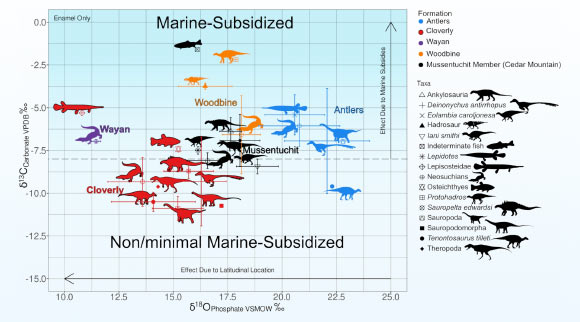
Dinosaurs May Have Dined on Seaweed, Study Suggests
Crétacé fossile Dinosauria isotope étude
Paleontologists studying Cretaceous fossils have repeatedly found that the teeth of many ancient animals contain more of a heavier carbon isotope, carbon-13, than their presumed plant-based diets would predict. The post Dinosaurs May Have Dined on Seaweed, Study Suggests appeared first on Sci.News: Breaking Science News.
01/10/2026 sci-news
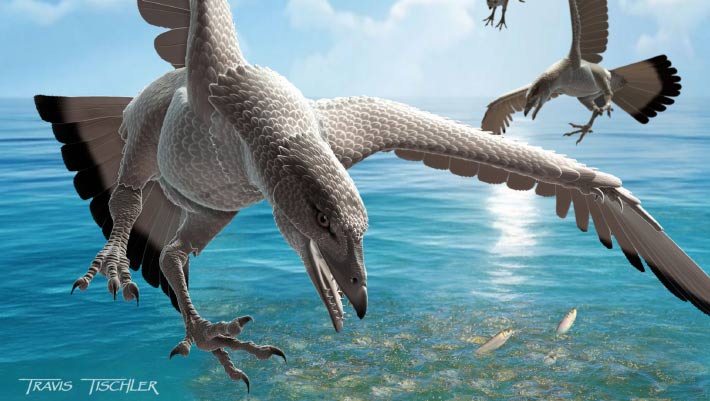
New Enantiornithine Bird Joins Australia’s Sparse Fossil Record
Un nouvel oiseau énantiornithine rejoint le record australien de fossiles clairsemés
Australie Crétacé fossile oiseau
Tenuicruris piscanexum n'est que la deuxième espèce d'oiseau du Crétacé nommée sur le continent australien. L’article Un nouvel oiseau énantiornithine rejoint le record australien de fossiles clairsemés est apparu en premier sur Sci.News : Breaking Science News.
30/09/2026 sci-news ⚙ Traduction automatique
Les scientifiques se sont trompés sur cet étrange mammifère pendant près de 40 ans
Mongolie Crétacé fossile mammifères
Un fossile magnifiquement conservé du désert de Gobi en Mongolie a résolu un mystère qui a intrigué les paléontologues pendant près de 40 ans. Tamirkhan balcarceli montre que les zhelestidés n'étaient pas les premiers parents des mammifères placentaires modernes, malgré leurs dents qui semblaient le suggérer. Au lieu de cela, l’animal ressemblant à un lapin appartenait à une lignée distincte de petits mammifères du Crétacé.
28/09/2026 sciencedaily ⚙ Traduction automatique
Garudimimus: Beast of the Week
Garudimimus : la bête de la semaine
Mongolie Crétacé Dinosauria Garudimimus oiseau évolution
Cette semaine, nous examinons un dinosaure à plumes qui nous aide à comprendre l'évolution de la famille des dinosaures « imitateurs d'oiseaux ».  Entrez Garudimimus brevipes ! Garudimimus était un dinosaure théropode qui vivait dans ce qui est aujourd'hui la Mongolie pendant la période du Crétacé, il y a entre 96 et 89 millions d'années.  Du bec à la queue, il mesurait environ 3,5 mètres de long et il aurait probablement été omnivore de son vivant.  Le nom du genre se traduit par « Garuda Mimic », en référence à Garuda, le
27/09/2026 prehistoricbeastoftheweek ⚙ Traduction automatique
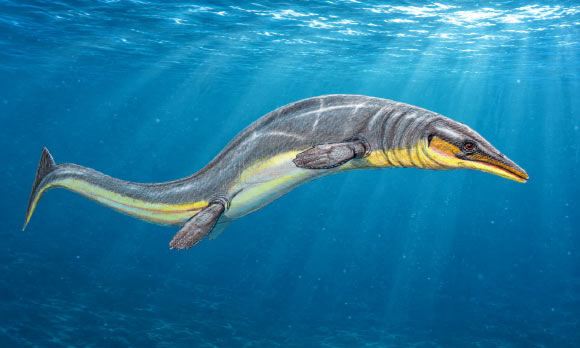
Paleontologists Uncover New Mosasaur Species in Egypt’s Western Desert
Des paléontologues découvrent de nouvelles espèces de mosasaures dans le désert occidental d’Égypte
Égypte Crétacé fossile Dinosauria Halisaurus
Les paléontologues ont décrit une espèce jusqu'alors inconnue de mosasaure – un groupe de reptiles marins disparus qui patrouillaient dans les mers du Crétacé aux côtés des dinosaures terrestres – sur la base de fossiles découverts dans l'oasis de Dakhla en Égypte. L’article Des paléontologues découvrent de nouvelles espèces de mosasaures dans le désert occidental égyptien est apparu en premier sur Sci.News : Breaking Science News.
16/09/2026 sci-news ⚙ Traduction automatique
1 2 3 4 5 6 7 8 9 10 11 12