Crétacé

Intervalle géologique

121 image(s) · 29 Actualités

Voir la fiche

Galerie d'images

Stratigraphy of the Upper Cretaceous Neuquén Group (after Garrido) indicating stratigraphic positions of definitive unenlagiine taxa (modified from Gianechini and Gianechini & Apesteguía). Skeletal reconstructions to approximate scale, redrawn and/or modified from works by Scott Hartman (Buitreraptor gonzalezorum, Austroraptor cabazai), Gabriel Lio (Unenlagia comahuensis, Neuquenraptor argentinus, Unenlagia paynemili), and Jaime Headden (Pamparaptor micros, Diuqin lechiguanae), used with permission
Taxons Unenlagiinae

Stratigraphy of the Upper Cretaceous Neuquén Group (after Garrido) indicating stratigraphic positions of definitive unenlagiine taxa (modified from Gianechini and Gianechini & Apesteguía). Skeletal reconstructions to approximate scale, redrawn and/or modified from works by Scott Hartman (Buitreraptor gonzalezorum, Austroraptor cabazai), Gabriel Lio (Unenlagia comahuensis, Neuquenraptor argentinus, Unenlagia paynemili), and Jaime Headden (Pamparaptor micros, Diuqin lechiguanae), used with permission

écaille Crétacé Austroraptor Buitreraptor +6
Leptocleidus capensis, a plesiosaur from the Early Cretaceous of South Africa, pencil drawing, digital coloring
Taxons Leptocleididae

Leptocleidus capensis, a plesiosaur from the Early Cretaceous of South Africa, pencil drawing, digital coloring

dessin Afrique du Sud Crétacé Crétacé inférieur +4
Amargasaurus lived in the  Cretaceous Period, about 100 million years ago.Photo taken in Museum of Victoria (Melbourne, Victoria, Australia)
Taxons Dicraeosauridae

Amargasaurus lived in the Cretaceous Period, about 100 million years ago.Photo taken in Museum of Victoria (Melbourne, Victoria, Australia)

musée Australie Crétacé Amargasaurus +2
Amargasaurus lived in the  Cretaceous Period, about 100 million years ago.Photo taken in Museum of Victoria (Melbourne, Victoria, Australia)
Taxons Dicraeosaurinae

Amargasaurus lived in the Cretaceous Period, about 100 million years ago.Photo taken in Museum of Victoria (Melbourne, Victoria, Australia)

musée Australie Crétacé Amargasaurus +2
The saltasaurine sauropod Neuquensaurus australis, from the Anacleto Formation (Upper Cretaceous), Patagonia, Argentina. Restoration of the skeleton mounted at the Museo de La Plata, Argentina.
Taxons Saltasauroidea

The saltasaurine sauropod Neuquensaurus australis, from the Anacleto Formation (Upper Cretaceous), Patagonia, Argentina. Restoration of the skeleton mounted at the Museo de La Plata, Argentina.

Argentine Anacleto Crétacé Lohuecosauria +4
The saltasaurine sauropod Neuquensaurus australis, from the Anacleto Formation (Upper Cretaceous), Patagonia, Argentina. Restoration of the skeleton mounted at the Museo de La Plata, Argentina.
Taxons Lohuecosauria

The saltasaurine sauropod Neuquensaurus australis, from the Anacleto Formation (Upper Cretaceous), Patagonia, Argentina. Restoration of the skeleton mounted at the Museo de La Plata, Argentina.

Argentine Anacleto Crétacé Lohuecosauria +4
Chasmosaurus belli ROM 843, Royal Tyrrell Museum of Paleontology. Late Cretaceous 75-74.5 millions years ago. Found at Dinosaur Provincial Park, Alberta, and prepared at the Royal Tyrrell Museum of Paleontology, Drumheller, Alberta.
Taxons Chasmosaurinae

Chasmosaurus belli ROM 843, Royal Tyrrell Museum of Paleontology. Late Cretaceous 75-74.5 millions years ago. Found at Dinosaur Provincial Park, Alberta, and prepared at the Royal Tyrrell Museum of Paleontology, Drumheller, Alberta.

musée Canada Crétacé Crétacé supérieur +5
Chasmosaurus belli ROM 843, Royal Tyrrell Museum of Paleontology. Late Cretaceous 75-74.5 millions years ago. Found at Dinosaur Provincial Park, Alberta, and prepared at the Royal Tyrrell Museum of Paleontology, Drumheller, Alberta.
Taxons Triceratopsini

Chasmosaurus belli ROM 843, Royal Tyrrell Museum of Paleontology. Late Cretaceous 75-74.5 millions years ago. Found at Dinosaur Provincial Park, Alberta, and prepared at the Royal Tyrrell Museum of Paleontology, Drumheller, Alberta.

musée Canada Crétacé Crétacé supérieur +5
Holotype of the polycotylid[1] plesiosaur Edgarosaurus muddi DRUCKENMILLER, 2002, (MOR 751) comprising the skull, the neck, and the left front flipper, on display in the Museum of the Rockies in Bozeman, Montana. The specimen was collected in Edgar, Carbon County, Montana, from the Shell Creek member of the Thermopolis Shale Formation, Upper Albian, uppermost Lower Cretaceous.[2]
Taxons Edgarosaurus

Holotype of the polycotylid[1] plesiosaur Edgarosaurus muddi DRUCKENMILLER, 2002, (MOR 751) comprising the skull, the neck, and the left front flipper, on display in the Museum of the Rockies in Bozeman, Montana. The specimen was collected in Edgar, Carbon County, Montana, from the Shell Creek member of the Thermopolis Shale Formation, Upper Albian, uppermost Lower Cretaceous.[2]

musée États-Unis Albien Crétacé +7
A more complete specimen of Wapuskanectes betsynichollsae. TMP2012.50.1.

(A) Dorsal view of the originally upside down remains recovered from north of the town of Fort McMurray, Alberta. The head and most of the neck were lost when intercepted by a grader during road construction. The right flipper was lost sometime in the Early Cretaceous prior to the final burial of the body. (B) The pelvic and abdominal regions of TMP2012.50.1 showing gastroliths (black arrows) within the body cavity that settled between the ribs of the inverted carcass and hint at a more substantial collection that is hidden inside the body cavity. Scale bars on body regions are 10 cm. Source credit: Sue Sabrowski, Royal Tyrrell Museum of Palaeontology.
Taxons Wapuskanectes

A more complete specimen of Wapuskanectes betsynichollsae. TMP2012.50.1. (A) Dorsal view of the originally upside down remains recovered from north of the town of Fort McMurray, Alberta. The head and most of the neck were lost when intercepted by a grader during road construction. The right flipper was lost sometime in the Early Cretaceous prior to the final burial of the body. (B) The pelvic and abdominal regions of TMP2012.50.1 showing gastroliths (black arrows) within the body cavity that settled between the ribs of the inverted carcass and hint at a more substantial collection that is hidden inside the body cavity. Scale bars on body regions are 10 cm. Source credit: Sue Sabrowski, Royal Tyrrell Museum of Palaeontology.

écaille musée Crétacé Crétacé inférieur +2
Jeholopterus ningchengensus Wang, Zhou, Zhang, and Xu, 2002, IVPP V 12705, Lower Yixian Formation (Early Cretaceous), China.
Taxons Jeholopterus

Jeholopterus ningchengensus Wang, Zhou, Zhang, and Xu, 2002, IVPP V 12705, Lower Yixian Formation (Early Cretaceous), China.

Chine Yixian Crétacé Crétacé inférieur +2
New wing skeleton of Forfexopterus (SDUST-V1003) from Jiufotang Formation of Early Cretaceous Jehol Biota in Jianchang, western Liaoning, northeastern China. Abbreviations: ca, carpus; co, coracoid portion; hu, humerus; mc, metacarpals I–IV; mdI–III, manual digits I–III; pt, pteroid; ra, radius; sc, scapular portion; ul, ulna; wp1–4, wing phalanges 1–4.
Taxons Forfexopterus

New wing skeleton of Forfexopterus (SDUST-V1003) from Jiufotang Formation of Early Cretaceous Jehol Biota in Jianchang, western Liaoning, northeastern China. Abbreviations: ca, carpus; co, coracoid portion; hu, humerus; mc, metacarpals I–IV; mdI–III, manual digits I–III; pt, pteroid; ra, radius; sc, scapular portion; ul, ulna; wp1–4, wing phalanges 1–4.

humérus Chine Jiufotang Crétacé +4
Ningchengopterus liuae, early Cretaceous of China. digital.
Taxons Ningchengopterus

Ningchengopterus liuae, early Cretaceous of China. digital.

Chine Crétacé Crétacé inférieur Ningchengopterus +1
Bakonydraco galaczi gen. et sp. nov.MTMGyn/3, Iharkút, Bakony Mts., Hungary, Csehbánya Formation, Santonian (Upper Cretaceous). Mandible

in dorsal (A, B), ventral (C, D), and lateral (E, F) views.
Taxons Bakonydraco

Bakonydraco galaczi gen. et sp. nov.MTMGyn/3, Iharkút, Bakony Mts., Hungary, Csehbánya Formation, Santonian (Upper Cretaceous). Mandible in dorsal (A, B), ventral (C, D), and lateral (E, F) views.

Hongrie Crétacé Santonien Bakonydraco +1
Aralazhdarcho bostobensis, ZIN PH 57/43, a proximal fragment of a left humerus in proximal (a), ventral (b), anterior (c), dorsal (d), and posterior (e) views. This specimen is from the Shakh Shakh II locality in the northeasten Aral Sea region of Kazakhstan; Bostobe Formation, Upper Cretaceous (Santonian – lower Campanian). Abbreviations: h, humeral head; pf, pneumatic foramen; uc, ulnar crest. Scale bar is 10 mm.
Taxons Aralazhdarcho

Aralazhdarcho bostobensis, ZIN PH 57/43, a proximal fragment of a left humerus in proximal (a), ventral (b), anterior (c), dorsal (d), and posterior (e) views. This specimen is from the Shakh Shakh II locality in the northeasten Aral Sea region of Kazakhstan; Bostobe Formation, Upper Cretaceous (Santonian – lower Campanian). Abbreviations: h, humeral head; pf, pneumatic foramen; uc, ulnar crest. Scale bar is 10 mm.

crête humérus écaille Kazakhstan +7
Azhdarchoid pterosaur Kariridraco dianae gen. et sp. nov. holotype (MPSC R 1056) from Lower Cretaceous of Northeastern Brazil. Skull in right lateral view. Photograph (A1), interpretative drawing (A2). Dark grey areas indicate remains of the carbonate matrix still attachaed to the skull.
Taxons Kariridraco

Azhdarchoid pterosaur Kariridraco dianae gen. et sp. nov. holotype (MPSC R 1056) from Lower Cretaceous of Northeastern Brazil. Skull in right lateral view. Photograph (A1), interpretative drawing (A2). Dark grey areas indicate remains of the carbonate matrix still attachaed to the skull.

dessin Brésil Crétacé holotype +3
1 2 3 4 5 6 7 8

Actualités

New Microraptorine Dinosaur Discovered in China
Un nouveau dinosaure microraptorine découvert en Chine
Chine Crétacé Crétacé inférieur spécimen Dinosauria Jian Microraptorinae oiseau
Jian changmaensis est le premier dinosaure non aviaire découvert sur un site paléontologique ayant livré plus de 100 spécimens d'oiseaux du Crétacé inférieur. L'article Un nouveau dinosaure microraptorine découvert en Chine est apparu en premier sur Sci.News : Breaking Science News.
04/06/2026 sci-news ⚙ Traduction automatique
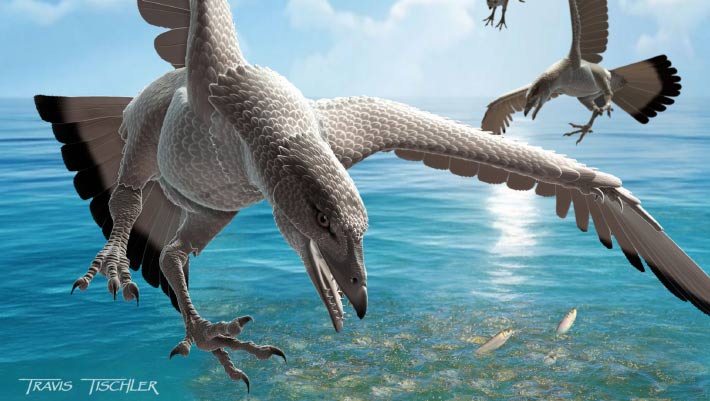
Un nouveau dinosaure Unenlagiid de Patagonie (Argentine)
Argentine Japon Crétacé Crétacé supérieur fossile Dinosauria Kank Unenlagiidae découverte formation nouvelle espèce
Une équipe de scientifiques argentins et japonais a décrit une nouvelle espèce de dinosaure unenlagiidé du sud de la Patagonie. Nommé Kank australis, ce petit dinosaure théropode vivait il y a environ 70 millions d'années à la fin du Crétacé. Les restes fossiles ont été découverts dans la formation Chorrillo de la province de Santa Cruz, en Argentine. La découverte aide mieux les paléontologues
02/06/2026 everythingdinosaur ⚙ Traduction automatique
Cet oiseau fossile arborait un étonnant plumage sur la queue
plume Crétacé fossile oiseau
Une espèce d'oiseau du Crétacé nouvellement décrite possédait d'étonnamment longues plumes sur la queue. Les chercheurs supposent qu'elles aidaient les mâles à séduire les femelles.
01/06/2026 sciencesetavenir
New Dinosaur Species from Argentina May Have Specialized in Catching Fish
De nouvelles espèces de dinosaures d'Argentine pourraient s'être spécialisées dans la capture de poissons
Argentine Crétacé Crétacé supérieur Dinosauria Kank Unenlagiidae
Des paléontologues argentins ont identifié une espèce jusqu'alors inconnue de dinosaures unenlagiidés qui parcouraient les zones humides d'eau douce à la fin du Crétacé, ajoutant ainsi la preuve que certains dinosaures se spécialisaient dans la capture de poissons. L'article De nouvelles espèces de dinosaures d'Argentine pourraient s'être spécialisées dans la capture de poissons est apparu en premier sur Sci.News : Breaking Science News.
29/05/2026 sci-news ⚙ Traduction automatique
Fungi Bloomed Twice around End-Cretaceous Mass Extinction
Les champignons ont fleuri deux fois autour de l'extinction massive de la fin du Crétacé
bassin Denver Crétacé Dinosauria extinction
En étudiant les microfossiles fongiques dans des échantillons de roches vieilles de 66 millions d'années du bassin de Denver, au Colorado, les microbiologistes de l'Université Johns Hopkins ont confirmé que l'impact de l'astéroïde tueur de dinosaures a déclenché une invasion fongique mondiale et a découvert une deuxième crise écologique, jusqu'alors inconnue, juste avant elle. L'article Les champignons ont fleuri deux fois autour de l'extinction massive de la fin du Crétacé est apparu en premier sur Sci.News : Breaking Science News.
28/05/2026 sci-news ⚙ Traduction automatique
1 2 3 4 5 6