Crétacé

Intervalle géologique

161 image(s) · 39 Actualités

Voir la fiche

Galerie d'images

Comptonatus is an iguanodontid ornithopod dinosaur that lived about 125 million years ago, in the Early Cretaceous of what is now Europe. It was a medium sized herbivore at about 7 m in length, and weighed around 1 t in body mass. Fossilized footprints found near the original specimen indicate that Comptonatus was likely a herding animal. Comparisons between Comptonatus and other iguanodontids that lived around the same time and region show a high rate of diversity. This indicates there may have been pressure for speedy evolutionary adaptation in the region, or perhaps a high volume of migration.
Taxons Comptonatus

Comptonatus is an iguanodontid ornithopod dinosaur that lived about 125 million years ago, in the Early Cretaceous of what is now Europe. It was a medium sized herbivore at about 7 m in length, and weighed around 1 t in body mass. Fossilized footprints found near the original specimen indicate that Comptonatus was likely a herding animal. Comparisons between Comptonatus and other iguanodontids that lived around the same time and region show a high rate of diversity. This indicates there may have been pressure for speedy evolutionary adaptation in the region, or perhaps a high volume of migration.

migration Crétacé Crétacé inférieur spécimen +3
Ancient landscape across the Cretaceous/Paleogene time interval in central Patagonia. Main floristic types from the Danian: Podocarps, Cheirolepidiaceae, palms.
doi:10.1371/journal.pone.0052455.g007

Ancient landscape across the Cretaceous/Paleogene time interval in central Patagonia. Main floristic types from the Danian: Podocarps, Cheirolepidiaceae, palms. doi:10.1371/journal.pone.0052455.g007

Crétacé Danien Paléogène
Iron trapped in Cretaceous limestone, forming tables

Iron trapped in Cretaceous limestone, forming tables

Crétacé
Limestone cliff with the stratigraphic stage of Cretaceous Coniacian near the eponym town of Cognac, Charente, Poitou-Charentes, France.

Limestone cliff with the stratigraphic stage of Cretaceous Coniacian near the eponym town of Cognac, Charente, Poitou-Charentes, France.

France Coniacien Crétacé
crétacé limestone at Cognac, Charente, SW France

crétacé limestone at Cognac, Charente, SW France

France Crétacé
Cretaceous limestone at Cognac, Charente, SW France

Cretaceous limestone at Cognac, Charente, SW France

France Crétacé
Ivy and limestone cliff of Cretaceous Coniacian, Cognac, Charente, France.

Ivy and limestone cliff of Cretaceous Coniacian, Cognac, Charente, France.

France Coniacien Crétacé
Limestone Cretaceous cornices (Coniacian type), valley of the river Voultron; Blanzaguet-Saint-Cybard, Charente, France.

Limestone Cretaceous cornices (Coniacian type), valley of the river Voultron; Blanzaguet-Saint-Cybard, Charente, France.

France Coniacien Crétacé
Quarry called “Ratssteinbruch” at Plauenscher Grund (gorge-like valley of the river Weißeritz nearby/in the city of Dresden, Saxony, Germany), Upper Carboniferous Monzonite (historically identified as Syenite) of the Meißen Massif (Paleozoic basement) unconformably overlain by Upper Cenomanian beds of the Dölzschen Formation, yellowish basal conglomerate and overlying bluish silty clay-marlstone (“plenus-Pläner”) of the Saxo-Bohemian Cretaceous Basin (Mesozoic platform).[1]

Quarry called “Ratssteinbruch” at Plauenscher Grund (gorge-like valley of the river Weißeritz nearby/in the city of Dresden, Saxony, Germany), Upper Carboniferous Monzonite (historically identified as Syenite) of the Meißen Massif (Paleozoic basement) unconformably overlain by Upper Cenomanian beds of the Dölzschen Formation, yellowish basal conglomerate and overlying bluish silty clay-marlstone (“plenus-Pläner”) of the Saxo-Bohemian Cretaceous Basin (Mesozoic platform).[1]

Allemagne Carbonifère Cénomanien Crétacé +3
landscape of Montmorélien (Cretaceous Campanian), Charente, SW France

landscape of Montmorélien (Cretaceous Campanian), Charente, SW France

France Campanien Crétacé
A fossil tree from the Coal Creek region, Fruitland Formation, latest Cretaceous (Late Campanian), San Juan Basin, New Mexico

A fossil tree from the Coal Creek region, Fruitland Formation, latest Cretaceous (Late Campanian), San Juan Basin, New Mexico

Mexique Fruitland Campanien Crétacé +2
Holotype skull of the centrosaurine ceratopsian dinosaur Diabloceratops eatoni from the Late Cretaceous (Campanian) of the Wahweap Formation, Grand Staircase-Escalante National Monument, Utah. Photograph by Nick Longrich, 2023.

Holotype skull of the centrosaurine ceratopsian dinosaur Diabloceratops eatoni from the Late Cretaceous (Campanian) of the Wahweap Formation, Grand Staircase-Escalante National Monument, Utah. Photograph by Nick Longrich, 2023.

Campanien Crétacé Crétacé supérieur holotype +5
Outcrops of the Late Cretaceous (Campanian) aged Aguja Formation, Big Bend National Park, Texas, USA

Outcrops of the Late Cretaceous (Campanian) aged Aguja Formation, Big Bend National Park, Texas, USA

États-Unis Aguja Campanien Crétacé +2
Mawsonia , giant coelocanth from the Cretaceous period (Albian and Cenomanian stages) of South America and North Africa

Mawsonia , giant coelocanth from the Cretaceous period (Albian and Cenomanian stages) of South America and North Africa

Albien Cénomanien Crétacé
Size of Austroraptor cabazai compared to a human, a species of Dromaeosaurid Unenlagiinae who lived during the Cretaceous period in Argentina, more precisely in the Allen Formation.
Taxons Unenlagia

Size of Austroraptor cabazai compared to a human, a species of Dromaeosaurid Unenlagiinae who lived during the Cretaceous period in Argentina, more precisely in the Allen Formation.

Argentine Allen Crétacé Austroraptor +5
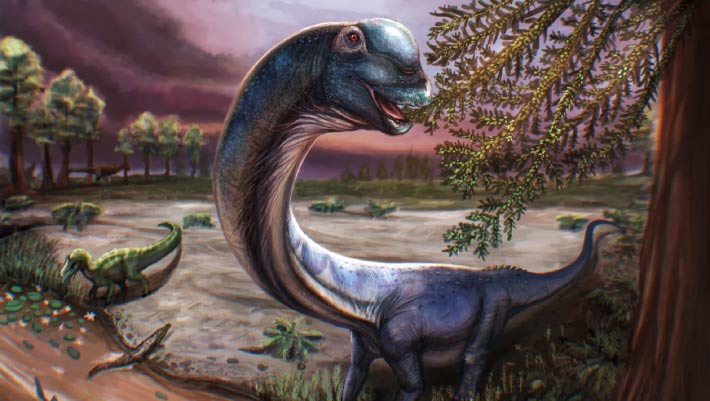
Sidersaura is a rebbachisaurid sauropod dinosaur from the Late Cretaceous of Argentina. Rebbachisaurids are the last known dipldocoids, and lived alongside the titanosaurs until fairly late in the Cretaceous before disappearing from the fossil record, presumably going extinct. They have long tails and relatively short necks, by sauropod standards. Sidersaura one of the most recent rebbachisaurids yet found, living in the Cenomanian–Turonian ages of the Late Cretaceous. It was large for a rebbachisaurid, growing to about 20 m in length.
Taxons Sidersaura

Sidersaura is a rebbachisaurid sauropod dinosaur from the Late Cretaceous of Argentina. Rebbachisaurids are the last known dipldocoids, and lived alongside the titanosaurs until fairly late in the Cretaceous before disappearing from the fossil record, presumably going extinct. They have long tails and relatively short necks, by sauropod standards. Sidersaura one of the most recent rebbachisaurids yet found, living in the Cenomanian–Turonian ages of the Late Cretaceous. It was large for a rebbachisaurid, growing to about 20 m in length.

Argentine Cénomanien Crétacé Crétacé supérieur +6
1 2 3 4 5 6 7 8 9 10 11

Actualités

Pentaceratops: Beast of the Week
Pentaceratops : la bête de la semaine
Mexique États-Unis Crétacé Crétacé supérieur Ceratopsia Dinosauria Pentaceratops
Cette semaine, nous allons découvrir encore un autre superbe dinosaure cératopsien.  Entrez Pentaceratops sternbergii ! Pentaceratops était un dinosaure herbivore qui mesurait environ vingt pieds de long du bec à la queue. En tant que cératopsien (cornes, becs et volants), il faisait partie du groupe des chasmosaurines et était étroitement apparenté au Chasmosaurus et au Coahuilaceratops pour n'en nommer que quelques-uns.  Il vivait dans ce qui est aujourd’hui le Nouveau-Mexique, aux États-Unis, à la fin du Crétacé, il y a entre 76 et 73 millions d’années.  Le nom du genre,
14/09/2025 prehistoricbeastoftheweek ⚙ Traduction automatique
Irritator: Beast of the Week
Irritateur : la bête de la semaine
reconstitution Brésil Crétacé Crétacé inférieur Dinosauria Irritator
La bête de cette semaine est un dinosaure spécial qui nous aide à mieux comprendre l'apparence et le mode de vie de sa famille.  Découvrez Irritator challengeri ! Reconstitution de la vie d'Irritator à l'aquarelle par Christopher DiPiazza. Irritator était un dinosaure carnivore qui vivait dans ce qui est aujourd'hui le Brésil au début du Crétacé, il y a entre 113 et 110 millions d'années. Du museau à la queue, il mesurait entre 6 et 8 mètres et était un mangeur de viande de son vivant.  Le nom du genre, Ir
24/08/2025 prehistoricbeastoftheweek ⚙ Traduction automatique
Critique du livre d'un paléontologue sur A Secret History of Sharks
Crétacé Permien
Depuis environ 450 millions d’années, les requins et leurs cousins ​​cartilagineux constituent une caractéristique majeure de la vie marine. Withstanding multiple cataclysmic events, most notably those at the end of the Permian and Cretaceous, and maintaining a great diversity in today’s oceans, the evolutionary history of sharks is a lengthy, gripping tale of one of the [&hellip
09/08/2025 palaeocast ⚙ Traduction automatique
Lepidotes: Beast of the Week
Lépidotes : la bête de la semaine
écaille reconstitution Crétacé Crétacé inférieur Jurassique inférieur Jurassique Dinosauria
 Cette fois-ci, nous examinerons une espèce unique de poissons préhistoriques qui nageaient dans les rivières et les lacs tandis que certains des plus grands dinosaures marchaient sur terre.  Découvrez Lepidotes ! Reconstitution à l'aquarelle de Lepidotes gigas par Christopher DiPiazza. Les Lepidotes étaient un genre de poissons osseux à fortes écailles qui vivaient dans ce qui est aujourd'hui l'Europe et l'Amérique du Nord au début du Jurassique, il y a entre 180 et 175 millions d'années.  Le genre a peut-être même persisté jusqu'au Crétacé inférieur, il y a seulement 115 millions d'années, mais
29/06/2025 prehistoricbeastoftheweek ⚙ Traduction automatique
1 2 3 4 5 6 7 8