spécimen

Nature du spécimen

197 image(s) · 17 Actualités

Galerie d'images

Skeletal reconstruction of Heyuannia yanshini (previously Ajancingenia yanshini). Specimens as: blue: MPC-D 100/30 (holotype); green: MPC-D 100/31; red: MPC-D 100/32; tan: MPC-D 100/20 (holotype skull of Conchoraptor gracilis).

Skeletal reconstruction of Heyuannia yanshini (previously Ajancingenia yanshini). Specimens as: blue: MPC-D 100/30 (holotype); green: MPC-D 100/31; red: MPC-D 100/32; tan: MPC-D 100/20 (holotype skull of Conchoraptor gracilis).

holotype spécimen Ajancingenia Conchoraptor +3
Silhouette of M.intrepidus showing recovered elements. Isolated indet. tyrannosauroid premaxillary tooth (NCSM 33393) recovered from nearby strata in (d) occlusal, (e) mesiodistal, and (f) lingual views. Holotype specimen of M.intrepidus (NCSM 33392) composed of (g) femur, (h) tibia, (i) fourth metatarsal, (j) second metatarsal, and (k) pedal phalanges of the fourth digit. Scale bar (c) 1 m, (g–k) 5 mm. (d–f) Enlarged to show detail, not to scale
Taxons Moros

Silhouette of M.intrepidus showing recovered elements. Isolated indet. tyrannosauroid premaxillary tooth (NCSM 33393) recovered from nearby strata in (d) occlusal, (e) mesiodistal, and (f) lingual views. Holotype specimen of M.intrepidus (NCSM 33392) composed of (g) femur, (h) tibia, (i) fourth metatarsal, (j) second metatarsal, and (k) pedal phalanges of the fourth digit. Scale bar (c) 1 m, (g–k) 5 mm. (d–f) Enlarged to show detail, not to scale

écaille dent holotype spécimen +1
Life restoration of Amargatitanis based on the holotype specimen and the skeletal diagram of Amargasaurus by Scott Hartman.
Taxons Amargatitanis

Life restoration of Amargatitanis based on the holotype specimen and the skeletal diagram of Amargasaurus by Scott Hartman.

holotype spécimen Amargasaurus Amargatitanis
Balaenognathus maeuseri gen. et sp. nov.: comparative interpretive drawings of the skulls of suspension feeding ctenochasmatoid pterosaurs in dorsal aspect. Balaenognathus this paper; Pterodaustro based on Bonaparte (1978); Plateleorhynchus based on Howse and Milner (1995); Gnathosaurus based on specimen JME-SOS 4580; Ctenochasma based on (2007 Fig. 2F)
Taxons Plataleorhynchus

Balaenognathus maeuseri gen. et sp. nov.: comparative interpretive drawings of the skulls of suspension feeding ctenochasmatoid pterosaurs in dorsal aspect. Balaenognathus this paper; Pterodaustro based on Bonaparte (1978); Plateleorhynchus based on Howse and Milner (1995); Gnathosaurus based on specimen JME-SOS 4580; Ctenochasma based on (2007 Fig. 2F)

alimentation dessin spécimen Balaenognathus +6
Identifier: annalsofmedicalh01pack (find matches)
Title: Annals of medical history
Year: 1917 (1910s)
Authors:  Packard, Francis R. (Francis Randolph), 1870-1950
Subjects:  Medicine
Publisher:  New York P.B. Hoeber
Contributing Library:  Gerstein - University of Toronto
Digitizing Sponsor:  University of Toronto

View Book Page: Book Viewer
About This Book: Catalog Entry
View All Images: All Images From Book
Click here to view book online to see this illustration in context in a browseable online version of this book.

Text Appearing Before Image:
ail strongly Hexed, and the toescontracted and appressed. The whole atti-tude strongly suggests a spastic distress,possibly brought on by some form ofpoisoning of the central nervous system,from infection or the deglutition of somepoisonous substance. 14. Osteomalacia is evidently the causeof the hypertrophy of the bones of Lim-nocyron potens, an early carnivore from theWashakie Eocene of Wyoming, nearly3,000,000 years old. MATERIALS AND METHODS The material described in the presentpaper has been loaned the writer lor de-scription by the Field Museum of Chii Osborn: Hull. Amcr. \lus. Natl. Hist., 1917,vol. 35. !>• 733. P>- 28. Studies in Paleopathology 393 by the American Museum of Natural His-tory of New York City, by Walker Museumof the University of Chicago, and by the Uni-versity of Kansas Natural History Museum. made by the well-known petrographic meth-ods so common in all geological labora-tories. The diagnoses, where they are at-tempted, arc made from comparisons of the
Text Appearing After Image:
Fig. 20. The skeleton of Strutbiomimus altus, a small dinosaur from the BeliyRiver series (Cretaceous), Red Deer River, Alberta, Canada, now regarded as ofapproximately the same age as the Judith River series. The unique feature ofthe skull is the total absence of teeth, with a size of skull one-third larger thanthe ostrich and a length of body of about fifteen feet. The position of the skeletonis decidedly that of the opisthotonos which may be regarded as an indication ofdisease. (After Osborn). A beautiful specimen of an osteoma, theonly one known so far, on the vertebra of aKansas Cretaceous mosasaur, was given thewriter by Dr. J. M. Armstrong of St. Paul.The writer expresses his obligations to thegentlemen connected with the above-men-tioned institutions and to Dr. Armstrong.The methods used are a combination ofprocedures in the various lines involved.Microscopic sections, which can be madethin enough for immersion lens study, are material with similar lesions in recent hu-man mat

Note About Images

Please note that these images are extracted from scanned page images that may have been digitally enhanced for readability - coloration and appearance of these illustrations may not perfectly resemble the original work.
Taxons Hexing

Identifier: annalsofmedicalh01pack (find matches) Title: Annals of medical history Year: 1917 (1910s) Authors: Packard, Francis R. (Francis Randolph), 1870-1950 Subjects: Medicine Publisher: New York P.B. Hoeber Contributing Library: Gerstein - University of Toronto Digitizing Sponsor: University of Toronto View Book Page: Book Viewer About This Book: Catalog Entry View All Images: All Images From Book Click here to view book online to see this illustration in context in a browseable online version of this book. Text Appearing Before Image: ail strongly Hexed, and the toescontracted and appressed. The whole atti-tude strongly suggests a spastic distress,possibly brought on by some form ofpoisoning of the central nervous system,from infection or the deglutition of somepoisonous substance. 14. Osteomalacia is evidently the causeof the hypertrophy of the bones of Lim-nocyron potens, an early carnivore from theWashakie Eocene of Wyoming, nearly3,000,000 years old. MATERIALS AND METHODS The material described in the presentpaper has been loaned the writer lor de-scription by the Field Museum of Chii Osborn: Hull. Amcr. \lus. Natl. Hist., 1917,vol. 35. !>• 733. P>- 28. Studies in Paleopathology 393 by the American Museum of Natural His-tory of New York City, by Walker Museumof the University of Chicago, and by the Uni-versity of Kansas Natural History Museum. made by the well-known petrographic meth-ods so common in all geological labora-tories. The diagnoses, where they are at-tempted, arc made from comparisons of the Text Appearing After Image: Fig. 20. The skeleton of Strutbiomimus altus, a small dinosaur from the BeliyRiver series (Cretaceous), Red Deer River, Alberta, Canada, now regarded as ofapproximately the same age as the Judith River series. The unique feature ofthe skull is the total absence of teeth, with a size of skull one-third larger thanthe ostrich and a length of body of about fifteen feet. The position of the skeletonis decidedly that of the opisthotonos which may be regarded as an indication ofdisease. (After Osborn). A beautiful specimen of an osteoma, theonly one known so far, on the vertebra of aKansas Cretaceous mosasaur, was given thewriter by Dr. J. M. Armstrong of St. Paul.The writer expresses his obligations to thegentlemen connected with the above-men-tioned institutions and to Dr. Armstrong.The methods used are a combination ofprocedures in the various lines involved.Microscopic sections, which can be madethin enough for immersion lens study, are material with similar lesions in recent hu-man mat Note About Images Please note that these images are extracted from scanned page images that may have been digitally enhanced for readability - coloration and appearance of these illustrations may not perfectly resemble the original work.

os vertèbre musée Canada +10
The holotype and only known specimen of the hauffiopterygian leptonectid, Xiphodracon goldencapensis (ROM VP52596) from Golden Cap, between Charmouth and Seatown, Dorset, UK. The skeleton is exposed in ventrolateral view. The skull has been fully prepared free of matrix whereas most of the skeleton is still in matrix. The left (upper) forefin has been prepared so that it is three-dimensionally preserved and projects upwards. Scale bar represents 20 cm.
Taxons Xiphodracon

The holotype and only known specimen of the hauffiopterygian leptonectid, Xiphodracon goldencapensis (ROM VP52596) from Golden Cap, between Charmouth and Seatown, Dorset, UK. The skeleton is exposed in ventrolateral view. The skull has been fully prepared free of matrix whereas most of the skeleton is still in matrix. The left (upper) forefin has been prepared so that it is three-dimensionally preserved and projects upwards. Scale bar represents 20 cm.

écaille Royaume-Uni holotype spécimen +5
Life restoration of the large, Middle Triassic Nevadan ichthyosaur Cymbopsondylus petrinus. This illustration is primarily based on specimen UCMP 9950, with much of the tail restored following UCMP 9947. The size of the eye was reconstructed based on UCMP 9954 and UCMP 9913. The unknown distal portions of the flippers, as well as some of the tail, was reconstructed after the related genus Xinminosaurus.
References
Merriam, J. C. (1908)       Triassic Ichthyosauria: With special reference to the American forms, Berkley, California:  Berkley: The University Press  
Klein, N.; Schmitz, L.; Wintrich, T.; Sander, P. M. (2020). "A new cymbospondylid ichthyosaur (Ichthyosauria) from the Middle Triassic (Anisian) of the Augusta Mountains, Nevada, USA". Journal of Systematic Palaeontology 18 (14): 1167-1191. DOI:10.1080/14772019.2020.1748132.
Jiang, D.; Motani, R.; Hao, W.; Schmitz, L.; Rieppel, O.; Sun, Y.; Sun, Z. (2008). "New primitive ichthyosaurian (Reptilia, Diapsida) from the Middle Triassic of Panxian, Guizhou, southwestern China and its position in the Triassic biotic recovery". Progress in Natural Science 18 (10): 1315. DOI:10.1016/j.pnsc.2008.01.039.
Taxons Xinminosaurus

Life restoration of the large, Middle Triassic Nevadan ichthyosaur Cymbopsondylus petrinus. This illustration is primarily based on specimen UCMP 9950, with much of the tail restored following UCMP 9947. The size of the eye was reconstructed based on UCMP 9954 and UCMP 9913. The unknown distal portions of the flippers, as well as some of the tail, was reconstructed after the related genus Xinminosaurus. References Merriam, J. C. (1908) Triassic Ichthyosauria: With special reference to the American forms, Berkley, California: Berkley: The University Press Klein, N.; Schmitz, L.; Wintrich, T.; Sander, P. M. (2020). "A new cymbospondylid ichthyosaur (Ichthyosauria) from the Middle Triassic (Anisian) of the Augusta Mountains, Nevada, USA". Journal of Systematic Palaeontology 18 (14): 1167-1191. DOI:10.1080/14772019.2020.1748132. Jiang, D.; Motani, R.; Hao, W.; Schmitz, L.; Rieppel, O.; Sun, Y.; Sun, Z. (2008). "New primitive ichthyosaurian (Reptilia, Diapsida) from the Middle Triassic of Panxian, Guizhou, southwestern China and its position in the Triassic biotic recovery". Progress in Natural Science 18 (10): 1315. DOI:10.1016/j.pnsc.2008.01.039.

Chine États-Unis Anisien Trias moyen +6
Comptonatus is an iguanodontid ornithopod dinosaur that lived about 125 million years ago, in the Early Cretaceous of what is now Europe. It was a medium sized herbivore at about 7 m in length, and weighed around 1 t in body mass. Fossilized footprints found near the original specimen indicate that Comptonatus was likely a herding animal. Comparisons between Comptonatus and other iguanodontids that lived around the same time and region show a high rate of diversity. This indicates there may have been pressure for speedy evolutionary adaptation in the region, or perhaps a high volume of migration.
Taxons Comptonatus

Comptonatus is an iguanodontid ornithopod dinosaur that lived about 125 million years ago, in the Early Cretaceous of what is now Europe. It was a medium sized herbivore at about 7 m in length, and weighed around 1 t in body mass. Fossilized footprints found near the original specimen indicate that Comptonatus was likely a herding animal. Comparisons between Comptonatus and other iguanodontids that lived around the same time and region show a high rate of diversity. This indicates there may have been pressure for speedy evolutionary adaptation in the region, or perhaps a high volume of migration.

migration Crétacé Crétacé inférieur spécimen +3
Dinosaur National Monument is a United States National Monument located on the southeast flank of the Uinta Mountains on the border between Colorado and Utah at the confluence of the Green and Yampa Rivers. Although most of the monument area is in Moffat County, Colorado, the Dinosaur Quarry is located in Utah just to the north of the town of Jensen, Utah.
The nearest communities are Jensen, Utah, and Dinosaur, Colorado. The park contains over 800 paleontological sites and has fossils of dinosaurs including Allosaurus, Deinonychus, Abydosaurus (a nearly complete skull, lower jaws and first four neck vertebrae of the specimen DINO 16488 found here at the base of the Mussentuchit Member of the Cedar Mountain Formation is the holotype for the description) and various long-neck, long-tail sauropods. It was declared a National Monument on October 4, 1915.
The rock layer enclosing the fossils is a sandstone and conglomerate bed of alluvial or river bed origin known as the Morrison Formation from the Jurassic Period some 150 million years old. The dinosaurs and other ancient animals were carried by the river system which eventually entombed their remains in Utah.
The pile of sediments were later buried and lithified into solid rock. The layers of rock were later uplifted and tilted to their present angle by the mountain building forces that formed the Uintas during the Laramide orogeny. The relentless forces of erosion exposed the layers at the surface to be found by paleontologists.
The dinosaur fossil beds (bone beds) were discovered in 1909 by Earl Douglass, a paleontologist working and collecting for the Carnegie Museum of Natural History. He and his crews excavated thousands of fossils and shipped them back to the museum in Pittsburgh, Pennsylvania for study and display. President Woodrow Wilson proclaimed the dinosaur beds as Dinosaur National Monument in 1915. The monument boundaries were expanded in 1938 from the original 80-acre (320,000 m2) tract surrounding the dinosaur quarry in Utah, to its present extent of over 200,000 acres (800 km²) in Utah and Colorado, encompassing the spectacular river canyons of the Green and Yampa.
Though lesser-known than the fossil beds, the petroglyphs in Dinosaur National Monument are another treasure the monument holds. Due to problems with vandals, many of the sites are not listed on area maps.
The "Wall of Bones" located within the Dinosaur Quarry building in the park consists of a steeply tilted (67° from horizontal) rock layer which contains hundreds of dinosaur fossils. The enclosing rock has been chipped away to reveal the fossil bones intact for public viewing. In July 2006, the Quarry Visitor Center was closed due to structural problems that since 1957 had plagued the building because it was built on unstable clay. The decision was made to build a new facility elsewhere in the monument to house the visitor center and administrative functions, making it easier to resolve the structural problems of the quarry building while still retaining a portion of the historic Mission 66 era exhibit hall. It was announced in April 2009 that Dinosaur National Monument would receive $13.1 million to refurbish and reopen the gallery as part of the Obama administration's $750 billion stimulus plan. The Park Service successfully rebuilt the Quarry Exhibit Hall, supporting its weight on 70-foot steel micropile columns that extend to the bedrock below the unstable clay. The Dinosaur Quarry was reopened in Fall 2011.
en.wikipedia.org/wiki/Dinosaur_National_Monument

en.wikipedia.org/wiki/Wikipedia:Text_of_Creative_Commons_...
Taxons Abydosaurus

Dinosaur National Monument is a United States National Monument located on the southeast flank of the Uinta Mountains on the border between Colorado and Utah at the confluence of the Green and Yampa Rivers. Although most of the monument area is in Moffat County, Colorado, the Dinosaur Quarry is located in Utah just to the north of the town of Jensen, Utah. The nearest communities are Jensen, Utah, and Dinosaur, Colorado. The park contains over 800 paleontological sites and has fossils of dinosaurs including Allosaurus, Deinonychus, Abydosaurus (a nearly complete skull, lower jaws and first four neck vertebrae of the specimen DINO 16488 found here at the base of the Mussentuchit Member of the Cedar Mountain Formation is the holotype for the description) and various long-neck, long-tail sauropods. It was declared a National Monument on October 4, 1915. The rock layer enclosing the fossils is a sandstone and conglomerate bed of alluvial or river bed origin known as the Morrison Formation from the Jurassic Period some 150 million years old. The dinosaurs and other ancient animals were carried by the river system which eventually entombed their remains in Utah. The pile of sediments were later buried and lithified into solid rock. The layers of rock were later uplifted and tilted to their present angle by the mountain building forces that formed the Uintas during the Laramide orogeny. The relentless forces of erosion exposed the layers at the surface to be found by paleontologists. The dinosaur fossil beds (bone beds) were discovered in 1909 by Earl Douglass, a paleontologist working and collecting for the Carnegie Museum of Natural History. He and his crews excavated thousands of fossils and shipped them back to the museum in Pittsburgh, Pennsylvania for study and display. President Woodrow Wilson proclaimed the dinosaur beds as Dinosaur National Monument in 1915. The monument boundaries were expanded in 1938 from the original 80-acre (320,000 m2) tract surrounding the dinosaur quarry in Utah, to its present extent of over 200,000 acres (800 km²) in Utah and Colorado, encompassing the spectacular river canyons of the Green and Yampa. Though lesser-known than the fossil beds, the petroglyphs in Dinosaur National Monument are another treasure the monument holds. Due to problems with vandals, many of the sites are not listed on area maps. The "Wall of Bones" located within the Dinosaur Quarry building in the park consists of a steeply tilted (67° from horizontal) rock layer which contains hundreds of dinosaur fossils. The enclosing rock has been chipped away to reveal the fossil bones intact for public viewing. In July 2006, the Quarry Visitor Center was closed due to structural problems that since 1957 had plagued the building because it was built on unstable clay. The decision was made to build a new facility elsewhere in the monument to house the visitor center and administrative functions, making it easier to resolve the structural problems of the quarry building while still retaining a portion of the historic Mission 66 era exhibit hall. It was announced in April 2009 that Dinosaur National Monument would receive $13.1 million to refurbish and reopen the gallery as part of the Obama administration's $750 billion stimulus plan. The Park Service successfully rebuilt the Quarry Exhibit Hall, supporting its weight on 70-foot steel micropile columns that extend to the bedrock below the unstable clay. The Dinosaur Quarry was reopened in Fall 2011. en.wikipedia.org/wiki/Dinosaur_National_Monument en.wikipedia.org/wiki/Wikipedia:Text_of_Creative_Commons_...

os description musée États-Unis +13
Life restoration of the Triassic ichthyosaur Callawayia neoscapularis. Three specimens of this ichthyosaur are known, the holotype, ROM 41993, and two referred specimens, TMP 94.380.11 and 94.382.2. The skull is primarily based on ROM 41993, cross-checked against TMP 94.380.11 and TMP 94.382.2. The vertebral column is based primarily on TMP 94.382.2 as it is the most complete of these specimens, while the ribs were based on ROM 41993. The forelimbs were mainly based on those of ROM 41993, with TMP 94.380.11 used to determine their breadth. The hindlimbs were based on TMP 94.380.11, especially the more complete right hindlimb.
ROM 41993 was cross-scaled with TMP 94.380.11 by the dimensions of the forelimb epipodials, which produced similar vertebral dimensions. The two TMP specimens were cross-scaled based on femoral length, also producing similar vertebral dimensions. Nicholls & Manabe (2001) stated that no wedge-shaped caudal centra supporting a tailbend were found and that there was no evidence of a bend being present, though considered that they might have existed in the gap in the preserved caudals. Since various other Triassic ichthyosaurs have since been found to have tail bends, one was illustrated here. A modest downturn of roughly 15° was illustrated, comparable to that in Guanlingsaurus, and the location of the bend within the gap in the preserved vertebrae matches well with the location of the bend in Guizhouichthyosaurus.

References
McGowan, C. (1994). "A new species of Shastasaurus (Reptilia: Ichthyosauria) from the Triassic of British Columbia: The most complete exemplar of the genus". Journal of Vertebrate Paleontology 14 (2): 168–179. DOI:10.1080/02724634.1994.10011550.
Nicholls, E. L.; Manabe, M. (2001). "A new genus of ichthyosaur from the Late Triassic Pardonet Formation of British Columbia: Bridging the Triassic-Jurassic gap". Canadian Journal of Earth Sciences 38 (6): 983–1002.
Ji, C.; Jiang, D.Y.; Hao, W.; Sun, Y. (2011). "True tailbend occurred in the Late Triassic: Evidence from ichthyosaur skeletons of South China". Acta Scientiarum Naturalium Universitatis Pekinensis 47 (2): 309–314.
Shang, Q. H.; Li, C. (2009). "On the occurrence of the ichthyosaur Shastasaurus in the Guanling biota (Late Triassic), Guizhou, China". Vertebrata PalAsiatica 47 (3): 178–193.
Taxons Guanlingsaurus

Life restoration of the Triassic ichthyosaur Callawayia neoscapularis. Three specimens of this ichthyosaur are known, the holotype, ROM 41993, and two referred specimens, TMP 94.380.11 and 94.382.2. The skull is primarily based on ROM 41993, cross-checked against TMP 94.380.11 and TMP 94.382.2. The vertebral column is based primarily on TMP 94.382.2 as it is the most complete of these specimens, while the ribs were based on ROM 41993. The forelimbs were mainly based on those of ROM 41993, with TMP 94.380.11 used to determine their breadth. The hindlimbs were based on TMP 94.380.11, especially the more complete right hindlimb. ROM 41993 was cross-scaled with TMP 94.380.11 by the dimensions of the forelimb epipodials, which produced similar vertebral dimensions. The two TMP specimens were cross-scaled based on femoral length, also producing similar vertebral dimensions. Nicholls & Manabe (2001) stated that no wedge-shaped caudal centra supporting a tailbend were found and that there was no evidence of a bend being present, though considered that they might have existed in the gap in the preserved caudals. Since various other Triassic ichthyosaurs have since been found to have tail bends, one was illustrated here. A modest downturn of roughly 15° was illustrated, comparable to that in Guanlingsaurus, and the location of the bend within the gap in the preserved vertebrae matches well with the location of the bend in Guizhouichthyosaurus. References McGowan, C. (1994). "A new species of Shastasaurus (Reptilia: Ichthyosauria) from the Triassic of British Columbia: The most complete exemplar of the genus". Journal of Vertebrate Paleontology 14 (2): 168–179. DOI:10.1080/02724634.1994.10011550. Nicholls, E. L.; Manabe, M. (2001). "A new genus of ichthyosaur from the Late Triassic Pardonet Formation of British Columbia: Bridging the Triassic-Jurassic gap". Canadian Journal of Earth Sciences 38 (6): 983–1002. Ji, C.; Jiang, D.Y.; Hao, W.; Sun, Y. (2011). "True tailbend occurred in the Late Triassic: Evidence from ichthyosaur skeletons of South China". Acta Scientiarum Naturalium Universitatis Pekinensis 47 (2): 309–314. Shang, Q. H.; Li, C. (2009). "On the occurrence of the ichthyosaur Shastasaurus in the Guanling biota (Late Triassic), Guizhou, China". Vertebrata PalAsiatica 47 (3): 178–193.

Chine Jurassique Trias supérieur Trias +12
A Specimen  of Parapuzosia daubreei (de Grossouvre, 1894), Santonian, Shumen on display  at Sofia University "St. Kliment Ohridski' Museum of Paleontology and Historical Geology

A Specimen of Parapuzosia daubreei (de Grossouvre, 1894), Santonian, Shumen on display at Sofia University "St. Kliment Ohridski' Museum of Paleontology and Historical Geology

musée Santonien spécimen géologie
Shetwemys, Plastral remains of the podocnemidid turtle S. fajumensis (Erymnochelyini). (a–b) NHMUK R3435, anterior plastral lobe, in ventral (a) and dorsal (b) views. (c–d) NHMUK R8441, plaster cast of the specimen CGM C8509, anterior plastral lobe, in ventral (c) and dorsal (d) views. (e–f) AMNH 5093, articulated epiplastra and entoplastron, in ventral (e) and dorsal (f) views. (g–h) SMNS 11233/6, anterior plastral lobe, in ventral (g) and dorsal (h) views. (i–j) NHMUK R3103, partial anterior plastral lobe, in ventral (i) and dorsal (j) views. (k–l) SMNS 11233/5, right hypoplastron, in ventral (k) and dorsal (l) views. (m–n) SMNS 11233/3, articulated left hypoplastron and xiphiplastron, in dorsal (m) and ventral (n) views, and detail of the outer ornamental pattern (o). Gebel Quatrani Formation, Fayum depression, Egypt, Lower Oligocene (Rupelian)

Shetwemys, Plastral remains of the podocnemidid turtle S. fajumensis (Erymnochelyini). (a–b) NHMUK R3435, anterior plastral lobe, in ventral (a) and dorsal (b) views. (c–d) NHMUK R8441, plaster cast of the specimen CGM C8509, anterior plastral lobe, in ventral (c) and dorsal (d) views. (e–f) AMNH 5093, articulated epiplastra and entoplastron, in ventral (e) and dorsal (f) views. (g–h) SMNS 11233/6, anterior plastral lobe, in ventral (g) and dorsal (h) views. (i–j) NHMUK R3103, partial anterior plastral lobe, in ventral (i) and dorsal (j) views. (k–l) SMNS 11233/5, right hypoplastron, in ventral (k) and dorsal (l) views. (m–n) SMNS 11233/3, articulated left hypoplastron and xiphiplastron, in dorsal (m) and ventral (n) views, and detail of the outer ornamental pattern (o). Gebel Quatrani Formation, Fayum depression, Egypt, Lower Oligocene (Rupelian)

Égypte Oligocène Rupélien moulage +3
Close up of the Eulithomyrmex rugosus holotype head.  Museum of Comparative Zoology  specimen UCM17019.
Priabonian; Florissant Formation, Colorado, USA
Intervalles Priabonian

Close up of the Eulithomyrmex rugosus holotype head. Museum of Comparative Zoology specimen UCM17019. Priabonian; Florissant Formation, Colorado, USA

musée États-Unis Priabonien holotype +2
Pleuroceras spinatum (Bruguière 1789)- Amaltheidae; Pyritic specimen. biozone index to the end of Pliensbachian.
Stage : Pliensbachian from 189,6 ± 1,5 Ma to -183,0 ± 1,5 Ma (million years ago) (Domerian)
Locality: Lanuéjols, Gard, France
Size : 4.5x3.8x1.45 cm 30.6g

Pleuroceras spinatum (Bruguière 1789)- Amaltheidae; Pyritic specimen. biozone index to the end of Pliensbachian. Stage : Pliensbachian from 189,6 ± 1,5 Ma to -183,0 ± 1,5 Ma (million years ago) (Domerian) Locality: Lanuéjols, Gard, France Size : 4.5x3.8x1.45 cm 30.6g

France Pliensbachien spécimen
Eekaulostomus cuevasae gen. and sp. nov. from the Danian marine deposits of the Belisario Domínguez quarry, near Palenque, Chiapas, southeastern Mexico. 1, General view of IGM 4716, holotype and single specimen known. 2, Idealized line drawing of the same specimen.

Eekaulostomus cuevasae gen. and sp. nov. from the Danian marine deposits of the Belisario Domínguez quarry, near Palenque, Chiapas, southeastern Mexico. 1, General view of IGM 4716, holotype and single specimen known. 2, Idealized line drawing of the same specimen.

dessin Mexique Danien holotype +1
Arisierpeton simplex, holotype specimen premaxilla

Arisierpeton simplex, holotype specimen premaxilla

holotype spécimen
1 2 3 4 5 6 7 8 9 10 11 12 13

Actualités

Un nouveau projet de recherche sur les collections coloniales examine des spécimens de musée du Togo et du Ghana
musée Ghana Togo spécimen étude
Un nouveau projet de recherche sur les collections coloniales a été lancé avec la participation de plusieurs grands musées berlinois. Les chercheurs étudieront les origines et l’histoire d’importantes collections d’histoire naturelle et culturelles rassemblées pendant la période coloniale allemande. Pour la première fois, des institutions berlinoises travaillent ensemble pour étudier les collections liées à l'ancienne colonie allemande du Togo. À
04/07/2026 everythingdinosaur ⚙ Traduction automatique
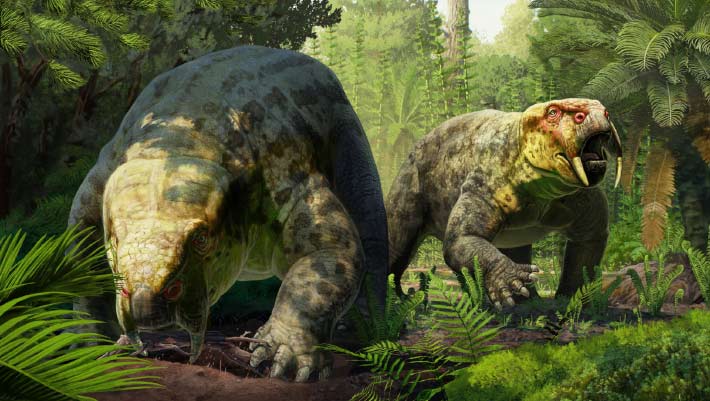
New Species of Ancient Bear-Dog Identified in Spain
Nouvelle espèce d'ancien chien-ours identifiée en Espagne
bassin Espagne fossile spécimen mammifères nouvelle espèce
Les paléontologues ont identifié une espèce jusqu'alors inconnue d'amphicyonidés - la famille éteinte de mammifères carnivores communément connue sous le nom de chiens-ours - à partir de deux spécimens découverts sur un riche site fossile du bassin du Vallès-Penedès, près de Barcelone, en Espagne. L'article Nouvelle espèce d'ancien chien-ours identifié en Espagne est apparu en premier sur Sci.News : Breaking Science News.
11/06/2026 sci-news ⚙ Traduction automatique
New Microraptorine Dinosaur Discovered in China
Un nouveau dinosaure microraptorine découvert en Chine
Chine Crétacé Crétacé inférieur spécimen Dinosauria Jian Microraptorinae oiseau
Jian changmaensis est le premier dinosaure non aviaire découvert sur un site paléontologique ayant livré plus de 100 spécimens d'oiseaux du Crétacé inférieur. L'article Un nouveau dinosaure microraptorine découvert en Chine est apparu en premier sur Sci.News : Breaking Science News.
04/06/2026 sci-news ⚙ Traduction automatique
New Species of Fossil Axolotl Unearthed in Mexico
De nouvelles espèces d’axolotl fossiles découvertes au Mexique
Mexique fossile spécimen découverte nouvelle espèce
Les paléontologues ont identifié une nouvelle espèce du genre axolotl Ambystoma à partir de plusieurs spécimens fossilisés trouvés au fond des affleurements rocheux de l'État mexicain d'Hidalgo. L'article De nouvelles espèces d'axolotl fossiles découvertes au Mexique sont apparus en premier sur Sci.News : Breaking Science News.
02/06/2026 sci-news ⚙ Traduction automatique
490-Million-Year-Old Arthropod Fossil Fills Puzzling Gap in Fossil Record
Un fossile d'arthropode vieux de 490 millions d'années comble une lacune déroutante dans les archives fossiles
Canada Cambrien Furongien fossile spécimen nouvelle espèce
Une nouvelle espèce d'arthropode corcoraniidé ayant vécu à l'époque furongienne, il y a entre 497 et 487 millions d'années, a été identifiée à partir d'un spécimen exceptionnellement préservé trouvé près de Québec, au Canada. L'article Un fossile d'arthropode vieux de 490 millions d'années comble une lacune déroutante dans les archives fossiles est apparu en premier sur Sci.News : Breaking Science News.
29/05/2026 sci-news ⚙ Traduction automatique
1 2 3 4