←

spécimen

Nature du spécimen

204 image(s) · 23 Actualités

Galerie d'images

Holotype of Jaculinykus yaruui gen. et sp. nov. (MPC-D 100/209). (A) Photograph of the specimen. (B) Explanatory drawing of (A). Highlighted areas refer to the indication of the skeletal elements; skull in green, tail in grey, pectoral girdle and forelimbs in red, pelvis and hind limbs in purple. (C) Reconstruction of Jaculinykus yaruui gen. et sp. nov. Grey areas are missing parts.
Taxons Jaculinykus

Holotype of Jaculinykus yaruui gen. et sp. nov. (MPC-D 100/209). (A) Photograph of the specimen. (B) Explanatory drawing of (A). Highlighted areas refer to the indication of the skeletal elements; skull in green, tail in grey, pectoral girdle and forelimbs in red, pelvis and hind limbs in purple. (C) Reconstruction of Jaculinykus yaruui gen. et sp. nov. Grey areas are missing parts.

membre bassin dessin holotype +3
Reconstruction of the skull of Lagenanectes richterae in right lateral view. Only the anterior part of the skull and lower jaw is preserved in the type and only known specimen. The posterior parts are reconstructed based on the related genus Libonectes.
Taxons Lagenanectes

Reconstruction of the skull of Lagenanectes richterae in right lateral view. Only the anterior part of the skull and lower jaw is preserved in the type and only known specimen. The posterior parts are reconstructed based on the related genus Libonectes.

spécimen Lagenanectes Libonectes crâne
Holotype specimen (CRILAR-Pv 151) of Huayracursor jaguensis, a long-necked dinosaur that lived approximately 230 million years ago, placed in approximate anatomical articulation.
Taxons Huayracursor

Holotype specimen (CRILAR-Pv 151) of Huayracursor jaguensis, a long-necked dinosaur that lived approximately 230 million years ago, placed in approximate anatomical articulation.

holotype spécimen Dinosauria Huayracursor
An overview of the known fossil material of Tyrannomimus fukuiensis. Fossil specimens shown in are not in the same scale. The bar is scaled for the paratype (FPDM-V-10295). The holotype (FPDM-V-11333) and paratype in are colored in red and blue, respectively. The right femur in is mirrored from the left one (FPDM-V-11338).
Taxons Tyrannomimus

An overview of the known fossil material of Tyrannomimus fukuiensis. Fossil specimens shown in are not in the same scale. The bar is scaled for the paratype (FPDM-V-10295). The holotype (FPDM-V-11333) and paratype in are colored in red and blue, respectively. The right femur in is mirrored from the left one (FPDM-V-11338).

écaille fossile holotype spécimen +1
Terminocavus sealeyi holotype NMMNH P-27468 parietal.

Dorsal (A) and ventral (B) views. Paired ep1 are deflected dorsally. em, median embayment of the posterior bar; ep, epiparietal loci numbered by hypothesized position (no epiossifications are fused to this specimen); f, parietal fenestra; lb, lateral bar; L-lr/R-lr, Left/Right lateral rami of the posterior bar; mb, median bar; te, tapering lateral edges of the median bar. Scalebar = 10 cm. Reconstruction adapted from Lehman (1998).
Taxons Terminocavus

Terminocavus sealeyi holotype NMMNH P-27468 parietal. Dorsal (A) and ventral (B) views. Paired ep1 are deflected dorsally. em, median embayment of the posterior bar; ep, epiparietal loci numbered by hypothesized position (no epiossifications are fused to this specimen); f, parietal fenestra; lb, lateral bar; L-lr/R-lr, Left/Right lateral rami of the posterior bar; mb, median bar; te, tapering lateral edges of the median bar. Scalebar = 10 cm. Reconstruction adapted from Lehman (1998).

Denver holotype spécimen Terminocavus
Fossil specimen in the Natural History Museum of Utah, Salt Lake City, Utah, USA. Photography was permitted in the museum without restriction.
Taxons Hagryphus

Fossil specimen in the Natural History Museum of Utah, Salt Lake City, Utah, USA. Photography was permitted in the museum without restriction.

musée États-Unis fossile spécimen +1
The holotype specimen of the extinct pterosaur Ceoptera, NHMUK PV R 37110
Taxons Ceoptera

The holotype specimen of the extinct pterosaur Ceoptera, NHMUK PV R 37110

musée holotype spécimen Ceoptera +1
Holotype specimen of the anurognathid pterosaur Sinomacrops
Taxons Sinomacrops

Holotype specimen of the anurognathid pterosaur Sinomacrops

holotype spécimen Anurognathidae Pterosauria +1
Vertebrae of the holotype specimen of Padillasaurus leivaensis.
Taxons Padillasaurus

Vertebrae of the holotype specimen of Padillasaurus leivaensis.

holotype spécimen Padillasaurus
Fossil specimen of Liaoningosaurus paradoxus on display at the Beijing Museum of Natural History.
Taxons Liaoningosaurus

Fossil specimen of Liaoningosaurus paradoxus on display at the Beijing Museum of Natural History.

musée fossile spécimen Liaoningosaurus
Ferrodraco lentoni gen. et sp. nov. holotype specimen AODF 876. All preserved elements were photographed and scaled to the same size, then articulated where possible. These were then used as the basis for the scaling of the skeletal reconstruction, the missing parts of which were based on the skeletal reconstruction of Tropeognathus mesembrinus by Mark Witton. Scale bar = 50 mm.
Taxons Ferrodraco

Ferrodraco lentoni gen. et sp. nov. holotype specimen AODF 876. All preserved elements were photographed and scaled to the same size, then articulated where possible. These were then used as the basis for the scaling of the skeletal reconstruction, the missing parts of which were based on the skeletal reconstruction of Tropeognathus mesembrinus by Mark Witton. Scale bar = 50 mm.

écaille holotype spécimen Ferrodraco +1
Photo of a specimen belonging to the anurognathid pterosaur Anurognathus
Taxons Anurognathus

Photo of a specimen belonging to the anurognathid pterosaur Anurognathus

spécimen Anurognathidae Anurognathus Pterosauria
Haliskia peterseni gen. et sp. nov., holotype specimen KK F1426. (A) dorsal vertebra, ribs, gastralium, left scapulocoracoid, left and right manual phalanx IV-2, right manual phalanx IV-3, left femur, left tibia, metatarsals and pedal phalanges, (B) mandible, teeth, ceratobranchials, cervical vertebra, rib, gastralium, right syncarpus, right lateral carpal, right pteroid, metacarpals, manual digits, right manual phalanx IV-1, left manual phalanx IV-4, (C) premaxilla with teeth, (D) isolated tooth, (E) isolated tooth, (F) left lateral carpal, (G) left metacarpal IV. Scale bar = 50 mm.
Taxons Haliskia

Haliskia peterseni gen. et sp. nov., holotype specimen KK F1426. (A) dorsal vertebra, ribs, gastralium, left scapulocoracoid, left and right manual phalanx IV-2, right manual phalanx IV-3, left femur, left tibia, metatarsals and pedal phalanges, (B) mandible, teeth, ceratobranchials, cervical vertebra, rib, gastralium, right syncarpus, right lateral carpal, right pteroid, metacarpals, manual digits, right manual phalanx IV-1, left manual phalanx IV-4, (C) premaxilla with teeth, (D) isolated tooth, (E) isolated tooth, (F) left lateral carpal, (G) left metacarpal IV. Scale bar = 50 mm.

écaille dent vertèbre holotype +2
Ohmdenosaurus holotype specimen, on exhibit at the Urweltmuseum Hauff. The specimen includes a lower leg (tibia, astragalus, calcaneus). Labels after Wild, 1978.
Wild, R. (1978). "Ein Sauropoden-Rest (Reptilia, Saurischia) aus dem Posidonienschiefer (Lias, Toarcium) von Holzmaden". Stuttgarter Beiträge zur Naturkunde, Serie B (Geologie und Paläontologie) (in German). 41: 1–15.
Taxons Ohmdenosaurus

Ohmdenosaurus holotype specimen, on exhibit at the Urweltmuseum Hauff. The specimen includes a lower leg (tibia, astragalus, calcaneus). Labels after Wild, 1978. Wild, R. (1978). "Ein Sauropoden-Rest (Reptilia, Saurischia) aus dem Posidonienschiefer (Lias, Toarcium) von Holzmaden". Stuttgarter Beiträge zur Naturkunde, Serie B (Geologie und Paläontologie) (in German). 41: 1–15.

holotype spécimen Ohmdenosaurus Saurischia
Oneirosaurus caballeroi holotype IGMp879524. A, photograph, drawing and interpretative scheme of the specimen without left mandibular ramus, in right lateral view. B, photograph, drawing and interpretative scheme of the specimen without left mandibular
ramus, in left lateral view. Gray fill, sediment; pattern fill, broken bone surface; black, empty space. Scale bars: A = 50 mm; C-D = 30 mm. Abbreviations: an, angular; avc, anterior aperture of the vidian canal; bo, basioccipital; bptm, basipterygoid meniscus; bs, basisphenoid; c, coronoid; d, dentary; ec, ectopterygoid; ep, epipterygoid; ex, exoccipital; f, frontal; im, internal auditory meatus; is, interorbital septum; j, jugal; la, lacrimal; m, mandible; mx, maxilla; na, nasal; op, opisthotic-exoccipital; p, parietal; par, prearticular; pl, palatine; pmx, premaxilla; pof, postorbitofrontal; pr, prootic; prf, prefrontal; ps, parasphenoid; pt, pterygoid; pvc, posterior aperture of the vidian canal q; quadrate; rv, right vomer; sa, surangular; scp, sclerotic plate; smx, septomaxilla; so, supraoccipital; sp, splenial; stp, stapes; VII, IX-XII, exit of cranial nerves.
Taxons Oneirosaurus

Oneirosaurus caballeroi holotype IGMp879524. A, photograph, drawing and interpretative scheme of the specimen without left mandibular ramus, in right lateral view. B, photograph, drawing and interpretative scheme of the specimen without left mandibular ramus, in left lateral view. Gray fill, sediment; pattern fill, broken bone surface; black, empty space. Scale bars: A = 50 mm; C-D = 30 mm. Abbreviations: an, angular; avc, anterior aperture of the vidian canal; bo, basioccipital; bptm, basipterygoid meniscus; bs, basisphenoid; c, coronoid; d, dentary; ec, ectopterygoid; ep, epipterygoid; ex, exoccipital; f, frontal; im, internal auditory meatus; is, interorbital septum; j, jugal; la, lacrimal; m, mandible; mx, maxilla; na, nasal; op, opisthotic-exoccipital; p, parietal; par, prearticular; pl, palatine; pmx, premaxilla; pof, postorbitofrontal; pr, prootic; prf, prefrontal; ps, parasphenoid; pt, pterygoid; pvc, posterior aperture of the vidian canal q; quadrate; rv, right vomer; sa, surangular; scp, sclerotic plate; smx, septomaxilla; so, supraoccipital; sp, splenial; stp, stapes; VII, IX-XII, exit of cranial nerves.

os écaille dessin holotype +2
Navajoceratops sullivani holotype SMP VP-1500 parietal.

Dorsal (A) and ventral (B) views. Cross section of median bar (mb) illustrated on dorsal view. Ep1 mostly removed during extraction or preparation (see Fig. S4 for original extent). em, median embayment of the posterior bar; ep, epiparietal loci numbered by hypothesized position (no epiossifications are fused to this specimen); f, parietal fenestra; L-lr/R-lr, Left/Right lateral rami of the posterior bar; te, tapering lateral edges of the median bar. Scalebar = 10 cm. Reconstruction adapted from Lehman (1998).
Taxons Navajoceratops

Navajoceratops sullivani holotype SMP VP-1500 parietal. Dorsal (A) and ventral (B) views. Cross section of median bar (mb) illustrated on dorsal view. Ep1 mostly removed during extraction or preparation (see Fig. S4 for original extent). em, median embayment of the posterior bar; ep, epiparietal loci numbered by hypothesized position (no epiossifications are fused to this specimen); f, parietal fenestra; L-lr/R-lr, Left/Right lateral rami of the posterior bar; te, tapering lateral edges of the median bar. Scalebar = 10 cm. Reconstruction adapted from Lehman (1998).

Denver holotype spécimen Navajoceratops
1 2 3 4 5 6 7 8 9 10 11 12 13

Actualités

Le séquençage du génome d’échantillons de musée pourrait transformer la science
musée spécimen découverte évolution génétique
Les musées d'histoire naturelle pourraient détenir la clé de découvertes scientifiques majeures, selon un nouvel article. Le séquençage du génome des spécimens de musée pourrait transformer la recherche en évolution, conservation, médecine et changement environnemental. Les collections d’histoire naturelle du monde entier contiennent plus d’un milliard de spécimens. Ensemble, ils préservent une énorme quantité d’informations génétiques. Cependant, les scientifiques ont séquencé
21/09/2026 everythingdinosaur ⚙ Traduction automatique
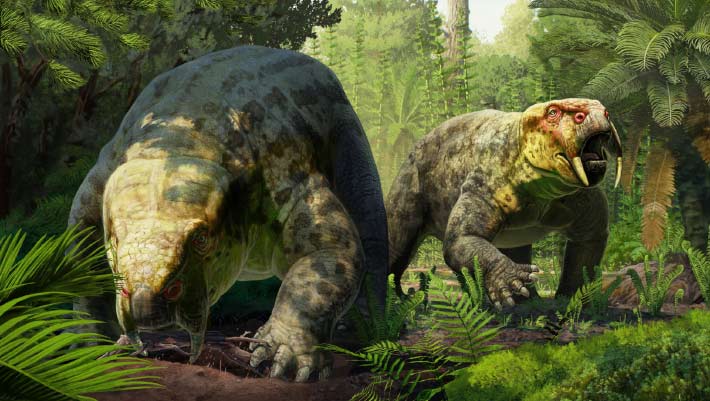
New Dicynodont Species from Tanzania Suggests Younger Age for Rocks Tied to Earliest Dinosaurs
Une nouvelle espèce de dicynodonte de Tanzanie suggère un âge plus jeune pour les roches liées aux premiers dinosaures
Tanzanie fossile spécimen Dinosauria nouvelle espèce
Les paléontologues ont identifié une nouvelle espèce de mammifère ancien et éloigné à partir de deux spécimens fossiles trouvés à des décennies d'intervalle dans les lits Manda de Tanzanie. L'article Une nouvelle espèce de dicynodonte de Tanzanie suggère un âge plus jeune pour les roches liées aux premiers dinosaures apparaît en premier sur Sci.News : Breaking Science News.
15/09/2026 sci-news ⚙ Traduction automatique
Un remarquable fossile de reptile marin du Trias préserve les organes internes
Chine Trias fossile spécimen anatomie squelette
Les scientifiques ont décrit un fossile exceptionnel du reptile marin du Trias au long cou, Austronaga minuta. Le spécimen vient de Chine et a environ 245 millions d’années. Remarquablement, une grande partie du système digestif de l’animal a été préservée. Le fossile presque complet offre aux scientifiques une vue sans précédent du squelette et de l’anatomie interne d’un archosauromorphe.
26/08/2026 everythingdinosaur ⚙ Traduction automatique
Un fossile remarquable révèle le régime alimentaire d'un ichtyosaure du Jurassique supérieur
Allemagne Jurassique Jurassique supérieur fossile spécimen Aegirosaurus Ichthyosauria Jabalisaurus squelette
Les scientifiques étudiant l’ichtyosaure Jabalisaurus tethyensis, récemment décrit, ont acquis un aperçu remarquable de son régime alimentaire. Un fossile magnifiquement conservé du sud de l'Allemagne contient des preuves des derniers repas de l'animal. De plus, le spécimen préserve des détails importants du squelette et des contours du corps. Le fossile, numéro de spécimen JME-SOS-08369, était auparavant attribué à Aegirosaurus. Cependant, les chercheurs
24/08/2026 everythingdinosaur ⚙ Traduction automatique
Nouvelles lignes directrices importantes pour les collections d’histoire naturelle coloniale
musée spécimen
Le Museum für Naturkunde Berlin a publié de nouvelles directives concernant les collections d'histoire naturelle coloniale. La publication examine comment les musées et autres institutions peuvent travailler de manière responsable avec des spécimens et des objets provenant d'anciens territoires coloniaux. Les collections d'histoire naturelle constituent une ressource inestimable pour les scientifiques. Cependant, les spécimens acquis pendant les périodes coloniales peuvent aussi refléter des inégalités historiques, des rapports de pouvoir
22/08/2026 everythingdinosaur ⚙ Traduction automatique
1 2 3 4 5