squelette

Type de vue

294 image(s) · 23 Actualités

Galerie d'images

Muttaburrasaurus
The plants, animals and climate of the Australian continent have changed dramatically over long periods of time. Imagine this giant creature roaming the luxuriant wet forests that covered parts of the continent in the Cretaceous period, about 100-110 million years ago. The Muttaburrasaurus ambled along on all four legs or stood on its hind legs. Its large teeth were well adapted to eat tough vegetation such as the leathery foliage of the evergreen forests of Araucaria trees, ancient relatives of the bunya pine of south-eastern Queensland.
In 1963, grazier Doug Langdon discovered the fossilised bones of a dinosaur on his property near Muttaburra in central-west Queensland. It was one of the most complete dinosaur skeletons found in Australia. The bones belonged to a new species of ornithopod and palaeontologists named it Muttaburrasaurus langdoni.

Cast of Muttaburresaurus langdoni 1987 made by Queensland Museum, Brisbane National Museum of Australia
Taxons Muttaburrasaurus

Muttaburrasaurus The plants, animals and climate of the Australian continent have changed dramatically over long periods of time. Imagine this giant creature roaming the luxuriant wet forests that covered parts of the continent in the Cretaceous period, about 100-110 million years ago. The Muttaburrasaurus ambled along on all four legs or stood on its hind legs. Its large teeth were well adapted to eat tough vegetation such as the leathery foliage of the evergreen forests of Araucaria trees, ancient relatives of the bunya pine of south-eastern Queensland. In 1963, grazier Doug Langdon discovered the fossilised bones of a dinosaur on his property near Muttaburra in central-west Queensland. It was one of the most complete dinosaur skeletons found in Australia. The bones belonged to a new species of ornithopod and palaeontologists named it Muttaburrasaurus langdoni. Cast of Muttaburresaurus langdoni 1987 made by Queensland Museum, Brisbane National Museum of Australia

os musée Australie Crétacé +5
Montanoceratops cerorhynchus (Brown & Schlaikjer, 1942) - fossil ceratopsian dinosaur skeleton from the Cretaceous of Montana, USA. (MOR 542, Museum of the Rockies, Bozeman, Montana, USA)
The species name is sometimes incorrectly spelled "cerorhynchos".  The original publication spells it "cerorhynchus".  The genus name is sometimes incorrectly spelled "Montanaceratops".
Ceratopsians are the "horned dinosaurs".  They were large, quadrupedal, herbivorous dinosaurs having a beaked skull and a frill - an extension of bone behind the skull that partially covered the neck.  Ceratopsian dinosaurs are known from the Jurassic and Cretaceous.  The last members of the group died out at the Cretaceous-Tertiary boundary, 65 million years ago.
This is a partial skeleton of a juvenile Montanoceratops, a ceratopsian from the near-latest Cretaceous of western North America.  This type of ceratopsian lacked facial horns.


From exhibit signage:
Sixty-eight million years ago, when the horned dinosaurs Triceratops and Torosaurus inhabited the coastal plain near the inland ocean, primitive "horned" dinosaurs named Montanoceratops lived in uplands near the young Rocky Mountains.  These little protoceratopsians fed on plants with slicing teeth and narrow beaks similar to their giant three-horned relatives.


Classification: Animalia, Chordata, Vertebrata, Reptilia, Archosauria, Dinosauria, Ornithischia, Marginocephalia, Ceratopsia, Leptoceratopsidae
Stratigraphy: St. Mary River Formation, Maastrichtian Stage, Upper Cretaceous
Locality: Little Rocky Coulee, north of the town of Cut Bank, eastern Glacier County, northwestern Montana, USA


Info. at:

en.wikipedia.org/wiki/Montanoceratops
Taxons Montanoceratops

Montanoceratops cerorhynchus (Brown & Schlaikjer, 1942) - fossil ceratopsian dinosaur skeleton from the Cretaceous of Montana, USA. (MOR 542, Museum of the Rockies, Bozeman, Montana, USA) The species name is sometimes incorrectly spelled "cerorhynchos". The original publication spells it "cerorhynchus". The genus name is sometimes incorrectly spelled "Montanaceratops". Ceratopsians are the "horned dinosaurs". They were large, quadrupedal, herbivorous dinosaurs having a beaked skull and a frill - an extension of bone behind the skull that partially covered the neck. Ceratopsian dinosaurs are known from the Jurassic and Cretaceous. The last members of the group died out at the Cretaceous-Tertiary boundary, 65 million years ago. This is a partial skeleton of a juvenile Montanoceratops, a ceratopsian from the near-latest Cretaceous of western North America. This type of ceratopsian lacked facial horns. From exhibit signage: Sixty-eight million years ago, when the horned dinosaurs Triceratops and Torosaurus inhabited the coastal plain near the inland ocean, primitive "horned" dinosaurs named Montanoceratops lived in uplands near the young Rocky Mountains. These little protoceratopsians fed on plants with slicing teeth and narrow beaks similar to their giant three-horned relatives. Classification: Animalia, Chordata, Vertebrata, Reptilia, Archosauria, Dinosauria, Ornithischia, Marginocephalia, Ceratopsia, Leptoceratopsidae Stratigraphy: St. Mary River Formation, Maastrichtian Stage, Upper Cretaceous Locality: Little Rocky Coulee, north of the town of Cut Bank, eastern Glacier County, northwestern Montana, USA Info. at: en.wikipedia.org/wiki/Montanoceratops

os musée États-Unis Crétacé +17
Partial skeleton of Claosaurus agilis (holotype YPM 1190).

(A) Right ilium in lateral view. (B) Partial postorbital in lateral view. (C) Distal process of the right ischium in lateral view. (D) Mounted partial skeleton of YPM 1190. (E) Coronoid process of the right dentary in lateral view. (F) Fragment of maxilla in lateral view. (G) Detail of the maxillary tooth crowns in (F). (H) Fragment of maxilla in lateral view. (I) Detail of a maxillary tooth crown in (H).
Taxons Claosaurus

Partial skeleton of Claosaurus agilis (holotype YPM 1190). (A) Right ilium in lateral view. (B) Partial postorbital in lateral view. (C) Distal process of the right ischium in lateral view. (D) Mounted partial skeleton of YPM 1190. (E) Coronoid process of the right dentary in lateral view. (F) Fragment of maxilla in lateral view. (G) Detail of the maxillary tooth crowns in (F). (H) Fragment of maxilla in lateral view. (I) Detail of a maxillary tooth crown in (H).

dent holotype Claosaurus partiel +1
Title: The dinosaur book : the ruling reptiles and their relatives
Identifier: bookruli00colb (find matches)
Year: 1951 (1950s)
Authors: Colbert, Edwin H. (Edwin Harris), 1905-2001; Knight, Charles Robert, 1874-1953; American Museum of Natural History
Subjects: Dinosaurs; Reptiles, Fossil
Publisher: New York : Published for the American Museum of Natural History by McGraw-Hill
Contributing Library: American Museum of Natural History Library
Digitizing Sponsor: IMLS / LSTA / METRO

View Book Page: Book Viewer
About This Book: Catalog Entry
View All Images: All Images From Book
Click here to view book online to see this illustration in context in a browseable online version of this book.

Text Appearing Before Image: 
'
Text Appearing After Image: 
bone A typical example of the parts usually found fossilized: portions of the skeleton of a small dinosaur from Mongolia A.M.N.H. photographs One of the rarest fossils: a dino- saur egg over 60 million years old, compared with a hen's egg (left) and an alligator egg (right)

Note About Images

Please note that these images are extracted from scanned page images that may have been digitally enhanced for readability - coloration and appearance of these illustrations may not perfectly resemble the original work.
Taxons Oviraptor

Title: The dinosaur book : the ruling reptiles and their relatives Identifier: bookruli00colb (find matches) Year: 1951 (1950s) Authors: Colbert, Edwin H. (Edwin Harris), 1905-2001; Knight, Charles Robert, 1874-1953; American Museum of Natural History Subjects: Dinosaurs; Reptiles, Fossil Publisher: New York : Published for the American Museum of Natural History by McGraw-Hill Contributing Library: American Museum of Natural History Library Digitizing Sponsor: IMLS / LSTA / METRO View Book Page: Book Viewer About This Book: Catalog Entry View All Images: All Images From Book Click here to view book online to see this illustration in context in a browseable online version of this book. Text Appearing Before Image: ' Text Appearing After Image: bone A typical example of the parts usually found fossilized: portions of the skeleton of a small dinosaur from Mongolia A.M.N.H. photographs One of the rarest fossils: a dino- saur egg over 60 million years old, compared with a hen's egg (left) and an alligator egg (right) Note About Images Please note that these images are extracted from scanned page images that may have been digitally enhanced for readability - coloration and appearance of these illustrations may not perfectly resemble the original work.

os livre musée Mongolie +4
Skeleton identified as Nemegtomaia by Greg Funston.[1] Central Museum of Mongolian Dinosaurs, Ulaanbaatar. Complete indexed photo collection at WorldHistoryPics.com.
Taxons Nemegtomaia

Skeleton identified as Nemegtomaia by Greg Funston.[1] Central Museum of Mongolian Dinosaurs, Ulaanbaatar. Complete indexed photo collection at WorldHistoryPics.com.

musée Dinosauria Nemegtomaia squelette
Early Triassic marine vertebrate apex predators during the Griesbachian to Smithian interval (left) and the Spathian to Anisian interval (right). Predators not exactly to scale; see text and Tables S1–S2 for details on body size and stratigraphic occurrence. Marine vertebrate apex predators: 1, Wantzosaurus (trematosaurid ‘amphibian’); 2, Fadenia (eugeneodontiform chondrichthyan); 3, Saurichthys (actinopterygian ambush predator); 4, Rebellatrix (fork-tailed actinistian); 5, Hovasaurus (‘younginiform’ diapsid reptile); 6, Birgeria (fast-swimming predatory actinopterygian); 7, Aphaneramma (trematosaurid ‘amphibian’); 8, Bobasatrania (durophagous actinopterygian); 9, hybodontoid chondrichthyan with durophagous (e.g. Acrodus, Palaeobates) or tearing-type dentition (e.g. Hybodus); 10, e.g., Mylacanthus (durophagous actinistian); 11, Tanystropheus (protorosaurian reptile); 12, Corosaurus (sauropterygian reptile); 13, e.g., Ticinepomis (actinistian); 14, Mixosaurus (small ichthyosaur); 15, large cymbospondylid/shastasaurid ichthyosaur; 16, neoselachian chondrichthyan; 17, Omphalosaurus skeleton (possible durophagous ichthyosaur); 18, Placodus (durophagous sauropterygian reptile).
Taxons Corosaurus

Early Triassic marine vertebrate apex predators during the Griesbachian to Smithian interval (left) and the Spathian to Anisian interval (right). Predators not exactly to scale; see text and Tables S1–S2 for details on body size and stratigraphic occurrence. Marine vertebrate apex predators: 1, Wantzosaurus (trematosaurid ‘amphibian’); 2, Fadenia (eugeneodontiform chondrichthyan); 3, Saurichthys (actinopterygian ambush predator); 4, Rebellatrix (fork-tailed actinistian); 5, Hovasaurus (‘younginiform’ diapsid reptile); 6, Birgeria (fast-swimming predatory actinopterygian); 7, Aphaneramma (trematosaurid ‘amphibian’); 8, Bobasatrania (durophagous actinopterygian); 9, hybodontoid chondrichthyan with durophagous (e.g. Acrodus, Palaeobates) or tearing-type dentition (e.g. Hybodus); 10, e.g., Mylacanthus (durophagous actinistian); 11, Tanystropheus (protorosaurian reptile); 12, Corosaurus (sauropterygian reptile); 13, e.g., Ticinepomis (actinistian); 14, Mixosaurus (small ichthyosaur); 15, large cymbospondylid/shastasaurid ichthyosaur; 16, neoselachian chondrichthyan; 17, Omphalosaurus skeleton (possible durophagous ichthyosaur); 18, Placodus (durophagous sauropterygian reptile).

écaille prédateur Anisien Early Triassic +9
Yangchuanosaurus shangyouensis skeleton displayed in Hong Kong Science Museum
Taxons Yangchuanosaurus

Yangchuanosaurus shangyouensis skeleton displayed in Hong Kong Science Museum

musée Yangchuanosaurus squelette
Skeleton of Sinovenator on display at the Tianjin Natural History Museum.
Taxons Sinovenator

Skeleton of Sinovenator on display at the Tianjin Natural History Museum.

musée Sinovenator squelette
Photograph of the skeleton of Patagosaurus fariasi Bonaparte, 1979. The skeleton is on display at Museo Argentino de Ciencias Naturales, in Argentina. Patagosaurus is a basal eusauropodan, closely related to Cetiosaurus possibly within Cetiosauridae. Photograph by Mathijs de Bruijne.
Taxons Patagosaurus

Photograph of the skeleton of Patagosaurus fariasi Bonaparte, 1979. The skeleton is on display at Museo Argentino de Ciencias Naturales, in Argentina. Patagosaurus is a basal eusauropodan, closely related to Cetiosaurus possibly within Cetiosauridae. Photograph by Mathijs de Bruijne.

Argentine Cetiosauria Cetiosauridae Eusauropoda +2
Skeleton of Chungkingosaurus jiangbeiensis displayed in Hong Kong Science Museum
Taxons Chungkingosaurus

Skeleton of Chungkingosaurus jiangbeiensis displayed in Hong Kong Science Museum

musée Chungkingosaurus squelette
Reconstructed Mononykus olecranus skeleton (AMNH 28508 and AMNH 28498) on display at the American Museum of Natural History.
Taxons Mononykus

Reconstructed Mononykus olecranus skeleton (AMNH 28508 and AMNH 28498) on display at the American Museum of Natural History.

musée Mononykus squelette
Fossil skeleton of Qianichthyosaurus zhoui on display at the Geological Museum of China.
Taxons Qianichthyosaurus

Fossil skeleton of Qianichthyosaurus zhoui on display at the Geological Museum of China.

musée Chine fossile Qianichthyosaurus +1
Photograph of a fossil cast of a Keichousaurus hui skeleton taken at the North American Museum of Ancient Life.
Taxons Keichousaurus

Photograph of a fossil cast of a Keichousaurus hui skeleton taken at the North American Museum of Ancient Life.

musée moulage fossile Keichousaurus +1
Avimimus skeleton
Taxons Avimimus

Avimimus skeleton

Avimimus squelette
Skeleton of '"Gyposaurus" sinensis on display at the Geological Museum of China.
Taxons Gyposaurus

Skeleton of '"Gyposaurus" sinensis on display at the Geological Museum of China.

musée Chine Gyposaurus squelette
Skeleton of Herrerasaurus
Taxons Herrerasaurus

Skeleton of Herrerasaurus

Herrerasaurus squelette
1 2 3 4 5 6 7 8 9 10 11 12 13 14 15 16 17 18 19

Actualités

Fossil of Giant Squid-Like Creature from Cretaceous Period Bears Marks of Deadly Attack
Canada Crétacé fossile squelette
Paleontologists studying a fossil unearthed in southern Manitoba, Canada, have identified what they believe are two bite marks on the internal skeleton of the ancient giant cephalopod Enchoteuthis. The post Fossil of Giant Squid-Like Creature from Cretaceous Period Bears Marks of Deadly Attack appeared first on Sci.News: Breaking Science News.
01/09/2026 sci-news
Un remarquable fossile de reptile marin du Trias préserve les organes internes
Chine Trias fossile spécimen anatomie squelette
Les scientifiques ont décrit un fossile exceptionnel du reptile marin du Trias au long cou, Austronaga minuta. Le spécimen vient de Chine et a environ 245 millions d’années. Remarquablement, une grande partie du système digestif de l’animal a été préservée. Le fossile presque complet offre aux scientifiques une vue sans précédent du squelette et de l’anatomie interne d’un archosauromorphe.
26/08/2026 everythingdinosaur ⚙ Traduction automatique
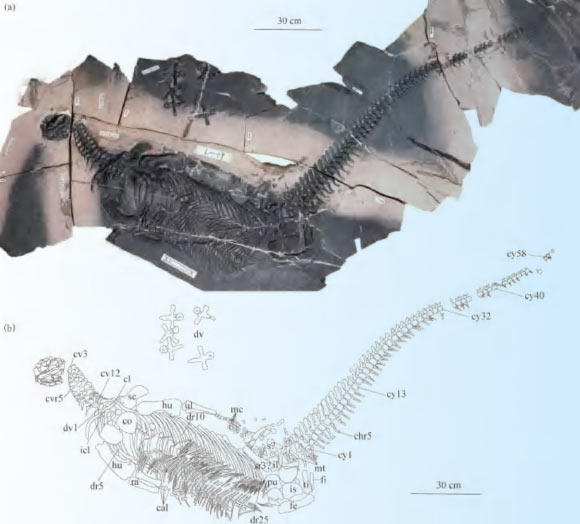
Un fossile remarquable révèle le régime alimentaire d'un ichtyosaure du Jurassique supérieur
Allemagne Jurassique Jurassique supérieur fossile spécimen Aegirosaurus Ichthyosauria Jabalisaurus squelette
Les scientifiques étudiant l’ichtyosaure Jabalisaurus tethyensis, récemment décrit, ont acquis un aperçu remarquable de son régime alimentaire. Un fossile magnifiquement conservé du sud de l'Allemagne contient des preuves des derniers repas de l'animal. De plus, le spécimen préserve des détails importants du squelette et des contours du corps. Le fossile, numéro de spécimen JME-SOS-08369, était auparavant attribué à Aegirosaurus. Cependant, les chercheurs
24/08/2026 everythingdinosaur ⚙ Traduction automatique
Spoon-Toothed, Short-Headed Marine Reptile Unearthed in China
Un reptile marin à dents de cuillère et à tête courte découvert en Chine
dent Chine Trias Sauropterygia nouvelle espèce autres reptiles squelette
Un nouveau genre et une nouvelle espèce de reptile sauroptérygien ayant vécu pendant la période du Trias, il y a environ 245 millions d'années, ont été identifiés à partir d'un squelette presque complet trouvé en Chine. L'article Un reptile marin à dents de cuillère et à tête courte découvert en Chine est apparu en premier sur Sci.News : Breaking Science News.
20/08/2026 sci-news ⚙ Traduction automatique
Des squelettes vieux de 3 500 ans remettent en question ce que les scientifiques pensaient savoir sur la syphilis
Viêt Nam découverte squelette
Des vestiges anciens du Vietnam suggèrent que des maladies comme le pian pourraient avoir été transmises de la mère à l'enfant il y a des milliers d'années, une forme de transmission souvent supposée indiquer la syphilis. Cette découverte pourrait bouleverser la façon dont les scientifiques interprètent les infections anciennes et compliquer le mystère de longue date des origines de la syphilis.
12/08/2026 sciencedaily-paleo ⚙ Traduction automatique
1 2 3 4 5