squelette

Type de vue

294 image(s) · 23 Actualités

Galerie d'images

Fossil skeleton of Qianichthyosaurus zhoui on display at the Geological Museum of China.

Fossil skeleton of Qianichthyosaurus zhoui on display at the Geological Museum of China.

musée Chine fossile Qianichthyosaurus +1
Photograph of a fossil cast of a Keichousaurus hui skeleton taken at the North American Museum of Ancient Life.

Photograph of a fossil cast of a Keichousaurus hui skeleton taken at the North American Museum of Ancient Life.

musée moulage fossile Keichousaurus +1
Avimimus skeleton
Taxons Avimimidae

Avimimus skeleton

Avimimidae Avimimus squelette
Chaohusaurus specimen AGM CHS-5, a nearly complete skeleton that is almost as large as AGM I-1. Large scale bars are 10 cm, and short bars 2 cm.

Chaohusaurus specimen AGM CHS-5, a nearly complete skeleton that is almost as large as AGM I-1. Large scale bars are 10 cm, and short bars 2 cm.

écaille spécimen Chaohusaurus squelette
Dinosaur skeleton.
Taxons Garudimimidae

Dinosaur skeleton.

Deinocheiridae Deinocheirus Dinosauria Garudimimidae +1
Skeleton of '"Gyposaurus" sinensis on display at the Geological Museum of China.

Skeleton of '"Gyposaurus" sinensis on display at the Geological Museum of China.

musée Chine Gyposaurus squelette
Skeleton of Herrerasaurus

Skeleton of Herrerasaurus

Herrerasaurus squelette
Mounted skeleton of Acrocanthosaurus specimen NCSM 14345 at North Carolina Museum of Natural Sciences

Mounted skeleton of Acrocanthosaurus specimen NCSM 14345 at North Carolina Museum of Natural Sciences

musée spécimen Acrocanthosaurus squelette
In 2000 a virtually complete Scelidosaurus skeleton was discovered in England. This fossil's hundreds of armor plates and spikes are preserved in their life positions, providing extraordinary details about how this dinosaur looked. St. George is the only place anywhere in the Western Hemisphere that the 11-foot long Scelidosaurus replica has been on display.
The St. George Dinosaur Discovery Site at Johnson Farm (St. George, Utah) is home to exceptionally well-preserved dinosaur tracks, some displaying skin impressions. These tracks, along with hundreds of fossil fish, plants, rare dinosaur remains, invertebrates traces and important sedimentary structures, show evidence that this site was produced along the western edge of a large, Early Jurassic (age between 195-198 million years ago) freshwater lake named Lake Dixie. 

Source: www.sgcity.org/dinotrax/
Taxons Scelidosauridae

In 2000 a virtually complete Scelidosaurus skeleton was discovered in England. This fossil's hundreds of armor plates and spikes are preserved in their life positions, providing extraordinary details about how this dinosaur looked. St. George is the only place anywhere in the Western Hemisphere that the 11-foot long Scelidosaurus replica has been on display. The St. George Dinosaur Discovery Site at Johnson Farm (St. George, Utah) is home to exceptionally well-preserved dinosaur tracks, some displaying skin impressions. These tracks, along with hundreds of fossil fish, plants, rare dinosaur remains, invertebrates traces and important sedimentary structures, show evidence that this site was produced along the western edge of a large, Early Jurassic (age between 195-198 million years ago) freshwater lake named Lake Dixie. Source: www.sgcity.org/dinotrax/

armure Jurassique inférieur Jurassique fossile +6
Composite skeleton wall mount of Lambeosaurus at Pacific Museum of Earth

Composite skeleton wall mount of Lambeosaurus at Pacific Museum of Earth

musée Lambeosauria squelette
Dicraeosaurus skeleton at the Museum für Naturkunde, Berlin.

Dicraeosaurus skeleton at the Museum für Naturkunde, Berlin.

musée Dicraeosaurus squelette
Velociraptor skeleton
Taxons Ovoraptor

Velociraptor skeleton

Ovoraptor Velociraptor squelette
The mounted skeleton of Brachiosaurus altithorax outside the Field Museum in Chicago, based on the holotype FMNH P25107, with missing parts filled in from the mounted Giraffatitan brancai MB.R.2181 at the Museum für Naturkunde Berlin.

The mounted skeleton of Brachiosaurus altithorax outside the Field Museum in Chicago, based on the holotype FMNH P25107, with missing parts filled in from the mounted Giraffatitan brancai MB.R.2181 at the Museum für Naturkunde Berlin.

musée holotype Brachiosauria Giraffatitan +1
Reconstruction of skeleton; Lower Cretaceous (120 mio. Years); Jungar Basin, China.

Reconstruction of skeleton; Lower Cretaceous (120 mio. Years); Jungar Basin, China.

Chine Crétacé Dsungaripteridae Dsungaripterus +1
Holotype skeleton (IVPP V15) of Lufengosaurus huenei on display at the Paleozoological Museum of China.

Holotype skeleton (IVPP V15) of Lufengosaurus huenei on display at the Paleozoological Museum of China.

musée Chine holotype Lufengosaurus +1
Plateosaurus engelhardti skeletons "Skelett 2" on exhibit at the museum of the Institute for Geosciences of the Eberhard-Karls-University Tübingen, Germany. "Skelett 2" is a composite from 2 individuals from Trossingen, Germany. Mounts created under the direction of Friedrich von Huene.

Plateosaurus engelhardti skeletons "Skelett 2" on exhibit at the museum of the Institute for Geosciences of the Eberhard-Karls-University Tübingen, Germany. "Skelett 2" is a composite from 2 individuals from Trossingen, Germany. Mounts created under the direction of Friedrich von Huene.

musée Allemagne Plateosauria squelette
1 2 3 4 5 6 7 8 9 10 11 12 13 14 15 16 17 18 19

Actualités

Fossil of Giant Squid-Like Creature from Cretaceous Period Bears Marks of Deadly Attack
Canada Crétacé fossile squelette
Paleontologists studying a fossil unearthed in southern Manitoba, Canada, have identified what they believe are two bite marks on the internal skeleton of the ancient giant cephalopod Enchoteuthis. The post Fossil of Giant Squid-Like Creature from Cretaceous Period Bears Marks of Deadly Attack appeared first on Sci.News: Breaking Science News.
01/09/2026 sci-news
Un remarquable fossile de reptile marin du Trias préserve les organes internes
Chine Trias fossile spécimen anatomie squelette
Les scientifiques ont décrit un fossile exceptionnel du reptile marin du Trias au long cou, Austronaga minuta. Le spécimen vient de Chine et a environ 245 millions d’années. Remarquablement, une grande partie du système digestif de l’animal a été préservée. Le fossile presque complet offre aux scientifiques une vue sans précédent du squelette et de l’anatomie interne d’un archosauromorphe.
26/08/2026 everythingdinosaur ⚙ Traduction automatique
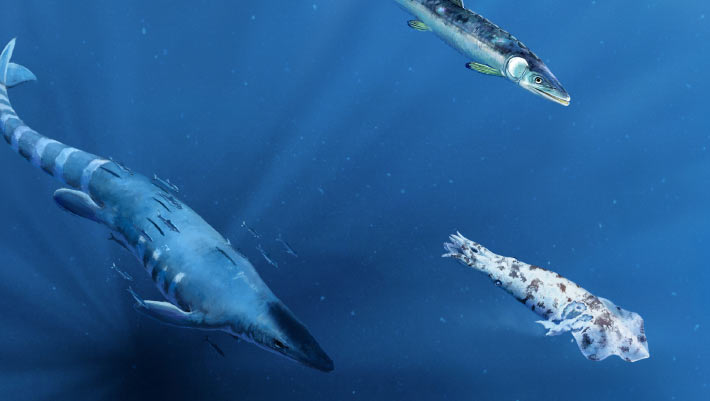
Un fossile remarquable révèle le régime alimentaire d'un ichtyosaure du Jurassique supérieur
Allemagne Jurassique Jurassique supérieur fossile spécimen Aegirosaurus Ichthyosauria Jabalisaurus squelette
Les scientifiques étudiant l’ichtyosaure Jabalisaurus tethyensis, récemment décrit, ont acquis un aperçu remarquable de son régime alimentaire. Un fossile magnifiquement conservé du sud de l'Allemagne contient des preuves des derniers repas de l'animal. De plus, le spécimen préserve des détails importants du squelette et des contours du corps. Le fossile, numéro de spécimen JME-SOS-08369, était auparavant attribué à Aegirosaurus. Cependant, les chercheurs
24/08/2026 everythingdinosaur ⚙ Traduction automatique
Spoon-Toothed, Short-Headed Marine Reptile Unearthed in China
Un reptile marin à dents de cuillère et à tête courte découvert en Chine
dent Chine Trias Sauropterygia nouvelle espèce autres reptiles squelette
Un nouveau genre et une nouvelle espèce de reptile sauroptérygien ayant vécu pendant la période du Trias, il y a environ 245 millions d'années, ont été identifiés à partir d'un squelette presque complet trouvé en Chine. L'article Un reptile marin à dents de cuillère et à tête courte découvert en Chine est apparu en premier sur Sci.News : Breaking Science News.
20/08/2026 sci-news ⚙ Traduction automatique
Des squelettes vieux de 3 500 ans remettent en question ce que les scientifiques pensaient savoir sur la syphilis
Viêt Nam découverte squelette
Des vestiges anciens du Vietnam suggèrent que des maladies comme le pian pourraient avoir été transmises de la mère à l'enfant il y a des milliers d'années, une forme de transmission souvent supposée indiquer la syphilis. Cette découverte pourrait bouleverser la façon dont les scientifiques interprètent les infections anciennes et compliquer le mystère de longue date des origines de la syphilis.
12/08/2026 sciencedaily-paleo ⚙ Traduction automatique
1 2 3 4 5