squelette

Type de vue

294 image(s) · 24 Actualités

Galerie d'images

"Daspletosaurus torosus" skeleton cast, reconstructed and mounted by Triebold Paleontology based on a nearly complete specimen from Montana's Judith River Formation
Taxons Daspletosaurini

"Daspletosaurus torosus" skeleton cast, reconstructed and mounted by Triebold Paleontology based on a nearly complete specimen from Montana's Judith River Formation

Judith River moulage spécimen Daspletosaurini +3
Reconstruction of skeleton; Lower Cretaceous (120 mio. Years); Jungar Basin, China.
Taxons Dsungaripteridae

Reconstruction of skeleton; Lower Cretaceous (120 mio. Years); Jungar Basin, China.

Chine Crétacé Dsungaripteridae squelette
Reconstruction of skeleton; Lower Cretaceous (120 mio. Years); Jungar Basin, China.
Taxons Dsungaripterus

Reconstruction of skeleton; Lower Cretaceous (120 mio. Years); Jungar Basin, China.

Chine Crétacé Dsungaripteridae squelette
Mounted replica of a composite skeleton of Edmontosaurus annectens on display at the University of Oxford Museum, Oxford, England. The original skeleton is compiled from disarticulated fossil bones from a bonebed of the Hell Creek Formation, exposed in the Ruth Mason Quarry in Harding County, South Dakota. It is 8.5 m (28 ft.) long and the skull is almost 1 m (39 in.) in length.[1][2]


↑ Dinosaurs in the Museum. Oxford University Museum of Natural History (brochure, PDF), p. 7

↑ BHI Fossil Replica Catalog 2012. Black Hills Institute of Geological Research, Inc., Hill City, SD, 2012 (PDF), p. 22
Taxons Saurolophinae

Mounted replica of a composite skeleton of Edmontosaurus annectens on display at the University of Oxford Museum, Oxford, England. The original skeleton is compiled from disarticulated fossil bones from a bonebed of the Hell Creek Formation, exposed in the Ruth Mason Quarry in Harding County, South Dakota. It is 8.5 m (28 ft.) long and the skull is almost 1 m (39 in.) in length.[1][2] ↑ Dinosaurs in the Museum. Oxford University Museum of Natural History (brochure, PDF), p. 7 ↑ BHI Fossil Replica Catalog 2012. Black Hills Institute of Geological Research, Inc., Hill City, SD, 2012 (PDF), p. 22

os musée Hell Creek fossile +6
Holotype block of Oksoko avarsan MPC-D 102/110. (a,b) Holotype block with skeletons in ventral view. Colours distinguish different individuals; the holotype individual is in blue.
Taxons Oksoko

Holotype block of Oksoko avarsan MPC-D 102/110. (a,b) Holotype block with skeletons in ventral view. Colours distinguish different individuals; the holotype individual is in blue.

holotype Oksoko squelette
Restoration of the skeleton, Age of Dinosaur Museum, Winton, Australia
Taxons Australovenator

Restoration of the skeleton, Age of Dinosaur Museum, Winton, Australia

musée Australie Winton Australovenator +2
Giganotosaurus skeleton mount at the Fernbank Museum of Natural History in Atlanta, Georgia.
Taxons Giganotosaurus

Giganotosaurus skeleton mount at the Fernbank Museum of Natural History in Atlanta, Georgia.

musée Géorgie Giganotosaurus squelette
Mounted skeleton of Acrocanthosaurus specimen NCSM 14345 at North Carolina Museum of Natural Sciences
Taxons Acrocanthosaurus

Mounted skeleton of Acrocanthosaurus specimen NCSM 14345 at North Carolina Museum of Natural Sciences

musée spécimen Acrocanthosaurus squelette
Velociraptor skeleton
Taxons Velociraptor

Velociraptor skeleton

Velociraptor squelette
Reconstructed skeleton of Argentinonectes calafatensis at the Bernardino Rivadavia Natural Sciences Argentine Museum in 2018.

Reconstructed skeleton of Argentinonectes calafatensis at the Bernardino Rivadavia Natural Sciences Argentine Museum in 2018.

musée Argentine Argentinonectes squelette
Schematic drawing of MUPA-ATZ0103, postcranial skeleton of the paratype of Paludidraco multidentatus.

Schematic drawing of MUPA-ATZ0103, postcranial skeleton of the paratype of Paludidraco multidentatus.

dessin Paludidraco squelette
Reconstructed skeleton of a megaraptoran highlighting the known bones of Joaquinraptor casali in blue. Reconstruction by TK Robinson and Andrew McAfee. Scale bar=1 m.

Reconstructed skeleton of a megaraptoran highlighting the known bones of Joaquinraptor casali in blue. Reconstruction by TK Robinson and Andrew McAfee. Scale bar=1 m.

os écaille Joaquinraptor Megaraptora +1
Hypothetical reconstruction of the skeleton of Amanasaurus nesbitti gen. et sp. nov. depicting (in orange) the preserved portions. (a) CAPPA/UFSM 0374 (holotype), a proximal portion of a right femur in anterior view. (b) CAPPA/UFSM 0375 (referred specimen), a distal portion of a left femur in anterior view. Figures were generated with GIMP 2.8 (https://www.gimp.org/).
Cropped from original image and letters adjusted to match.

Hypothetical reconstruction of the skeleton of Amanasaurus nesbitti gen. et sp. nov. depicting (in orange) the preserved portions. (a) CAPPA/UFSM 0374 (holotype), a proximal portion of a right femur in anterior view. (b) CAPPA/UFSM 0375 (referred specimen), a distal portion of a left femur in anterior view. Figures were generated with GIMP 2.8 (https://www.gimp.org/). Cropped from original image and letters adjusted to match.

holotype spécimen Amanasaurus squelette
Pliosaurus (Luskhan itilensis) lived on the territory of the Volga region in the Hauterivian age of the Early Cretaceous period. Discovered in 2002 by G.N. Uspensky on the banks of the Volga near the village of Slantsevy Rudnik. This is the most complete pliosaurus skeleton found in Russia. This pliosaurus was not a predator and preferred to feed on fish and cephalopods.

Pliosaurus (Luskhan itilensis) lived on the territory of the Volga region in the Hauterivian age of the Early Cretaceous period. Discovered in 2002 by G.N. Uspensky on the banks of the Volga near the village of Slantsevy Rudnik. This is the most complete pliosaurus skeleton found in Russia. This pliosaurus was not a predator and preferred to feed on fish and cephalopods.

prédateur Russie Crétacé Crétacé inférieur +5
Skeleton and reconstruction of Luskhan
Taxons Luskhan

Skeleton and reconstruction of Luskhan

Luskhan squelette
Holotype of Alcione elainus.
Fig. 6 of:
Longrich, N. R., Martill, D. M., & Andres, B. (2018). Late Maastrichtian pterosaurs from North Africa and mass extinction of Pterosauria at the Cretaceous-Paleogene boundary. PLoS biology, 16(3), e2001663.
---
Original figure legend:
A. elainus FSAC-OB 2, holotype partial skeleton and FSAC-OB 217, metacarpal IV.

(A) Holotype right humerus in anterior view, (B) holotype right ulna and radius in anterior view, respectively, (C) holotype sternum in left lateral view, (D) referred metacarpal IV, (E) holotype, distal end of left metacarpal IV and left scapulocoracoid, and (F) holotype right femur in posterior view. Abbreviations: co, coracoid; cr, cristospine; dc, distal condyle; dpc, deltopectoral crest; ect, ectepicondyle; fh, femoral head; gl, glenoid; gt, greater trochanter; hh, humeral head; hum, humerus; mcIV, metacarpal IV, pc, proximal cotyle; pf, pneumatic foramen; rad, radius; scpr, supracondylar process; ste, sternum; uln, ulna.

Holotype of Alcione elainus. Fig. 6 of: Longrich, N. R., Martill, D. M., & Andres, B. (2018). Late Maastrichtian pterosaurs from North Africa and mass extinction of Pterosauria at the Cretaceous-Paleogene boundary. PLoS biology, 16(3), e2001663. --- Original figure legend: A. elainus FSAC-OB 2, holotype partial skeleton and FSAC-OB 217, metacarpal IV. (A) Holotype right humerus in anterior view, (B) holotype right ulna and radius in anterior view, respectively, (C) holotype sternum in left lateral view, (D) referred metacarpal IV, (E) holotype, distal end of left metacarpal IV and left scapulocoracoid, and (F) holotype right femur in posterior view. Abbreviations: co, coracoid; cr, cristospine; dc, distal condyle; dpc, deltopectoral crest; ect, ectepicondyle; fh, femoral head; gl, glenoid; gt, greater trochanter; hh, humeral head; hum, humerus; mcIV, metacarpal IV, pc, proximal cotyle; pf, pneumatic foramen; rad, radius; scpr, supracondylar process; ste, sternum; uln, ulna.

crête humérus Crétacé Maastrichtien +7
1 2 3 4 5 6 7 8 9 10 11 12 13 14 15 16 17 18 19

Actualités

Remarkable “Chunky” Jurassic Squid from Wyoming is Scientifically Described
Jurassique Oxfordian fossile formation nouvelle espèce squelette
A remarkable new species of Jurassic squid-like animal has been described from Wyoming. The bizarre belemnite, named Wyoteuthis linsterorum, lived around 160 million years ago (Oxfordian faunal stage). Furthermore, it had an extraordinarily thick and barrel-shaped internal skeleton. An international research team studied two exceptionally rare fossils from the famous Sundance Formation. The scientists concluded
10/09/2026 everythingdinosaur
Fossil of Giant Squid-Like Creature from Cretaceous Period Bears Marks of Deadly Attack
Canada Crétacé fossile squelette
Paleontologists studying a fossil unearthed in southern Manitoba, Canada, have identified what they believe are two bite marks on the internal skeleton of the ancient giant cephalopod Enchoteuthis. The post Fossil of Giant Squid-Like Creature from Cretaceous Period Bears Marks of Deadly Attack appeared first on Sci.News: Breaking Science News.
01/09/2026 sci-news
Un remarquable fossile de reptile marin du Trias préserve les organes internes
Chine Trias fossile spécimen anatomie squelette
Les scientifiques ont décrit un fossile exceptionnel du reptile marin du Trias au long cou, Austronaga minuta. Le spécimen vient de Chine et a environ 245 millions d’années. Remarquablement, une grande partie du système digestif de l’animal a été préservée. Le fossile presque complet offre aux scientifiques une vue sans précédent du squelette et de l’anatomie interne d’un archosauromorphe.
26/08/2026 everythingdinosaur ⚙ Traduction automatique
Un fossile remarquable révèle le régime alimentaire d'un ichtyosaure du Jurassique supérieur
Allemagne Jurassique Jurassique supérieur fossile spécimen Aegirosaurus Ichthyosauria Jabalisaurus squelette
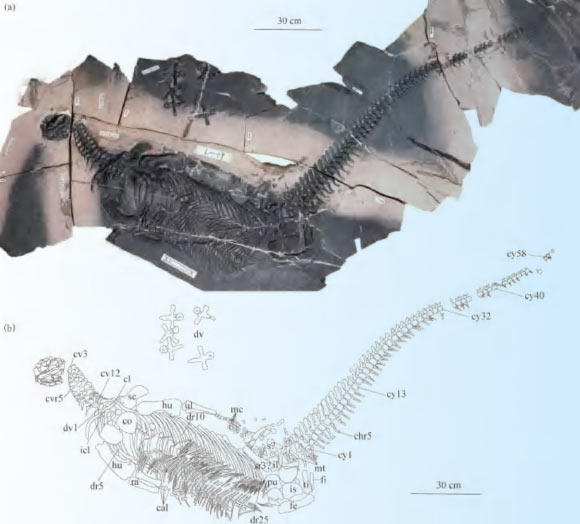
Les scientifiques étudiant l’ichtyosaure Jabalisaurus tethyensis, récemment décrit, ont acquis un aperçu remarquable de son régime alimentaire. Un fossile magnifiquement conservé du sud de l'Allemagne contient des preuves des derniers repas de l'animal. De plus, le spécimen préserve des détails importants du squelette et des contours du corps. Le fossile, numéro de spécimen JME-SOS-08369, était auparavant attribué à Aegirosaurus. Cependant, les chercheurs
24/08/2026 everythingdinosaur ⚙ Traduction automatique
Spoon-Toothed, Short-Headed Marine Reptile Unearthed in China
Un reptile marin à dents de cuillère et à tête courte découvert en Chine
dent Chine Trias Sauropterygia nouvelle espèce autres reptiles squelette
Un nouveau genre et une nouvelle espèce de reptile sauroptérygien ayant vécu pendant la période du Trias, il y a environ 245 millions d'années, ont été identifiés à partir d'un squelette presque complet trouvé en Chine. L'article Un reptile marin à dents de cuillère et à tête courte découvert en Chine est apparu en premier sur Sci.News : Breaking Science News.
20/08/2026 sci-news ⚙ Traduction automatique
1 2 3 4 5