skeleton

View type

167 image(s) · 17 News

Image gallery

Hypothetical reconstruction of the skeleton of Amanasaurus nesbitti gen. et sp. nov. depicting (in orange) the preserved portions. (a) CAPPA/UFSM 0374 (holotype), a proximal portion of a right femur in anterior view. (b) CAPPA/UFSM 0375 (referred specimen), a distal portion of a left femur in anterior view. Figures were generated with GIMP 2.8 (https://www.gimp.org/).
Cropped from original image and letters adjusted to match.

Hypothetical reconstruction of the skeleton of Amanasaurus nesbitti gen. et sp. nov. depicting (in orange) the preserved portions. (a) CAPPA/UFSM 0374 (holotype), a proximal portion of a right femur in anterior view. (b) CAPPA/UFSM 0375 (referred specimen), a distal portion of a left femur in anterior view. Figures were generated with GIMP 2.8 (https://www.gimp.org/). Cropped from original image and letters adjusted to match.

holotype specimen Amanasaurus skeleton
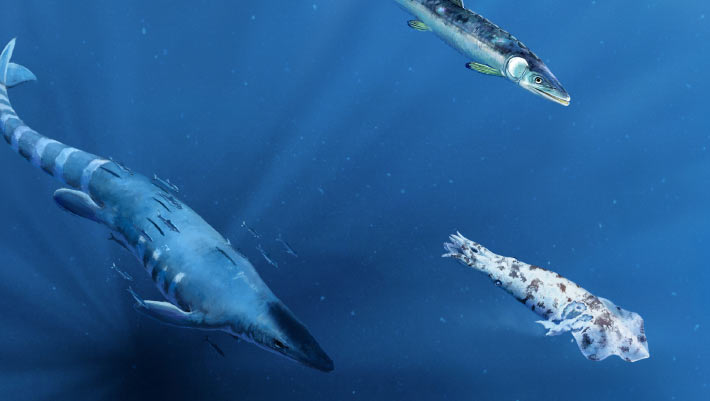
Pliosaurus (Luskhan itilensis) lived on the territory of the Volga region in the Hauterivian age of the Early Cretaceous period. Discovered in 2002 by G.N. Uspensky on the banks of the Volga near the village of Slantsevy Rudnik. This is the most complete pliosaurus skeleton found in Russia. This pliosaurus was not a predator and preferred to feed on fish and cephalopods.

Pliosaurus (Luskhan itilensis) lived on the territory of the Volga region in the Hauterivian age of the Early Cretaceous period. Discovered in 2002 by G.N. Uspensky on the banks of the Volga near the village of Slantsevy Rudnik. This is the most complete pliosaurus skeleton found in Russia. This pliosaurus was not a predator and preferred to feed on fish and cephalopods.

predator Russia Cretaceous Early Cretaceous +5
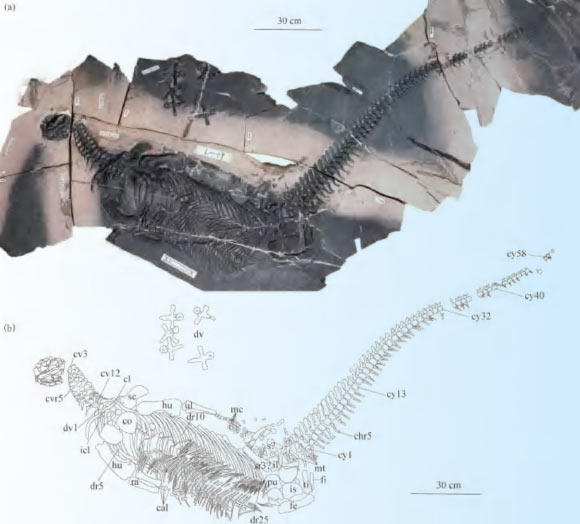
Skeleton and reconstruction of Luskhan
Taxa Luskhan

Skeleton and reconstruction of Luskhan

Luskhan skeleton
Holotype of Alcione elainus.
Fig. 6 of:
Longrich, N. R., Martill, D. M., & Andres, B. (2018). Late Maastrichtian pterosaurs from North Africa and mass extinction of Pterosauria at the Cretaceous-Paleogene boundary. PLoS biology, 16(3), e2001663.
---
Original figure legend:
A. elainus FSAC-OB 2, holotype partial skeleton and FSAC-OB 217, metacarpal IV.

(A) Holotype right humerus in anterior view, (B) holotype right ulna and radius in anterior view, respectively, (C) holotype sternum in left lateral view, (D) referred metacarpal IV, (E) holotype, distal end of left metacarpal IV and left scapulocoracoid, and (F) holotype right femur in posterior view. Abbreviations: co, coracoid; cr, cristospine; dc, distal condyle; dpc, deltopectoral crest; ect, ectepicondyle; fh, femoral head; gl, glenoid; gt, greater trochanter; hh, humeral head; hum, humerus; mcIV, metacarpal IV, pc, proximal cotyle; pf, pneumatic foramen; rad, radius; scpr, supracondylar process; ste, sternum; uln, ulna.
Taxa Alcione

Holotype of Alcione elainus. Fig. 6 of: Longrich, N. R., Martill, D. M., & Andres, B. (2018). Late Maastrichtian pterosaurs from North Africa and mass extinction of Pterosauria at the Cretaceous-Paleogene boundary. PLoS biology, 16(3), e2001663. --- Original figure legend: A. elainus FSAC-OB 2, holotype partial skeleton and FSAC-OB 217, metacarpal IV. (A) Holotype right humerus in anterior view, (B) holotype right ulna and radius in anterior view, respectively, (C) holotype sternum in left lateral view, (D) referred metacarpal IV, (E) holotype, distal end of left metacarpal IV and left scapulocoracoid, and (F) holotype right femur in posterior view. Abbreviations: co, coracoid; cr, cristospine; dc, distal condyle; dpc, deltopectoral crest; ect, ectepicondyle; fh, femoral head; gl, glenoid; gt, greater trochanter; hh, humeral head; hum, humerus; mcIV, metacarpal IV, pc, proximal cotyle; pf, pneumatic foramen; rad, radius; scpr, supracondylar process; ste, sternum; uln, ulna.

crest humerus Cretaceous Maastrichtian +7
Identifier: annalsofmedicalh01pack (find matches)
Title: Annals of medical history
Year: 1917 (1910s)
Authors:  Packard, Francis R. (Francis Randolph), 1870-1950
Subjects:  Medicine
Publisher:  New York P.B. Hoeber
Contributing Library:  Gerstein - University of Toronto
Digitizing Sponsor:  University of Toronto

View Book Page: Book Viewer
About This Book: Catalog Entry
View All Images: All Images From Book
Click here to view book online to see this illustration in context in a browseable online version of this book.

Text Appearing Before Image:
ail strongly Hexed, and the toescontracted and appressed. The whole atti-tude strongly suggests a spastic distress,possibly brought on by some form ofpoisoning of the central nervous system,from infection or the deglutition of somepoisonous substance. 14. Osteomalacia is evidently the causeof the hypertrophy of the bones of Lim-nocyron potens, an early carnivore from theWashakie Eocene of Wyoming, nearly3,000,000 years old. MATERIALS AND METHODS The material described in the presentpaper has been loaned the writer lor de-scription by the Field Museum of Chii Osborn: Hull. Amcr. \lus. Natl. Hist., 1917,vol. 35. !>• 733. P>- 28. Studies in Paleopathology 393 by the American Museum of Natural His-tory of New York City, by Walker Museumof the University of Chicago, and by the Uni-versity of Kansas Natural History Museum. made by the well-known petrographic meth-ods so common in all geological labora-tories. The diagnoses, where they are at-tempted, arc made from comparisons of the
Text Appearing After Image:
Fig. 20. The skeleton of Strutbiomimus altus, a small dinosaur from the BeliyRiver series (Cretaceous), Red Deer River, Alberta, Canada, now regarded as ofapproximately the same age as the Judith River series. The unique feature ofthe skull is the total absence of teeth, with a size of skull one-third larger thanthe ostrich and a length of body of about fifteen feet. The position of the skeletonis decidedly that of the opisthotonos which may be regarded as an indication ofdisease. (After Osborn). A beautiful specimen of an osteoma, theonly one known so far, on the vertebra of aKansas Cretaceous mosasaur, was given thewriter by Dr. J. M. Armstrong of St. Paul.The writer expresses his obligations to thegentlemen connected with the above-men-tioned institutions and to Dr. Armstrong.The methods used are a combination ofprocedures in the various lines involved.Microscopic sections, which can be madethin enough for immersion lens study, are material with similar lesions in recent hu-man mat

Note About Images

Please note that these images are extracted from scanned page images that may have been digitally enhanced for readability - coloration and appearance of these illustrations may not perfectly resemble the original work.
Taxa Hexing

Identifier: annalsofmedicalh01pack (find matches) Title: Annals of medical history Year: 1917 (1910s) Authors: Packard, Francis R. (Francis Randolph), 1870-1950 Subjects: Medicine Publisher: New York P.B. Hoeber Contributing Library: Gerstein - University of Toronto Digitizing Sponsor: University of Toronto View Book Page: Book Viewer About This Book: Catalog Entry View All Images: All Images From Book Click here to view book online to see this illustration in context in a browseable online version of this book. Text Appearing Before Image: ail strongly Hexed, and the toescontracted and appressed. The whole atti-tude strongly suggests a spastic distress,possibly brought on by some form ofpoisoning of the central nervous system,from infection or the deglutition of somepoisonous substance. 14. Osteomalacia is evidently the causeof the hypertrophy of the bones of Lim-nocyron potens, an early carnivore from theWashakie Eocene of Wyoming, nearly3,000,000 years old. MATERIALS AND METHODS The material described in the presentpaper has been loaned the writer lor de-scription by the Field Museum of Chii Osborn: Hull. Amcr. \lus. Natl. Hist., 1917,vol. 35. !>• 733. P>- 28. Studies in Paleopathology 393 by the American Museum of Natural His-tory of New York City, by Walker Museumof the University of Chicago, and by the Uni-versity of Kansas Natural History Museum. made by the well-known petrographic meth-ods so common in all geological labora-tories. The diagnoses, where they are at-tempted, arc made from comparisons of the Text Appearing After Image: Fig. 20. The skeleton of Strutbiomimus altus, a small dinosaur from the BeliyRiver series (Cretaceous), Red Deer River, Alberta, Canada, now regarded as ofapproximately the same age as the Judith River series. The unique feature ofthe skull is the total absence of teeth, with a size of skull one-third larger thanthe ostrich and a length of body of about fifteen feet. The position of the skeletonis decidedly that of the opisthotonos which may be regarded as an indication ofdisease. (After Osborn). A beautiful specimen of an osteoma, theonly one known so far, on the vertebra of aKansas Cretaceous mosasaur, was given thewriter by Dr. J. M. Armstrong of St. Paul.The writer expresses his obligations to thegentlemen connected with the above-men-tioned institutions and to Dr. Armstrong.The methods used are a combination ofprocedures in the various lines involved.Microscopic sections, which can be madethin enough for immersion lens study, are material with similar lesions in recent hu-man mat Note About Images Please note that these images are extracted from scanned page images that may have been digitally enhanced for readability - coloration and appearance of these illustrations may not perfectly resemble the original work.

bone vertebra museum Canada +10
The holotype and only known specimen of the hauffiopterygian leptonectid, Xiphodracon goldencapensis (ROM VP52596) from Golden Cap, between Charmouth and Seatown, Dorset, UK. The skeleton is exposed in ventrolateral view. The skull has been fully prepared free of matrix whereas most of the skeleton is still in matrix. The left (upper) forefin has been prepared so that it is three-dimensionally preserved and projects upwards. Scale bar represents 20 cm.
Taxa Xiphodracon

The holotype and only known specimen of the hauffiopterygian leptonectid, Xiphodracon goldencapensis (ROM VP52596) from Golden Cap, between Charmouth and Seatown, Dorset, UK. The skeleton is exposed in ventrolateral view. The skull has been fully prepared free of matrix whereas most of the skeleton is still in matrix. The left (upper) forefin has been prepared so that it is three-dimensionally preserved and projects upwards. Scale bar represents 20 cm.

scale United Kingdom holotype specimen +5
Life restoration of the Triassic ichthyosaur Callawayia neoscapularis. Three specimens of this ichthyosaur are known, the holotype, ROM 41993, and two referred specimens, TMP 94.380.11 and 94.382.2. The skull is primarily based on ROM 41993, cross-checked against TMP 94.380.11 and TMP 94.382.2. The vertebral column is based primarily on TMP 94.382.2 as it is the most complete of these specimens, while the ribs were based on ROM 41993. The forelimbs were mainly based on those of ROM 41993, with TMP 94.380.11 used to determine their breadth. The hindlimbs were based on TMP 94.380.11, especially the more complete right hindlimb.
ROM 41993 was cross-scaled with TMP 94.380.11 by the dimensions of the forelimb epipodials, which produced similar vertebral dimensions. The two TMP specimens were cross-scaled based on femoral length, also producing similar vertebral dimensions. Nicholls & Manabe (2001) stated that no wedge-shaped caudal centra supporting a tailbend were found and that there was no evidence of a bend being present, though considered that they might have existed in the gap in the preserved caudals. Since various other Triassic ichthyosaurs have since been found to have tail bends, one was illustrated here. A modest downturn of roughly 15° was illustrated, comparable to that in Guanlingsaurus, and the location of the bend within the gap in the preserved vertebrae matches well with the location of the bend in Guizhouichthyosaurus.

References
McGowan, C. (1994). "A new species of Shastasaurus (Reptilia: Ichthyosauria) from the Triassic of British Columbia: The most complete exemplar of the genus". Journal of Vertebrate Paleontology 14 (2): 168–179. DOI:10.1080/02724634.1994.10011550.
Nicholls, E. L.; Manabe, M. (2001). "A new genus of ichthyosaur from the Late Triassic Pardonet Formation of British Columbia: Bridging the Triassic-Jurassic gap". Canadian Journal of Earth Sciences 38 (6): 983–1002.
Ji, C.; Jiang, D.Y.; Hao, W.; Sun, Y. (2011). "True tailbend occurred in the Late Triassic: Evidence from ichthyosaur skeletons of South China". Acta Scientiarum Naturalium Universitatis Pekinensis 47 (2): 309–314.
Shang, Q. H.; Li, C. (2009). "On the occurrence of the ichthyosaur Shastasaurus in the Guanling biota (Late Triassic), Guizhou, China". Vertebrata PalAsiatica 47 (3): 178–193.
Taxa Guanlingsaurus

Life restoration of the Triassic ichthyosaur Callawayia neoscapularis. Three specimens of this ichthyosaur are known, the holotype, ROM 41993, and two referred specimens, TMP 94.380.11 and 94.382.2. The skull is primarily based on ROM 41993, cross-checked against TMP 94.380.11 and TMP 94.382.2. The vertebral column is based primarily on TMP 94.382.2 as it is the most complete of these specimens, while the ribs were based on ROM 41993. The forelimbs were mainly based on those of ROM 41993, with TMP 94.380.11 used to determine their breadth. The hindlimbs were based on TMP 94.380.11, especially the more complete right hindlimb. ROM 41993 was cross-scaled with TMP 94.380.11 by the dimensions of the forelimb epipodials, which produced similar vertebral dimensions. The two TMP specimens were cross-scaled based on femoral length, also producing similar vertebral dimensions. Nicholls & Manabe (2001) stated that no wedge-shaped caudal centra supporting a tailbend were found and that there was no evidence of a bend being present, though considered that they might have existed in the gap in the preserved caudals. Since various other Triassic ichthyosaurs have since been found to have tail bends, one was illustrated here. A modest downturn of roughly 15° was illustrated, comparable to that in Guanlingsaurus, and the location of the bend within the gap in the preserved vertebrae matches well with the location of the bend in Guizhouichthyosaurus. References McGowan, C. (1994). "A new species of Shastasaurus (Reptilia: Ichthyosauria) from the Triassic of British Columbia: The most complete exemplar of the genus". Journal of Vertebrate Paleontology 14 (2): 168–179. DOI:10.1080/02724634.1994.10011550. Nicholls, E. L.; Manabe, M. (2001). "A new genus of ichthyosaur from the Late Triassic Pardonet Formation of British Columbia: Bridging the Triassic-Jurassic gap". Canadian Journal of Earth Sciences 38 (6): 983–1002. Ji, C.; Jiang, D.Y.; Hao, W.; Sun, Y. (2011). "True tailbend occurred in the Late Triassic: Evidence from ichthyosaur skeletons of South China". Acta Scientiarum Naturalium Universitatis Pekinensis 47 (2): 309–314. Shang, Q. H.; Li, C. (2009). "On the occurrence of the ichthyosaur Shastasaurus in the Guanling biota (Late Triassic), Guizhou, China". Vertebrata PalAsiatica 47 (3): 178–193.

China Jurassic Late Triassic Triassic +12
Holotype block of Oksoko avarsan MPC-D 102/110. (a,b) Holotype block with skeletons in ventral view. Colours distinguish different individuals; the holotype individual is in blue.
Taxa Oksoko

Holotype block of Oksoko avarsan MPC-D 102/110. (a,b) Holotype block with skeletons in ventral view. Colours distinguish different individuals; the holotype individual is in blue.

holotype Oksoko skeleton
Life restoration of the German Jurassic ichthyosaur Suevoleviathan disinteger. The dorsal and caudal fins are loosely based on those of Stenopterygius.
References
Maisch, M.W. (2020). "The best-preserved skeleton of Suevoleviathan integer (Bronn, 1844)(Reptilia: Ichthyosauria) from the lower Jurassic of south-western Germany, with a discussion of the genus". Neues Jahrbuch für Geologie und Paläontologie, Abhandlungen 297 (2): 153–172.
Maisch, M.W. (1998). "A new ichthyosaur genus from the Posidonia Shale (Lower Toarcian, Jurassic) of Holzmaden, SW-Germany with comments on the phylogeny of post-Triassic ichthyosaurs". Neues Jahrbuch für Geologie und Paläontologie-Abhandlungen 209 (1): 47–78.
Taxa Suevoleviathan

Life restoration of the German Jurassic ichthyosaur Suevoleviathan disinteger. The dorsal and caudal fins are loosely based on those of Stenopterygius. References Maisch, M.W. (2020). "The best-preserved skeleton of Suevoleviathan integer (Bronn, 1844)(Reptilia: Ichthyosauria) from the lower Jurassic of south-western Germany, with a discussion of the genus". Neues Jahrbuch für Geologie und Paläontologie, Abhandlungen 297 (2): 153–172. Maisch, M.W. (1998). "A new ichthyosaur genus from the Posidonia Shale (Lower Toarcian, Jurassic) of Holzmaden, SW-Germany with comments on the phylogeny of post-Triassic ichthyosaurs". Neues Jahrbuch für Geologie und Paläontologie-Abhandlungen 209 (1): 47–78.

Germany Posidonia Shale Jurassic Toarcian +6
Tuarangisaurus cabazai skeleton restoration, Copenhagen
Taxa Tuarangisaurus

Tuarangisaurus cabazai skeleton restoration, Copenhagen

Tuarangisaurus skeleton
Restored skeleton of Anzu wyliei (previously labelled as a specimen of Chirostenotes)
Taxa Anzu

Restored skeleton of Anzu wyliei (previously labelled as a specimen of Chirostenotes)

United States specimen Anzu Chirostenotes +1
Protoceratops andrewsi skeleton at Carnegie Museum of Natural History.
Taxa Protoceratops

Protoceratops andrewsi skeleton at Carnegie Museum of Natural History.

museum Poland Protoceratops skeleton
Ceratosaurus skeleton mount, Wisconsin

Ceratosaurus skeleton mount, Wisconsin

United States Averostra Ceratosauria skeleton
Ceratosaurus skeleton mount, Wisconsin

Ceratosaurus skeleton mount, Wisconsin

United States Averostra Ceratosauria skeleton
Model of an Anhanguera circling over the Acrocanthosaurus skeleton and its prey.

Model of an Anhanguera circling over the Acrocanthosaurus skeleton and its prey.

prey Acrocanthosaurus Anhanguera skeleton
Anhanguera skeleton, North American Museum of Ancient Life.

Anhanguera skeleton, North American Museum of Ancient Life.

museum United States Anhanguera skeleton
1 2 3 4 5 6 7 8 9 10 11

News

Small Sauropod Dinosaur from Jurassic Period Discovered in India
pelvis India Jurassic Middle Jurassic Dinosauria partial skeleton
Paleontologists in India have unearthed a partial skeleton of a diminutive, previously unknown neosauropod dinosaur from the Middle Jurassic rocks of Gujarat’s Kachchh Basin. The post Small Sauropod Dinosaur from Jurassic Period Discovered in India appeared first on Sci.News: Breaking Science News.
21/07/2026 sci-news
Il devient le dinosaure le plus cher du monde en 10 minutes : voici l’incroyable histoire de Gus
He becomes the most expensive dinosaur in the world in 10 minutes: here is Gus' incredible story
museum Dinosauria Tyrannosaurus skeleton
It spent 67 million years buried in the ground before shaking an auction house. The skeleton of Tyrannosaurus rex nicknamed “Gus” was sold for $50.13 million at Sotheby’s in New York. An absolute record for a dinosaur, which revives the debate on the privatization of...
15/07/2026 futura-terre ⚙ Auto-translated
Voici le mystérieux dragon marin qui pourrait résoudre une énigme vieille de presque 200 millions d'années
Meet the mysterious sea dragon that could solve a riddle almost 200 million years old
United Kingdom Xiphodracon skeleton
A three-metre skeleton has been lying dormant in Dorset chalk for 150 million years. Amateur excavators brought it out of obscurity in 2001, but it took more than twenty years for science to finally give it a name. This sea dragon shakes up what we thought we knew about...
21/06/2026 futura-terre ⚙ Auto-translated
New Duck-Billed Dinosaur Unearthed in Romania
pelvis Hungary Italy Romania United Kingdom Maastrichtian Dinosauria Kryptohadros new species skeleton
An international team of paleontologists from Romania, Hungary and Italy has identified a new genus and species of herbivorous, duck-billed dinosaur from an incomplete skeleton unearthed in the Hațeg Basin, a bowl-shaped depression in the Carpathians of present-day Romania. The post New Duck-Billed Dinosaur Unearthed in Romania appeared first on Sci.News: Breaking Science News.
16/06/2026 sci-news
Half-Ton Cattle Relatives Roamed Europe 4 Million Years Ago
Spain Pliocene mammals skeleton
Near-complete bovine skeletons unearthed the Early Pliocene site of Camp dels Ninots in northeastern Spain reveal that the ancestors of today’s buffalo and cattle were already growing to impressive sizes long before humans arrived on the continent. The post Half-Ton Cattle Relatives Roamed Europe 4 Million Years Ago appeared first on Sci.News: Breaking Science News.
05/06/2026 sci-news
1 2 3 4