←

États-Unis

Pays

67 image(s) · 21 Actualités

Galerie d'images

Montanoceratops cerorhynchus (Brown & Schlaikjer, 1942) - fossil ceratopsian dinosaur skeleton from the Cretaceous of Montana, USA. (MOR 542, Museum of the Rockies, Bozeman, Montana, USA)
The species name is sometimes incorrectly spelled "cerorhynchos".  The original publication spells it "cerorhynchus".  The genus name is sometimes incorrectly spelled "Montanaceratops".
Ceratopsians are the "horned dinosaurs".  They were large, quadrupedal, herbivorous dinosaurs having a beaked skull and a frill - an extension of bone behind the skull that partially covered the neck.  Ceratopsian dinosaurs are known from the Jurassic and Cretaceous.  The last members of the group died out at the Cretaceous-Tertiary boundary, 65 million years ago.
This is a partial skeleton of a juvenile Montanoceratops, a ceratopsian from the near-latest Cretaceous of western North America.  This type of ceratopsian lacked facial horns.


From exhibit signage:
Sixty-eight million years ago, when the horned dinosaurs Triceratops and Torosaurus inhabited the coastal plain near the inland ocean, primitive "horned" dinosaurs named Montanoceratops lived in uplands near the young Rocky Mountains.  These little protoceratopsians fed on plants with slicing teeth and narrow beaks similar to their giant three-horned relatives.


Classification: Animalia, Chordata, Vertebrata, Reptilia, Archosauria, Dinosauria, Ornithischia, Marginocephalia, Ceratopsia, Leptoceratopsidae
Stratigraphy: St. Mary River Formation, Maastrichtian Stage, Upper Cretaceous
Locality: Little Rocky Coulee, north of the town of Cut Bank, eastern Glacier County, northwestern Montana, USA


Info. at:

en.wikipedia.org/wiki/Montanoceratops
Taxons Montanoceratops

Montanoceratops cerorhynchus (Brown & Schlaikjer, 1942) - fossil ceratopsian dinosaur skeleton from the Cretaceous of Montana, USA. (MOR 542, Museum of the Rockies, Bozeman, Montana, USA) The species name is sometimes incorrectly spelled "cerorhynchos". The original publication spells it "cerorhynchus". The genus name is sometimes incorrectly spelled "Montanaceratops". Ceratopsians are the "horned dinosaurs". They were large, quadrupedal, herbivorous dinosaurs having a beaked skull and a frill - an extension of bone behind the skull that partially covered the neck. Ceratopsian dinosaurs are known from the Jurassic and Cretaceous. The last members of the group died out at the Cretaceous-Tertiary boundary, 65 million years ago. This is a partial skeleton of a juvenile Montanoceratops, a ceratopsian from the near-latest Cretaceous of western North America. This type of ceratopsian lacked facial horns. From exhibit signage: Sixty-eight million years ago, when the horned dinosaurs Triceratops and Torosaurus inhabited the coastal plain near the inland ocean, primitive "horned" dinosaurs named Montanoceratops lived in uplands near the young Rocky Mountains. These little protoceratopsians fed on plants with slicing teeth and narrow beaks similar to their giant three-horned relatives. Classification: Animalia, Chordata, Vertebrata, Reptilia, Archosauria, Dinosauria, Ornithischia, Marginocephalia, Ceratopsia, Leptoceratopsidae Stratigraphy: St. Mary River Formation, Maastrichtian Stage, Upper Cretaceous Locality: Little Rocky Coulee, north of the town of Cut Bank, eastern Glacier County, northwestern Montana, USA Info. at: en.wikipedia.org/wiki/Montanoceratops

os musée États-Unis Crétacé +17
Left ilium of Stokesosaurus clevelandi, Madsen 1974 (UMNH VP 7473), Morrison Formation, Utah, USA, Late Jurassic (early Tithonian).
Taxons Stokesosaurus

Left ilium of Stokesosaurus clevelandi, Madsen 1974 (UMNH VP 7473), Morrison Formation, Utah, USA, Late Jurassic (early Tithonian).

États-Unis Morrison Jurassique Jurassique supérieur +3
Magnoavipes sp. - dinosaur track from the Cretaceous of Colorado, USA. (replica; public display, Red Rocks Amphitheater visitor center, west of Denver, Colorado, USA)
Dinosaur Ridge, Colorado has numerous dinosaur fossils, including bones and tracks.  The most common track type at the site is Caririchnium leonardii, which was made by an iguanodontid dinosaur.  A less common track is this - a slender, three-toed print called Magnoavipes, which was made by a theropod dinosaur.
Stratigraphy: Dakota Sandstone, upper Lower Cretaceous

Provenance: eastern side of Dinosaur Ridge, Dakota Hogback, west of Denver, north-central Colorado, USA
Taxons Magnoavipes

Magnoavipes sp. - dinosaur track from the Cretaceous of Colorado, USA. (replica; public display, Red Rocks Amphitheater visitor center, west of Denver, Colorado, USA) Dinosaur Ridge, Colorado has numerous dinosaur fossils, including bones and tracks. The most common track type at the site is Caririchnium leonardii, which was made by an iguanodontid dinosaur. A less common track is this - a slender, three-toed print called Magnoavipes, which was made by a theropod dinosaur. Stratigraphy: Dakota Sandstone, upper Lower Cretaceous Provenance: eastern side of Dinosaur Ridge, Dakota Hogback, west of Denver, north-central Colorado, USA

os États-Unis Denver Crétacé +7
Otozoum tracks in the Dinosaur State Park and Arboretum, Rocky Hill, Connecticut, USA. The exhibit sign reads: "These large negative tracks were made by a heavy animal that walked on four toes and had a short stride. It may have been a prosauropod. All of these tracks have rare skin impressions. This specimen was removed from the Portland Quarry in 1896. Donated by Wesleyan University."
Taxons Otozoum

Otozoum tracks in the Dinosaur State Park and Arboretum, Rocky Hill, Connecticut, USA. The exhibit sign reads: "These large negative tracks were made by a heavy animal that walked on four toes and had a short stride. It may have been a prosauropod. All of these tracks have rare skin impressions. This specimen was removed from the Portland Quarry in 1896. Donated by Wesleyan University."

peau États-Unis Portland spécimen +3
Halisaurus mosasaur, Wyoming Dinosaur Center, Thermopolis / 2006
Taxons Halisaurus

Halisaurus mosasaur, Wyoming Dinosaur Center, Thermopolis / 2006

États-Unis Dinosauria Halisaurus
Theiophytalia kerri Brill & Carpenter, 2006 - ornithopod dinosaur skull from the Cretaceous of Colorado, USA. (YPM 1887, public display, Garden of the Gods visitor center, Colorado Springs, Colorado, USA)
This skull is the holotype and only known specimen of an entire genus of ornithopod dinosaurs, Theiophytalia.  Ornithopods were herbivorous dinosaurs.


From exhibit signage:
A Brand New Dinosaur Species Theiophytalia kerri
What we know about the dinosaur fossil - so far:
It is the only Theiophytalia kerri fossil known to exist in the world.
It is a brand new genus and species of dinosaur.
Theiophytalia kerri means "belonging to the Garden of the Gods".  "Theios" is a Greek word that means "belonging to the gods" and "phytalia" means "garden".  "kerri" honors James Hutchinson Kerr (pronounced "Care"), who discovered the dinosaur fossil.
Theiophytalia was a medium-sized dinosaur, measuring about 30 feet from head to tail.
It was found in 1878 in the Garden of the Gods in the lower Lytle Member of the Purgatoire Rock Formation of the Dakota Group.
The dinosaur fossil skull is from the Aptian-Albian Age of the Cretaceous Ear, 125 - 100 million years old.
Look closely at the fossil skull.  Where are the teeth located?  You can see the teeth in the back of the jaw.  There are no teeth in the front of the dinosaur's beak-like mouth.  This is evidence that the Theiophytalia was a plant eater.  It could nip and tear plants, then grind them between its tightly-packed back teeth, similar to plant-eaters of today.
Timeline:
Dinosaur Fossil Discovered, then Forgotten
1878 - James Kerr, geology professor at Colorado College, finds a fossil skull "in one of the ridges east of the red rocks of the Garden of the Gods."
1886 - O.C. Marsh, famous 1800s dinosaur collector from Yale University, obtains the fossil skull from James Kerr, identifies it as a Camptosaurus dinosaur, and sends the fossil to the Yale Peabody Museum in New Haven, Connecticut.
1886 - 1995 - While the dinosaur fossil skull safely rests in the Yale Museum for many decades, knowledge of its existence is forgotten in Colorado Springs.
Rediscovery - 117 years later
1994 - Colorado Springs City park staff research new exhibits for the Garden of the Gods Visitor and Nature Center, set to open in 1995.  They meet with Doctor Kirk Johnson, curator of paleontology at the Denver Museum of Nature & Science.
1995 - Kirk Johnson refers the park staff to his museum colleague Doctor Ken Carpenter, expert dinosaur scientist.  Doctor Carpenter remembers seeing in his files "something about a dinosaur fossil found in Garden of the Gods" and mails the following article to park staff.
Camptosaurus amplus No. 1887, Yale Museum, consisting of portions of the skull and lower jaw.  It was collected from deposits in the Garden of the Gods, Colorado Springs, Colorado.  With this specimen was found the following note in Professor O.C. Marsh's handwriting, "Part of this animal and various Sauropoda bones were taken out by Professor Kerr in 1878."
A Case of Mistaken Identity Reveals a Brand New Dinosaur!
1996 - Kirk Johnson (a Yale alumnus) secures permission to hand-carry the Camptosaurus fossil from the Yale Peabody Museum to Denver so that Ken Carpenter can make a cast (a precise replica) of the fossil.
Doctor Carpenter notices irregularities in the Camptosaurus fossil and decides to re-examine the fossil when his schedule permits.
1997 - The Camptosaurus fossil replica is given to the City of Colorado Springs and is exhibited at the Garden of the Gods Visitor and Nature Center.
2006 - Doctor Carpenter and his associate Kathleen Brill reassess the fossil skull and note that it differs from other Camptosaurus skulls in several significant ways, such as the narrower mouth and snout, and the position of the nasal openings, and the bony structures over the eyes.
Also, microscopic identification of the rock matrix clinging to the fossil, and research of archival maps, reveal that the fossil skull was actually found in the lower Dakota Rock Formation, not the Morrison Formation as originally reported in the 1800s.  The skull is from a dinosaur that lived in the Cretaceous Ear and can't be a Jurassic Era Camptosaurus.
Doctor Carpenter's exacting research reveals that the dinosaur skull is a brand new genus and species of dinosaur!  He names it Theiophytalia kerri.
2008 - The Theiophytalia kerri is proudly re-exhibited at the Garden of the Gods Visitor and Nature Center.


Classification: Animalia, Chordata, Vertebrata, Dinosauria, Ornithischia, Ornithopoda
Stratigraphy: lower Lytle Member, Purgatoire Formation, Dakota Group, Aptian to Albian Stages, upper Lower Cretaceous
Locality: Garden of the Gods, Colorado Springs, Colorado, USA


See info. at:
en.wikipedia.org/wiki/Theiophytalia
and

en.wikipedia.org/wiki/Ornithopoda
Taxons Theiophytalia

Theiophytalia kerri Brill & Carpenter, 2006 - ornithopod dinosaur skull from the Cretaceous of Colorado, USA. (YPM 1887, public display, Garden of the Gods visitor center, Colorado Springs, Colorado, USA) This skull is the holotype and only known specimen of an entire genus of ornithopod dinosaurs, Theiophytalia. Ornithopods were herbivorous dinosaurs. From exhibit signage: A Brand New Dinosaur Species Theiophytalia kerri What we know about the dinosaur fossil - so far: It is the only Theiophytalia kerri fossil known to exist in the world. It is a brand new genus and species of dinosaur. Theiophytalia kerri means "belonging to the Garden of the Gods". "Theios" is a Greek word that means "belonging to the gods" and "phytalia" means "garden". "kerri" honors James Hutchinson Kerr (pronounced "Care"), who discovered the dinosaur fossil. Theiophytalia was a medium-sized dinosaur, measuring about 30 feet from head to tail. It was found in 1878 in the Garden of the Gods in the lower Lytle Member of the Purgatoire Rock Formation of the Dakota Group. The dinosaur fossil skull is from the Aptian-Albian Age of the Cretaceous Ear, 125 - 100 million years old. Look closely at the fossil skull. Where are the teeth located? You can see the teeth in the back of the jaw. There are no teeth in the front of the dinosaur's beak-like mouth. This is evidence that the Theiophytalia was a plant eater. It could nip and tear plants, then grind them between its tightly-packed back teeth, similar to plant-eaters of today. Timeline: Dinosaur Fossil Discovered, then Forgotten 1878 - James Kerr, geology professor at Colorado College, finds a fossil skull "in one of the ridges east of the red rocks of the Garden of the Gods." 1886 - O.C. Marsh, famous 1800s dinosaur collector from Yale University, obtains the fossil skull from James Kerr, identifies it as a Camptosaurus dinosaur, and sends the fossil to the Yale Peabody Museum in New Haven, Connecticut. 1886 - 1995 - While the dinosaur fossil skull safely rests in the Yale Museum for many decades, knowledge of its existence is forgotten in Colorado Springs. Rediscovery - 117 years later 1994 - Colorado Springs City park staff research new exhibits for the Garden of the Gods Visitor and Nature Center, set to open in 1995. They meet with Doctor Kirk Johnson, curator of paleontology at the Denver Museum of Nature & Science. 1995 - Kirk Johnson refers the park staff to his museum colleague Doctor Ken Carpenter, expert dinosaur scientist. Doctor Carpenter remembers seeing in his files "something about a dinosaur fossil found in Garden of the Gods" and mails the following article to park staff. Camptosaurus amplus No. 1887, Yale Museum, consisting of portions of the skull and lower jaw. It was collected from deposits in the Garden of the Gods, Colorado Springs, Colorado. With this specimen was found the following note in Professor O.C. Marsh's handwriting, "Part of this animal and various Sauropoda bones were taken out by Professor Kerr in 1878." A Case of Mistaken Identity Reveals a Brand New Dinosaur! 1996 - Kirk Johnson (a Yale alumnus) secures permission to hand-carry the Camptosaurus fossil from the Yale Peabody Museum to Denver so that Ken Carpenter can make a cast (a precise replica) of the fossil. Doctor Carpenter notices irregularities in the Camptosaurus fossil and decides to re-examine the fossil when his schedule permits. 1997 - The Camptosaurus fossil replica is given to the City of Colorado Springs and is exhibited at the Garden of the Gods Visitor and Nature Center. 2006 - Doctor Carpenter and his associate Kathleen Brill reassess the fossil skull and note that it differs from other Camptosaurus skulls in several significant ways, such as the narrower mouth and snout, and the position of the nasal openings, and the bony structures over the eyes. Also, microscopic identification of the rock matrix clinging to the fossil, and research of archival maps, reveal that the fossil skull was actually found in the lower Dakota Rock Formation, not the Morrison Formation as originally reported in the 1800s. The skull is from a dinosaur that lived in the Cretaceous Ear and can't be a Jurassic Era Camptosaurus. Doctor Carpenter's exacting research reveals that the dinosaur skull is a brand new genus and species of dinosaur! He names it Theiophytalia kerri. 2008 - The Theiophytalia kerri is proudly re-exhibited at the Garden of the Gods Visitor and Nature Center. Classification: Animalia, Chordata, Vertebrata, Dinosauria, Ornithischia, Ornithopoda Stratigraphy: lower Lytle Member, Purgatoire Formation, Dakota Group, Aptian to Albian Stages, upper Lower Cretaceous Locality: Garden of the Gods, Colorado Springs, Colorado, USA See info. at: en.wikipedia.org/wiki/Theiophytalia and en.wikipedia.org/wiki/Ornithopoda

os musée États-Unis Denver +19
Malefica is a hadrosaurid dinosaur from the Late Cretaceous of Texas in the United States. Like other hadrosaurs, Malefica was herbivorous, processing plant matter with their broad beaks and battery of teeth in the back of the mouth. It could grow to around 6 m in length, and weighed about 1 t. The discovery of Malefica helped to understand the distribution of hadrosaurs in Cretaceous North America, as well as evolutionary lineages between basal hadrosaurs and the more derived saurolophids.
Taxons Malefica

Malefica is a hadrosaurid dinosaur from the Late Cretaceous of Texas in the United States. Like other hadrosaurs, Malefica was herbivorous, processing plant matter with their broad beaks and battery of teeth in the back of the mouth. It could grow to around 6 m in length, and weighed about 1 t. The discovery of Malefica helped to understand the distribution of hadrosaurs in Cretaceous North America, as well as evolutionary lineages between basal hadrosaurs and the more derived saurolophids.

États-Unis Crétacé Crétacé supérieur Dinosauria +5
Photograph of the holotype skull of Titanoceratops ouranos, from the late Campanian aged Kirtland/Fruitland beds of New Mexico, USA. Photograph by Nick Longrich
Taxons Titanoceratops

Photograph of the holotype skull of Titanoceratops ouranos, from the late Campanian aged Kirtland/Fruitland beds of New Mexico, USA. Photograph by Nick Longrich

Mexique États-Unis Fruitland Kirtland +4
Life restoration of Harpactognathus gentryii, a pterosaur from Jurassic USA
Taxons Harpactognathus

Life restoration of Harpactognathus gentryii, a pterosaur from Jurassic USA

États-Unis Jurassique Harpactognathus Pterosauria
Fossil specimen in the Natural History Museum of Utah, Salt Lake City, Utah, USA. Photography was permitted in the museum without restriction.
Taxons Hagryphus

Fossil specimen in the Natural History Museum of Utah, Salt Lake City, Utah, USA. Photography was permitted in the museum without restriction.

musée États-Unis fossile spécimen +1
Taken at the National Geographic Museum Spinosaurus Exhibit.

Photo by www.ieonexus.com
Taxons Rugops

Taken at the National Geographic Museum Spinosaurus Exhibit. Photo by www.ieonexus.com

musée États-Unis Rugops Spinosauria
Holotype of the polycotylid[1] plesiosaur Edgarosaurus muddi DRUCKENMILLER, 2002, (MOR 751) comprising the skull, the neck, and the left front flipper, on display in the Museum of the Rockies in Bozeman, Montana. The specimen was collected in Edgar, Carbon County, Montana, from the Shell Creek member of the Thermopolis Shale Formation, Upper Albian, uppermost Lower Cretaceous.[2]
Taxons Edgarosaurus

Holotype of the polycotylid[1] plesiosaur Edgarosaurus muddi DRUCKENMILLER, 2002, (MOR 751) comprising the skull, the neck, and the left front flipper, on display in the Museum of the Rockies in Bozeman, Montana. The specimen was collected in Edgar, Carbon County, Montana, from the Shell Creek member of the Thermopolis Shale Formation, Upper Albian, uppermost Lower Cretaceous.[2]

musée États-Unis Albien Crétacé +7
Ceratopsipes goldenensis Lockley & Hunt, 1995 - ceratopsian dinosaur trackway in the Cretaceous of Colorado, USA.
Ceratopsians are the "horned dinosaurs".  They were large, quadrupedal, herbivorous dinosaurs having a beaked skull and a frill - an extension of bone behind the skull that partially covered the neck.  Ceratopsian dinosaurs are known from the Jurassic and Cretaceous.  The last members of the group died out at the Cretaceous-Tertiary boundary, 65 million years ago.
Seen here is a ceratopsian dinosaur trackway.  Ceratopsian footprints are very rare.  The best examples are in Colorado's Laramie Formation, a nonmarine, coastal plain to deltaic succession of mostly mixed siliciclastic sedimentary rocks - sandstones, siltstones, claystones, and coals.  The footprints here consist of convex bulges on the basal surfaces of structurally-tilted sandstone beds.
The ichnospecies Ceratopsipes goldenensis was named based on footprints at this locality.  The trackmaker was very likely Triceratops, the # 1 most famous ceratopsian dinosaur.


From on-site signage:
Triceratops Tracks
Several tracks of Triceratops, or a closely related horned dinosaur were first discovered in this area and named Ceratopsipes goldenensis (meaning tracks of a horned dinosaur from Golden).  By happy coincidence, the first Triceratops known to science also comes from the greater Denver area near 13th Avenue and Federal Blvd.  Growing to a length of almost 25 feet, Triceratops and other members of the horned dinosaur family were herbivorous animals that roamed in herds.  Their trademark horns and frills that covered their necks probably served for defense.  A replica Triceratops skull is on display in the clubhouse at the Fossil Trace Golf Club.
These tracks (identified by small signs) help us understand that Triceratops walked with a narrow gait and erect front limbs  than with a wide, sprawling gait as previously depicted.  In 1887, the first Triceratops bones known to science were also discovered locally at a site near 13th Avenue and Federal Boulevard in Denver.
Nearby one may see many other traces of life such as burrows, probably made by invertebrates and impressions of plant debris.  Note that you are looking at all tracks and traces from the underside - in negative aspect - what one might call a worm’s eye view.  All of these trace fossils indicate that the Golden area once had a warm, temperate to subtropical climate.


Classification: Animalia, Chordata, Vertebrata, Reptilia, Archosauria, Dinosauria, Ornithischia, Marginocephalia, Ceratopsia, Ceratopsidae
Stratigraphy: Laramie Formation, Maastrichtian Stage, upper Upper Cretaceous
Locality: outcrop along Triceratops Trail, Parfet Prehistoric Preserve, southern side of the town of Golden, Colorado, USA (~vicinity of 39° 44' 35.24" North latitude, 105° 13’ 09.69" West longitude)


Some info. from:

Lockley & Hunt (1995) - Ceratopsid tracks and associated ichnofauna from the Laramie Formation (Upper Cretaceous: Maastrichtian) of Colorado.  Journal of Vertebrate Paleontology 15: 592-614.
Taxons Ceratopsipes

Ceratopsipes goldenensis Lockley & Hunt, 1995 - ceratopsian dinosaur trackway in the Cretaceous of Colorado, USA. Ceratopsians are the "horned dinosaurs". They were large, quadrupedal, herbivorous dinosaurs having a beaked skull and a frill - an extension of bone behind the skull that partially covered the neck. Ceratopsian dinosaurs are known from the Jurassic and Cretaceous. The last members of the group died out at the Cretaceous-Tertiary boundary, 65 million years ago. Seen here is a ceratopsian dinosaur trackway. Ceratopsian footprints are very rare. The best examples are in Colorado's Laramie Formation, a nonmarine, coastal plain to deltaic succession of mostly mixed siliciclastic sedimentary rocks - sandstones, siltstones, claystones, and coals. The footprints here consist of convex bulges on the basal surfaces of structurally-tilted sandstone beds. The ichnospecies Ceratopsipes goldenensis was named based on footprints at this locality. The trackmaker was very likely Triceratops, the # 1 most famous ceratopsian dinosaur. From on-site signage: Triceratops Tracks Several tracks of Triceratops, or a closely related horned dinosaur were first discovered in this area and named Ceratopsipes goldenensis (meaning tracks of a horned dinosaur from Golden). By happy coincidence, the first Triceratops known to science also comes from the greater Denver area near 13th Avenue and Federal Blvd. Growing to a length of almost 25 feet, Triceratops and other members of the horned dinosaur family were herbivorous animals that roamed in herds. Their trademark horns and frills that covered their necks probably served for defense. A replica Triceratops skull is on display in the clubhouse at the Fossil Trace Golf Club. These tracks (identified by small signs) help us understand that Triceratops walked with a narrow gait and erect front limbs than with a wide, sprawling gait as previously depicted. In 1887, the first Triceratops bones known to science were also discovered locally at a site near 13th Avenue and Federal Boulevard in Denver. Nearby one may see many other traces of life such as burrows, probably made by invertebrates and impressions of plant debris. Note that you are looking at all tracks and traces from the underside - in negative aspect - what one might call a worm’s eye view. All of these trace fossils indicate that the Golden area once had a warm, temperate to subtropical climate. Classification: Animalia, Chordata, Vertebrata, Reptilia, Archosauria, Dinosauria, Ornithischia, Marginocephalia, Ceratopsia, Ceratopsidae Stratigraphy: Laramie Formation, Maastrichtian Stage, upper Upper Cretaceous Locality: outcrop along Triceratops Trail, Parfet Prehistoric Preserve, southern side of the town of Golden, Colorado, USA (~vicinity of 39° 44' 35.24" North latitude, 105° 13’ 09.69" West longitude) Some info. from: Lockley & Hunt (1995) - Ceratopsid tracks and associated ichnofauna from the Laramie Formation (Upper Cretaceous: Maastrichtian) of Colorado. Journal of Vertebrate Paleontology 15: 592-614.

os membre défense États-Unis +16
Dinosaur National Monument is a United States National Monument located on the southeast flank of the Uinta Mountains on the border between Colorado and Utah at the confluence of the Green and Yampa Rivers. Although most of the monument area is in Moffat County, Colorado, the Dinosaur Quarry is located in Utah just to the north of the town of Jensen, Utah.
The nearest communities are Jensen, Utah, and Dinosaur, Colorado. The park contains over 800 paleontological sites and has fossils of dinosaurs including Allosaurus, Deinonychus, Abydosaurus (a nearly complete skull, lower jaws and first four neck vertebrae of the specimen DINO 16488 found here at the base of the Mussentuchit Member of the Cedar Mountain Formation is the holotype for the description) and various long-neck, long-tail sauropods. It was declared a National Monument on October 4, 1915.
The rock layer enclosing the fossils is a sandstone and conglomerate bed of alluvial or river bed origin known as the Morrison Formation from the Jurassic Period some 150 million years old. The dinosaurs and other ancient animals were carried by the river system which eventually entombed their remains in Utah.
The pile of sediments were later buried and lithified into solid rock. The layers of rock were later uplifted and tilted to their present angle by the mountain building forces that formed the Uintas during the Laramide orogeny. The relentless forces of erosion exposed the layers at the surface to be found by paleontologists.
The dinosaur fossil beds (bone beds) were discovered in 1909 by Earl Douglass, a paleontologist working and collecting for the Carnegie Museum of Natural History. He and his crews excavated thousands of fossils and shipped them back to the museum in Pittsburgh, Pennsylvania for study and display. President Woodrow Wilson proclaimed the dinosaur beds as Dinosaur National Monument in 1915. The monument boundaries were expanded in 1938 from the original 80-acre (320,000 m2) tract surrounding the dinosaur quarry in Utah, to its present extent of over 200,000 acres (800 km²) in Utah and Colorado, encompassing the spectacular river canyons of the Green and Yampa.
Though lesser-known than the fossil beds, the petroglyphs in Dinosaur National Monument are another treasure the monument holds. Due to problems with vandals, many of the sites are not listed on area maps.
The "Wall of Bones" located within the Dinosaur Quarry building in the park consists of a steeply tilted (67° from horizontal) rock layer which contains hundreds of dinosaur fossils. The enclosing rock has been chipped away to reveal the fossil bones intact for public viewing. In July 2006, the Quarry Visitor Center was closed due to structural problems that since 1957 had plagued the building because it was built on unstable clay. The decision was made to build a new facility elsewhere in the monument to house the visitor center and administrative functions, making it easier to resolve the structural problems of the quarry building while still retaining a portion of the historic Mission 66 era exhibit hall. It was announced in April 2009 that Dinosaur National Monument would receive $13.1 million to refurbish and reopen the gallery as part of the Obama administration's $750 billion stimulus plan. The Park Service successfully rebuilt the Quarry Exhibit Hall, supporting its weight on 70-foot steel micropile columns that extend to the bedrock below the unstable clay. The Dinosaur Quarry was reopened in Fall 2011.
en.wikipedia.org/wiki/Dinosaur_National_Monument

en.wikipedia.org/wiki/Wikipedia:Text_of_Creative_Commons_...
Taxons Abydosaurus

Dinosaur National Monument is a United States National Monument located on the southeast flank of the Uinta Mountains on the border between Colorado and Utah at the confluence of the Green and Yampa Rivers. Although most of the monument area is in Moffat County, Colorado, the Dinosaur Quarry is located in Utah just to the north of the town of Jensen, Utah. The nearest communities are Jensen, Utah, and Dinosaur, Colorado. The park contains over 800 paleontological sites and has fossils of dinosaurs including Allosaurus, Deinonychus, Abydosaurus (a nearly complete skull, lower jaws and first four neck vertebrae of the specimen DINO 16488 found here at the base of the Mussentuchit Member of the Cedar Mountain Formation is the holotype for the description) and various long-neck, long-tail sauropods. It was declared a National Monument on October 4, 1915. The rock layer enclosing the fossils is a sandstone and conglomerate bed of alluvial or river bed origin known as the Morrison Formation from the Jurassic Period some 150 million years old. The dinosaurs and other ancient animals were carried by the river system which eventually entombed their remains in Utah. The pile of sediments were later buried and lithified into solid rock. The layers of rock were later uplifted and tilted to their present angle by the mountain building forces that formed the Uintas during the Laramide orogeny. The relentless forces of erosion exposed the layers at the surface to be found by paleontologists. The dinosaur fossil beds (bone beds) were discovered in 1909 by Earl Douglass, a paleontologist working and collecting for the Carnegie Museum of Natural History. He and his crews excavated thousands of fossils and shipped them back to the museum in Pittsburgh, Pennsylvania for study and display. President Woodrow Wilson proclaimed the dinosaur beds as Dinosaur National Monument in 1915. The monument boundaries were expanded in 1938 from the original 80-acre (320,000 m2) tract surrounding the dinosaur quarry in Utah, to its present extent of over 200,000 acres (800 km²) in Utah and Colorado, encompassing the spectacular river canyons of the Green and Yampa. Though lesser-known than the fossil beds, the petroglyphs in Dinosaur National Monument are another treasure the monument holds. Due to problems with vandals, many of the sites are not listed on area maps. The "Wall of Bones" located within the Dinosaur Quarry building in the park consists of a steeply tilted (67° from horizontal) rock layer which contains hundreds of dinosaur fossils. The enclosing rock has been chipped away to reveal the fossil bones intact for public viewing. In July 2006, the Quarry Visitor Center was closed due to structural problems that since 1957 had plagued the building because it was built on unstable clay. The decision was made to build a new facility elsewhere in the monument to house the visitor center and administrative functions, making it easier to resolve the structural problems of the quarry building while still retaining a portion of the historic Mission 66 era exhibit hall. It was announced in April 2009 that Dinosaur National Monument would receive $13.1 million to refurbish and reopen the gallery as part of the Obama administration's $750 billion stimulus plan. The Park Service successfully rebuilt the Quarry Exhibit Hall, supporting its weight on 70-foot steel micropile columns that extend to the bedrock below the unstable clay. The Dinosaur Quarry was reopened in Fall 2011. en.wikipedia.org/wiki/Dinosaur_National_Monument en.wikipedia.org/wiki/Wikipedia:Text_of_Creative_Commons_...

os description musée États-Unis +13
Caririchnium leonardii - dinosaur track from the Cretaceous of Colorado, USA. (replica; public display, Red Rocks Amphitheater visitor center, west of Denver, Colorado, USA)
Dinosaur Ridge, Colorado has numerous dinosaur fossils, including bones and tracks.  The most common track type at the site is Caririchnium leonardii, which was made by an iguanodontid dinosaur.  The large, wide, three-toed print was produced by a hindfoot.
Stratigraphy: Dakota Sandstone, upper Lower Cretaceous

Provenance: eastern side of Dinosaur Ridge, Dakota Hogback, west of Denver, north-central Colorado, USA
Taxons Caririchnium

Caririchnium leonardii - dinosaur track from the Cretaceous of Colorado, USA. (replica; public display, Red Rocks Amphitheater visitor center, west of Denver, Colorado, USA) Dinosaur Ridge, Colorado has numerous dinosaur fossils, including bones and tracks. The most common track type at the site is Caririchnium leonardii, which was made by an iguanodontid dinosaur. The large, wide, three-toed print was produced by a hindfoot. Stratigraphy: Dakota Sandstone, upper Lower Cretaceous Provenance: eastern side of Dinosaur Ridge, Dakota Hogback, west of Denver, north-central Colorado, USA

os États-Unis Denver Crétacé +6
Elangatoolithidae fossil dinosaur eggs, from China. Exhibit in the Academy of Natural Sciences, 1900 Benjamin Franklin Parkway, Philadelphia, Pennsylvania, USA. Photography was permitted in this area of the museum without restrictions.
Taxons Elongatoolithidae

Elangatoolithidae fossil dinosaur eggs, from China. Exhibit in the Academy of Natural Sciences, 1900 Benjamin Franklin Parkway, Philadelphia, Pennsylvania, USA. Photography was permitted in this area of the museum without restrictions.

musée Chine États-Unis fossile +2
1 2 3 4 5

Actualités

Modèles de dinosaures expédiés aux États-Unis – fiables, rapides et faciles
Royaume-Uni États-Unis Dinosauria
Everything Dinosaur continue d'envoyer des modèles de dinosaures aux États-Unis, approvisionnant ainsi les collectionneurs de toute l'Amérique. En effet, les États-Unis restent un marché important pour l’entreprise basée au Royaume-Uni. Chaque jour, des colis entament leur voyage à travers l'Atlantique. Mike et Sue travaillent dur pour s'assurer que les commandes sont soigneusement emballées et expédiées rapidement. Les clients américains peuvent choisir parmi
04/09/2026 everythingdinosaur ⚙ Traduction automatique
Arundelconodon: Beast of the Week
Arundelconodon : Bête de la semaine
États-Unis Crétacé Crétacé inférieur Dinosauria mammifères
 Cette semaine, nous allons nous pencher sur un mammifère unique qui vivait aux côtés de certains des plus grands dinosaures !  Découvrez Arundelconodon hottoni.  Arundelconodon était un petit mammifère qui vivait dans ce qui est aujourd'hui le Maryland, aux États-Unis, au début du Crétacé, il y a environ 115 millions d'années, ce qui en fait l'un des plus anciens mammifères connus de la côte est des États-Unis.  On estime qu’il mesurait environ 20 à 25 cm de long du nez à la queue, soit à peu près la même taille qu’un rat.  Basé
31/08/2026 prehistoricbeastoftheweek ⚙ Traduction automatique
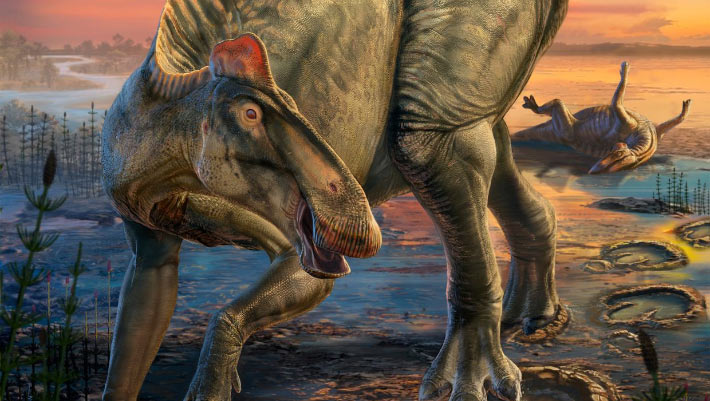
Tyrannosaurus rex Scavenged Duck-Billed Dinosaurs in Ancient Wyoming, Bite Marks Reveal
Des dinosaures à bec de canard récupérés par Tyrannosaurus rex dans l'ancien Wyoming et des marques de morsure révélées
os alimentation chasse États-Unis Crétacé Canardia Dinosauria Edmontosaurus Tyrannosaurus comportement
Des milliers d'os fossilisés provenant d'un gisement d'ossements du Crétacé dans le Wyoming, aux États-Unis, offrent des preuves physiques rares que le Tyrannosaurus rex s'est nourri des carcasses d'une espèce de dinosaure à bec de canard appelée Edmontosaurus annectens. L'article Tyrannosaurus rex a récupéré des dinosaures à bec de canard dans l'ancien Wyoming, les marques de morsure révèlent est apparu en premier sur Sci.News : Breaking Science News.
16/07/2026 sci-news ⚙ Traduction automatique
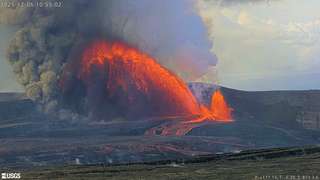
Des fontaines de lave géantes filmées en direct : ce volcan hawaïen en est déjà à 50 épisodes éruptifs en 18 mois !
États-Unis géologie volcanisme
Depuis le début de cette éruption, le 23 décembre 2024, l’activité est épisodique : des pauses de une à trois semaines séparent des phases d’activité soutenue de quelques heures à l’intérieur de la caldeira sommitale du volcan. Cinquante épisodes se sont ainsi succédé en une année et demie,...
30/06/2026 futura-terre
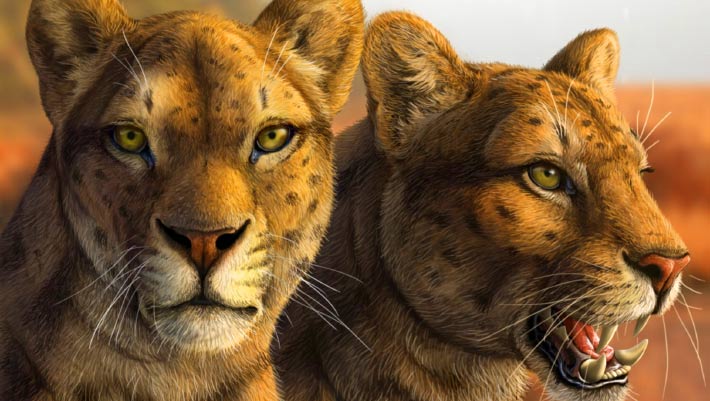
Early Saber-Toothed Cat Gets New Face after Decades of Mystery
Le premier chat à dents de sabre obtient un nouveau visage après des décennies de mystère
dent paléoart reconstitution États-Unis Pliocène mammifères crâne
Un crâne presque complet découvert il y a plusieurs décennies en Arizona a donné aux paléontologues leur aperçu le plus clair à ce jour d'Adelphailurus kansensis, une espèce énigmatique de félidés qui habitait l'Amérique du Nord il y a plus de 5 millions d'années et occupait une des premières branches de l'arbre généalogique des chats à dents de sabre. L'article Le premier chat à dents de sabre obtient un nouveau visage après des décennies de mystère est apparu en premier sur Sci.News : Breaking Science News.
29/06/2026 sci-news ⚙ Traduction automatique
1 2 3 4 5