←

États-Unis

Pays

67 image(s) · 21 Actualités

Galerie d'images

Banded fine-grained pyrite in shale from the Precambrian of Australia. (public display, Leadville Mining Museum, Leadville, Colorado, USA)
A mineral is a naturally-occurring, solid, inorganic, crystalline substance having a fairly definite chemical composition and having fairly definite physical properties.  At its simplest, a mineral is a naturally-occurring solid chemical.  Currently, there are over 4900 named and described minerals - about 200 of them are common and about 20 of them are very common.  Mineral classification is based on anion chemistry.  Major categories of minerals are: elements, sulfides, oxides, halides, carbonates, sulfates, phosphates, and silicates.
The sulfide minerals contain one or more sulfide anions (S-2).  The sulfides are usually considered together with the arsenide minerals, the sulfarsenide minerals, and the telluride minerals.  Many sulfides are economically significant, as they occur commonly in ores.  The metals that combine with S-2 are mainly Fe, Cu, Ni, Ag, etc.  Most sulfides have a metallic luster, are moderately soft, and are noticeably heavy for their size.  These minerals will not form in the presence of free oxygen.  Under an oxygen-rich atmosphere, sulfide minerals tend to chemically weather to various oxide and hydroxide minerals.
Pyrite is a common iron sulfide mineral (FeS2).  It’s nickname is “fool's gold”.  Pyrite has a metallic luster, brassy gold color (in contrast to the deep rich yellow gold color of true gold - www.flickr.com/photos/jsjgeology/sets/72157651325153769/), dark gray to black streak, is hard (H=6 to 6.5), has no cleavage, and is moderately heavy for its size.  It often forms cubic crystals or pyritohedrons (crystals having pentagonal faces).
Pyrite is common in many hydrothermal veins, shales, coals, various metamorphic rocks, and massive sulfide deposits.
The rock shown above consists of numerous bands of fine-grained pyrite interbedded with dark shale.  Published research has shown that the pyrite is diagenetic, formed by sulfate reduction from sulfate-bearing groundwater that moved along bedding planes of the Urquhart Shale host rocks (see Painter et al., 1999).  The sulfate source was evaporitic gypsum-anhydrite-barite in the same stratigraphic unit.
Stratigraphy: Urquhart Shale, Mount Isa Group, Mesoproterozoic, ~1655 Ma
Age of metamorphism: peak greenschist-facies metamorphism at ~1505 Ma during the Isan Orogeny
Locality: Mount Isa Mines, northwestern Queensland, northeastern Australia


Some info. from:
Kawasaki & Symons (2010) - Dating of Mesoproterozoic metamorphism in the Mount Isa and George Fisher Zn-Pb-Cu-Ag deposits, Australia, by paleomagnetism.  American Geophysical Union, Fall Meeting 2010, Abstract GP33C-0953.
Painter et al. (1999) - Sedimentologic, petrographic, and sulfur isotope constraints on fine-grained pyrite formation at Mount Isa Mine and environs, northwest Queensland, Australia.  Economic Geology 94: 883-912.


Photo gallery of pyrite:

www.mindat.org/gallery.php?min=3314
Intervalles Mesoproterozoic

Banded fine-grained pyrite in shale from the Precambrian of Australia. (public display, Leadville Mining Museum, Leadville, Colorado, USA) A mineral is a naturally-occurring, solid, inorganic, crystalline substance having a fairly definite chemical composition and having fairly definite physical properties. At its simplest, a mineral is a naturally-occurring solid chemical. Currently, there are over 4900 named and described minerals - about 200 of them are common and about 20 of them are very common. Mineral classification is based on anion chemistry. Major categories of minerals are: elements, sulfides, oxides, halides, carbonates, sulfates, phosphates, and silicates. The sulfide minerals contain one or more sulfide anions (S-2). The sulfides are usually considered together with the arsenide minerals, the sulfarsenide minerals, and the telluride minerals. Many sulfides are economically significant, as they occur commonly in ores. The metals that combine with S-2 are mainly Fe, Cu, Ni, Ag, etc. Most sulfides have a metallic luster, are moderately soft, and are noticeably heavy for their size. These minerals will not form in the presence of free oxygen. Under an oxygen-rich atmosphere, sulfide minerals tend to chemically weather to various oxide and hydroxide minerals. Pyrite is a common iron sulfide mineral (FeS2). It’s nickname is “fool's gold”. Pyrite has a metallic luster, brassy gold color (in contrast to the deep rich yellow gold color of true gold - www.flickr.com/photos/jsjgeology/sets/72157651325153769/), dark gray to black streak, is hard (H=6 to 6.5), has no cleavage, and is moderately heavy for its size. It often forms cubic crystals or pyritohedrons (crystals having pentagonal faces). Pyrite is common in many hydrothermal veins, shales, coals, various metamorphic rocks, and massive sulfide deposits. The rock shown above consists of numerous bands of fine-grained pyrite interbedded with dark shale. Published research has shown that the pyrite is diagenetic, formed by sulfate reduction from sulfate-bearing groundwater that moved along bedding planes of the Urquhart Shale host rocks (see Painter et al., 1999). The sulfate source was evaporitic gypsum-anhydrite-barite in the same stratigraphic unit. Stratigraphy: Urquhart Shale, Mount Isa Group, Mesoproterozoic, ~1655 Ma Age of metamorphism: peak greenschist-facies metamorphism at ~1505 Ma during the Isan Orogeny Locality: Mount Isa Mines, northwestern Queensland, northeastern Australia Some info. from: Kawasaki & Symons (2010) - Dating of Mesoproterozoic metamorphism in the Mount Isa and George Fisher Zn-Pb-Cu-Ag deposits, Australia, by paleomagnetism. American Geophysical Union, Fall Meeting 2010, Abstract GP33C-0953. Painter et al. (1999) - Sedimentologic, petrographic, and sulfur isotope constraints on fine-grained pyrite formation at Mount Isa Mine and environs, northwest Queensland, Australia. Economic Geology 94: 883-912. Photo gallery of pyrite: www.mindat.org/gallery.php?min=3314

musée Australie États-Unis Mésoprotérozoïque +5
Banded iron formation from the Precambrian of Wyoming, USA. (~10.9 cm across at its widest)
Banded iron formations, or BIFs, are unusual, dense sedimentary rocks consisting of alternating layers of iron-rich oxides and iron-rich silicates.  Most BIFs are Proterozoic in age (although some are Late Archean), and do not form today - they're “extinct”!  Many specific varieties of iron formation are known, and some are given special rock names.  For example, jaspilite is an attractive reddish & silvery gray banded rock consisting of hematite, red chert (“jasper”), and specular hematite or magnetite.
Because of their age, most BIFs have been around long enough to have been subjected to one or more orogenic (mountain-building) events.  As such, most BIFs are folded and/or metamorphosed to varying degrees. 
BIFs are known from around the world, but some of the most famous & extensive BIF deposits are found in the vicinity of North America’s Lake Superior Basin.  Many BIFs have economic concentrations of iron and are mined.  BIFs are the most important variety of iron ore on Earth.
Some iron mines in west-central Wyoming exploit BIFs in the Goldman Meadows Formation, a Mesoarchean unit exposed in the Wind River Range.  These rocks have been multiply metamorphosed during the Precambrian.  The result of this metamorphism is highly contorted folding and fracturing.  The rock shown above is a folded quartz-hematite-limonite meta-BIF.
Stratigraphy: iron formation member (probably the upper iron formation member) of the Goldman Meadows Formation, upper Mesoarchean, 2.87 Ga (metamorphosed in the Archean at 2.8 Ga and in the Mesoproterozoic at 1.4 Ga)
Geologic context: northwestern flank of the South Pass Greenstone Belt, southern Wind River Range

Locality: Atlantic City Iron Mine (open-pit mine; sample possibly collected from tailings piles around the now-flooded pit) (E1/2 of section 26, T30N, R100W, Miners Delight 7.5' USGS topographic quadrangle), South Pass-Atlantic City Mining District, along Rt. 28, southwestern side of South Pass, north of Atlantic City, southwestern Fremont County, west-central Wyoming, USA (mine is at 42° 32' 45" North latitude, 108° 44' 33" West longitude)
Intervalles Mesoarchean

Banded iron formation from the Precambrian of Wyoming, USA. (~10.9 cm across at its widest) Banded iron formations, or BIFs, are unusual, dense sedimentary rocks consisting of alternating layers of iron-rich oxides and iron-rich silicates. Most BIFs are Proterozoic in age (although some are Late Archean), and do not form today - they're “extinct”! Many specific varieties of iron formation are known, and some are given special rock names. For example, jaspilite is an attractive reddish & silvery gray banded rock consisting of hematite, red chert (“jasper”), and specular hematite or magnetite. Because of their age, most BIFs have been around long enough to have been subjected to one or more orogenic (mountain-building) events. As such, most BIFs are folded and/or metamorphosed to varying degrees. BIFs are known from around the world, but some of the most famous & extensive BIF deposits are found in the vicinity of North America’s Lake Superior Basin. Many BIFs have economic concentrations of iron and are mined. BIFs are the most important variety of iron ore on Earth. Some iron mines in west-central Wyoming exploit BIFs in the Goldman Meadows Formation, a Mesoarchean unit exposed in the Wind River Range. These rocks have been multiply metamorphosed during the Precambrian. The result of this metamorphism is highly contorted folding and fracturing. The rock shown above is a folded quartz-hematite-limonite meta-BIF. Stratigraphy: iron formation member (probably the upper iron formation member) of the Goldman Meadows Formation, upper Mesoarchean, 2.87 Ga (metamorphosed in the Archean at 2.8 Ga and in the Mesoproterozoic at 1.4 Ga) Geologic context: northwestern flank of the South Pass Greenstone Belt, southern Wind River Range Locality: Atlantic City Iron Mine (open-pit mine; sample possibly collected from tailings piles around the now-flooded pit) (E1/2 of section 26, T30N, R100W, Miners Delight 7.5' USGS topographic quadrangle), South Pass-Atlantic City Mining District, along Rt. 28, southwestern side of South Pass, north of Atlantic City, southwestern Fremont County, west-central Wyoming, USA (mine is at 42° 32' 45" North latitude, 108° 44' 33" West longitude)

États-Unis Archéen Mésoarchéen Mésoprotérozoïque +3
Khaan fossil holotype IGM 100/1127.
Taxons Khaan

Khaan fossil holotype IGM 100/1127.

États-Unis fossile holotype Khaan
Falcarius skeleton reconstruction, Utah Museum of Natural History.
Taxons Falcarius

Falcarius skeleton reconstruction, Utah Museum of Natural History.

musée États-Unis Falcarius squelette
Achelousaurus horneri skull, collected in Glacier County, Montana, at the Museum of the Rockies in Bozeman, Montana.
The Ceratopsidae are those dinosaurs with head frills.  There are three large subgroups of Ceratopsidae: Centrosaurinae, Ceratopsinae, and Chasmosaurinae. The Triceratopsini are a "tribe" of the Chasmosaurinae -- a genus so vast that it gets the special name "tribe".  The Pachyrhinosaurini are a "tribe" within the Centrosaurinae.

Achelousaurus is a genus within the Pachyrhinosaurini.  So far, only three skulls and some limited skeletal remains have been collected anywhere in the world -- and all of them in Montana.  Their bony frills are quite similar to the Styracosaurus albertensis, although their other skull features (such as big bony bosses on the nose and behind the eyes) are not.
Taxons Achelousaurus

Achelousaurus horneri skull, collected in Glacier County, Montana, at the Museum of the Rockies in Bozeman, Montana. The Ceratopsidae are those dinosaurs with head frills. There are three large subgroups of Ceratopsidae: Centrosaurinae, Ceratopsinae, and Chasmosaurinae. The Triceratopsini are a "tribe" of the Chasmosaurinae -- a genus so vast that it gets the special name "tribe". The Pachyrhinosaurini are a "tribe" within the Centrosaurinae. Achelousaurus is a genus within the Pachyrhinosaurini. So far, only three skulls and some limited skeletal remains have been collected anywhere in the world -- and all of them in Montana. Their bony frills are quite similar to the Styracosaurus albertensis, although their other skull features (such as big bony bosses on the nose and behind the eyes) are not.

musée États-Unis Achelousaurus Centrosaurinae +8
Anhanguerid pterosaur Uktenadactylus wadleighi (Lee, 1994), SMU 73058, Tarrant County, Texas, USA, Albian. In anterior (A1), leftlateral (A2), palatal (A3) and right lateral (A4), and dorsal (A5) views. Photographs by BH
Taxons Uktenadactylus

Anhanguerid pterosaur Uktenadactylus wadleighi (Lee, 1994), SMU 73058, Tarrant County, Texas, USA, Albian. In anterior (A1), leftlateral (A2), palatal (A3) and right lateral (A4), and dorsal (A5) views. Photographs by BH

États-Unis Albien Anhangueridae Pterosauria +1
Cast of a Scaphognathus crassirostris, a kind of pterosaur. On display as part of the exhibit "Pterosaurs: Flight in the Age of Dinosaurs" at the Cleveland Natural History Museum in Cleveland, Ohio, in the United States.
This animal lived about 150 million years ago. This fossil was found in the Solnhofen formation in Germany. This is a cast; the fossil itself is held by the Institute of Geology and Paleontology at the University of Bonn.
Taxons Scaphognathus

Cast of a Scaphognathus crassirostris, a kind of pterosaur. On display as part of the exhibit "Pterosaurs: Flight in the Age of Dinosaurs" at the Cleveland Natural History Museum in Cleveland, Ohio, in the United States. This animal lived about 150 million years ago. This fossil was found in the Solnhofen formation in Germany. This is a cast; the fossil itself is held by the Institute of Geology and Paleontology at the University of Bonn.

vol musée Allemagne États-Unis +7
Chert & phosphorite in the Permian of Wyoming, USA.
The Permian-aged Phosphoria Formation has a significant component of phosphorite, a scarce, phosphate-rich sedimentary rock.  This material is mined in southern Idaho as a source of phosphorus for the fertilizer industry, the fireworks industry, and other uses.
Phosphorites are generally considered to have >15-20% phosphate content.  Texturally, phosphorites can be obviously granular, with fossil fragments or oolites or peloids or lithic fragments, or they can be composed of extremely fine-grained, phosphate-rich mud.  Compositionally, the phosphate component in phosphorites is principally a mix of apatite minerals: chlorapatite (Ca5(PO4)3Cl), fluorapatite (Ca5(PO4)3F), hydroxyapatite (Ca5(PO4)3OH)), and carbonate fluorapatite (Ca10(PO4,CO3)6F2-3).
Phosphorites are generally marine sedimentary rocks.  They range in age from Precambrian to Holocene.  In modern oceans, they tend to occur along the eastern margins of some ocean basins where deep-water upwelling occurs under areas of high biologic productivity.
Stratigraphy: Rex Chert Member over Meade Peak Member, Phosphoria Formation, Roadian Stage to Wordian Stage, lower Guadalupian Series, mid-Permian

Locality: roadcut on the northern side of Route 26/Route 89 at the town of Astoria Hot Springs, Snake River Canyon, southern Teton County, northwestern Wyoming, USA

Chert & phosphorite in the Permian of Wyoming, USA. The Permian-aged Phosphoria Formation has a significant component of phosphorite, a scarce, phosphate-rich sedimentary rock. This material is mined in southern Idaho as a source of phosphorus for the fertilizer industry, the fireworks industry, and other uses. Phosphorites are generally considered to have >15-20% phosphate content. Texturally, phosphorites can be obviously granular, with fossil fragments or oolites or peloids or lithic fragments, or they can be composed of extremely fine-grained, phosphate-rich mud. Compositionally, the phosphate component in phosphorites is principally a mix of apatite minerals: chlorapatite (Ca5(PO4)3Cl), fluorapatite (Ca5(PO4)3F), hydroxyapatite (Ca5(PO4)3OH)), and carbonate fluorapatite (Ca10(PO4,CO3)6F2-3). Phosphorites are generally marine sedimentary rocks. They range in age from Precambrian to Holocene. In modern oceans, they tend to occur along the eastern margins of some ocean basins where deep-water upwelling occurs under areas of high biologic productivity. Stratigraphy: Rex Chert Member over Meade Peak Member, Phosphoria Formation, Roadian Stage to Wordian Stage, lower Guadalupian Series, mid-Permian Locality: roadcut on the northern side of Route 26/Route 89 at the town of Astoria Hot Springs, Snake River Canyon, southern Teton County, northwestern Wyoming, USA

États-Unis Guadalupien Holocène Permien +5
Life restoration of the large, Middle Triassic Nevadan ichthyosaur Cymbopsondylus petrinus. This illustration is primarily based on specimen UCMP 9950, with much of the tail restored following UCMP 9947. The size of the eye was reconstructed based on UCMP 9954 and UCMP 9913. The unknown distal portions of the flippers, as well as some of the tail, was reconstructed after the related genus Xinminosaurus.
References
Merriam, J. C. (1908)       Triassic Ichthyosauria: With special reference to the American forms, Berkley, California:  Berkley: The University Press  
Klein, N.; Schmitz, L.; Wintrich, T.; Sander, P. M. (2020). "A new cymbospondylid ichthyosaur (Ichthyosauria) from the Middle Triassic (Anisian) of the Augusta Mountains, Nevada, USA". Journal of Systematic Palaeontology 18 (14): 1167-1191. DOI:10.1080/14772019.2020.1748132.
Jiang, D.; Motani, R.; Hao, W.; Schmitz, L.; Rieppel, O.; Sun, Y.; Sun, Z. (2008). "New primitive ichthyosaurian (Reptilia, Diapsida) from the Middle Triassic of Panxian, Guizhou, southwestern China and its position in the Triassic biotic recovery". Progress in Natural Science 18 (10): 1315. DOI:10.1016/j.pnsc.2008.01.039.

Life restoration of the large, Middle Triassic Nevadan ichthyosaur Cymbopsondylus petrinus. This illustration is primarily based on specimen UCMP 9950, with much of the tail restored following UCMP 9947. The size of the eye was reconstructed based on UCMP 9954 and UCMP 9913. The unknown distal portions of the flippers, as well as some of the tail, was reconstructed after the related genus Xinminosaurus. References Merriam, J. C. (1908) Triassic Ichthyosauria: With special reference to the American forms, Berkley, California: Berkley: The University Press Klein, N.; Schmitz, L.; Wintrich, T.; Sander, P. M. (2020). "A new cymbospondylid ichthyosaur (Ichthyosauria) from the Middle Triassic (Anisian) of the Augusta Mountains, Nevada, USA". Journal of Systematic Palaeontology 18 (14): 1167-1191. DOI:10.1080/14772019.2020.1748132. Jiang, D.; Motani, R.; Hao, W.; Schmitz, L.; Rieppel, O.; Sun, Y.; Sun, Z. (2008). "New primitive ichthyosaurian (Reptilia, Diapsida) from the Middle Triassic of Panxian, Guizhou, southwestern China and its position in the Triassic biotic recovery". Progress in Natural Science 18 (10): 1315. DOI:10.1016/j.pnsc.2008.01.039.

Chine États-Unis Anisien Trias moyen +5
Close up of the Eulithomyrmex rugosus holotype head.  Museum of Comparative Zoology  specimen UCM17019.
Priabonian; Florissant Formation, Colorado, USA

Close up of the Eulithomyrmex rugosus holotype head. Museum of Comparative Zoology specimen UCM17019. Priabonian; Florissant Formation, Colorado, USA

musée États-Unis Priabonien holotype +2
Outcrops of the Late Cretaceous (Campanian) aged Aguja Formation, Big Bend National Park, Texas, USA
Formations Aguja

Outcrops of the Late Cretaceous (Campanian) aged Aguja Formation, Big Bend National Park, Texas, USA

États-Unis Aguja Campanien Crétacé +2
Ceratosaurus skeleton mount, Wisconsin

Ceratosaurus skeleton mount, Wisconsin

États-Unis Averostra Ceratosauria squelette
Ceratosaurus skeleton mount, Wisconsin

Ceratosaurus skeleton mount, Wisconsin

États-Unis Averostra Ceratosauria squelette
The Tyrannosaurus rex, Dromaeosaurus, Triceratops, and Struthiomimus diorama in the Third Planet exhibit at the Milwaukee Public Museum in Milwaukee, Wisconsin (United States).

The Tyrannosaurus rex, Dromaeosaurus, Triceratops, and Struthiomimus diorama in the Third Planet exhibit at the Milwaukee Public Museum in Milwaukee, Wisconsin (United States).

musée États-Unis Dromaeosauria Struthiomimus +2
The Tyrannosaurus rex, Dromaeosaurus, Triceratops, and Struthiomimus diorama in the Third Planet exhibit at the Milwaukee Public Museum in Milwaukee, Wisconsin (United States).

The Tyrannosaurus rex, Dromaeosaurus, Triceratops, and Struthiomimus diorama in the Third Planet exhibit at the Milwaukee Public Museum in Milwaukee, Wisconsin (United States).

musée États-Unis Dromaeosauria Struthiomimus +2
The Tyrannosaurus rex, Dromaeosaurus, Triceratops, and Struthiomimus diorama in the Third Planet exhibit at the Milwaukee Public Museum in Milwaukee, Wisconsin (United States).

The Tyrannosaurus rex, Dromaeosaurus, Triceratops, and Struthiomimus diorama in the Third Planet exhibit at the Milwaukee Public Museum in Milwaukee, Wisconsin (United States).

musée États-Unis Dromaeosauria Struthiomimus +2
1 2 3 4 5

Actualités

Modèles de dinosaures expédiés aux États-Unis – fiables, rapides et faciles
Royaume-Uni États-Unis Dinosauria
Everything Dinosaur continue d'envoyer des modèles de dinosaures aux États-Unis, approvisionnant ainsi les collectionneurs de toute l'Amérique. En effet, les États-Unis restent un marché important pour l’entreprise basée au Royaume-Uni. Chaque jour, des colis entament leur voyage à travers l'Atlantique. Mike et Sue travaillent dur pour s'assurer que les commandes sont soigneusement emballées et expédiées rapidement. Les clients américains peuvent choisir parmi
04/09/2026 everythingdinosaur ⚙ Traduction automatique
Arundelconodon: Beast of the Week
Arundelconodon : Bête de la semaine
États-Unis Crétacé Crétacé inférieur Dinosauria mammifères
 Cette semaine, nous allons nous pencher sur un mammifère unique qui vivait aux côtés de certains des plus grands dinosaures !  Découvrez Arundelconodon hottoni.  Arundelconodon était un petit mammifère qui vivait dans ce qui est aujourd'hui le Maryland, aux États-Unis, au début du Crétacé, il y a environ 115 millions d'années, ce qui en fait l'un des plus anciens mammifères connus de la côte est des États-Unis.  On estime qu’il mesurait environ 20 à 25 cm de long du nez à la queue, soit à peu près la même taille qu’un rat.  Basé
31/08/2026 prehistoricbeastoftheweek ⚙ Traduction automatique
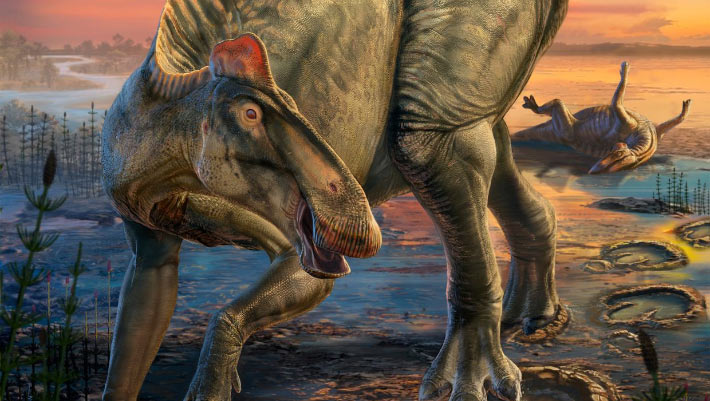
Tyrannosaurus rex Scavenged Duck-Billed Dinosaurs in Ancient Wyoming, Bite Marks Reveal
Des dinosaures à bec de canard récupérés par Tyrannosaurus rex dans l'ancien Wyoming et des marques de morsure révélées
os alimentation chasse États-Unis Crétacé Canardia Dinosauria Edmontosaurus Tyrannosaurus comportement
Des milliers d'os fossilisés provenant d'un gisement d'ossements du Crétacé dans le Wyoming, aux États-Unis, offrent des preuves physiques rares que le Tyrannosaurus rex s'est nourri des carcasses d'une espèce de dinosaure à bec de canard appelée Edmontosaurus annectens. L'article Tyrannosaurus rex a récupéré des dinosaures à bec de canard dans l'ancien Wyoming, les marques de morsure révèlent est apparu en premier sur Sci.News : Breaking Science News.
16/07/2026 sci-news ⚙ Traduction automatique
Des fontaines de lave géantes filmées en direct : ce volcan hawaïen en est déjà à 50 épisodes éruptifs en 18 mois !
États-Unis géologie volcanisme
Depuis le début de cette éruption, le 23 décembre 2024, l’activité est épisodique : des pauses de une à trois semaines séparent des phases d’activité soutenue de quelques heures à l’intérieur de la caldeira sommitale du volcan. Cinquante épisodes se sont ainsi succédé en une année et demie,...
30/06/2026 futura-terre
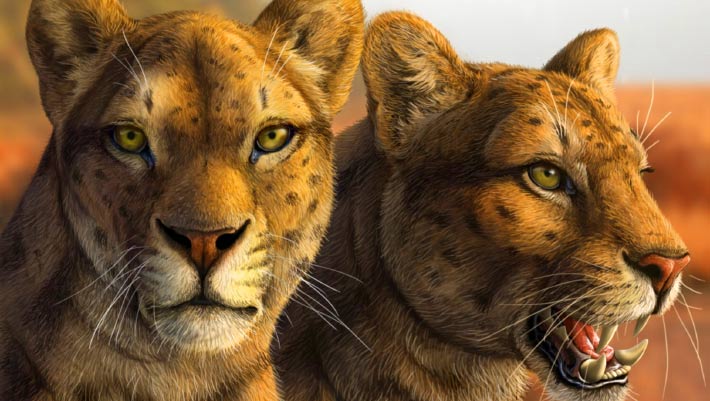
Early Saber-Toothed Cat Gets New Face after Decades of Mystery
Le premier chat à dents de sabre obtient un nouveau visage après des décennies de mystère
dent paléoart reconstitution États-Unis Pliocène mammifères crâne
Un crâne presque complet découvert il y a plusieurs décennies en Arizona a donné aux paléontologues leur aperçu le plus clair à ce jour d'Adelphailurus kansensis, une espèce énigmatique de félidés qui habitait l'Amérique du Nord il y a plus de 5 millions d'années et occupait une des premières branches de l'arbre généalogique des chats à dents de sabre. L'article Le premier chat à dents de sabre obtient un nouveau visage après des décennies de mystère est apparu en premier sur Sci.News : Breaking Science News.
29/06/2026 sci-news ⚙ Traduction automatique
1 2 3 4 5