Espagne

Pays

10 image(s) · 1 Actualités

Galerie d'images

Ceratosaurian theropod Camarillasaurus cirugedae gen. et sp. nov. from the Camarillas Formation of Camarillas, Soria Province, Spain, presacral vertebra, MPG-KPC9,  in anterior (A), left lateral (B), and posterior (C) views; possible neural spine tips, MPG1116, 32, 33 in ?posterior (D) and transverse (E) views; and presacral rib MPG-KPC7, in ventral view (F) and detail of its proximal end (G). Scale bars are 10 mm (A-C, G), 20 mm (D-E) and 100 mm (F).
Taxons Camarillasaurus

Ceratosaurian theropod Camarillasaurus cirugedae gen. et sp. nov. from the Camarillas Formation of Camarillas, Soria Province, Spain, presacral vertebra, MPG-KPC9, in anterior (A), left lateral (B), and posterior (C) views; possible neural spine tips, MPG1116, 32, 33 in ?posterior (D) and transverse (E) views; and presacral rib MPG-KPC7, in ventral view (F) and detail of its proximal end (G). Scale bars are 10 mm (A-C, G), 20 mm (D-E) and 100 mm (F).

écaille vertèbre Espagne Camarillas +3
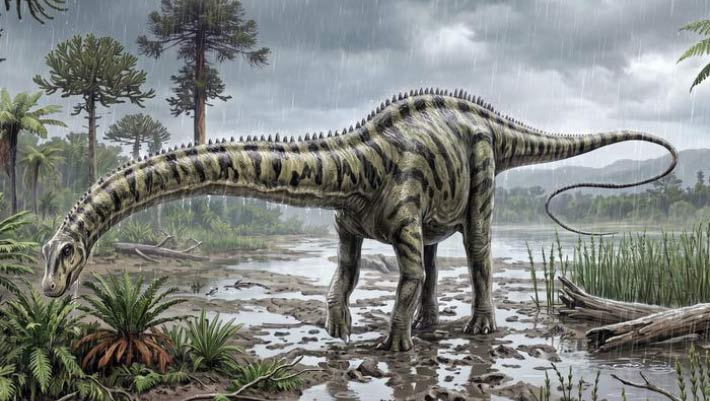
Garumbatitan is a sauropod dinosaur from the Early Cretaceous of what is now Spain. It is classified as a basal somphospondylan - a Titanosauriform, but not a true Titanosaur.
Taxons Garumbatitan

Garumbatitan is a sauropod dinosaur from the Early Cretaceous of what is now Spain. It is classified as a basal somphospondylan - a Titanosauriform, but not a true Titanosaur.

Espagne Crétacé Crétacé inférieur Dinosauria +4
Qunkasaura is a titanosaurian sauropod dinosaur that lived approximately 75 million years ago in the Late Cretaceous of what is now Spain. Specifically, it is a saltasaurid titanosaur, and its discovery marks the first instance of two distinct lineages of this group present in the same locality. In the Late Cretaceous, Europe was a large archipelago, and the coexistence of these differing lineages indicates that saltasaurids arrived in the Iberian Peninsula much later than other groups of dinosaurs.
Taxons Qunkasaura

Qunkasaura is a titanosaurian sauropod dinosaur that lived approximately 75 million years ago in the Late Cretaceous of what is now Spain. Specifically, it is a saltasaurid titanosaur, and its discovery marks the first instance of two distinct lineages of this group present in the same locality. In the Late Cretaceous, Europe was a large archipelago, and the coexistence of these differing lineages indicates that saltasaurids arrived in the Iberian Peninsula much later than other groups of dinosaurs.

Espagne Crétacé Crétacé supérieur Dinosauria +4
Detail of the stratigraphic section of the El Castellar dinosaur footprints site, Teruel, Spain.

Detail of the stratigraphic section of the El Castellar dinosaur footprints site, Teruel, Spain.

Espagne El Castellar Dinosauria
Dryolestidan mammal Crusafontia amoae sp. nov., MPZ CC2−1 M4 or M5, holotype, from the site of Cuesta Corrales 2, Colladico Blanco level, El Castellar Formation, Galve, Teruel, Spain in, occlusal (A), mesial (B), labial (C), distal (D), and lingual (E) views. The schematic drawing of C. amoae, in the box in the lower left−hand corner shows the main anatomical elements of the occlusal surface of a dryolestidan.
Formations El Castellar

Dryolestidan mammal Crusafontia amoae sp. nov., MPZ CC2−1 M4 or M5, holotype, from the site of Cuesta Corrales 2, Colladico Blanco level, El Castellar Formation, Galve, Teruel, Spain in, occlusal (A), mesial (B), labial (C), distal (D), and lingual (E) views. The schematic drawing of C. amoae, in the box in the lower left−hand corner shows the main anatomical elements of the occlusal surface of a dryolestidan.

dessin Espagne El Castellar holotype +1
Paleogeography and paleoclimate of the Late Jurassic - 150 Ma with dinosaur fossil localities:
A = Tendaguru Formation, Tanzania
C1 =  Shishugou & Kalazha Formations, China
C2 =  Shangshaximiao (Upper Shaximiao) Formation, China
E1 =  Sables de Glos, Argiles d’Octeville, Marnes de Bléville, Kimmeridge Clay, Calcareous Grit, Corallian Oolite, Oxford Clay, Portland Stone, England & France
E2 = Villar del Arzobispo, Alcobaça, Guimarota, Sobral, Amoreira-Porto Novo, Bombarral, Freixial, Lourinhã Formations, Spain & Portugal
M1-6 = Morrison Formation, United States
S1 =  Toquí & Cañadón Calcáreo Formations, Chile & Argentina

Paleogeography and paleoclimate of the Late Jurassic - 150 Ma with dinosaur fossil localities: A = Tendaguru Formation, Tanzania C1 = Shishugou & Kalazha Formations, China C2 = Shangshaximiao (Upper Shaximiao) Formation, China E1 = Sables de Glos, Argiles d’Octeville, Marnes de Bléville, Kimmeridge Clay, Calcareous Grit, Corallian Oolite, Oxford Clay, Portland Stone, England & France E2 = Villar del Arzobispo, Alcobaça, Guimarota, Sobral, Amoreira-Porto Novo, Bombarral, Freixial, Lourinhã Formations, Spain & Portugal M1-6 = Morrison Formation, United States S1 = Toquí & Cañadón Calcáreo Formations, Chile & Argentina

Argentine Chili Chine France +19
The geological park of Aliaga (Teruel, Spain) is one of the most interesting geological zones of Aragon, a viewpoint of the last 200 million years of Earth's history.
Formations Camarillas

The geological park of Aliaga (Teruel, Spain) is one of the most interesting geological zones of Aragon, a viewpoint of the last 200 million years of Earth's history.

Espagne
Stratigraphy, Tremp Formation in Spain.
Formations La Posa

Stratigraphy, Tremp Formation in Spain.

Espagne formation stratigraphie
Stratigraphy, Tremp Formation in Spain.
Formations Conques

Stratigraphy, Tremp Formation in Spain.

Espagne formation stratigraphie
Drawings of Dryolestida left upper−molar, modified from the original descriptions. A–C, Kimmeridgian; D–F, Tithonian–Berriasian; G–H, early Barremian; I, late Barremian. A. Left M4 or M5 of Comotherium richi Prothero, 1981, from the Upper Jurassic Morrison Formation, Como Bluff locality, Wyoming, USA. B. Right M5, reversed, of Dryolestes leiriensis Martin, 1999, from Guimarota, Portugal.C. Left M6 of Krebsotherium lusitanicum Martin, 1999, from Guimarota, Portugal. D. Right M4 or M 6 (reversed) of Portopinheirodon asymmetricus Martin, 1999, Porto Pinheiro, Lourinha, Portugal. E. Right M5 (reversed) of Laolestes andresi Martin, 1999, from Porto Pinheiro, Lourinha, Portugal. F. Right upper molar of Donodon perscriptoris Sigogneau−Russell, 1991, Anoual, Morocco.G. Left M4 orM5 of Crusafontia amoae sp. nov., holotype, Cuesta Corrales 2, El Castellar Formation, Galve, Teruel, Spain. H. Right M6 orM7 (reversed) of Crusafontia amoae sp. nov., first described as upper molar of Crusafontia cuencana by Krebs (1993), P−2 H4 Pelejón 2, Galve, Teruel, Spain. I. Left M2 or M3, of Crusafontia cuencana Henkel and Krebs, 1969, Uña, La Huérguina Formation, Cuenca, Spain, (from Krebs 1993). Scale bars 1 mm.

Drawings of Dryolestida left upper−molar, modified from the original descriptions. A–C, Kimmeridgian; D–F, Tithonian–Berriasian; G–H, early Barremian; I, late Barremian. A. Left M4 or M5 of Comotherium richi Prothero, 1981, from the Upper Jurassic Morrison Formation, Como Bluff locality, Wyoming, USA. B. Right M5, reversed, of Dryolestes leiriensis Martin, 1999, from Guimarota, Portugal.C. Left M6 of Krebsotherium lusitanicum Martin, 1999, from Guimarota, Portugal. D. Right M4 or M 6 (reversed) of Portopinheirodon asymmetricus Martin, 1999, Porto Pinheiro, Lourinha, Portugal. E. Right M5 (reversed) of Laolestes andresi Martin, 1999, from Porto Pinheiro, Lourinha, Portugal. F. Right upper molar of Donodon perscriptoris Sigogneau−Russell, 1991, Anoual, Morocco.G. Left M4 orM5 of Crusafontia amoae sp. nov., holotype, Cuesta Corrales 2, El Castellar Formation, Galve, Teruel, Spain. H. Right M6 orM7 (reversed) of Crusafontia amoae sp. nov., first described as upper molar of Crusafontia cuencana by Krebs (1993), P−2 H4 Pelejón 2, Galve, Teruel, Spain. I. Left M2 or M3, of Crusafontia cuencana Henkel and Krebs, 1969, Uña, La Huérguina Formation, Cuenca, Spain, (from Krebs 1993). Scale bars 1 mm.

description dessin Maroc Portugal +11
The titanosaurian sauropod Lirainosaurus astibiae Sanz, Powell, Le Loeuff, Martínez, and Pereda Suberbiola, 1999 from the Late Cretaceous of Laño (northern Spain), paratypic braincase (MCNA 7439). Right lateral, left lateral, posterior, and anterior views.
Taxons Lirainosaurus

The titanosaurian sauropod Lirainosaurus astibiae Sanz, Powell, Le Loeuff, Martínez, and Pereda Suberbiola, 1999 from the Late Cretaceous of Laño (northern Spain), paratypic braincase (MCNA 7439). Right lateral, left lateral, posterior, and anterior views.

Espagne Crétacé Crétacé supérieur Lirainosaurus +1

Actualités

Des mines de l’âge du bronze découvertes en Espagne pourraient expliquer le mystère du métal scandinave
Espagne découverte
Les archéologues ont découvert six mines de l'âge du bronze jusqu'alors inconnues dans le sud-ouest de l'Espagne, offrant un nouvel indice frappant sur l'origine possible du métal présent dans les anciens artefacts scandinaves. Situés près de Cabeza del Buey, les sites comprennent de tout, des petites zones d'extraction aux plus grandes opérations minières, l'une d'elles contenant même environ 80 haches de pierre utilisées pour broyer le minerai. Ces mines contiennent du cuivre, du plomb et de l’argent, des matériaux clés qui alimentaient les réseaux commerciaux il y a des milliers d’années.
29/04/2026 sciencedaily-fossils ⚙ Traduction automatique