spécimen

Nature du spécimen

177 image(s) · 15 Actualités

Galerie d'images

The Chicago specimen of Archaeopteryx (PA 830), a well-preserved fossil highlighting the transitional features between non-avian dinosaurs and birds, housed at the Field Museum of Natural History.

The Chicago specimen of Archaeopteryx (PA 830), a well-preserved fossil highlighting the transitional features between non-avian dinosaurs and birds, housed at the Field Museum of Natural History.

musée fossile spécimen Archaeopteryx +2
A photograph of partial specimen American Museum of Natural History (AMNH) 22555, skull without mandible, of Anhanguera sp. (formerly often assigned to Anhanguera santanae),[1] from the Early Cretaceous Romualdo Formation (former Romualdo Member of the Santana Formation) of NE Brazil in right lateral view.

A photograph of partial specimen American Museum of Natural History (AMNH) 22555, skull without mandible, of Anhanguera sp. (formerly often assigned to Anhanguera santanae),[1] from the Early Cretaceous Romualdo Formation (former Romualdo Member of the Santana Formation) of NE Brazil in right lateral view.

musée Brésil Conway Romualdo +7
A photograph of partial specimen American Museum of Natural History (AMNH) 22555, anterior dorsal vertebrae, dorsal ribs and partial shoulder girdle (at least right scapula) of Anhanguera sp. (formerly often assigned to Anhanguera santanae),[1] from the Early Cretaceous Romualdo Formation (former Romualdo Member of the Santana Formation) of NE Brazil in dorsal view.

A photograph of partial specimen American Museum of Natural History (AMNH) 22555, anterior dorsal vertebrae, dorsal ribs and partial shoulder girdle (at least right scapula) of Anhanguera sp. (formerly often assigned to Anhanguera santanae),[1] from the Early Cretaceous Romualdo Formation (former Romualdo Member of the Santana Formation) of NE Brazil in dorsal view.

musée Brésil Conway Romualdo +6
A photograph of partial specimen American Museum of Natural History (AMNH) 22555, posterior dorsal vertebrae, and the sacrum and pelvis (both iliae, and right ischium and pubis) of Anhanguera sp. (formerly often assigned to Anhanguera santanae),[1] from the Early Cretaceous Romualdo Formation (former Romualdo Member of the Santana Formation) of NE Brazil in dorsal view.
Taxons Anhanguera

A photograph of partial specimen American Museum of Natural History (AMNH) 22555, posterior dorsal vertebrae, and the sacrum and pelvis (both iliae, and right ischium and pubis) of Anhanguera sp. (formerly often assigned to Anhanguera santanae),[1] from the Early Cretaceous Romualdo Formation (former Romualdo Member of the Santana Formation) of NE Brazil in dorsal view.

bassin musée Brésil Conway +7
Close-up of the traumatic lesion observed in the right squamosal bone of Big John, a fossilized specimen of the dinosaur species Triceratops horridus. This image shows plaque-like deposition of reactive bone (white arrows) and lytic lesions (black arrows) on the surface around the lesion. These suggest that the lesion was surrounded by newly-formed bone and, therefore, had started to heal.
This image was originally published as Figure 1c in the following journal article:
Ruggero D’Anastasio, Jacopo Cilli, Flavio Bacchia, Federico Fanti, Giacomo Gobbo & Luigi Capasso (2022) Histological and chemical diagnosis of a combat lesion in Triceratops Scientific Reports, 12, 3941 (2022). DOI: 10.1038/s41598-022-08033-2
This article was published with the following license:
"This article is licensed under a Creative Commons Attribution 4.0 International License, which permits use, sharing, adaptation, distribution and reproduction in any medium or format, as long as you give appropriate credit to the original author(s) and the source, provide a link to the Creative Commons licence, and indicate if changes were made. The images or other third party material in this article are included in the article's Creative Commons licence, unless indicated otherwise in a credit line to the material. If material is not included in the article's Creative Commons licence and your intended use is not permitted by statutory regulation or exceeds the permitted use, you will need to obtain permission directly from the copyright holder. To view a copy of this licence, visit http://creativecommons.org/licenses/by/4.0/."

Figure 1c is published without a credit line and, therefore, falls under the article's CC BY 4.0 licence.

Close-up of the traumatic lesion observed in the right squamosal bone of Big John, a fossilized specimen of the dinosaur species Triceratops horridus. This image shows plaque-like deposition of reactive bone (white arrows) and lytic lesions (black arrows) on the surface around the lesion. These suggest that the lesion was surrounded by newly-formed bone and, therefore, had started to heal. This image was originally published as Figure 1c in the following journal article: Ruggero D’Anastasio, Jacopo Cilli, Flavio Bacchia, Federico Fanti, Giacomo Gobbo & Luigi Capasso (2022) Histological and chemical diagnosis of a combat lesion in Triceratops Scientific Reports, 12, 3941 (2022). DOI: 10.1038/s41598-022-08033-2 This article was published with the following license: "This article is licensed under a Creative Commons Attribution 4.0 International License, which permits use, sharing, adaptation, distribution and reproduction in any medium or format, as long as you give appropriate credit to the original author(s) and the source, provide a link to the Creative Commons licence, and indicate if changes were made. The images or other third party material in this article are included in the article's Creative Commons licence, unless indicated otherwise in a credit line to the material. If material is not included in the article's Creative Commons licence and your intended use is not permitted by statutory regulation or exceeds the permitted use, you will need to obtain permission directly from the copyright holder. To view a copy of this licence, visit http://creativecommons.org/licenses/by/4.0/." Figure 1c is published without a credit line and, therefore, falls under the article's CC BY 4.0 licence.

os reproduction spécimen Dinosauria +1
Complete specimen of the Laueropterus vitriolus holotype (LF 6268). The holotype specimen seen under natural light. Major elements are labeled. Abbreviations as follows here and in subsequent figures: ca, caudal vertebra; cp, carpal; cv, cervical vertebrae; dv, dorsal vertebra; fe, femur; hu, humerus; mn, mandible; mt, metatarsal; ph, phalanges; pmm, premaxilla-maxilla; pp, prepubis; pt, pteroid; pv, pelvic plate; r, rib; sa, sacrum; sc, scapulocoracoid; sk, skull part; st, sternum; ta, tarsals; ti, tibia; ul, ulna; un, ungual; wpx, wing phalanges; wmc, wing metacarpal. Scale bar = 100 mm.
Taxons Laueropterus

Complete specimen of the Laueropterus vitriolus holotype (LF 6268). The holotype specimen seen under natural light. Major elements are labeled. Abbreviations as follows here and in subsequent figures: ca, caudal vertebra; cp, carpal; cv, cervical vertebrae; dv, dorsal vertebra; fe, femur; hu, humerus; mn, mandible; mt, metatarsal; ph, phalanges; pmm, premaxilla-maxilla; pp, prepubis; pt, pteroid; pv, pelvic plate; r, rib; sa, sacrum; sc, scapulocoracoid; sk, skull part; st, sternum; ta, tarsals; ti, tibia; ul, ulna; un, ungual; wpx, wing phalanges; wmc, wing metacarpal. Scale bar = 100 mm.

humérus écaille vertèbre holotype +3
Chaohusaurus specimen AGM CHS-5, a nearly complete skeleton that is almost as large as AGM I-1. Large scale bars are 10 cm, and short bars 2 cm.
Taxons Chaohusaurus

Chaohusaurus specimen AGM CHS-5, a nearly complete skeleton that is almost as large as AGM I-1. Large scale bars are 10 cm, and short bars 2 cm.

écaille spécimen Chaohusaurus squelette
The holotype and only known specimen of the hauffiopterygian leptonectid, Xiphodracon goldencapensis (ROM VP52596) from Golden Cap, between Charmouth and Seatown, Dorset, UK. The skeleton is exposed in ventrolateral view. The skull has been fully prepared free of matrix whereas most of the skeleton is still in matrix. The left (upper) forefin has been prepared so that it is three-dimensionally preserved and projects upwards. Scale bar represents 20 cm.
Taxons Xiphodracon

The holotype and only known specimen of the hauffiopterygian leptonectid, Xiphodracon goldencapensis (ROM VP52596) from Golden Cap, between Charmouth and Seatown, Dorset, UK. The skeleton is exposed in ventrolateral view. The skull has been fully prepared free of matrix whereas most of the skeleton is still in matrix. The left (upper) forefin has been prepared so that it is three-dimensionally preserved and projects upwards. Scale bar represents 20 cm.

écaille Royaume-Uni holotype spécimen +5
Oneirosaurus caballeroi holotype IGMp879524. A, photograph, drawing and interpretative scheme of the specimen without left mandibular ramus, in right lateral view. B, photograph, drawing and interpretative scheme of the specimen without left mandibular
ramus, in left lateral view. Gray fill, sediment; pattern fill, broken bone surface; black, empty space. Scale bars: A = 50 mm; C-D = 30 mm. Abbreviations: an, angular; avc, anterior aperture of the vidian canal; bo, basioccipital; bptm, basipterygoid meniscus; bs, basisphenoid; c, coronoid; d, dentary; ec, ectopterygoid; ep, epipterygoid; ex, exoccipital; f, frontal; im, internal auditory meatus; is, interorbital septum; j, jugal; la, lacrimal; m, mandible; mx, maxilla; na, nasal; op, opisthotic-exoccipital; p, parietal; par, prearticular; pl, palatine; pmx, premaxilla; pof, postorbitofrontal; pr, prootic; prf, prefrontal; ps, parasphenoid; pt, pterygoid; pvc, posterior aperture of the vidian canal q; quadrate; rv, right vomer; sa, surangular; scp, sclerotic plate; smx, septomaxilla; so, supraoccipital; sp, splenial; stp, stapes; VII, IX-XII, exit of cranial nerves.
Taxons Oneirosaurus

Oneirosaurus caballeroi holotype IGMp879524. A, photograph, drawing and interpretative scheme of the specimen without left mandibular ramus, in right lateral view. B, photograph, drawing and interpretative scheme of the specimen without left mandibular ramus, in left lateral view. Gray fill, sediment; pattern fill, broken bone surface; black, empty space. Scale bars: A = 50 mm; C-D = 30 mm. Abbreviations: an, angular; avc, anterior aperture of the vidian canal; bo, basioccipital; bptm, basipterygoid meniscus; bs, basisphenoid; c, coronoid; d, dentary; ec, ectopterygoid; ep, epipterygoid; ex, exoccipital; f, frontal; im, internal auditory meatus; is, interorbital septum; j, jugal; la, lacrimal; m, mandible; mx, maxilla; na, nasal; op, opisthotic-exoccipital; p, parietal; par, prearticular; pl, palatine; pmx, premaxilla; pof, postorbitofrontal; pr, prootic; prf, prefrontal; ps, parasphenoid; pt, pterygoid; pvc, posterior aperture of the vidian canal q; quadrate; rv, right vomer; sa, surangular; scp, sclerotic plate; smx, septomaxilla; so, supraoccipital; sp, splenial; stp, stapes; VII, IX-XII, exit of cranial nerves.

os écaille dessin holotype +2
Illustration of a juvenile Tyrannosaurus rex.
Most of this restoration is mostly inspired from the models of 1-year old Tyrannosaurus from the exhibition "T.rex: The Ultimate Predator" at American Museum of Natural History, New York (2019-2021).[1]
[2] and the juvenile Tarbosaurus MPC-D 107/7 (2-3 years old at death).[3]

References

↑ [1]

↑ [2]

↑ Tsuihiji T et.al (2011). "Cranial osteology of a juvenile specimen of Tarbosaurus bataar (Theropoda, Tyrannosauridae) from the Nemegt Formation (Upper Cretaceous) of Bugin Tsav, Mongolia". Journal of Vertebrate Paleontology 31(3): p. 497-517

Illustration of a juvenile Tyrannosaurus rex. Most of this restoration is mostly inspired from the models of 1-year old Tyrannosaurus from the exhibition "T.rex: The Ultimate Predator" at American Museum of Natural History, New York (2019-2021).[1] [2] and the juvenile Tarbosaurus MPC-D 107/7 (2-3 years old at death).[3] References ↑ [1] ↑ [2] ↑ Tsuihiji T et.al (2011). "Cranial osteology of a juvenile specimen of Tarbosaurus bataar (Theropoda, Tyrannosauridae) from the Nemegt Formation (Upper Cretaceous) of Bugin Tsav, Mongolia". Journal of Vertebrate Paleontology 31(3): p. 497-517

prédateur musée Mongolie Crétacé +8
Various fossils pertaining to the holotype of the Triassic ichthyosaur Toretocnemus (originally Leptocheirus, also Merriamia) zitteli. This image is derived from plate 23 in Merriam (1903), done by an uncredited artist. The arrangement of the individual figures has been modified from the original (most notably, figures 3 and 4 were swapped to minimize confusion).
Original description:
Leptocheirus zitteli n. gen. and sp.
Figures reproduced natural size from the type specimen.

Fig. 1.— Right side of skull.
Fig. 2. — Cross-section of posterior portion of the lower jaw, taken above the point marked A on the lateral view of the skull.
Fig. 3. — Cross-section of the upper and lower jaws, taken at the break immediately behind the point marked Sp on the lateral view of the skull.
Fig. 4. — Lateral view of an anterior caudal centrum.
Legend (modified from original):

Ar - articular
A - angular
D - dentary
J - jugal
L - lacrimal
Mx - maxilla
Po - postorbital
Sa - surangular
Se - sclerotic ring
Sp - spenial
T - cross-section of tooth
X - doubtful element

Various fossils pertaining to the holotype of the Triassic ichthyosaur Toretocnemus (originally Leptocheirus, also Merriamia) zitteli. This image is derived from plate 23 in Merriam (1903), done by an uncredited artist. The arrangement of the individual figures has been modified from the original (most notably, figures 3 and 4 were swapped to minimize confusion). Original description: Leptocheirus zitteli n. gen. and sp. Figures reproduced natural size from the type specimen. Fig. 1.— Right side of skull. Fig. 2. — Cross-section of posterior portion of the lower jaw, taken above the point marked A on the lateral view of the skull. Fig. 3. — Cross-section of the upper and lower jaws, taken at the break immediately behind the point marked Sp on the lateral view of the skull. Fig. 4. — Lateral view of an anterior caudal centrum. Legend (modified from original): Ar - articular A - angular D - dentary J - jugal L - lacrimal Mx - maxilla Po - postorbital Sa - surangular Se - sclerotic ring Sp - spenial T - cross-section of tooth X - doubtful element

description Trias fossile holotype +7
The shoulder girdle of the holotype of the Triassic ichthyosaur Toretocnemus (originally Leptocheirus, also Merriamia) zitteli. This image is derived from plate 21 in Merriam (1903), done by an uncredited artist. The arrangement of the individual figures has been slightly modified from the original.
Original description: Leptocheirus zitteli n. gen. and sp.
Figures reproduced natural size from the type specimen.

Fig. 1.—Clavicles (cl) and probable interelavicle (Ic and Ic')- The interclavicle has been separated into two fragments by a crack in the matrix.
Fig. 2.—Inner side of the coracoids and the left scapula.

The shoulder girdle of the holotype of the Triassic ichthyosaur Toretocnemus (originally Leptocheirus, also Merriamia) zitteli. This image is derived from plate 21 in Merriam (1903), done by an uncredited artist. The arrangement of the individual figures has been slightly modified from the original. Original description: Leptocheirus zitteli n. gen. and sp. Figures reproduced natural size from the type specimen. Fig. 1.—Clavicles (cl) and probable interelavicle (Ic and Ic')- The interclavicle has been separated into two fragments by a crack in the matrix. Fig. 2.—Inner side of the coracoids and the left scapula.

description Trias holotype spécimen +5
Forelimb and partial hindlimb of the holotype of the Triassic ichthyosaur Toretocnemus (originally Leptocheirus, also Merriamia) zitteli. This image is derived from plate 22 in Merriam (1903), done by an uncredited artist.
Original description: Leptocheirus zitteli n. gen. and sp.
Figures reproduced natural size from the type specimen.

Fig. 1. — Superior side of left anterior limb. r, radius.
Fig. 2. — Posterior limb. t, tibia.

Forelimb and partial hindlimb of the holotype of the Triassic ichthyosaur Toretocnemus (originally Leptocheirus, also Merriamia) zitteli. This image is derived from plate 22 in Merriam (1903), done by an uncredited artist. Original description: Leptocheirus zitteli n. gen. and sp. Figures reproduced natural size from the type specimen. Fig. 1. — Superior side of left anterior limb. r, radius. Fig. 2. — Posterior limb. t, tibia.

membre description Trias holotype +7
Various fossils pertaining to the holotype of the Triassic ichthyosaur Toretocnemus californicus. This image is derived from plate 24 in Merriam (1903), done by an uncredited artist. The arrangement of the individual figures has been modified from the original.
Original description:
Toretocnemus californicus n. gen. and sp.
Figures reproduced natural size from the type specimen.

Fig. 1. — Inferior side of right posterior limb. t, tibia.
Fig. 2. — Right anterior limb. r, radius.
Fig. 3.— Pelvic arch.
Fig. 4. — Middle dorsal vertebrae and a rib from the same region.

Various fossils pertaining to the holotype of the Triassic ichthyosaur Toretocnemus californicus. This image is derived from plate 24 in Merriam (1903), done by an uncredited artist. The arrangement of the individual figures has been modified from the original. Original description: Toretocnemus californicus n. gen. and sp. Figures reproduced natural size from the type specimen. Fig. 1. — Inferior side of right posterior limb. t, tibia. Fig. 2. — Right anterior limb. r, radius. Fig. 3.— Pelvic arch. Fig. 4. — Middle dorsal vertebrae and a rib from the same region.

membre description Trias fossile +6
Illustration of some anterior caudal vertebrae of the Californian ichthyosaur Torteocnemus californicus (specimen UCMP 8100), from Merriam's 1908 monograph on American Triassic ichthyosaurs. This illustration appeared as figure 4 of plate 14; it has been modified to remove the stamp placed on top of it. While Merriam credits two illustrators as having produced artwork for this publication, it is not clear which of them created this image.

Illustration of some anterior caudal vertebrae of the Californian ichthyosaur Torteocnemus californicus (specimen UCMP 8100), from Merriam's 1908 monograph on American Triassic ichthyosaurs. This illustration appeared as figure 4 of plate 14; it has been modified to remove the stamp placed on top of it. While Merriam credits two illustrators as having produced artwork for this publication, it is not clear which of them created this image.

Trias spécimen Ichthyosauria Merriamia +1
Comparison between the tails of for different Ichthyosauria specimens, captions present and in German, from Abel, O. (1919). Die Stämme der Wirbeltiere.

Comparison between the tails of for different Ichthyosauria specimens, captions present and in German, from Abel, O. (1919). Die Stämme der Wirbeltiere.

spécimen Ichthyosauria Mixosauridae
1 2 3 4 5 6 7 8 9 10 11 12

Actualités

Museum Fossil Reveals Triassic Crocodile Cousin with Powerful Jaws
Un fossile de musée révèle un cousin crocodile du Trias doté de mâchoires puissantes
mâchoire musée Trias supérieur Trias fossile spécimen tomographie nouvelle espèce
Les tomodensitogrammes d'un spécimen vieux de plusieurs décennies du Musée d'histoire naturelle de Yale Peabody montrent une nouvelle espèce de crocodylomorphe au museau court et aux mâchoires inhabituellement fortes, offrant un instantané rare de la spécialisation écologique à l'époque du Trias supérieur. Le post Museum Fossil révèle un cousin crocodile du Trias doté de mâchoires puissantes est apparu en premier sur Sci.News: Breaking Science News.
20/04/2026 sci-news ⚙ Traduction automatique
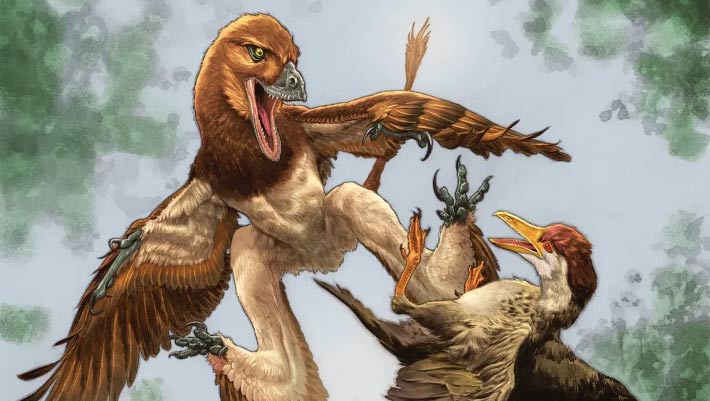
Épisode 174 : Une histoire des dinosaures en 50 fossiles
musée fossile spécimen Dinosauria
Le professeur Paul Barrett du Natural History Museum de Londres a récemment écrit A History of Dinosaurs in 50 Fossils. Nous en avons profité pour avoir un aperçu de ce que nous savons réellement sur les dinosaures et comment il est même possible de raconter leur histoire avec seulement 50 spécimens. Dans cet épisode, Paul discute de l'histoire [&hellip
15/04/2026 palaeocast ⚙ Traduction automatique
Cette petite griffe dans un fossile vieux de 500 millions d'années vient de réécrire l'origine des araignées
griffe Cambrien fossile spécimen
Ce qui a commencé comme un nettoyage de routine des fossiles s'est transformé en une surprise scientifique majeure lorsque des chercheurs ont découvert une petite griffe dans un spécimen vieux de 500 millions d'années, là où aucune griffe ne devrait exister. Ce détail a révélé Megachelicerax cousteaui, le plus ancien parent connu des araignées, repoussant les origines de ce groupe de 20 millions d'années. Le fossile montre que les principales caractéristiques des araignées et des limules modernes étaient déjà apparues lors de l'explosion cambrienne.
03/04/2026 sciencedaily ⚙ Traduction automatique
Haolong: Beast of the Week
Haolong : Bête de la semaine
Chine Crétacé Crétacé inférieur juvénile spécimen Dinosauria Haolong
 Cette semaine, nous allons découvrir un dinosaure nouvellement décrit qui est si unique qu'il change complètement ce que nous pensions savoir sur la peau des dinosaures !  Entrez Haolong Dongi ! Haolong était un dinosaure herbivore qui vivait dans ce qui est aujourd'hui le Liaoning, en Chine, au début du Crétacé, il y a environ 112,5 millions d'années.  Le seul spécimen enregistré mesure environ 8 pieds (2,45 m) du bec à la queue, mais il était juvénile lorsqu'il est mort, l'espèce a donc probablement grandi.  Le nom du genre se traduit du chinois par "S
08/03/2026 prehistoricbeastoftheweek ⚙ Traduction automatique
Il a fallu 40 ans au T. rex pour atteindre sa taille réelle, selon une étude
os croissance prédateur spécimen Tyrannosaurus étude
Le Tyrannosaurus rex a peut-être mis beaucoup plus de temps à grandir que les scientifiques ne le pensaient autrefois. En analysant les anneaux de croissance des os fossilisés des pattes de 17 spécimens de tyrannosaures et en utilisant de nouvelles méthodes statistiques, les chercheurs ont découvert que le célèbre prédateur avait probablement mis environ 40 ans pour atteindre sa taille maximale, soit environ huit tonnes, au lieu des 25 ans précédemment estimés.
05/03/2026 sciencedaily ⚙ Traduction automatique
1 2 3