Crétacé

Intervalle géologique

161 image(s) · 39 Actualités

Voir la fiche

Galerie d'images

Changmiania liaoningensis, an ornithopod dinosaur from the Lower Cretaceous of Lujiatun (Liaoning Province, China).
(A) Holotype PMOL AD00114 in dorsal view; (B) anterior part of the holotype PMOL AD00114 in caudolateral view; (C) referred specimen PMOL LFV022 in dorsal view. Red arrows indicate the emplacement of the gastrolith clusters.
Taxons Changmiania

Changmiania liaoningensis, an ornithopod dinosaur from the Lower Cretaceous of Lujiatun (Liaoning Province, China). (A) Holotype PMOL AD00114 in dorsal view; (B) anterior part of the holotype PMOL AD00114 in caudolateral view; (C) referred specimen PMOL LFV022 in dorsal view. Red arrows indicate the emplacement of the gastrolith clusters.

Chine Crétacé holotype spécimen +2
Partial skeleton of the heterodontosaurid Tianyulong confuciusi from the Lower Cretaceous Jehol Group of China. Partial skeleton mainly in right lateral view (IVPP V17090). Enlargements of subsequent figures are shown in red. Scale bar equals 10 cm.
Taxons Tianyulong

Partial skeleton of the heterodontosaurid Tianyulong confuciusi from the Lower Cretaceous Jehol Group of China. Partial skeleton mainly in right lateral view (IVPP V17090). Enlargements of subsequent figures are shown in red. Scale bar equals 10 cm.

écaille Chine Crétacé Heterodontosauridae +3
Reconstruction of the holotype material of Silutitan sinensis (IVPP V27874), a Cretaceous euhelopid sauropod from the Chinese Shengjinkou Formation, scaled after Euhelopus zdanskyi. Silhouette modified from  "Euhelopus zdanskyi Skeletal" by Gunnar Bivens (CC BY 3.0) (https://www.deviantart.com/gunnarbivens/art/Euhelopus-zdanskyi-Skeletal-833724646)
Taxons Silutitan

Reconstruction of the holotype material of Silutitan sinensis (IVPP V27874), a Cretaceous euhelopid sauropod from the Chinese Shengjinkou Formation, scaled after Euhelopus zdanskyi. Silhouette modified from "Euhelopus zdanskyi Skeletal" by Gunnar Bivens (CC BY 3.0) (https://www.deviantart.com/gunnarbivens/art/Euhelopus-zdanskyi-Skeletal-833724646)

Crétacé holotype Euhelopus Silutitan +1
Jiangxititan a titanosaurian sauropod from the Late Cretaceous of China. Typical for a sauropod, it had a long neck and stood on four pillar-like legs to support its massive body. Jiangxititan is a member of the Lognkosauria, which include some of the largest dinosaurs known, and is one of the few from mainland Asia. The discovery of Jiangxititan demonstrates the presence of both early-diverging and late-diverging titanosauriform sauropods in that area during the Late Cretaceous.
Taxons Jiangxititan

Jiangxititan a titanosaurian sauropod from the Late Cretaceous of China. Typical for a sauropod, it had a long neck and stood on four pillar-like legs to support its massive body. Jiangxititan is a member of the Lognkosauria, which include some of the largest dinosaurs known, and is one of the few from mainland Asia. The discovery of Jiangxititan demonstrates the presence of both early-diverging and late-diverging titanosauriform sauropods in that area during the Late Cretaceous.

Chine Crétacé Crétacé supérieur Dinosauria +5
Restoration of Dongbeititan dongi from the Early Cretaceous of China
Taxons Dongbeititan

Restoration of Dongbeititan dongi from the Early Cretaceous of China

Chine Crétacé Crétacé inférieur Dongbeititan
Garumbatitan is a sauropod dinosaur from the Early Cretaceous of what is now Spain. It is classified as a basal somphospondylan - a Titanosauriform, but not a true Titanosaur.
Taxons Garumbatitan

Garumbatitan is a sauropod dinosaur from the Early Cretaceous of what is now Spain. It is classified as a basal somphospondylan - a Titanosauriform, but not a true Titanosaur.

Espagne Crétacé Crétacé inférieur Dinosauria +4
Reconstruction of Bravasaurus arreirosorum a titanosaur dinosaur from the Late Cretaceous of Argentina
Taxons Bravasaurus

Reconstruction of Bravasaurus arreirosorum a titanosaur dinosaur from the Late Cretaceous of Argentina

Argentine Crétacé Crétacé supérieur Bravasaurus +2
Gandititan is a basal titanosaurian sauropod dinosaur from the Late Cretaceous of what is now China. It was a long-necked herbivore, typical of sauropods, with a relatively short tail, a characteristic of titanosaurs compared to other sauropods. Titanosauria have a wide range of body sizes, and Gandititan falls around the middle, slightly on the smaller side. Discovered with a fairly well articluated spine from neck to tail, Gandititan is estimated at about 14 m in total body length.
Taxons Gandititan

Gandititan is a basal titanosaurian sauropod dinosaur from the Late Cretaceous of what is now China. It was a long-necked herbivore, typical of sauropods, with a relatively short tail, a characteristic of titanosaurs compared to other sauropods. Titanosauria have a wide range of body sizes, and Gandititan falls around the middle, slightly on the smaller side. Discovered with a fairly well articluated spine from neck to tail, Gandititan is estimated at about 14 m in total body length.

Chine Crétacé Crétacé supérieur Dinosauria +2
This file represents a possible life appearance of the Indian Titanosaurian Sauropod dinosaur Jainosaurus septentrionalis from the Late Cretaceous (Maastrichtian) of India, belonging to the Lameta Formation.
References used: 
Huene & Matley (1933)
Hunt et al. (1995)
Gunnar Bivens' skeletal diagram

Wilson et al. (2008) "Reassessment of Sauropod Dinosaur Jainosaurus (="Antarctosaurus") Septentrionalis from the Upper Cretaceous of India"
Taxons Jainosaurus

This file represents a possible life appearance of the Indian Titanosaurian Sauropod dinosaur Jainosaurus septentrionalis from the Late Cretaceous (Maastrichtian) of India, belonging to the Lameta Formation. References used: Huene & Matley (1933) Hunt et al. (1995) Gunnar Bivens' skeletal diagram Wilson et al. (2008) "Reassessment of Sauropod Dinosaur Jainosaurus (="Antarctosaurus") Septentrionalis from the Upper Cretaceous of India"

Inde Lameta Crétacé Crétacé supérieur +6
Udelartitan is a titanosaurian sauropod from the Late Cretaceous of what is now Uruguay. It had the typical sauropod body plan, standing on four thick pillar-like legs, and possessing a long neck. Titanosaurs are a very diverse group, Udelartitan was a small one, estimated at only 15 m in body length. Though a skull has yet to be discovered, it probably had peglike teeth, and a large gut for processing vegetation.
Taxons Udelartitan

Udelartitan is a titanosaurian sauropod from the Late Cretaceous of what is now Uruguay. It had the typical sauropod body plan, standing on four thick pillar-like legs, and possessing a long neck. Titanosaurs are a very diverse group, Udelartitan was a small one, estimated at only 15 m in body length. Though a skull has yet to be discovered, it probably had peglike teeth, and a large gut for processing vegetation.

Uruguay Crétacé Crétacé supérieur Titanosauria +2
Restoration of Zhuchengtitan zangjiazhuangensis from the Late Cretaceous of China
Taxons Zhuchengtitan

Restoration of Zhuchengtitan zangjiazhuangensis from the Late Cretaceous of China

Chine Crétacé Crétacé supérieur Zhuchengtitan
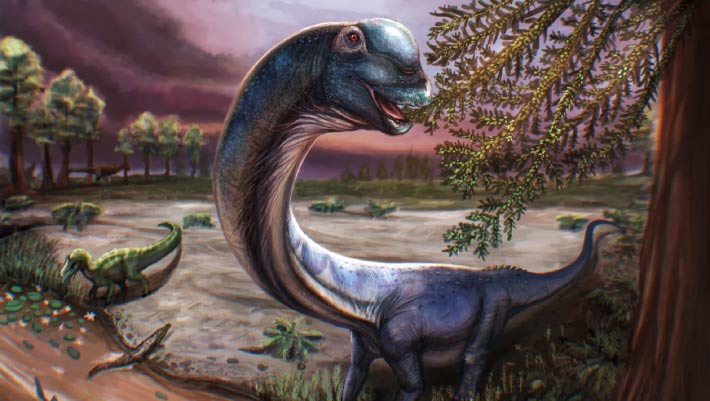
Qunkasaura is a titanosaurian sauropod dinosaur that lived approximately 75 million years ago in the Late Cretaceous of what is now Spain. Specifically, it is a saltasaurid titanosaur, and its discovery marks the first instance of two distinct lineages of this group present in the same locality. In the Late Cretaceous, Europe was a large archipelago, and the coexistence of these differing lineages indicates that saltasaurids arrived in the Iberian Peninsula much later than other groups of dinosaurs.
Taxons Qunkasaura

Qunkasaura is a titanosaurian sauropod dinosaur that lived approximately 75 million years ago in the Late Cretaceous of what is now Spain. Specifically, it is a saltasaurid titanosaur, and its discovery marks the first instance of two distinct lineages of this group present in the same locality. In the Late Cretaceous, Europe was a large archipelago, and the coexistence of these differing lineages indicates that saltasaurids arrived in the Iberian Peninsula much later than other groups of dinosaurs.

Espagne Crétacé Crétacé supérieur Dinosauria +4
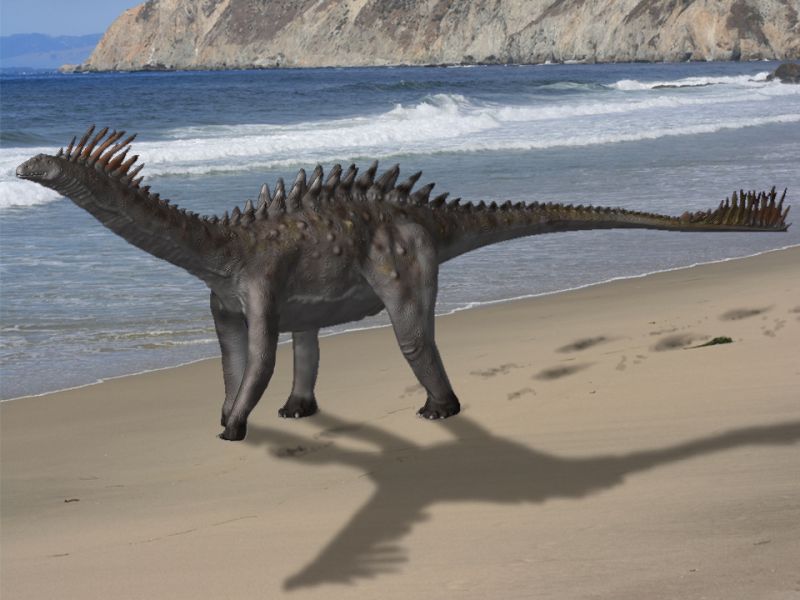
Saltasaurus (which means "lizard from Salta") was a sauropod dinosaur of the Late Cretaceous Period. Relatively small among sauropods, though still massive by human standards, it was characterized by a diplodocid-like head
Taxons Saltasaurus

Saltasaurus (which means "lizard from Salta") was a sauropod dinosaur of the Late Cretaceous Period. Relatively small among sauropods, though still massive by human standards, it was characterized by a diplodocid-like head

Crétacé Crétacé supérieur Balochisauridae Dinosauria +7
Saltasaurus (which means "lizard from Salta") was a sauropod dinosaur of the Late Cretaceous Period. Relatively small among sauropods, though still massive by human standards, it was characterized by a diplodocid-like head
Taxons Lithostrotia

Saltasaurus (which means "lizard from Salta") was a sauropod dinosaur of the Late Cretaceous Period. Relatively small among sauropods, though still massive by human standards, it was characterized by a diplodocid-like head

Crétacé Crétacé supérieur Balochisauridae Dinosauria +7
Saltasaurus (which means "lizard from Salta") was a sauropod dinosaur of the Late Cretaceous Period. Relatively small among sauropods, though still massive by human standards, it was characterized by a diplodocid-like head
Taxons Titanosauridae

Saltasaurus (which means "lizard from Salta") was a sauropod dinosaur of the Late Cretaceous Period. Relatively small among sauropods, though still massive by human standards, it was characterized by a diplodocid-like head

Crétacé Crétacé supérieur Balochisauridae Dinosauria +7
Saltasaurus (which means "lizard from Salta") was a sauropod dinosaur of the Late Cretaceous Period. Relatively small among sauropods, though still massive by human standards, it was characterized by a diplodocid-like head
Taxons Saltasauridae

Saltasaurus (which means "lizard from Salta") was a sauropod dinosaur of the Late Cretaceous Period. Relatively small among sauropods, though still massive by human standards, it was characterized by a diplodocid-like head

Crétacé Crétacé supérieur Balochisauridae Dinosauria +7
1 2 3 4 5 6 7 8 9 10 11

Actualités

Pentaceratops: Beast of the Week
Pentaceratops : la bête de la semaine
Mexique États-Unis Crétacé Crétacé supérieur Ceratopsia Dinosauria Pentaceratops
Cette semaine, nous allons découvrir encore un autre superbe dinosaure cératopsien.  Entrez Pentaceratops sternbergii ! Pentaceratops était un dinosaure herbivore qui mesurait environ vingt pieds de long du bec à la queue. En tant que cératopsien (cornes, becs et volants), il faisait partie du groupe des chasmosaurines et était étroitement apparenté au Chasmosaurus et au Coahuilaceratops pour n'en nommer que quelques-uns.  Il vivait dans ce qui est aujourd’hui le Nouveau-Mexique, aux États-Unis, à la fin du Crétacé, il y a entre 76 et 73 millions d’années.  Le nom du genre,
14/09/2025 prehistoricbeastoftheweek ⚙ Traduction automatique
Irritator: Beast of the Week
Irritateur : la bête de la semaine
reconstitution Brésil Crétacé Crétacé inférieur Dinosauria Irritator
La bête de cette semaine est un dinosaure spécial qui nous aide à mieux comprendre l'apparence et le mode de vie de sa famille.  Découvrez Irritator challengeri ! Reconstitution de la vie d'Irritator à l'aquarelle par Christopher DiPiazza. Irritator était un dinosaure carnivore qui vivait dans ce qui est aujourd'hui le Brésil au début du Crétacé, il y a entre 113 et 110 millions d'années. Du museau à la queue, il mesurait entre 6 et 8 mètres et était un mangeur de viande de son vivant.  Le nom du genre, Ir
24/08/2025 prehistoricbeastoftheweek ⚙ Traduction automatique
Critique du livre d'un paléontologue sur A Secret History of Sharks
Crétacé Permien
Depuis environ 450 millions d’années, les requins et leurs cousins ​​cartilagineux constituent une caractéristique majeure de la vie marine. Withstanding multiple cataclysmic events, most notably those at the end of the Permian and Cretaceous, and maintaining a great diversity in today’s oceans, the evolutionary history of sharks is a lengthy, gripping tale of one of the [&hellip
09/08/2025 palaeocast ⚙ Traduction automatique
Lepidotes: Beast of the Week
Lépidotes : la bête de la semaine
écaille reconstitution Crétacé Crétacé inférieur Jurassique inférieur Jurassique Dinosauria
 Cette fois-ci, nous examinerons une espèce unique de poissons préhistoriques qui nageaient dans les rivières et les lacs tandis que certains des plus grands dinosaures marchaient sur terre.  Découvrez Lepidotes ! Reconstitution à l'aquarelle de Lepidotes gigas par Christopher DiPiazza. Les Lepidotes étaient un genre de poissons osseux à fortes écailles qui vivaient dans ce qui est aujourd'hui l'Europe et l'Amérique du Nord au début du Jurassique, il y a entre 180 et 175 millions d'années.  Le genre a peut-être même persisté jusqu'au Crétacé inférieur, il y a seulement 115 millions d'années, mais
29/06/2025 prehistoricbeastoftheweek ⚙ Traduction automatique
1 2 3 4 5 6 7 8