←

Crétacé

Intervalle géologique

163 image(s) · 59 Actualités

Voir la fiche

Galerie d'images

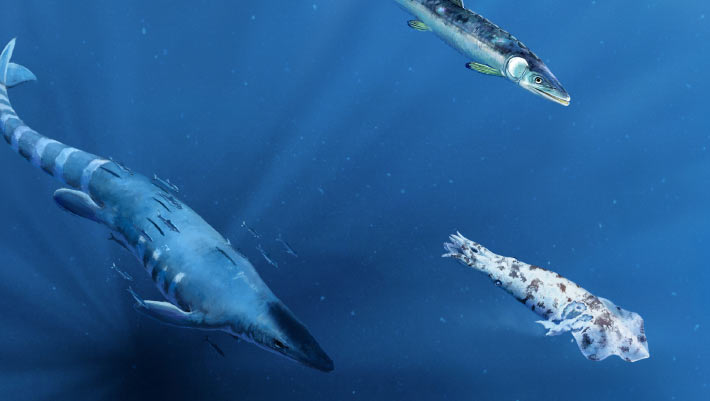
Eonatator sternbergi, a mosasaur from the Late Cretaceous of Kansas. Digital.
Taxons Eonatator

Eonatator sternbergi, a mosasaur from the Late Cretaceous of Kansas. Digital.

Crétacé Crétacé supérieur Eonatator Spinops
Phylogenetic relationships, chronostratigraphic, and paleoecological implications of M. intrepidus. a Graphic illustrating temporal range of North American tyrannosauroids including species-level range prior to the discovery of M. intrepidus, extension of current range, and hypothesized range based on isolated teeth12. The current gap in the North American tyrannosauroid record spans from the Tithonian to the Aptian. Faunal composition of Late Cretaceous ecosystems was established between the Albian and Turonian, as recognized by the stratigraphic appearance of major clades (see refs. 7,12 and references therein). b generalized phylogenetic relationships of Tyrannosauroidea, showing the appearance of select traits related to cursoriality in tyrannosaurs that are newly optimized as a result of the discovery of M. intrepidus. Tree topology follows this study using the modified dataset of Carr and colleagues27. Coelurus and Tanycolagreus are grafted as basal tyrannosauroids following Brusatte and colleagues5. c Stratigraphic distribution of Allosauria in North America (incl. Megaraptora but see ref. 70 for alternative hypotheses regarding this clade) documents overlap with M. intrepidus in early Late Cretaceous ecosystems leading to (d) refined calibration on the origin of late diverging tyrannosauroids and clade-level faunal turnover within apex predator roles throughout the Late Jurassic–Late Cretaceous of North America. Colored polygons are stylized call-outs and are not intended to reflect two-dimensional data. Temporal data corresponding to this figure are available in Supplementary Table 5
Taxons Coelurus

Phylogenetic relationships, chronostratigraphic, and paleoecological implications of M. intrepidus. a Graphic illustrating temporal range of North American tyrannosauroids including species-level range prior to the discovery of M. intrepidus, extension of current range, and hypothesized range based on isolated teeth12. The current gap in the North American tyrannosauroid record spans from the Tithonian to the Aptian. Faunal composition of Late Cretaceous ecosystems was established between the Albian and Turonian, as recognized by the stratigraphic appearance of major clades (see refs. 7,12 and references therein). b generalized phylogenetic relationships of Tyrannosauroidea, showing the appearance of select traits related to cursoriality in tyrannosaurs that are newly optimized as a result of the discovery of M. intrepidus. Tree topology follows this study using the modified dataset of Carr and colleagues27. Coelurus and Tanycolagreus are grafted as basal tyrannosauroids following Brusatte and colleagues5. c Stratigraphic distribution of Allosauria in North America (incl. Megaraptora but see ref. 70 for alternative hypotheses regarding this clade) documents overlap with M. intrepidus in early Late Cretaceous ecosystems leading to (d) refined calibration on the origin of late diverging tyrannosauroids and clade-level faunal turnover within apex predator roles throughout the Late Jurassic–Late Cretaceous of North America. Colored polygons are stylized call-outs and are not intended to reflect two-dimensional data. Temporal data corresponding to this figure are available in Supplementary Table 5

prédateur Albien Aptien Crétacé +12
Clidastes propython, a mosasaur from the Late Cretaceous of Kansas, digital.
Taxons Clidastes

Clidastes propython, a mosasaur from the Late Cretaceous of Kansas, digital.

Crétacé Crétacé supérieur Clidastes Spinops
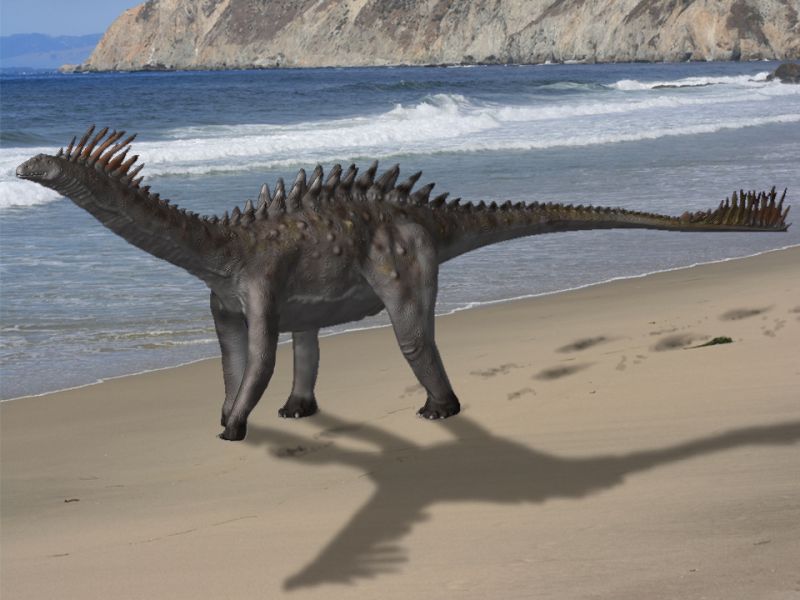
Reconstruction of Agustinia ligabuei from the Early Cretaceous of Argentina as a rebbachisaurid following Bellardini et al. 2022

Reconstruction of Agustinia ligabuei from the Early Cretaceous of Argentina as a rebbachisaurid following Bellardini et al. 2022

Argentine Crétacé Crétacé inférieur Agustinia +2
Agustinia ligabuei, a sauropod from the Early Cretaceous of Argentina. Digital.

Agustinia ligabuei, a sauropod from the Early Cretaceous of Argentina. Digital.

Argentine Crétacé Crétacé inférieur Agustinia +2
Pliosaurus (Luskhan itilensis) lived on the territory of the Volga region in the Hauterivian age of the Early Cretaceous period. Discovered in 2002 by G.N. Uspensky on the banks of the Volga near the village of Slantsevy Rudnik. This is the most complete pliosaurus skeleton found in Russia. This pliosaurus was not a predator and preferred to feed on fish and cephalopods.

Pliosaurus (Luskhan itilensis) lived on the territory of the Volga region in the Hauterivian age of the Early Cretaceous period. Discovered in 2002 by G.N. Uspensky on the banks of the Volga near the village of Slantsevy Rudnik. This is the most complete pliosaurus skeleton found in Russia. This pliosaurus was not a predator and preferred to feed on fish and cephalopods.

prédateur Russie Crétacé Crétacé inférieur +5
Reconstruction of brachauchenin pliosaurid Luskhan itilensis. Early Cretaceous of Ulyanovsk region. 2017.

Reconstruction of brachauchenin pliosaurid Luskhan itilensis. Early Cretaceous of Ulyanovsk region. 2017.

Crétacé Crétacé inférieur Brachaucheninae Luskhan +1
A new plesiosaur, Leurospondylus, from the Edmonton Cretaceous of Alberta

A new plesiosaur, Leurospondylus, from the Edmonton Cretaceous of Alberta

Crétacé Edmontonia Leurospondylus Plesiosauria
Ancient landscape across the Cretaceous/Paleogene time interval in central Patagonia. Main floristic types from the Danian: Podocarps, Cheirolepidiaceae, palms.
doi:10.1371/journal.pone.0052455.g007

Ancient landscape across the Cretaceous/Paleogene time interval in central Patagonia. Main floristic types from the Danian: Podocarps, Cheirolepidiaceae, palms. doi:10.1371/journal.pone.0052455.g007

Crétacé Danien Paléogène
Iron trapped in Cretaceous limestone, forming tables

Iron trapped in Cretaceous limestone, forming tables

Crétacé
Limestone cliff with the stratigraphic stage of Cretaceous Coniacian near the eponym town of Cognac, Charente, Poitou-Charentes, France.

Limestone cliff with the stratigraphic stage of Cretaceous Coniacian near the eponym town of Cognac, Charente, Poitou-Charentes, France.

France Coniacien Crétacé
crétacé limestone at Cognac, Charente, SW France

crétacé limestone at Cognac, Charente, SW France

France Crétacé
Cretaceous limestone at Cognac, Charente, SW France

Cretaceous limestone at Cognac, Charente, SW France

France Crétacé
Ivy and limestone cliff of Cretaceous Coniacian, Cognac, Charente, France.

Ivy and limestone cliff of Cretaceous Coniacian, Cognac, Charente, France.

France Coniacien Crétacé
Limestone Cretaceous cornices (Coniacian type), valley of the river Voultron; Blanzaguet-Saint-Cybard, Charente, France.

Limestone Cretaceous cornices (Coniacian type), valley of the river Voultron; Blanzaguet-Saint-Cybard, Charente, France.

France Coniacien Crétacé
Quarry called “Ratssteinbruch” at Plauenscher Grund (gorge-like valley of the river Weißeritz nearby/in the city of Dresden, Saxony, Germany), Upper Carboniferous Monzonite (historically identified as Syenite) of the Meißen Massif (Paleozoic basement) unconformably overlain by Upper Cenomanian beds of the Dölzschen Formation, yellowish basal conglomerate and overlying bluish silty clay-marlstone (“plenus-Pläner”) of the Saxo-Bohemian Cretaceous Basin (Mesozoic platform).[1]

Quarry called “Ratssteinbruch” at Plauenscher Grund (gorge-like valley of the river Weißeritz nearby/in the city of Dresden, Saxony, Germany), Upper Carboniferous Monzonite (historically identified as Syenite) of the Meißen Massif (Paleozoic basement) unconformably overlain by Upper Cenomanian beds of the Dölzschen Formation, yellowish basal conglomerate and overlying bluish silty clay-marlstone (“plenus-Pläner”) of the Saxo-Bohemian Cretaceous Basin (Mesozoic platform).[1]

Allemagne Carbonifère Cénomanien Crétacé +3
1 2 3 4 5 6 7 8 9 10 11

Actualités

Fossil of Giant Squid-Like Creature from Cretaceous Period Bears Marks of Deadly Attack
Un fossile d'une créature ressemblant à un calmar géant de la période du Crétacé porte des marques d'attaque mortelle
Canada Crétacé fossile squelette
Des paléontologues étudiant un fossile découvert dans le sud du Manitoba, au Canada, ont identifié ce qu'ils pensent être deux marques de morsure sur le squelette interne de l'ancien céphalopode géant Enchoteuthis. L'article Un fossile d'une créature ressemblant à un calmar géant de la période du Crétacé porte des marques d'attaque mortelle est apparu en premier sur Sci.News : Breaking Science News.
01/09/2026 sci-news ⚙ Traduction automatique
Arundelconodon: Beast of the Week
Arundelconodon : Bête de la semaine
États-Unis Crétacé Crétacé inférieur Dinosauria mammifères
 Cette semaine, nous allons nous pencher sur un mammifère unique qui vivait aux côtés de certains des plus grands dinosaures !  Découvrez Arundelconodon hottoni.  Arundelconodon était un petit mammifère qui vivait dans ce qui est aujourd'hui le Maryland, aux États-Unis, au début du Crétacé, il y a environ 115 millions d'années, ce qui en fait l'un des plus anciens mammifères connus de la côte est des États-Unis.  On estime qu’il mesurait environ 20 à 25 cm de long du nez à la queue, soit à peu près la même taille qu’un rat.  Basé
31/08/2026 prehistoricbeastoftheweek ⚙ Traduction automatique
Incroyable découverte d’un dinosaure blindé – le premier ankylosaure définitif du Japon
Japon Crétacé fossile Ankylosauria Dinosauria Nodosauridae découverte
Un nouveau genre et une nouvelle espèce de dinosaure cuirassé ont été nommés à partir de fossiles trouvés au Japon. Nipponopelta yezoensis représente le premier ankylosaure japonais officiellement nommé. De plus, cette découverte fournit des informations importantes sur la dispersion des nodosauridés au cours du Crétacé. Le nouveau dinosaure a été nommé et décrit par une équipe internationale de paléontologues. La recherche
30/08/2026 everythingdinosaur ⚙ Traduction automatique
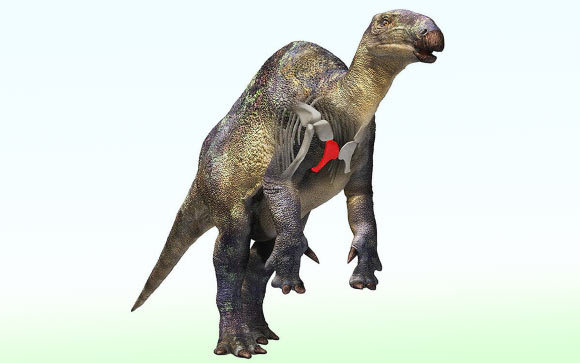
Fossil of Small Duck-Billed Dinosaur Relative Found in Japan
Un fossile d'un petit dinosaure à bec de canard découvert au Japon
os Japon Crétacé fossile Canardia Dinosauria Iguanodontia Styracosterna
Un os fossilisé découvert il y a vingt ans dans le nord-est du Japon appartient à l'un des plus petits dinosaures iguanodontiens jamais découverts dans les roches marines du Crétacé du pays, selon une nouvelle recherche menée par l'Université de Tsukuba. L'article Un fossile d'un petit dinosaure à bec de canard trouvé au Japon est apparu en premier sur Sci.News : Breaking Science News.
20/08/2026 sci-news ⚙ Traduction automatique
Un fossile vieux de 30 ans cachait les os d'un mystérieux monstre marin ancien
os mâchoire Crétacé fossile Mosasaurus nouvelle espèce crâne
Des fossiles collectés à Osaka il y a plus de 30 ans ont révélé une surprise cachée à la vue de tous : quatre os jusqu'alors méconnus provenant d'un mosasaure géant du Crétacé. Parmi eux se trouve le premier prémaxillaire confirmé – l’os le plus en avant de la mâchoire supérieure – jamais identifié dans un fossile de mosasaure japonais. Plus intrigant encore, certaines parties du crâne présentent des caractéristiques anatomiques inhabituelles qui ne correspondent pas aux mosasaures connus, ce qui laisse penser que les restes appartiennent à une espèce entièrement nouvelle.
15/08/2026 sciencedaily ⚙ Traduction automatique
1 2 3 4 5 6 7 8 9 10 11 12