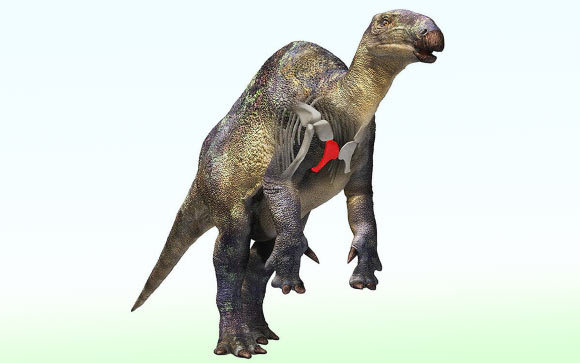
Styracosterna

Taxon

3 image(s) · 1 Actualités

Voir la fiche

Galerie d'images

Calvarius is a genus of styracosternan ornithopod from the Late Cretaceous of Spain. The name alludes to its chronostratigraphic proximity to the extinction event that wiped out the non-avian dinosaurs at the end of the Cretaceous. The highly modified metatarsal that is known from shows an example of convergent evolution, as it is more similar to non-iguanodontian ornithopods than to other styracosternans. It is thought that this is due to fulfilling a niche in its island habitat, resulting in Calvarius becoming a small-bodied animal, capable of rapid locomotion.
Taxons Calvarius

Calvarius is a genus of styracosternan ornithopod from the Late Cretaceous of Spain. The name alludes to its chronostratigraphic proximity to the extinction event that wiped out the non-avian dinosaurs at the end of the Cretaceous. The highly modified metatarsal that is known from shows an example of convergent evolution, as it is more similar to non-iguanodontian ornithopods than to other styracosternans. It is thought that this is due to fulfilling a niche in its island habitat, resulting in Calvarius becoming a small-bodied animal, capable of rapid locomotion.

locomotion Espagne Crétacé Crétacé supérieur +6
Calvarius is a genus of styracosternan ornithopod from the Late Cretaceous of Spain. The name alludes to its chronostratigraphic proximity to the extinction event that wiped out the non-avian dinosaurs at the end of the Cretaceous. The highly modified metatarsal that is known from shows an example of convergent evolution, as it is more similar to non-iguanodontian ornithopods than to other styracosternans. It is thought that this is due to fulfilling a niche in its island habitat, resulting in Calvarius becoming a small-bodied animal, capable of rapid locomotion.

Calvarius is a genus of styracosternan ornithopod from the Late Cretaceous of Spain. The name alludes to its chronostratigraphic proximity to the extinction event that wiped out the non-avian dinosaurs at the end of the Cretaceous. The highly modified metatarsal that is known from shows an example of convergent evolution, as it is more similar to non-iguanodontian ornithopods than to other styracosternans. It is thought that this is due to fulfilling a niche in its island habitat, resulting in Calvarius becoming a small-bodied animal, capable of rapid locomotion.

locomotion Espagne Crétacé Crétacé supérieur +6
Six ankylopollexian ornithopods (top left to bottom right):  Shantungosaurus, Iguanodon, Tethyshadros, Uteodon (possibly Camptosaurus), Olorotitan, Gonpoquansaurus
Taxons Styracosterna

Six ankylopollexian ornithopods (top left to bottom right): Shantungosaurus, Iguanodon, Tethyshadros, Uteodon (possibly Camptosaurus), Olorotitan, Gonpoquansaurus

Ankylopollexia Camptosaurus Hadrosauriformes Iguanodon +6
Six ankylopollexian ornithopods (top left to bottom right):  Shantungosaurus, Iguanodon, Tethyshadros, Uteodon (possibly Camptosaurus), Olorotitan, Gonpoquansaurus
Taxons Hadrosauriformes

Six ankylopollexian ornithopods (top left to bottom right): Shantungosaurus, Iguanodon, Tethyshadros, Uteodon (possibly Camptosaurus), Olorotitan, Gonpoquansaurus

Ankylopollexia Camptosaurus Hadrosauriformes Iguanodon +6
Six ankylopollexian ornithopods (top left to bottom right):  Shantungosaurus, Iguanodon, Tethyshadros, Uteodon (possibly Camptosaurus), Olorotitan, Gonpoquansaurus
Taxons Neoiguanodontia

Six ankylopollexian ornithopods (top left to bottom right): Shantungosaurus, Iguanodon, Tethyshadros, Uteodon (possibly Camptosaurus), Olorotitan, Gonpoquansaurus

Ankylopollexia Camptosaurus Hadrosauriformes Iguanodon +6

Actualités

Fossil of Small Duck-Billed Dinosaur Relative Found in Japan
Un fossile d'un petit dinosaure à bec de canard découvert au Japon
os Japon Crétacé fossile Canardia Dinosauria Iguanodontia Styracosterna
Un os fossilisé découvert il y a vingt ans dans le nord-est du Japon appartient à l'un des plus petits dinosaures iguanodontiens jamais découverts dans les roches marines du Crétacé du pays, selon une nouvelle recherche menée par l'Université de Tsukuba. L'article Un fossile d'un petit dinosaure à bec de canard trouvé au Japon est apparu en premier sur Sci.News : Breaking Science News.
20/08/2026 sci-news ⚙ Traduction automatique