News

Latest palaeontology news

All FR EN everythingdinosaur futura-terre palaeocast prehistoricbeastoftheweek sci-news sciencedaily sciencedaily-fossils sciencedaily-human-evo sciencedaily-paleo sciencesetavenir
Scientists find perfect fossils in rust beneath Australian farmland
fossil
Beneath the dry farmland of New South Wales lies a hidden window into a lost rainforest teeming with life from 11-16 million years ago. At McGraths Flat, scientists have uncovered fossils preserved in astonishing detail—not in typical rock like shale or sandstone, but in iron-rich sediment once thought incapable of such preservation. Tiny iron particles filled and captured entire cells, preserving everything from insect organs to fish eye pigments and delicate spider hairs.
23/04/2026 sciencedaily
This ancient crocodile relative grew up on four legs then walked on two
fossil Dinosauria
A bizarre crocodile relative from the age of dinosaurs is rewriting what scientists thought they knew about ancient reptiles. This poodle-sized creature, called Sonselasuchus cedrus, appears to have started life walking on all fours before shifting to a two-legged stance as it matured—an unusual transformation rarely seen in the fossil record.
23/04/2026 sciencedaily
289-million-year-old mummified reptile reveals how breathing began on land
bird mammals
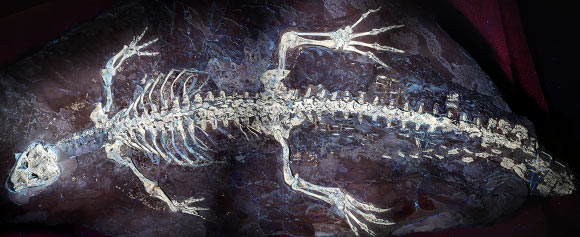
A remarkably preserved, mummified reptile from 289 million years ago is rewriting what we know about how animals first breathed on land. This tiny creature, Captorhinus aguti, reveals the earliest known version of the rib-powered breathing system used by modern reptiles, birds, and mammals — a crucial innovation that helped vertebrates thrive outside water.
23/04/2026 sciencedaily
Ancient DNA reveals a lost population near Paris replaced by strangers
DNA genetics
Ancient DNA from a tomb near Paris reveals a shocking prehistoric reset: one population vanished and was replaced by newcomers from the south. The two groups show no genetic connection, signaling a major upheaval around 3000 BC. Disease, including early plague, likely played a role, but wasn’t the only cause. The change also reshaped society, ending tightly knit family burials and coinciding with the disappearance of Europe’s megalith builders.
22/04/2026 sciencedaily-fossils
La plus ancienne feuille de cannabis ? Un musée fait une étonnante découverte
The oldest cannabis leaf? A museum makes an astonishing discovery
museum discovery
The Berlin Natural History Museum has dated what appears to be the footprint of a Cannabis genus plant in dried mud.
22/04/2026 sciencesetavenir ⚙ Auto-translated
Ancient DNA reveals a hidden Neanderthal group frozen in time
DNA Poland genetics
A remarkable genetic breakthrough has uncovered what may be one of the clearest snapshots yet of a Neanderthal “community” living together 100,000 years ago in what is now Poland. The findings reveal that these individuals shared genetic ties with Neanderthals spread across Europe and the Caucasus, hinting at widespread ancient lineages that later disappeared.
22/04/2026 sciencedaily-fossils
450-Million-Year-Old Fossils Reveal Strange, Tube-Dwelling Jellyfish Relative
Canada fossil specimen new species
Paleontologists have identified a new genus and species of soft-bodied, tubicolous polyp medusozoan from well-preserved specimens found about 50 km northeast of Quebec City in Canada. The post 450-Million-Year-Old Fossils Reveal Strange, Tube-Dwelling Jellyfish Relative appeared first on Sci.News: Breaking Science News.
21/04/2026 sci-news
These tiny dinosaur fossils fooled scientists for 20 years
armor bone growth fossil Ankylosauria Dinosauria discovery
Tiny dinosaur fossils that puzzled scientists for over 20 years have finally revealed their true identity. Rather than belonging to a miniature species, they are actually baby ankylosaurs—some less than a year old, including a possible hatchling. By studying bone growth patterns, researchers confirmed these young dinosaurs hadn’t yet developed into full-sized adults. The discovery sheds new light on how ankylosaurs grew, showing they began developing armor surprisingly early.
21/04/2026 sciencedaily
Museum Fossil Reveals Triassic Crocodile Cousin with Powerful Jaws
jaw museum Late Triassic Triassic fossil specimen CT-scan new species
CT scans of a decades-old specimen from the Yale Peabody Museum of Natural History show a new species of short-snouted crocodylomorph with unusually strong jaws, offering a rare snapshot of ecological specialization in the Late Triassic epoch. The post Museum Fossil Reveals Triassic Crocodile Cousin with Powerful Jaws appeared first on Sci.News: Breaking Science News.
20/04/2026 sci-news
After 200 years scientists finally crack the “dolomite problem”
growth discovery
After two centuries of failed attempts, scientists have finally grown dolomite in the lab, cracking a long-standing geological puzzle. They discovered that the mineral’s growth stalls because of tiny defects—but in nature, those flaws get washed away over time. By mimicking this process with precise simulations and electron beam pulses, the team achieved record-breaking crystal growth. The finding could reshape how high-tech materials are made.
20/04/2026 sciencedaily-paleo
Peloroplites: Beast of the Week
United States Cedar Mountain Lance Cretaceous Dinosauria Peloroplites
 This week we will be checking out a large tank dinosaur.  Enter Peloroplites cedrimontanus!Peloroplites was a plant-eating dinosaur that lived in what is now Utah, USA, during the Cretaceous period, between 98 and 93 million years ago.  From snout to tail it would have measured about 20 feet (6m) long.  It's genus name translates to "Giant Hoplite" in reference to hoplites, the ancient Greek soldiers who famously carried spears and large shields.  The species name translates to "Cedar Mountain"
19/04/2026 prehistoricbeastoftheweek
Ce phénomène au cœur de la Terre explique pourquoi certaines régions sont si riches en or
This phenomenon in the heart of the Earth explains why certain regions are so rich in gold
study
Why do certain regions of the world concentrate much more gold than others? A study shows that the answer lies in the depths of the Earth, through an unsuspected process.
19/04/2026 futura-terre ⚙ Auto-translated
New Triassic Dinosaur Species Identified in New Mexico
Mexico United States Triassic Dinosauria new species skull
A new genus and species of carnivorous herrerasaurian dinosaur has been described from an incomplete but well-preserved skull found in northern New Mexico, the United States. The post New Triassic Dinosaur Species Identified in New Mexico appeared first on Sci.News: Breaking Science News.
17/04/2026 sci-news
Scientists thought this was a young T. rex. They were wrong
bone growth predator fossil juvenile Dinosauria Nanotyrannus
A long-running dinosaur mystery may finally be solved: Nanotyrannus, once dismissed as just a teenage T. rex, appears to have been its own distinct species after all. Scientists analyzed a tiny throat bone from the original fossil and discovered growth patterns showing the animal was already mature, not a juvenile giant-in-the-making. This smaller predator—about half the size of a full-grown T. rex—likely roamed alongside its famous cousin, adding a new layer of complexity to prehistoric ecosyst
16/04/2026 sciencedaily
Episode 174: A History of Dinosaurs in 50 Fossils
museum fossil specimen Dinosauria
Prof. Paul Barrett of the Natural History Museum, London, recently authored A History of Dinosaurs in 50 Fossils. We took this as an opportunity to get an overview of what we really know about dinosaurs and how it’s even possible to tell their story with just 50 specimens. In this episode, Paul discusses the history [&hellip
15/04/2026 palaeocast
A crushed fossil revealed a dinosaur that shouldn’t have existed
Triassic fossil Dinosauria discovery extinction new species skull
A badly mangled dinosaur skull, once forgotten in a drawer, turned out to be a rare and important discovery. Reconstructed by a Virginia Tech student, it revealed a new species of early carnivorous dinosaur with unusual features never seen before. The fossil suggests some dinosaur groups were wiped out during the end-Triassic extinction, not just their rivals. It may represent one of the last survivors of an ancient dinosaur lineage.
15/04/2026 sciencedaily
This 31-foot “terror croc” ate dinosaurs. Now it’s back
predator museum United States Dinosauria skeleton
A massive, bus-sized “terror croc” that once preyed on dinosaurs has been brought back to life in stunning detail with the first scientifically accurate full skeleton of Deinosuchus schwimmeri. Stretching over 30 feet long, this ancient apex predator ruled the southeastern U.S. more than 75 million years ago—and now visitors can see it up close at the Tellus Science Museum, the only place in the world with this replica.
15/04/2026 sciencedaily
Scientists just solved a 160-million-year fossil mystery “I’ve never seen anything like it”
fossil discovery evolution
A rare fossil discovery is shedding light on the “missing years” of early sponge evolution. Scientists found a 550-million-year-old sponge that likely lacked hard skeletal parts, explaining why earlier fossils are so scarce. This supports the idea that the earliest sponges were soft-bodied and rarely preserved. The finding changes how researchers hunt for the origins of animal life.
15/04/2026 sciencedaily
Mammal ancestors laid eggs, and this 250-million-year-old fossil finally proves it
fossil discovery extinction mammals
In the aftermath of Earth’s most catastrophic extinction event, one unlikely survivor rose to dominate a shattered world: Lystrosaurus. Now, a stunning fossil discovery—an ancient egg containing a curled-up embryo—has finally answered a decades-old mystery about whether mammal ancestors laid eggs. Using advanced imaging technology, scientists confirmed that these resilient creatures did reproduce this way, likely producing large, soft-shelled eggs packed with nutrients.
14/04/2026 sciencedaily
Diamantinasaurus: Beast of the Week
Australia Cretaceous Diamantinasauria Dinosauria
This week we'll be learning about a beast that greatly helps us understand how sauropod dinosaurs ("long-necks") looked and lived.  Check out Diamantinasaurus matildae!Diamantinasaurus lived in what is now Queensland, Australia during the middle Cretaceous period, between 95 and 92 million years ago.  It's considered medium-sized for a sauropod, and would have measured about 52 feet (16m) long from snout to tail. (Yes. 52 feet is only medium for sauropods!) Like all sauropods it would have eaten
12/04/2026 prehistoricbeastoftheweek
1 2 3 4 5 6 7 8 9 10 11 12 13 14 15 16 17