News

Latest palaeontology news

All FR EN everythingdinosaur futura-terre palaeocast prehistoricbeastoftheweek sci-news sciencedaily sciencedaily-fossils sciencedaily-human-evo sciencedaily-paleo sciencesetavenir
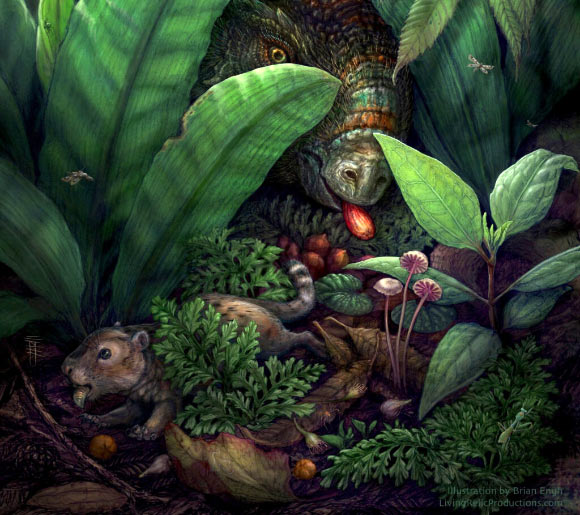
Omnivorous, Rodent-Like Mammal Lived in Dinosaurs’ Shadow on Pacific Coast
Mexico fossil Dinosauria mammals new species
Paleontologists have descibed a new species of the multituberculate mammal genus Cimolodon based on a fossil found in Baja California, Mexico. The post Omnivorous, Rodent-Like Mammal Lived in Dinosaurs’ Shadow on Pacific Coast appeared first on Sci.News: Breaking Science News.
29/04/2026 sci-news
Bronze Age mines discovered in Spain may explain Scandinavian metal mystery
Spain discovery
Archaeologists have uncovered six previously unknown Bronze Age mines in southwestern Spain, offering a striking new clue about where the metal in ancient Scandinavian artifacts may have come from. Found near Cabeza del Buey, the sites include everything from small extraction zones to larger mining operations—one even packed with around 80 stone axes used to crush ore. These mines contain copper, lead, and silver, key materials that powered trade networks thousands of years ago.
29/04/2026 sciencedaily-fossils
50-foot ancient snake discovered in India may be one of the largest ever
vertebra India discovery
A massive prehistoric snake discovered in India may rank among the largest ever to slither across Earth. Named Vasuki indicus, this ancient giant lived around 47 million years ago and is estimated to have stretched an astonishing 11 to 15 meters long—rivaling the legendary Titanoboa. Fossilized vertebrae unearthed from a lignite mine in Gujarat reveal a thick-bodied, powerful snake likely built for slow, stealthy ambush attacks, similar to modern anacondas.
29/04/2026 sciencedaily-paleo
Small Titanosaur Species from Morocco Reveals Surprising South American Ties
Morocco Dinosauria Titanosauria new species
A new genus and species of titanosaurian sauropod dinosaur related to South American forms has been described by a team of paleontologist led by University of Bath’s Dr. Nick Longrich. The post Small Titanosaur Species from Morocco Reveals Surprising South American Ties appeared first on Sci.News: Breaking Science News.
28/04/2026 sci-news
Early Platypuses Had Strong Teeth and Powerful Jaws, Fossils Show
jaw tooth Australia fossil formation
New fossils from the Namba Formation of South Australia reveal that 25 million years ago, Obdurodon insignis thrived in lush inland lakes alongside freshwater dolphins and other now-lost species. The post Early Platypuses Had Strong Teeth and Powerful Jaws, Fossils Show appeared first on Sci.News: Breaking Science News.
28/04/2026 sci-news
Ce fossile prouve enfin une théorie vieille de 200 ans
This fossil finally proves a 200-year-old theory
reproduction fossil evolution mammals
This small fossilized nodule was discovered in 2008. It has only just revealed its secrets: enough to validate a theory almost two centuries old on the evolution of reproduction among the ancestors of mammals.
28/04/2026 sciencesetavenir ⚙ Auto-translated
Scientists think they finally know why Neanderthals vanished
Homo sapiens study
A new study suggests Neanderthals didn’t go extinct simply because of climate change or competition with Homo sapiens. Instead, the key difference may have been social connectivity—Homo sapiens formed stronger, more flexible networks that helped them survive environmental shocks. Neanderthals had connections too, but they were more fragile and regionally limited. This made them less resilient as conditions became increasingly unpredictable.
28/04/2026 sciencedaily-paleo
Maya collapse mystery deepens as scientists find no drought at key site
migration Guatemala
The mysterious collapse of the Maya civilization may not have been driven solely by drought after all. New evidence from lake sediments in Guatemala reveals that one key city, Itzan, enjoyed a stable climate even as its population abruptly vanished. Instead of environmental collapse, the findings point to something more complex: a tightly interconnected network of cities unraveling under pressure. As drought struck neighboring regions, wars, migration, and economic breakdown likely rippled outwa
28/04/2026 sciencedaily-fossils
Why Geologists Love Pond Scum
If you’ve ever wondered how geologists know so much about ancient beaches and shallow oceans, they owe it all to the sand particles bound together by microbes, forming structures known as microbial mats. The post Why Geologists Love Pond Scum appeared first on Sci.News: Breaking Science News.
27/04/2026 sci-news
In Cretaceous Oceans, Giant ‘Kraken-Like’ Octopuses May Have Been Top Predators
predator Cretaceous
Massive, soft-bodied cephalopods up to 19 m (62 feet) long rivaled -- and perhaps hunted -- the ocean’s fiercest reptiles in the Cretaceous period, according to new research led by Hokkaido University paleontologists. The post In Cretaceous Oceans, Giant ‘Kraken-Like’ Octopuses May Have Been Top Predators appeared first on Sci.News: Breaking Science News.
27/04/2026 sci-news
This tiny mammal survived the dinosaur apocalypse and changed life on Earth
fossil Dinosauria extinction mammals
A newly discovered prehistoric mammal may hold clues to how life survived the dinosaur-killing extinction. The tiny species, Cimolodon desosai, lived 75 million years ago and had traits—like a small body and varied diet—that likely boosted survival odds. Found in Baja California, the fossil includes rare skeletal remains that reveal how it moved and lived. Researchers believe its lineage helped mammals endure one of Earth’s deadliest events.
27/04/2026 sciencedaily
Blood vessels found in T. rex bones are rewriting dinosaur science
bone DNA fossil Dinosauria Tyrannosaurus
Dinosaur DNA may still be out of reach, but scientists are uncovering something almost as exciting—ancient blood vessels hidden inside fossilized bones. In a massive Tyrannosaurus rex nicknamed Scotty, researchers discovered a network of preserved vessels within a rib that once fractured and began healing 66 million years ago. Using powerful synchrotron X-rays from particle accelerators, they were able to peer inside the dense fossil without damaging it, revealing intricate, iron-rich structures
26/04/2026 sciencedaily
Scientists just discovered Africa is closer to breaking apart than we thought
fossil formation
Beneath East Africa’s Turkana Rift, scientists have found the crust is thinning to a critical point, suggesting the continent is gradually breaking apart. This “necking” process marks an advanced stage of rifting that could eventually lead to a new ocean forming millions of years from now. Surprisingly, the same geological forces that are splitting the land may also explain why the region holds such a rich fossil record. Instead of being the birthplace of humanity, Turkana may just be where the
25/04/2026 sciencedaily-paleo
Giant prehistoric insects didn’t need high oxygen after all, study finds
flight predator study
Ancient Earth once buzzed with enormous dragonfly-like insects, and scientists long thought high oxygen levels made their size possible. A new study overturns that idea, revealing insect flight muscles weren’t constrained by oxygen after all. Their breathing system has plenty of room to expand, meaning oxygen alone can’t explain their giant forms. Now, researchers are searching for new answers—like predators or physical limits of their bodies.
25/04/2026 sciencedaily-fossils
Giant octopuses ruled the oceans 100 million years ago, study finds
jaw predator prey fossil Dinosauria study
Giant, fearsome octopuses may have once ruled the ancient seas, according to new research that flips the script on their evolutionary past. By uncovering exquisitely preserved fossil jaws hidden inside rock, scientists revealed that early octopuses from the age of dinosaurs weren’t shy, soft-bodied drifters—they were massive apex predators, possibly stretching up to 20 meters long and crushing prey with powerful bites.
25/04/2026 sciencedaily-paleo
This 100 million-year-old snake had hind legs and a lost bone that changes evolution
bone limb predator Argentina fossil evolution
Nearly 100 million years ago, snakes weren’t the sleek, limbless creatures we know today—they still had hind legs and even a cheekbone that has almost vanished in modern species. A remarkably preserved fossil of Najash rionegrina from Argentina has reshaped how scientists think about snake origins, suggesting early snakes were large, wide-mouthed predators rather than tiny burrowers.
24/04/2026 sciencedaily
New Fossil from Brazil Reveals Unexpected Diversity among Pre-Dinosaur Herbivores
jaw Brazil Triassic fossil Dinosauria new species partial skull
Paleontologists in Brazil have identified a new genus and species of hyperodapedontine rhynchosaur -- an extinct lineage of beaked, herbivorous reptiles -- based on a partial skull and lower jaws recovered from Triassic rocks. The post New Fossil from Brazil Reveals Unexpected Diversity among Pre-Dinosaur Herbivores appeared first on Sci.News: Breaking Science News.
23/04/2026 sci-news
Hidden voids found in Menkaure pyramid hint at secret entrance
Egypt
A fresh mystery is unfolding inside Egypt’s pyramids. Researchers have discovered two hidden air-filled voids lurking behind the smooth eastern face of the Menkaure pyramid—an area long suspected to conceal something unusual. Using advanced, non-invasive techniques like radar and ultrasound, the team pinpointed these cavities with surprising precision, lending strong support to the idea that a secret entrance may exist.
23/04/2026 sciencedaily-fossils
Ancient mass grave reveals how a pandemic wiped out a city 1,500 years ago
Jordan
A newly confirmed mass grave in ancient Jordan offers chilling insight into one of history’s first pandemics. Hundreds of plague victims were buried within days, revealing how the Plague of Justinian devastated entire communities. The findings show that people who usually lived spread out across regions were suddenly concentrated in death. It’s a powerful reminder that pandemics don’t just spread disease—they reshape how societies live and collapse.
23/04/2026 sciencedaily-fossils
Stunning 132 million-year-old dinosaur tracks are rewriting history
fossil tracks Dinosauria discovery
A long-standing mystery in southern Africa’s fossil record is beginning to unravel. After massive lava flows 182 million years ago seemed to erase evidence of dinosaurs in the region, scientists have now uncovered surprising new clues along the Western Cape coast. Dozens of dinosaur tracks, about 132 million years old, have been discovered in a tiny stretch of rock near Knysna—making them the youngest ever found in southern Africa.
23/04/2026 sciencedaily
1 2 3 4 5 6 7 8 9 10 11 12 13 14 15 16 17