Ankylosauria

Taxon

10 image(s) · 2 Actualités

Voir la fiche

Galerie d'images

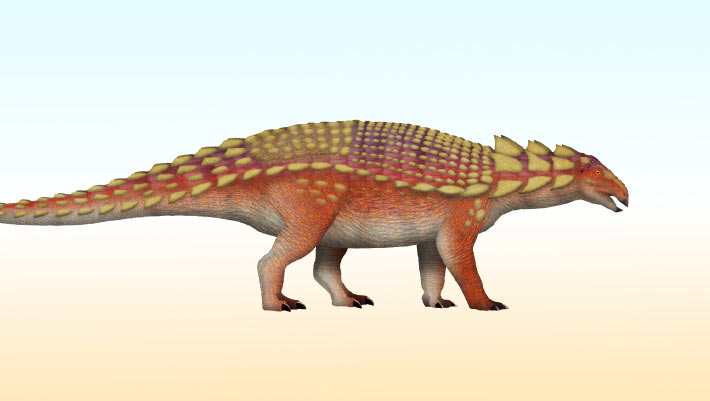
Skeletal reconstruction of Ahshislepelta minor, a small ankylosaur from the Late Cretaceous Kirtland Formation of New Mexico. While originally recovered as an ankylosaurid related to Gastonia, later analyses favored a nodosaurid position which this is based on. Based on the holotype SMP VP-1930, consisting of fragmentary shoulder, forelimb, and vertebral elements as well as several osteoderms. Unknown material filled in using Niobrarasaurus, Pawpawsaurus, Silvisaurus, Sauropelta, and Borealopelta. Total length is approximately 4.9 m through the centra.
Notes: Osteoderm placement somewhat speculative, not all osteoderms and vertebral fragments are figured.

References: Burns & Sullivan, 2011.
Taxons Ahshislepelta

Skeletal reconstruction of Ahshislepelta minor, a small ankylosaur from the Late Cretaceous Kirtland Formation of New Mexico. While originally recovered as an ankylosaurid related to Gastonia, later analyses favored a nodosaurid position which this is based on. Based on the holotype SMP VP-1930, consisting of fragmentary shoulder, forelimb, and vertebral elements as well as several osteoderms. Unknown material filled in using Niobrarasaurus, Pawpawsaurus, Silvisaurus, Sauropelta, and Borealopelta. Total length is approximately 4.9 m through the centra. Notes: Osteoderm placement somewhat speculative, not all osteoderms and vertebral fragments are figured. References: Burns & Sullivan, 2011.

Mexique Kirtland Crétacé Crétacé supérieur +13
a Ankylosaurus vertebra from the green sand of Folkestone (UK) - Albian

a Ankylosaurus vertebra from the green sand of Folkestone (UK) - Albian

vertèbre Royaume-Uni Albien Ankylosauria
Fossil of Pinacosaurus, an ankylosaurian  dinosaur
Took the photo at Musee d'Histoire Naturelle, Brussels
Taxons Eopinacosaurus

Fossil of Pinacosaurus, an ankylosaurian dinosaur Took the photo at Musee d'Histoire Naturelle, Brussels

fossile Ankylosauria Dinosauria Eopinacosaurus +1
Ankylosauria
Taxons Ankylosauria
Ankylosauria Ankylosauromorpha Euankylosauria
Euankylosauria
Taxons Euankylosauria
Ankylosauria Ankylosauromorpha Euankylosauria
Ankylosauromorpha
Taxons Ankylosauromorpha
Ankylosauria Ankylosauromorpha Euankylosauria
Gastonia
Taxons Gastonia
Ankylosauria Ankylosauromorpha Euankylosauria
A skeletal mount of the ankylosaur Akainacephalus in a traveling exhibit at the Fernbank Museum in Georgia
Taxons Akainacephalus

A skeletal mount of the ankylosaur Akainacephalus in a traveling exhibit at the Fernbank Museum in Georgia

musée Akainacephalus Ankylosauria Géorgie
Locality map for Australian eurypodan thyreophoran fossils.

1, Stegosaurian? footprint (QM F5701), Walloon Coal Measures, Balgowan Colliery, Balgowan (Bajocian–Bathonian); 2, Minmi paravertebra holotype (QM F10329) (Molnar, 1980), Minmi Member, Bungil Formation (Valanginian–Barremian); 3, Thyreophoran trackways, Broome Sandstone, Dampier Peninsula, Western Australia (Valanginian–Barremian); 4, Ankylosauria indet. (see Barrett et al., 2010) ‘Flat Rocks’ Wonthaggi Formation (upper Hauterivian–Albian); 5, NMV P216739, ‘Lake Copco–Dinosaur Cove’ Eumeralla Formation (middle upper Aptian to lower middle Albian) (Barrett et al., 2010); 6, QM F33286; 7, AM F119849 and AM F35259; 8, Kunbarrasaurus ieversi gen. et sp. nov. (formerly Minmi sp.) (QM F18101); 9, QM F33565 and QM F33566; 10, QM F44324-28. Legend: Dark Green, Toolebuc Formation (late middle–early late Albian); Green, Allaru Formation (upper Albian–(?)lower Cenomanian); Light green, Mackunda Formation (upper Albian–lower Cenomanian); Lightest green, Winton Formation (late Albian–early Turonian).
Formations Toolebuc

Locality map for Australian eurypodan thyreophoran fossils. 1, Stegosaurian? footprint (QM F5701), Walloon Coal Measures, Balgowan Colliery, Balgowan (Bajocian–Bathonian); 2, Minmi paravertebra holotype (QM F10329) (Molnar, 1980), Minmi Member, Bungil Formation (Valanginian–Barremian); 3, Thyreophoran trackways, Broome Sandstone, Dampier Peninsula, Western Australia (Valanginian–Barremian); 4, Ankylosauria indet. (see Barrett et al., 2010) ‘Flat Rocks’ Wonthaggi Formation (upper Hauterivian–Albian); 5, NMV P216739, ‘Lake Copco–Dinosaur Cove’ Eumeralla Formation (middle upper Aptian to lower middle Albian) (Barrett et al., 2010); 6, QM F33286; 7, AM F119849 and AM F35259; 8, Kunbarrasaurus ieversi gen. et sp. nov. (formerly Minmi sp.) (QM F18101); 9, QM F33565 and QM F33566; 10, QM F44324-28. Legend: Dark Green, Toolebuc Formation (late middle–early late Albian); Green, Allaru Formation (upper Albian–(?)lower Cenomanian); Light green, Mackunda Formation (upper Albian–lower Cenomanian); Lightest green, Winton Formation (late Albian–early Turonian).

Australie Broome Sandstone Eumeralla Toolebuc +18
Остеодерма анкилозавра (Ankylosauria indet.) в музее при местонахождении Шестаково-3 (илекская свита).

Остеодерма анкилозавра (Ankylosauria indet.) в музее при местонахождении Шестаково-3 (илекская свита).

Ankylosauria
Simple drawing of Ankylosaurus magniventris, a North American Cretaceous ankylosaurid. Based on skeletal reconstruction in Paul 2010.
Taxons Crichtonpelta

Simple drawing of Ankylosaurus magniventris, a North American Cretaceous ankylosaurid. Based on skeletal reconstruction in Paul 2010.

dessin Crétacé Ankylosauria Ankylosauridae +2
Hungarosaurus tormai (Ankylosauria, Nodosauridae), right dentary (MTM 2007.25.2) in lateral view
Taxons Hungarosaurus

Hungarosaurus tormai (Ankylosauria, Nodosauridae), right dentary (MTM 2007.25.2) in lateral view

Ankylosauria Hungarosaurus Nodosauridae
An Ankylosaurus head (cast of specimen AMNH 5214), on display at the Museum of the Rockies in Bozeman, Montana.  This is from a specimen collected in Custer County, Montana.
The Ankylosauria were armored dinosaurs that lived from 122 million years ago to 66 million years ago in western North America, Europe, and East Asia.  There were two subgroups:  The Nodosauridae and Ankylosauridae. 
The Ankylosauridae contained six species, and a single subfamily -- the Ankylosaurinae.  There 18 genus within the subfamily, of which Ankylosaurus is the best known.  Ankylosaurus as the last of these, and lived 65.5 to 66.5 million years ago.
Ankylosaurus was about 20.5 feet long, 5 feet wide, and 5.5 feet tall at the hip.  It walked on all fours, with the rear legs longer than the front ones.  They ripped vegetation, and swallowed it whole.  Their defining feature was their armor.  They body was covered in thick, heavy bony plates, and most of the plates were fused together to make them even stronger.  Embedded in the skin were more knobs of bone, and the outer skin above these knobs covered in keratin (the same stuff fingernails are made of).  Ankylosaurus had a tail club, which consisted of several large osteoderms fused to the last few tail vertebrae.

Ankylosaurus was discovered in 1908.
Taxons Ankylosaurus

An Ankylosaurus head (cast of specimen AMNH 5214), on display at the Museum of the Rockies in Bozeman, Montana. This is from a specimen collected in Custer County, Montana. The Ankylosauria were armored dinosaurs that lived from 122 million years ago to 66 million years ago in western North America, Europe, and East Asia. There were two subgroups: The Nodosauridae and Ankylosauridae. The Ankylosauridae contained six species, and a single subfamily -- the Ankylosaurinae. There 18 genus within the subfamily, of which Ankylosaurus is the best known. Ankylosaurus as the last of these, and lived 65.5 to 66.5 million years ago. Ankylosaurus was about 20.5 feet long, 5 feet wide, and 5.5 feet tall at the hip. It walked on all fours, with the rear legs longer than the front ones. They ripped vegetation, and swallowed it whole. Their defining feature was their armor. They body was covered in thick, heavy bony plates, and most of the plates were fused together to make them even stronger. Embedded in the skin were more knobs of bone, and the outer skin above these knobs covered in keratin (the same stuff fingernails are made of). Ankylosaurus had a tail club, which consisted of several large osteoderms fused to the last few tail vertebrae. Ankylosaurus was discovered in 1908.

armure musée moulage spécimen +5

Actualités

Ces minuscules fossiles de dinosaures ont trompé les scientifiques pendant 20 ans
armure os croissance fossile Ankylosauria Dinosauria découverte
De minuscules fossiles de dinosaures qui ont intrigué les scientifiques pendant plus de 20 ans ont enfin révélé leur véritable identité. Plutôt que d’appartenir à une espèce miniature, ce sont en réalité des bébés ankylosaures, certains âgés de moins d’un an, y compris un possible nouveau-né. En étudiant les schémas de croissance osseuse, les chercheurs ont confirmé que ces jeunes dinosaures n’étaient pas encore devenus des adultes de grande taille. La découverte apporte un nouvel éclairage sur la façon dont les ankylosaures se sont développés, montrant qu'ils ont commencé à développer une armure étonnamment tôt.
21/04/2026 sciencedaily ⚙ Traduction automatique
Zuul: Beast of the Week
Zuul : la bête de la semaine
film États-Unis Crétacé Crétacé supérieur Ankylosauria Dinosauria Zuul
 Cette semaine, nous allons découvrir un étonnant dinosaure blindé au nom délicieusement effrayant.  Découvrez le crurivastateur Zuul !  Zuul était un dinosaure ankylosaure qui vivait dans ce qui est aujourd'hui le Montana, aux États-Unis, à la fin du Crétacé, il y a environ 75 millions d'années.  Il mesurait environ 6 mètres du bec à la queue et aurait mangé des plantes de son vivant.  Le nom du genre fait directement référence au monstre du film Ghostbusters de 1984, qui, selon les paléontologues, ressemblait au dinosaure.
31/10/2025 prehistoricbeastoftheweek ⚙ Traduction automatique