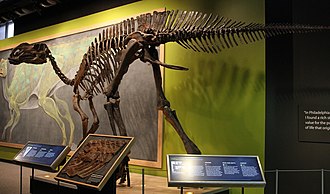
Hadrosauria

Taxon

11 image(s) · 7 Actualités

Voir la fiche

Galerie d'images

Malefica is a hadrosaurid dinosaur from the Late Cretaceous of Texas in the United States. Like other hadrosaurs, Malefica was herbivorous, processing plant matter with their broad beaks and battery of teeth in the back of the mouth. It could grow to around 6 m in length, and weighed about 1 t. The discovery of Malefica helped to understand the distribution of hadrosaurs in Cretaceous North America, as well as evolutionary lineages between basal hadrosaurs and the more derived saurolophids.
Taxons Malefica

Malefica is a hadrosaurid dinosaur from the Late Cretaceous of Texas in the United States. Like other hadrosaurs, Malefica was herbivorous, processing plant matter with their broad beaks and battery of teeth in the back of the mouth. It could grow to around 6 m in length, and weighed about 1 t. The discovery of Malefica helped to understand the distribution of hadrosaurs in Cretaceous North America, as well as evolutionary lineages between basal hadrosaurs and the more derived saurolophids.

États-Unis Crétacé Crétacé supérieur Dinosauria +5
A life restoration of the Hadrosaur Aquilarhinus palimentus.
Taxons Aquilarhinus

A life restoration of the Hadrosaur Aquilarhinus palimentus.

Aquilarhinus Hadrosauria
Plesiolophus is a lambeosaurine hadrosaur known from the same locality, but an earlier time period than Parasaurolophus. Though it is nearly impossible to know conclusively, Plesiolophus cannot be ruled out as a direct ancestor. Like Parasaurolophus, Plesiolophus would have had a distinct crest protruding backward from its skull.

Plesiolophus is a lambeosaurine hadrosaur known from the same locality, but an earlier time period than Parasaurolophus. Though it is nearly impossible to know conclusively, Plesiolophus cannot be ruled out as a direct ancestor. Like Parasaurolophus, Plesiolophus would have had a distinct crest protruding backward from its skull.

crête Hadrosauria Parasaurolophus Plesiolophus +1
Hadrosaurus
Taxons Hadrosaurus
Hadrosauria
Historical life restoration of “Hadrosaurus mirabilis” (i.e. Edmontosaurus annectens aka Anatosaurus copei) by a lake.
120
Reconstitution historique  d’un « Hadrosaurus mirabilis » (c’est-à-dire Edmontosaurus annectens alias Anatoasaurus copei) au bord d’un lac.

Historical life restoration of “Hadrosaurus mirabilis” (i.e. Edmontosaurus annectens aka Anatosaurus copei) by a lake. 120 Reconstitution historique d’un « Hadrosaurus mirabilis » (c’est-à-dire Edmontosaurus annectens alias Anatoasaurus copei) au bord d’un lac.

old school paléoart reconstitution Anatosaurus +2
Probactrosaurus hecho por Deibvort
Taxons Hadrosauria

Probactrosaurus hecho por Deibvort

Hadrosauria Hadrosauroidea Probactrosaurus Trachodontoidea
Probactrosaurus hecho por Deibvort
Taxons Trachodontoidea

Probactrosaurus hecho por Deibvort

Hadrosauria Hadrosauroidea Probactrosaurus Trachodontoidea
Malefica is a hadrosaurid dinosaur from the Late Cretaceous of Texas in the United States. Like other hadrosaurs, Malefica was herbivorous, processing plant matter with their broad beaks and battery of teeth in the back of the mouth. It could grow to around 6 m in length, and weighed about 1 t. The discovery of Malefica helped to understand the distribution of hadrosaurs in Cretaceous North America, as well as evolutionary lineages between basal hadrosaurs and the more derived saurolophids.

Malefica is a hadrosaurid dinosaur from the Late Cretaceous of Texas in the United States. Like other hadrosaurs, Malefica was herbivorous, processing plant matter with their broad beaks and battery of teeth in the back of the mouth. It could grow to around 6 m in length, and weighed about 1 t. The discovery of Malefica helped to understand the distribution of hadrosaurs in Cretaceous North America, as well as evolutionary lineages between basal hadrosaurs and the more derived saurolophids.

États-Unis Crétacé Crétacé supérieur Dinosauria +5
A life restoration of the Hadrosaur Aquilarhinus palimentus.

A life restoration of the Hadrosaur Aquilarhinus palimentus.

Aquilarhinus Hadrosauria
Figure 6. Hadrosaurs of North America, exemplied by the selection of skulls of valid nominal genera. The grey shadows on the skulls represent the reconstructed parts. Highlighted names indicate the unique genera for each region

Figure 6. Hadrosaurs of North America, exemplied by the selection of skulls of valid nominal genera. The grey shadows on the skulls represent the reconstructed parts. Highlighted names indicate the unique genera for each region

Hadrosauria Protohadros crâne
Pectoral girdles and forelimbs of dinosaurs in left lateral view, depicting resting scapular and forelimb orientations in different dinosaurian groups as recommended according to the results of this study.

In each case, solid horizontal line is parallel to long axis of sacrum. A. theropods without semilunate carpals (Dilophosaurus wetherilli, UCMP 37302). B. theropods with semilunate carpals other than Caudipteryx (Velociraptor mongoliensis, after reference [60]). C. Caudipteryx (C. sp., after reference [8]). D. ceratopsids (Styracosaurus albertensis, NMC 344). E. basal sauropodomorphs (Plateosaurus engelhardti, AMNH 6810). F. non-hadrosaurian ornithopods (Thescelosaurus neglectus, reference [62]). G. hadrosaurids (Parasaurolophus walkeri, after reference [48]). Angle labels: B = scapular orientation relative to long axis of sacrum. E = elbow angle. S = shoulder angle. W = wrist angle. See Materials and Methods section for descriptions of angles.

Pectoral girdles and forelimbs of dinosaurs in left lateral view, depicting resting scapular and forelimb orientations in different dinosaurian groups as recommended according to the results of this study. In each case, solid horizontal line is parallel to long axis of sacrum. A. theropods without semilunate carpals (Dilophosaurus wetherilli, UCMP 37302). B. theropods with semilunate carpals other than Caudipteryx (Velociraptor mongoliensis, after reference [60]). C. Caudipteryx (C. sp., after reference [8]). D. ceratopsids (Styracosaurus albertensis, NMC 344). E. basal sauropodomorphs (Plateosaurus engelhardti, AMNH 6810). F. non-hadrosaurian ornithopods (Thescelosaurus neglectus, reference [62]). G. hadrosaurids (Parasaurolophus walkeri, after reference [48]). Angle labels: B = scapular orientation relative to long axis of sacrum. E = elbow angle. S = shoulder angle. W = wrist angle. See Materials and Methods section for descriptions of angles.

description Caudipteryx Ceratopsidae Dilophosaurus +9
Hadrosauria

Actualités

Une vidéo exclusive du modèle CollectA Deluxe Magnapaulia
écaille Dinosauria Hadrosauria Magnapaulia
Everything Dinosaur a produit une courte vidéo mettant en avant un modèle de dinosaure CollectA Deluxe récemment introduit. Nous avons créé une vidéo exclusive du modèle CollectA Deluxe Magnapaulia. Cette impressionnante figurine d'hadrosaure est en stock et disponible chez Everything Dinosaur. La vidéo offre une vue rapprochée de cette remarquable lambéosaurine à l’échelle 1:60. Il met également en lumière certains des
19/08/2026 everythingdinosaur ⚙ Traduction automatique
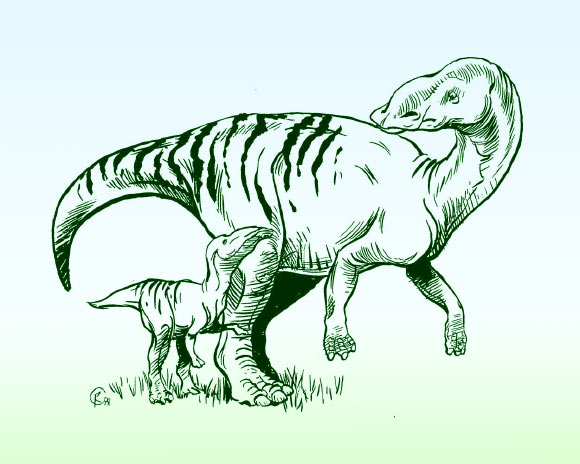
Modèle CollectA Deluxe Edmontosaurus se nourrissant de certains conifères
alimentation Crétacé Crétacé supérieur Dinosauria Edmontosaurus Hadrosauria
Merci Caldey de nous avoir envoyé une photo de votre CollectA Deluxe Edmontosaurus se nourrissant dans le jardin.  Le dinosaure a l’air très à l’aise en grignotant certains conifères.  Les paléontologues savent, grâce au contenu de l'estomac des hadrosaures, que ces herbivores du Crétacé supérieur se nourrissaient de conifères.  C'est une photographie délicieusement composée.  L'angle de vision donne l'impression
23/06/2026 everythingdinosaur ⚙ Traduction automatique
Une nouvelle étude suggère que le jeune Maiasaura mangeait des aliments différents de ceux des adultes
dent alimentation fossile juvénile Hadrosauria Maiasaura étude
Un article scientifique récemment publié a fourni de nouvelles informations sur les habitudes alimentaires du célèbre hadrosaure Maiasaura peeblesorum. L'analyse de l'usure des dents chez les Maiasaura juvéniles par rapport aux hadrosaures adultes suggère que les jeunes Maiasaura se nourrissaient différemment des animaux adultes. Les chercheurs ont examiné l’usure dentaire associée aux dents fossiles de Maiasaura peeblesorum.  Des informations sur l'alimentation peuvent aider à
13/05/2026 everythingdinosaur ⚙ Traduction automatique
Dinosaurs May Have Fed Their Young a Special Diet, Study Suggests
Les dinosaures auraient pu nourrir leurs petits avec un régime spécial, selon une étude
dent juvénile Dinosauria Hadrosauria Maiasaura étude
Une analyse de l'usure des dents fossilisées du dinosaure hadrosaure Maiasaura peeblesorum indique que leurs juvéniles pourraient avoir mangé des aliments plus mous et plus nutritifs que les adultes, ce qui fait allusion à des soins parentaux avancés chez les dinosaures. L'article Les dinosaures pourraient avoir nourri leurs petits avec un régime spécial, suggère une étude, apparaît en premier sur Sci.News : Breaking Science News.
11/05/2026 sci-news ⚙ Traduction automatique
Gongshuilong: Beast of the Week
Gongshuilong : Bête de la semaine
os Chine Crétacé Crétacé supérieur Gongshuilong Hadrosauria
 Aujourd'hui, nous examinons un hadrosaure récemment décrit avec un look unique, Gongshuilong fanwei ! Gongshuilong vivait dans ce qui est aujourd'hui l'est de la Chine, à la fin du Crétacé, il y a entre 68 et 66 millions d'années.  Du bec à la queue, il mesurait environ 7 m de long et aurait été un herbivore de son vivant.  Le nom du genre se traduit du mandarin par "Dragon de la rivière Gong" en référence à la rivière Gong près de l'endroit où ses os ont été découverts. Reconstruction de la vie de Gongshuilong à l'aquarelle b
10/05/2026 prehistoricbeastoftheweek ⚙ Traduction automatique
1 2