oiseau

Thématique

23 image(s) · 26 Actualités

Galerie d'images

Diagram illustrating the "Temporal paradox" in paleontology. First given it's nickname by Alan Feduccia, the paradox is made up by the fact that almost all feathered dinosaurs are dated to have lived millions of years after Archaeopteryx, the oldest bird (late Jurassic, believed to have existed about 150 million years ago). Only a few of the feathered dinosaurs/birdlike dinosaurs are given an older date than Archaeopteryx.

Diagram illustrating the "Temporal paradox" in paleontology. First given it's nickname by Alan Feduccia, the paradox is made up by the fact that almost all feathered dinosaurs are dated to have lived millions of years after Archaeopteryx, the oldest bird (late Jurassic, believed to have existed about 150 million years ago). Only a few of the feathered dinosaurs/birdlike dinosaurs are given an older date than Archaeopteryx.

Jurassique Jurassique supérieur Archaeopteryx Coelurosauria +2
Restoration of Early Jurassic environment preserved at the SGDS, with the theropod Dilophosaurus wetherilli in bird-like resting pose, demonstrating the manufacture of SGDS.18.T1 resting trace.

Restoration of Early Jurassic environment preserved at the SGDS, with the theropod Dilophosaurus wetherilli in bird-like resting pose, demonstrating the manufacture of SGDS.18.T1 resting trace.

Jurassique inférieur Jurassique Dilophosaurus Neotheropoda +1
Diagram made to illustrate the debate over the hands of theropod dinosaurs and their alleged descendants, the birds ( Aves ). In the last years, the difference between the hands of theropods and birds have been an important thing when it comes question the theory that birds evolved from dinosaurs, even though some scientists may could refute it. In the diagram, a Neotheropoda ( 1 ), basal tetanurae ( 2 ), a coelurosaurian ( 3 ), the bird (?)Archaeopteryx ( 4 ) and modern bird ( 5 ).
In 1997, birdexpert Alan Feduccia at University of North Carolina discovered that birds develop hands with the digits II, III and IV ( see The Cincinnati Enquirer, 25 - 10 - 1997 ). This is in contrast with the hands of tetanurae, which seems to have the digits I, II and III. This make it almost impossible for dinosaurs and birds to be closely related, according to Feduccia.
Since the discovery by Feduccia, scientific research have came up with a possible explanation to the mystery of the dinosaur - bird hand difference, called The frame shift hypothesis ( see http://scienceblogs.com/tetrapodzoology/2009/06/limusaurus_is_awesome.php ). This hypothesis is based on a discovery which shows that although bird embryos develop the fingers II, III and IV, the genes which is coding for the external appearance of the digits seems to be from the fingers I, II and III. Based on this, scientists belive this: when neotheropods evolved into tetanurae, the losed digit I ( not digit IV, as earlier suggested ). During this process, the genes which coded for how the digits should looks like ( the number of phalanges, for example ) became refurnished ( see the color spots in th upper section in the diagram to understan ). The discovery of Limusaurus has been said to support this theory ( see https://www.livescience.com/animals/090617-dinosaur-hands.html ).
One thing is that may can be used to refute that Limusaurus should support the Frame shift hypothesis is that Limusaurus was a ceratosaurian, and is dated to be much younger than the oldest tetanurae's.
Also, some tetanure´s may had 4 digits' like the Archaeornithomimus ( see number 4 in the diagram ) ( see also http://dml.cmnh.org/1998Oct/msg00443.html and the Allosaurus hand in the image here: http://upload.wikimedia.org/wikipedia/commons/6/69/Allosaurus-mounted.jpg ). If this is the digits I, II, III and IV. If so, it shows that tetanurae had the digits I, II and III, and not II, II and IV, like birds.
For more in this debate, see text section to my picture Raptor-Archaeopteryx-bird hands differens.JPG at http://commons.wikimedia.org/wiki/File:Raptor-Archaeopteryx-bird_hands_differens.JPG.

Diagram made to illustrate the debate over the hands of theropod dinosaurs and their alleged descendants, the birds ( Aves ). In the last years, the difference between the hands of theropods and birds have been an important thing when it comes question the theory that birds evolved from dinosaurs, even though some scientists may could refute it. In the diagram, a Neotheropoda ( 1 ), basal tetanurae ( 2 ), a coelurosaurian ( 3 ), the bird (?)Archaeopteryx ( 4 ) and modern bird ( 5 ). In 1997, birdexpert Alan Feduccia at University of North Carolina discovered that birds develop hands with the digits II, III and IV ( see The Cincinnati Enquirer, 25 - 10 - 1997 ). This is in contrast with the hands of tetanurae, which seems to have the digits I, II and III. This make it almost impossible for dinosaurs and birds to be closely related, according to Feduccia. Since the discovery by Feduccia, scientific research have came up with a possible explanation to the mystery of the dinosaur - bird hand difference, called The frame shift hypothesis ( see http://scienceblogs.com/tetrapodzoology/2009/06/limusaurus_is_awesome.php ). This hypothesis is based on a discovery which shows that although bird embryos develop the fingers II, III and IV, the genes which is coding for the external appearance of the digits seems to be from the fingers I, II and III. Based on this, scientists belive this: when neotheropods evolved into tetanurae, the losed digit I ( not digit IV, as earlier suggested ). During this process, the genes which coded for how the digits should looks like ( the number of phalanges, for example ) became refurnished ( see the color spots in th upper section in the diagram to understan ). The discovery of Limusaurus has been said to support this theory ( see https://www.livescience.com/animals/090617-dinosaur-hands.html ). One thing is that may can be used to refute that Limusaurus should support the Frame shift hypothesis is that Limusaurus was a ceratosaurian, and is dated to be much younger than the oldest tetanurae's. Also, some tetanure´s may had 4 digits' like the Archaeornithomimus ( see number 4 in the diagram ) ( see also http://dml.cmnh.org/1998Oct/msg00443.html and the Allosaurus hand in the image here: http://upload.wikimedia.org/wikipedia/commons/6/69/Allosaurus-mounted.jpg ). If this is the digits I, II, III and IV. If so, it shows that tetanurae had the digits I, II and III, and not II, II and IV, like birds. For more in this debate, see text section to my picture Raptor-Archaeopteryx-bird hands differens.JPG at http://commons.wikimedia.org/wiki/File:Raptor-Archaeopteryx-bird_hands_differens.JPG.

Archaeopteryx Coelurosauria Dinosauria Neotheropoda +3
The Chicago specimen of Archaeopteryx (PA 830), a well-preserved fossil highlighting the transitional features between non-avian dinosaurs and birds, housed at the Field Museum of Natural History.

The Chicago specimen of Archaeopteryx (PA 830), a well-preserved fossil highlighting the transitional features between non-avian dinosaurs and birds, housed at the Field Museum of Natural History.

musée fossile spécimen Archaeopteryx +2
This diagram illustrates how scientists believe the dinosaur group theropoda shall be classed in a  phylogenetic tree, besides Sauropoda and Pterosauria. The main reason of this diagram is to show groups or families which had respiratory system like birds. AS in the diagram is abbreviations for "Airsacs", and ASW means "AirSacs supported by immobile femur and a knee-driven Walk". BL means "Bellow lungs". 
Airsacs are known in many different theropods, as well as in birds, which most scientists believe are descendants of dinosaurus. Air sacs are found in the primitive Tawa hallae,[1] the abelisaurid Majungasaurus,[2] as well as Allosauroids like Aerosteon.[3] There is also evidence for respiratory systems like penguinss in Deinonychosaurians.[4] The primitive bird Archaeopteryx also had airsacs (Bonde and Christiansen, 2000).
It is very likely that Deinonychosaurians had airsacs. We don't know  whether Deinonychosauria had a walking/breathing system with immobile thighbones, ASW (like birds) or movable thighbones. However, some people suggsest coeluosaurs had the same type of leg movement as birds ("kneedriven walking").[5]
Bellow lungs are lungs like our own, which alternately is filled with air, and thereafter emptied, after which you take a new breath. This type of lungs exist in mammals, most reptiles, and most amphibians (although some frogs get their oxygen through the skin). There is no evidence for airsacs in Ornithischia, so the likely had bellow lungs.
References.=

↑ (see the video at http://www.nsf.gov/news/special_reports/tawa/)

↑ (Claessens & O'connor, 2006).

↑ Alcober O.A, Sereno P.C, Larsson H.C.E et.al (2008), "Evidence for Avian Intrathoracic Air Sacs in a New Predatory Dinosaur from Argentina", Public Library of Science Journals.

↑ http://www.stumbleupon.com/su/20q5Z4/news.bbc.co.uk/2/hi/science/nature/7081166.stm

↑ http://www.geol.umd.edu/~tholtz/G104/lectures/104coelur.html.

This diagram illustrates how scientists believe the dinosaur group theropoda shall be classed in a phylogenetic tree, besides Sauropoda and Pterosauria. The main reason of this diagram is to show groups or families which had respiratory system like birds. AS in the diagram is abbreviations for "Airsacs", and ASW means "AirSacs supported by immobile femur and a knee-driven Walk". BL means "Bellow lungs". Airsacs are known in many different theropods, as well as in birds, which most scientists believe are descendants of dinosaurus. Air sacs are found in the primitive Tawa hallae,[1] the abelisaurid Majungasaurus,[2] as well as Allosauroids like Aerosteon.[3] There is also evidence for respiratory systems like penguinss in Deinonychosaurians.[4] The primitive bird Archaeopteryx also had airsacs (Bonde and Christiansen, 2000). It is very likely that Deinonychosaurians had airsacs. We don't know whether Deinonychosauria had a walking/breathing system with immobile thighbones, ASW (like birds) or movable thighbones. However, some people suggsest coeluosaurs had the same type of leg movement as birds ("kneedriven walking").[5] Bellow lungs are lungs like our own, which alternately is filled with air, and thereafter emptied, after which you take a new breath. This type of lungs exist in mammals, most reptiles, and most amphibians (although some frogs get their oxygen through the skin). There is no evidence for airsacs in Ornithischia, so the likely had bellow lungs. References.= ↑ (see the video at http://www.nsf.gov/news/special_reports/tawa/) ↑ (Claessens & O'connor, 2006). ↑ Alcober O.A, Sereno P.C, Larsson H.C.E et.al (2008), "Evidence for Avian Intrathoracic Air Sacs in a New Predatory Dinosaur from Argentina", Public Library of Science Journals. ↑ http://www.stumbleupon.com/su/20q5Z4/news.bbc.co.uk/2/hi/science/nature/7081166.stm ↑ http://www.geol.umd.edu/~tholtz/G104/lectures/104coelur.html.

Abelisauridae Aerosteon Archaeopteryx Deinonychosauria +7
Representative taxa from the latest Campanian–Maastrichtian faunas from Transylvania, western Romania. A–B Nidophis insularis (Serpentes, Madtsoiidae), articulated vertebrae (LPB (FGGUB) v.547/2) in left lateral (A) and dorsal (B) views (Densuş-Ciula Formation, Tuştea, Haţeg Basin; photo by Ştefan Vasile) C Allodaposuchus precedens (Eusuchia, ?Hylaeochampsidae), skull (PSMUBB V 438) in dorsal view (Sebeş = Şard Formation, Oarda de Jos, southwestern Transylvanian Basin; photo by Vlad Codrea/Massimo Delfino) D Theriosuchus sympiestodon (Mesoeucrocodylia, Atoposauridae), right maxilla (MCDRD 793) in lateral view (Sînpetru Formation, Sînpetru, Haţeg Basin) E–F Indeterminate titanosaur (?Magyarosaurus dacus) (Sauropoda, Titanosauria), isolated osteoderm (LPB (FGGUB) R.1410) in dorsal (E) and lateral (F) views (Sînpetru Formation, Sînpetru, Haţeg Basin) G Indeterminate ornithuran bird (Aves, Ornithurae), incomplete left tibiotarsus (LPB (FGGUB) R.1902) in anterior view (Densuş-Ciula Formation, Vălioara, Haţeg Basin) H Balaur bondoc (Theropoda, Dromaeosauridae), articulated left distal hindlimb (EME PV.313) in lateral view (Sebeş = Şard Formation, Sebeş-Glod, southewestern Transylvanian Basin; photo by Mick Ellison) I Zalmoxes robustus (Ornithopoda, Rhabdodontidae), right dentary (NHMUK R.3407) in medial view (Sînpetru Formation, Sînpetru, Haţeg Basin) J Telmatosaurus transsylvanicus (Hadrosauria), right maxilla (MFGI unnumbered) in lateral view (Sînpetru Formation, Sînpetru, Haţeg Basin) K Indeterminate nodosaurid – Struthiosaurus transylvanicus or new taxon – (Ankylosauria, Nodosauridae), isolated tooth (LPB (FGGUB) R.2182) in medial view (Sînpetru Formation, Sînpetru, Haţeg Basin) L Barbatodon transylvanicus (Multituberculata, Kogaionidae), right maxilla (LPB (FGGUB) M.1635) in medial view (Sînpetru Formation, Pui, Haţeg Basin). Scale bars equal 1 mm in A, B; 5 mm in K; 1 cm in G, L; 2 cm in D; and 5 cm in C, E, F, H, I, J.

Representative taxa from the latest Campanian–Maastrichtian faunas from Transylvania, western Romania. A–B Nidophis insularis (Serpentes, Madtsoiidae), articulated vertebrae (LPB (FGGUB) v.547/2) in left lateral (A) and dorsal (B) views (Densuş-Ciula Formation, Tuştea, Haţeg Basin; photo by Ştefan Vasile) C Allodaposuchus precedens (Eusuchia, ?Hylaeochampsidae), skull (PSMUBB V 438) in dorsal view (Sebeş = Şard Formation, Oarda de Jos, southwestern Transylvanian Basin; photo by Vlad Codrea/Massimo Delfino) D Theriosuchus sympiestodon (Mesoeucrocodylia, Atoposauridae), right maxilla (MCDRD 793) in lateral view (Sînpetru Formation, Sînpetru, Haţeg Basin) E–F Indeterminate titanosaur (?Magyarosaurus dacus) (Sauropoda, Titanosauria), isolated osteoderm (LPB (FGGUB) R.1410) in dorsal (E) and lateral (F) views (Sînpetru Formation, Sînpetru, Haţeg Basin) G Indeterminate ornithuran bird (Aves, Ornithurae), incomplete left tibiotarsus (LPB (FGGUB) R.1902) in anterior view (Densuş-Ciula Formation, Vălioara, Haţeg Basin) H Balaur bondoc (Theropoda, Dromaeosauridae), articulated left distal hindlimb (EME PV.313) in lateral view (Sebeş = Şard Formation, Sebeş-Glod, southewestern Transylvanian Basin; photo by Mick Ellison) I Zalmoxes robustus (Ornithopoda, Rhabdodontidae), right dentary (NHMUK R.3407) in medial view (Sînpetru Formation, Sînpetru, Haţeg Basin) J Telmatosaurus transsylvanicus (Hadrosauria), right maxilla (MFGI unnumbered) in lateral view (Sînpetru Formation, Sînpetru, Haţeg Basin) K Indeterminate nodosaurid – Struthiosaurus transylvanicus or new taxon – (Ankylosauria, Nodosauridae), isolated tooth (LPB (FGGUB) R.2182) in medial view (Sînpetru Formation, Sînpetru, Haţeg Basin) L Barbatodon transylvanicus (Multituberculata, Kogaionidae), right maxilla (LPB (FGGUB) M.1635) in medial view (Sînpetru Formation, Pui, Haţeg Basin). Scale bars equal 1 mm in A, B; 5 mm in K; 1 cm in G, L; 2 cm in D; and 5 cm in C, E, F, H, I, J.

Roumanie Densuş-Ciula Sebeş Sînpetru +9
The Naturmuseum Senckenberg in Frankfurt is the second largest museum of natural history in Germany. It is particularly popular with children, who enjoy the extensive collection of dinosaur skeletons: Senckenberg boasts the largest exhibition of large dinosaurs in Europe. One particular treasure is a dinosaur fossil with unique, preserved scaled skin. The museum contains the world's largest and most diverse collection of stuffed birds with about 2000 specimens.

The Naturmuseum Senckenberg in Frankfurt is the second largest museum of natural history in Germany. It is particularly popular with children, who enjoy the extensive collection of dinosaur skeletons: Senckenberg boasts the largest exhibition of large dinosaurs in Europe. One particular treasure is a dinosaur fossil with unique, preserved scaled skin. The museum contains the world's largest and most diverse collection of stuffed birds with about 2000 specimens.

musée Allemagne fossile spécimen +4
Fossil specimen RTMP 82.19.23 - A lacrimal, postorbitals, squamosals, frontals, parietals, and braincase referred to Latenivenatrix mcmasterae, but formerly assigned to Stenonychosaurus inequalis (=Troodon inequalis). Described by 

Currie, 1985. "Cranial anatomy of Stenonychosaurus inequalis (Saurischia, Theropoda) and its bearing on the origin of birds." Canadian Journal of Earth Sciences, 22(1), 643-658.
5d-dinosaur-camp-day2-20120802-15.jpg

Fossil specimen RTMP 82.19.23 - A lacrimal, postorbitals, squamosals, frontals, parietals, and braincase referred to Latenivenatrix mcmasterae, but formerly assigned to Stenonychosaurus inequalis (=Troodon inequalis). Described by Currie, 1985. "Cranial anatomy of Stenonychosaurus inequalis (Saurischia, Theropoda) and its bearing on the origin of birds." Canadian Journal of Earth Sciences, 22(1), 643-658. 5d-dinosaur-camp-day2-20120802-15.jpg

Canada fossile spécimen Dinosauria +7
Saurexallopus, a four toed dinosaur or bird trace fossil (jr syn Exallopus

Saurexallopus, a four toed dinosaur or bird trace fossil (jr syn Exallopus

fossile Dinosauria Exallopus Saurexallopus +1
Megapnosaurus is a coelophysid theropod dinosaur from the Early Jurassic Period of Africa. It was a lightly built bipedal carnivore that grew to just over 2 m long and 13 kg in body mass. Its close relation to Coelophysis has caused some confusion in classifying the genus - it had a slender build and curved S-shaped neck, but was more robust. Comparisons between the scleral rings of Megapnosaurus and modern birds and reptiles indicate that it may have been nocturnal.

Megapnosaurus is a coelophysid theropod dinosaur from the Early Jurassic Period of Africa. It was a lightly built bipedal carnivore that grew to just over 2 m long and 13 kg in body mass. Its close relation to Coelophysis has caused some confusion in classifying the genus - it had a slender build and curved S-shaped neck, but was more robust. Comparisons between the scleral rings of Megapnosaurus and modern birds and reptiles indicate that it may have been nocturnal.

Jurassique inférieur Jurassique Coelophysidae Coelophysis +3
1 2

Actualités

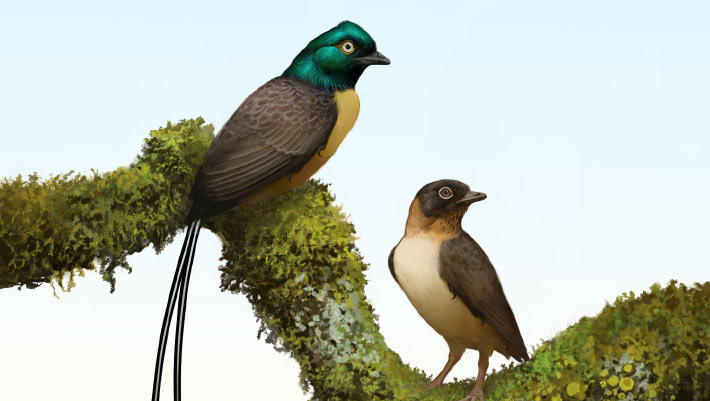
Cet oiseau fossile arborait un étonnant plumage sur la queue
plume Crétacé fossile oiseau
Une espèce d'oiseau du Crétacé nouvellement décrite possédait d'étonnamment longues plumes sur la queue. Les chercheurs supposent qu'elles aidaient les mâles à séduire les femelles.
01/06/2026 sciencesetavenir
Cretaceous Bird from China Had Pair of Tail Feathers Twice as Long as Its Body
Un oiseau du Crétacé de Chine avait une paire de plumes de queue deux fois plus longues que son corps
plume Chine Crétacé oiseau
Nommée Plumadraco bankoorum, l'espèce d'oiseau énantiornithine nouvellement décrite vivait dans ce qui est aujourd'hui le nord-est de la Chine pendant la période du Crétacé, il y a environ 121 millions d'années. L'article Un oiseau du Crétacé de Chine avait une paire de plumes de queue deux fois plus longues que son corps est apparu en premier sur Sci.News : Breaking Science News.
28/05/2026 sci-news ⚙ Traduction automatique
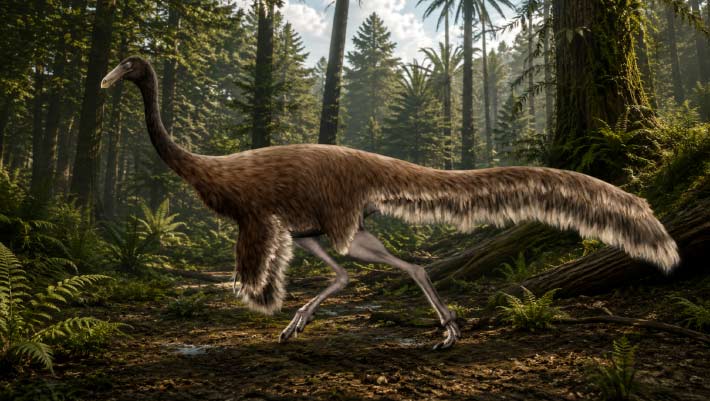
Rare Ostrich-Like Dinosaur Fossil Found on Canadian Island
Un rare fossile de dinosaure ressemblant à une autruche découvert sur une île canadienne
vertèbre Canada Colombie fossile Dinosauria Ornithomimosauria oiseau
Des paléontologues canadiens affirment avoir découvert une vertèbre caudale de dinosaure dans des roches marines vieilles de 75 à 80 millions d'années sur une petite île au large de la Colombie-Britannique, fournissant ainsi la preuve la plus claire à ce jour que des ornithomimosaures ressemblant à des oiseaux parcouraient autrefois l'ancienne côte du Pacifique de l'Amérique du Nord. L'article Un fossile rare de dinosaure ressemblant à une autruche trouvé sur une île canadienne est apparu en premier sur Sci.News : Breaking Science News.
25/05/2026 sci-news ⚙ Traduction automatique
Magnifique dessin de Muttaburrasaurus par un artiste talentueux
dessin Muttaburrasaurus comportement oiseau
Nos remerciements à la talentueuse artiste Caldey pour avoir partagé avec nous son magnifique dessin de Muttaburrasaurus.  Le couple Muttaburrasaurus se frotte doucement la tête.  Un tel comportement est observé chez les oiseaux vivants. Ce comportement est souvent appelé allopreening. Il réaffirme le lien social.  Les oiseaux existants se livrent à de tels comportements, notamment en se frottant le bec (facturation).  Il
09/05/2026 everythingdinosaur ⚙ Traduction automatique
Un reptile momifié vieux de 289 millions d'années révèle comment la respiration a commencé sur terre
oiseau mammifères
Un reptile momifié remarquablement préservé datant d’il y a 289 millions d’années est en train de réécrire ce que nous savons sur la façon dont les animaux respiraient pour la première fois sur terre. Cette minuscule créature, Captorhinus aguti, révèle la première version connue du système respiratoire actionné par les côtes utilisé par les reptiles, les oiseaux et les mammifères modernes – une innovation cruciale qui a aidé les vertébrés à prospérer en dehors de l'eau.
23/04/2026 sciencedaily ⚙ Traduction automatique
1 2 3 4 5 6