écaille

Partie anatomique

207 image(s) · 11 Actualités

Galerie d'images

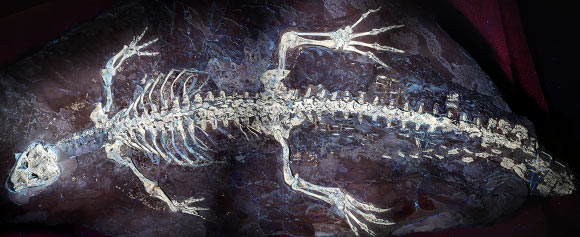
Besanosaurus leptorhynchus referred specimen PIMUZ T 4376, preserved on the same slab as a specimen of the smaller Mixosaurus. Scale bar represents 50 cm (1.6 ft). Figure 3C of Bindellini et al. (2021).
References:

Bindellini, G.; Wolniewicz, A.S.; Miedema, F.; Scheyer, T.M.; Dal Sasso, C. (2021). "Cranial anatomy of Besanosaurus leptorhynchus Dal Sasso & Pinna, 1996 (Reptilia: Ichthyosauria) from the Middle Triassic Besano Formation of Monte San Giorgio, Italy/Switzerland: Taxonomic and palaeobiological implications". PeerJ 9: e11179. DOI:10.7717/peerj.11179.

Besanosaurus leptorhynchus referred specimen PIMUZ T 4376, preserved on the same slab as a specimen of the smaller Mixosaurus. Scale bar represents 50 cm (1.6 ft). Figure 3C of Bindellini et al. (2021). References: Bindellini, G.; Wolniewicz, A.S.; Miedema, F.; Scheyer, T.M.; Dal Sasso, C. (2021). "Cranial anatomy of Besanosaurus leptorhynchus Dal Sasso & Pinna, 1996 (Reptilia: Ichthyosauria) from the Middle Triassic Besano Formation of Monte San Giorgio, Italy/Switzerland: Taxonomic and palaeobiological implications". PeerJ 9: e11179. DOI:10.7717/peerj.11179.

écaille Italie Suisse Trias moyen +8
Compsognathidae skeletons to scale.
Taxons Compsognathidae

Compsognathidae skeletons to scale.

écaille Compsognatha Compsognathidae Sinosauropterygidae +1
Compsognathidae skeletons to scale.
Taxons Sinosauropterygidae

Compsognathidae skeletons to scale.

écaille Compsognatha Compsognathidae Sinosauropterygidae +1
Compsognathidae skeletons to scale.
Taxons Compsognatha

Compsognathidae skeletons to scale.

écaille Compsognatha Compsognathidae Sinosauropterygidae +1
Stratigraphy of the Upper Cretaceous Neuquén Group (after Garrido) indicating stratigraphic positions of definitive unenlagiine taxa (modified from Gianechini and Gianechini & Apesteguía). Skeletal reconstructions to approximate scale, redrawn and/or modified from works by Scott Hartman (Buitreraptor gonzalezorum, Austroraptor cabazai), Gabriel Lio (Unenlagia comahuensis, Neuquenraptor argentinus, Unenlagia paynemili), and Jaime Headden (Pamparaptor micros, Diuqin lechiguanae), used with permission
Taxons Unenlagiinae

Stratigraphy of the Upper Cretaceous Neuquén Group (after Garrido) indicating stratigraphic positions of definitive unenlagiine taxa (modified from Gianechini and Gianechini & Apesteguía). Skeletal reconstructions to approximate scale, redrawn and/or modified from works by Scott Hartman (Buitreraptor gonzalezorum, Austroraptor cabazai), Gabriel Lio (Unenlagia comahuensis, Neuquenraptor argentinus, Unenlagia paynemili), and Jaime Headden (Pamparaptor micros, Diuqin lechiguanae), used with permission

écaille Crétacé Austroraptor Buitreraptor +6
Figure 4
The reconstruction of the skull and lower jaw of the holotype of Darwinopterus camposi sp. nov. (IVPP V 17957). Scale bar: 50 mm. Abbreviations: d, dentary; f, frontal; j, jugal; ltf, lower temporal fenestra; m, maxilla; man.sys, mandibular symphysis; naof, nasoantorbital fenestra; o, orbit; p, parietal; pm, premaxilla; pmcr, premaxillary crest; po, postorbital; prn, nasal process; q, quadrate; sq, squamosal; utf, upper temporal fenestra.
Taxons Monofenestrata

Figure 4 The reconstruction of the skull and lower jaw of the holotype of Darwinopterus camposi sp. nov. (IVPP V 17957). Scale bar: 50 mm. Abbreviations: d, dentary; f, frontal; j, jugal; ltf, lower temporal fenestra; m, maxilla; man.sys, mandibular symphysis; naof, nasoantorbital fenestra; o, orbit; p, parietal; pm, premaxilla; pmcr, premaxillary crest; po, postorbital; prn, nasal process; q, quadrate; sq, squamosal; utf, upper temporal fenestra.

crête écaille holotype Darwinoptera +3
Figure 4
The reconstruction of the skull and lower jaw of the holotype of Darwinopterus camposi sp. nov. (IVPP V 17957). Scale bar: 50 mm. Abbreviations: d, dentary; f, frontal; j, jugal; ltf, lower temporal fenestra; m, maxilla; man.sys, mandibular symphysis; naof, nasoantorbital fenestra; o, orbit; p, parietal; pm, premaxilla; pmcr, premaxillary crest; po, postorbital; prn, nasal process; q, quadrate; sq, squamosal; utf, upper temporal fenestra.
Taxons Darwinoptera

Figure 4 The reconstruction of the skull and lower jaw of the holotype of Darwinopterus camposi sp. nov. (IVPP V 17957). Scale bar: 50 mm. Abbreviations: d, dentary; f, frontal; j, jugal; ltf, lower temporal fenestra; m, maxilla; man.sys, mandibular symphysis; naof, nasoantorbital fenestra; o, orbit; p, parietal; pm, premaxilla; pmcr, premaxillary crest; po, postorbital; prn, nasal process; q, quadrate; sq, squamosal; utf, upper temporal fenestra.

crête écaille holotype Darwinoptera +3
Skeletal reconstruction of Suchomimus tenerensis and Baryonyx walkeri to scale.
Taxons Baryonychinae

Skeletal reconstruction of Suchomimus tenerensis and Baryonyx walkeri to scale.

écaille Baryonychinae Baryonyx Ceratosuchopsini +1
Skeletal reconstruction of Suchomimus tenerensis and Baryonyx walkeri to scale.
Taxons Ceratosuchopsini

Skeletal reconstruction of Suchomimus tenerensis and Baryonyx walkeri to scale.

écaille Baryonychinae Baryonyx Ceratosuchopsini +1
Targaryendraco wiedenrothi (formerly ‘Ornithocheirus’), holotype SMNS 56628 (Hauterivian, Engelbostel clay pit, Hannover), anterior part of the mandibular symphysis. A dorsal view B respective line drawing C left lateral view D respective line drawing. Abbreviations: d – dentary, sul – sulcus. Arrows and numbers indicate alveoli or teeth and their respective position. Scale bar = 10 mm.
Taxons Targaryendraco

Targaryendraco wiedenrothi (formerly ‘Ornithocheirus’), holotype SMNS 56628 (Hauterivian, Engelbostel clay pit, Hannover), anterior part of the mandibular symphysis. A dorsal view B respective line drawing C left lateral view D respective line drawing. Abbreviations: d – dentary, sul – sulcus. Arrows and numbers indicate alveoli or teeth and their respective position. Scale bar = 10 mm.

écaille dessin Hauterivien holotype +3
Targaryendraco wiedenrothi (formerly ‘Ornithocheirus’), holotype SMNS 56628 (Hauterivian, Engelbostel clay pit, Hannover), anterior part of the mandibular symphysis. A dorsal view B respective line drawing C left lateral view D respective line drawing. Abbreviations: d – dentary, sul – sulcus. Arrows and numbers indicate alveoli or teeth and their respective position. Scale bar = 10 mm.
Taxons Targaryendraconia

Targaryendraco wiedenrothi (formerly ‘Ornithocheirus’), holotype SMNS 56628 (Hauterivian, Engelbostel clay pit, Hannover), anterior part of the mandibular symphysis. A dorsal view B respective line drawing C left lateral view D respective line drawing. Abbreviations: d – dentary, sul – sulcus. Arrows and numbers indicate alveoli or teeth and their respective position. Scale bar = 10 mm.

écaille dessin Hauterivien holotype +3
Type specimen of Pterodactylus scolopaciceps (BSP AS V 29 a). Scale bar = 20 mm.
Taxons Aerodactylus

Type specimen of Pterodactylus scolopaciceps (BSP AS V 29 a). Scale bar = 20 mm.

écaille spécimen Aerodactylus Pterodactylus
CMN 50791, mid-cervical vertebra (C6) of Sigilmassasaurus brevicollis.

(A) posterior view; (B) anterior view; (C) ventral view; (D) dorsal view; (E) right lateral view; (F) left lateral view. Abbreviations: cpf, central pneumatic foramen; epi, epipophyses; iprl, interprezygapophyseal lamina; ns, neural spine; poz, postzygapophysis; pp, parapophysis; prz, prezygapophysis; tp, transverse process; vtp, ventral triangular plateau. Scale bar equals 10 cm.
Taxons Sigilmassasaurus

CMN 50791, mid-cervical vertebra (C6) of Sigilmassasaurus brevicollis. (A) posterior view; (B) anterior view; (C) ventral view; (D) dorsal view; (E) right lateral view; (F) left lateral view. Abbreviations: cpf, central pneumatic foramen; epi, epipophyses; iprl, interprezygapophyseal lamina; ns, neural spine; poz, postzygapophysis; pp, parapophysis; prz, prezygapophysis; tp, transverse process; vtp, ventral triangular plateau. Scale bar equals 10 cm.

écaille vertèbre Sigilmassasaurus
Fig 3. Skeletal map of Keilhauia nui (PMO 222.655) viewed from the side stratigraphically down, i.e. the prepared side.
Vertebrae numbers (“x#”) indicate position relative to the anterior end of the preserved skeleton and do not correspond to their actual position in the column. Dashed lines show three faults. Scale bar equals 50 cm. Modified from Delsett et al. 2016.
Taxons Keilhauia

Fig 3. Skeletal map of Keilhauia nui (PMO 222.655) viewed from the side stratigraphically down, i.e. the prepared side. Vertebrae numbers (“x#”) indicate position relative to the anterior end of the preserved skeleton and do not correspond to their actual position in the column. Dashed lines show three faults. Scale bar equals 50 cm. Modified from Delsett et al. 2016.

écaille Keilhauia squelette
A more complete specimen of Wapuskanectes betsynichollsae. TMP2012.50.1.

(A) Dorsal view of the originally upside down remains recovered from north of the town of Fort McMurray, Alberta. The head and most of the neck were lost when intercepted by a grader during road construction. The right flipper was lost sometime in the Early Cretaceous prior to the final burial of the body. (B) The pelvic and abdominal regions of TMP2012.50.1 showing gastroliths (black arrows) within the body cavity that settled between the ribs of the inverted carcass and hint at a more substantial collection that is hidden inside the body cavity. Scale bars on body regions are 10 cm. Source credit: Sue Sabrowski, Royal Tyrrell Museum of Palaeontology.
Taxons Wapuskanectes

A more complete specimen of Wapuskanectes betsynichollsae. TMP2012.50.1. (A) Dorsal view of the originally upside down remains recovered from north of the town of Fort McMurray, Alberta. The head and most of the neck were lost when intercepted by a grader during road construction. The right flipper was lost sometime in the Early Cretaceous prior to the final burial of the body. (B) The pelvic and abdominal regions of TMP2012.50.1 showing gastroliths (black arrows) within the body cavity that settled between the ribs of the inverted carcass and hint at a more substantial collection that is hidden inside the body cavity. Scale bars on body regions are 10 cm. Source credit: Sue Sabrowski, Royal Tyrrell Museum of Palaeontology.

écaille musée Crétacé Crétacé inférieur +2
Quarry map and reconstruction of PMO 224.248.
(A) Drawing from a combination of field and laboratory drawings in ventral view (modified from Delsett et al. (2016)); (B) skeletal reconstruction of PMO 224.248, where red indicates preserved elements. Scale bar equals 50 cm. Drawn by Aubrey Jane Roberts.
Taxons Ophthalmothule

Quarry map and reconstruction of PMO 224.248. (A) Drawing from a combination of field and laboratory drawings in ventral view (modified from Delsett et al. (2016)); (B) skeletal reconstruction of PMO 224.248, where red indicates preserved elements. Scale bar equals 50 cm. Drawn by Aubrey Jane Roberts.

écaille dessin Ophthalmothule
1 2 3 4 5 6 7 8 9 10 11 12 13

Actualités

Lepidotes: Beast of the Week
Lépidotes : la bête de la semaine
écaille reconstitution Crétacé Crétacé inférieur Jurassique inférieur Jurassique Dinosauria
 Cette fois-ci, nous examinerons une espèce unique de poissons préhistoriques qui nageaient dans les rivières et les lacs tandis que certains des plus grands dinosaures marchaient sur terre.  Découvrez Lepidotes ! Reconstitution à l'aquarelle de Lepidotes gigas par Christopher DiPiazza. Les Lepidotes étaient un genre de poissons osseux à fortes écailles qui vivaient dans ce qui est aujourd'hui l'Europe et l'Amérique du Nord au début du Jurassique, il y a entre 180 et 175 millions d'années.  Le genre a peut-être même persisté jusqu'au Crétacé inférieur, il y a seulement 115 millions d'années, mais
29/06/2025 prehistoricbeastoftheweek ⚙ Traduction automatique
1 2 3