tissus

Partie anatomique

7 image(s) · 2 Actualités

Galerie d'images

Life restoration of the mosasaurine mosasaurid Eremiasaurus, with unknown portions and soft tissues based primarily on Prognathodon and supplemented with Mosasaurus where needed.
References
Leblanc, A.R.H.; Caldwell, M.W.; Bardet, N. (2012). "A new mosasaurine from the Maastrichtian (Upper Cretaceous) phosphates of Morocco and its implications for mosasaurine systematics". Journal of Vertebrate Paleontology 32 (1): 82–104.
Lindgren, J.; Kaddumi, H.; Polcyn, M. (2013). "Soft tissue preservation in a fossil marine lizard with a bilobed tail fin". Nature Communications 4: 2423. DOI:10.1038/ncomms3423.
Konishi, T.; Brinkman, D.; Massare, J.A.; Caldwell, M.W. (2011). "New exceptional specimens of Prognathodon overtoni (Squamata, Mosasauridae) from the upper Campanian of Alberta, Canada, and the systematics and ecology of the genus". Journal of Vertebrate Paleontology 31 (5): 1026–1046.
Russell, D.A. (1967). "Systematics and morphology of American mosasaurs". Bulletin of the Peabody Museum of Natural History 23: 1–241.
Taxons Eremiasaurus

Life restoration of the mosasaurine mosasaurid Eremiasaurus, with unknown portions and soft tissues based primarily on Prognathodon and supplemented with Mosasaurus where needed. References Leblanc, A.R.H.; Caldwell, M.W.; Bardet, N. (2012). "A new mosasaurine from the Maastrichtian (Upper Cretaceous) phosphates of Morocco and its implications for mosasaurine systematics". Journal of Vertebrate Paleontology 32 (1): 82–104. Lindgren, J.; Kaddumi, H.; Polcyn, M. (2013). "Soft tissue preservation in a fossil marine lizard with a bilobed tail fin". Nature Communications 4: 2423. DOI:10.1038/ncomms3423. Konishi, T.; Brinkman, D.; Massare, J.A.; Caldwell, M.W. (2011). "New exceptional specimens of Prognathodon overtoni (Squamata, Mosasauridae) from the upper Campanian of Alberta, Canada, and the systematics and ecology of the genus". Journal of Vertebrate Paleontology 31 (5): 1026–1046. Russell, D.A. (1967). "Systematics and morphology of American mosasaurs". Bulletin of the Peabody Museum of Natural History 23: 1–241.

tissus écologie musée Canada +11
Skeletal restoration of Anchiornis huxleyi by Scott Hartman (2017), incorporating the soft tissue outlines revealed by laser fluorescence studies.
Taxons Anchiornithidae

Skeletal restoration of Anchiornis huxleyi by Scott Hartman (2017), incorporating the soft tissue outlines revealed by laser fluorescence studies.

tissus Anchiornis Anchiornithidae
Holotype of Eosipterus yangi GMV 2117, displaying soft tissue preservation around the hind limbs and/or ankles.
Taxons Eosipterus

Holotype of Eosipterus yangi GMV 2117, displaying soft tissue preservation around the hind limbs and/or ankles.

membre tissus holotype Eosipterus
The National history museum in Milan, Italy. Fossil of a juvenile individual of Scipionyx samniticus. The fossil (to date the first of this species ever) preserves in an exceptional way clear traces of soft tissues - a rather rare event. Picture by Giovanni Dall'Orto, April 22 2007.
Taxons Scipionyx

The National history museum in Milan, Italy. Fossil of a juvenile individual of Scipionyx samniticus. The fossil (to date the first of this species ever) preserves in an exceptional way clear traces of soft tissues - a rather rare event. Picture by Giovanni Dall'Orto, April 22 2007.

tissus musée Italie fossile +2
Main evolutionary steps proposed for the morphofunctional and postural changes of the sauropod pedes. (A) Sauropod body mass through time (in metric tons) based on the sauropod body mass estimations of (41) (NB: data lacking for the second half of the Upper Cretaceous so illustrated here faded, in continuity with the data recorded in the Cretaceous). Schematic outlines of selected large specimens illustrated in the curve, including (from left to right) P. engelhardti, Vulcanodon karibaensis, R. brownei, G. brancai, Cedarosaurus weiskopfae, and Notocolossus gonzalezparejasi. (B) Projected evolutionary changes occurring in the sauropod pes associated with trend in body mass, including 1, skeletal and functional digitigrade pedal posture among basal non-sauropod sauropodomorphs with an incipient soft tissue pad (ISP) (see figs. S34 and S35); 2 and 3, expansion of a well-developed soft tissue pad beneath the elevated pedal bones (SP), resulting in a functionally plantigrade pes + retention of skeletal posture within a range of digitigrady; 4, retention of a soft tissue pad and yet undetermined trend toward more elevated bones; 5, conservation of the neomorphic soft tissue pad within all lineages. Selected examples of well-preserved non-sauropod sauropodomorph and sauropod pedal tracks illustrated above the trends, including (from left to right) Evazoum siriguii; Pseudotetrasauropus bipedoida, Eosauropus isp., Lavinipes cheminii; Kalosauropus pollex, Liujianpus shunan, Polyonyx gomesi; Parabrontopodus mcintoshi; Brontopodus birdi; Titanopodus mendozensis; and unnamed Asian sauropod track. Source of adapted drawing and notes are listed in table S9 and data S2.
Taxons Evazoum

Main evolutionary steps proposed for the morphofunctional and postural changes of the sauropod pedes. (A) Sauropod body mass through time (in metric tons) based on the sauropod body mass estimations of (41) (NB: data lacking for the second half of the Upper Cretaceous so illustrated here faded, in continuity with the data recorded in the Cretaceous). Schematic outlines of selected large specimens illustrated in the curve, including (from left to right) P. engelhardti, Vulcanodon karibaensis, R. brownei, G. brancai, Cedarosaurus weiskopfae, and Notocolossus gonzalezparejasi. (B) Projected evolutionary changes occurring in the sauropod pes associated with trend in body mass, including 1, skeletal and functional digitigrade pedal posture among basal non-sauropod sauropodomorphs with an incipient soft tissue pad (ISP) (see figs. S34 and S35); 2 and 3, expansion of a well-developed soft tissue pad beneath the elevated pedal bones (SP), resulting in a functionally plantigrade pes + retention of skeletal posture within a range of digitigrady; 4, retention of a soft tissue pad and yet undetermined trend toward more elevated bones; 5, conservation of the neomorphic soft tissue pad within all lineages. Selected examples of well-preserved non-sauropod sauropodomorph and sauropod pedal tracks illustrated above the trends, including (from left to right) Evazoum siriguii; Pseudotetrasauropus bipedoida, Eosauropus isp., Lavinipes cheminii; Kalosauropus pollex, Liujianpus shunan, Polyonyx gomesi; Parabrontopodus mcintoshi; Brontopodus birdi; Titanopodus mendozensis; and unnamed Asian sauropod track. Source of adapted drawing and notes are listed in table S9 and data S2.

os tissus Crétacé spécimen +6
Main evolutionary steps proposed for the morphofunctional and postural changes of the sauropod pedes. (A) Sauropod body mass through time (in metric tons) based on the sauropod body mass estimations of (41) (NB: data lacking for the second half of the Upper Cretaceous so illustrated here faded, in continuity with the data recorded in the Cretaceous). Schematic outlines of selected large specimens illustrated in the curve, including (from left to right) P. engelhardti, Vulcanodon karibaensis, R. brownei, G. brancai, Cedarosaurus weiskopfae, and Notocolossus gonzalezparejasi. (B) Projected evolutionary changes occurring in the sauropod pes associated with trend in body mass, including 1, skeletal and functional digitigrade pedal posture among basal non-sauropod sauropodomorphs with an incipient soft tissue pad (ISP) (see figs. S34 and S35); 2 and 3, expansion of a well-developed soft tissue pad beneath the elevated pedal bones (SP), resulting in a functionally plantigrade pes + retention of skeletal posture within a range of digitigrady; 4, retention of a soft tissue pad and yet undetermined trend toward more elevated bones; 5, conservation of the neomorphic soft tissue pad within all lineages. Selected examples of well-preserved non-sauropod sauropodomorph and sauropod pedal tracks illustrated above the trends, including (from left to right) Evazoum siriguii; Pseudotetrasauropus bipedoida, Eosauropus isp., Lavinipes cheminii; Kalosauropus pollex, Liujianpus shunan, Polyonyx gomesi; Parabrontopodus mcintoshi; Brontopodus birdi; Titanopodus mendozensis; and unnamed Asian sauropod track. Source of adapted drawing and notes are listed in table S9 and data S2.
Taxons Kalosauropus

Main evolutionary steps proposed for the morphofunctional and postural changes of the sauropod pedes. (A) Sauropod body mass through time (in metric tons) based on the sauropod body mass estimations of (41) (NB: data lacking for the second half of the Upper Cretaceous so illustrated here faded, in continuity with the data recorded in the Cretaceous). Schematic outlines of selected large specimens illustrated in the curve, including (from left to right) P. engelhardti, Vulcanodon karibaensis, R. brownei, G. brancai, Cedarosaurus weiskopfae, and Notocolossus gonzalezparejasi. (B) Projected evolutionary changes occurring in the sauropod pes associated with trend in body mass, including 1, skeletal and functional digitigrade pedal posture among basal non-sauropod sauropodomorphs with an incipient soft tissue pad (ISP) (see figs. S34 and S35); 2 and 3, expansion of a well-developed soft tissue pad beneath the elevated pedal bones (SP), resulting in a functionally plantigrade pes + retention of skeletal posture within a range of digitigrady; 4, retention of a soft tissue pad and yet undetermined trend toward more elevated bones; 5, conservation of the neomorphic soft tissue pad within all lineages. Selected examples of well-preserved non-sauropod sauropodomorph and sauropod pedal tracks illustrated above the trends, including (from left to right) Evazoum siriguii; Pseudotetrasauropus bipedoida, Eosauropus isp., Lavinipes cheminii; Kalosauropus pollex, Liujianpus shunan, Polyonyx gomesi; Parabrontopodus mcintoshi; Brontopodus birdi; Titanopodus mendozensis; and unnamed Asian sauropod track. Source of adapted drawing and notes are listed in table S9 and data S2.

os tissus Crétacé spécimen +6
New reconstruction of Tylosaurus proriger, based on recent data about mosasaur's soft tissue

New reconstruction of Tylosaurus proriger, based on recent data about mosasaur's soft tissue

tissus Tylosaurus
Life restoration of the mosasaurine mosasaurid Eremiasaurus, with unknown portions and soft tissues based primarily on Prognathodon and supplemented with Mosasaurus where needed.
References
Leblanc, A.R.H.; Caldwell, M.W.; Bardet, N. (2012). "A new mosasaurine from the Maastrichtian (Upper Cretaceous) phosphates of Morocco and its implications for mosasaurine systematics". Journal of Vertebrate Paleontology 32 (1): 82–104.
Lindgren, J.; Kaddumi, H.; Polcyn, M. (2013). "Soft tissue preservation in a fossil marine lizard with a bilobed tail fin". Nature Communications 4: 2423. DOI:10.1038/ncomms3423.
Konishi, T.; Brinkman, D.; Massare, J.A.; Caldwell, M.W. (2011). "New exceptional specimens of Prognathodon overtoni (Squamata, Mosasauridae) from the upper Campanian of Alberta, Canada, and the systematics and ecology of the genus". Journal of Vertebrate Paleontology 31 (5): 1026–1046.
Russell, D.A. (1967). "Systematics and morphology of American mosasaurs". Bulletin of the Peabody Museum of Natural History 23: 1–241.

Life restoration of the mosasaurine mosasaurid Eremiasaurus, with unknown portions and soft tissues based primarily on Prognathodon and supplemented with Mosasaurus where needed. References Leblanc, A.R.H.; Caldwell, M.W.; Bardet, N. (2012). "A new mosasaurine from the Maastrichtian (Upper Cretaceous) phosphates of Morocco and its implications for mosasaurine systematics". Journal of Vertebrate Paleontology 32 (1): 82–104. Lindgren, J.; Kaddumi, H.; Polcyn, M. (2013). "Soft tissue preservation in a fossil marine lizard with a bilobed tail fin". Nature Communications 4: 2423. DOI:10.1038/ncomms3423. Konishi, T.; Brinkman, D.; Massare, J.A.; Caldwell, M.W. (2011). "New exceptional specimens of Prognathodon overtoni (Squamata, Mosasauridae) from the upper Campanian of Alberta, Canada, and the systematics and ecology of the genus". Journal of Vertebrate Paleontology 31 (5): 1026–1046. Russell, D.A. (1967). "Systematics and morphology of American mosasaurs". Bulletin of the Peabody Museum of Natural History 23: 1–241.

tissus écologie musée Canada +11

Actualités

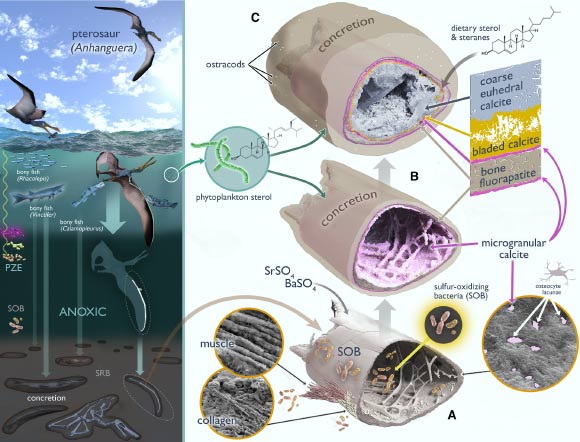
113-Million-Year-Old Pterosaur Fossil Reveals What Flying Reptiles Ate
Un fossile de ptérosaure vieux de 113 millions d'années révèle ce que mangeaient les reptiles volants
tissus alimentation Brésil fossile Anhangueridae Pterosauria poisson
Un fossile de ptérosaure vieux de 113 millions d'années provenant du nord-est du Brésil a fourni des preuves rares de tissus mous, de molécules organiques et de traces chimiques d'un régime alimentaire riche en poissons et en céphalopodes tels que les calmars ou les nautiles. L'article Un fossile de ptérosaure vieux de 113 millions d'années révèle ce que mangeaient les reptiles volants est apparu en premier sur Sci.News : Breaking Science News.
19/06/2026 sci-news ⚙ Traduction automatique
Une étude révolutionnaire renforce les arguments en faveur des lèvres chez les dinosaures
peau tissus dent Dinosauria biomécanique étude
Le débat sur les lèvres des dinosaures se poursuit.  La question de savoir si les dinosaures possédaient des tissus extra-oraux reste controversée. Cependant, une nouvelle étude remarquable vient renforcer considérablement l’idée selon laquelle la plupart des dinosaures possédaient des tissus extra-oraux qui recouvraient et protégeaient leurs dents. Une nouvelle étude, publiée dans la revue "Palaeontology", fournit des preuves irréfutables que les lèvres étaient une condition ancestrale
15/06/2026 everythingdinosaur ⚙ Traduction automatique