Late Triassic

Geological interval

9 image(s) · 7 News

View page

Image gallery

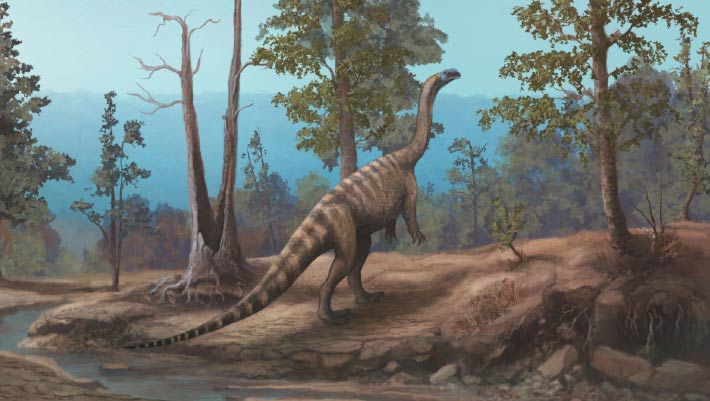
Tawa is an early theropod from the Late Triassic. The genus is named after the Hopi word for the Puebloan sun god. It was a bipedal carnivore, estimated around 2.5 m in length, and weighing about 15 kg. A basal theropod, Tawa shares physical characteristics with coelophysoids and herrerasaurids, and its discovery supports the theory that dinosaurs originated in the southern supercontinent of Gondwanna, before diversifying as Pangea split apart.

Tawa is an early theropod from the Late Triassic. The genus is named after the Hopi word for the Puebloan sun god. It was a bipedal carnivore, estimated around 2.5 m in length, and weighing about 15 kg. A basal theropod, Tawa shares physical characteristics with coelophysoids and herrerasaurids, and its discovery supports the theory that dinosaurs originated in the southern supercontinent of Gondwanna, before diversifying as Pangea split apart.

Late Triassic Triassic Dinosauria Herrerasauridae +2
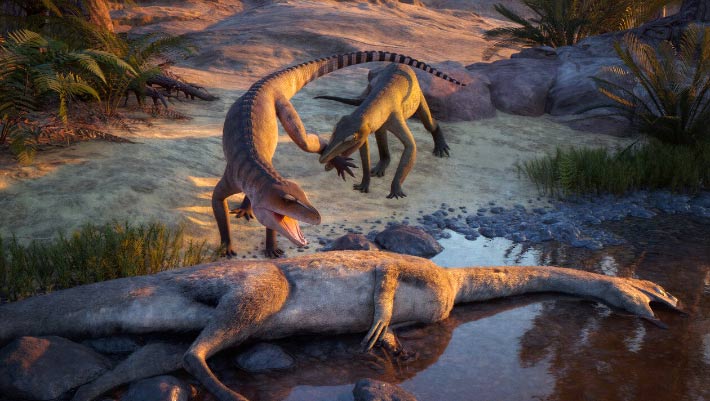
Thalattosaurus alexandrae (left) and Nectosaurus halinus (right) of Late Triassic California
Taxa Nectosaurus

Thalattosaurus alexandrae (left) and Nectosaurus halinus (right) of Late Triassic California

Late Triassic Triassic Nectosaurus
Original figure caption: Trackway S1 (Eosauropus sp.), here attributed to a sauropod trackmaker based on pedal synapomorphies; trackmaker is moving towards the south-west. Two consequtive pes impressions of a tridactyl Grallator [i.e. a theropod] trackway can be seen left to the S1 trackway.
Note: The tracks are preserved on a bedding plane of a thin siltstone bed of the Late Triassic Fleming Fjord Formation of East Greenland. A) shows a photograph of the trackway(s) as preserved on the bedding plane (i.e. as concave epireliefs); B) shows a color shaded relief map based on a high-resolution photogrammetric 3D-model of the bedding plane; C) is an interpretative outline drawing of the S1 trackway; abbreviations: LM = left manus (i.e. forefoot), LP = left pes (i.e. hindfoot), RM = right manus, RP = right pes, numbers increase in walking direction.

Original figure caption: Trackway S1 (Eosauropus sp.), here attributed to a sauropod trackmaker based on pedal synapomorphies; trackmaker is moving towards the south-west. Two consequtive pes impressions of a tridactyl Grallator [i.e. a theropod] trackway can be seen left to the S1 trackway. Note: The tracks are preserved on a bedding plane of a thin siltstone bed of the Late Triassic Fleming Fjord Formation of East Greenland. A) shows a photograph of the trackway(s) as preserved on the bedding plane (i.e. as concave epireliefs); B) shows a color shaded relief map based on a high-resolution photogrammetric 3D-model of the bedding plane; C) is an interpretative outline drawing of the S1 trackway; abbreviations: LM = left manus (i.e. forefoot), LP = left pes (i.e. hindfoot), RM = right manus, RP = right pes, numbers increase in walking direction.

drawing Greenland Late Triassic Triassic +4
Californosaurus perrini, an ichthyosaur from the Late Triassic of North America, pencil drawing
Taxa Barracudasaurus

Californosaurus perrini, an ichthyosaur from the Late Triassic of North America, pencil drawing

drawing Late Triassic Triassic Barracudasaurus +4
Californosaurus perrini, an ichthyosaur from the Late Triassic of North America, pencil drawing
Taxa Toretocnemidae

Californosaurus perrini, an ichthyosaur from the Late Triassic of North America, pencil drawing

drawing Late Triassic Triassic Barracudasaurus +4
Left maxilla of the silesaurid Agnosphitys cromhallensis from the Late Triassic (Rhaetian) of England.
Taxa Agnosphitys

Left maxilla of the silesaurid Agnosphitys cromhallensis from the Late Triassic (Rhaetian) of England.

Late Triassic Rhaetian Triassic Agnosphitys +1
Pantydraco caducus, a sauropodomorph from the Late Triassic or Early Jurassic of England, after Yates, 2003, pencil drawing, digital coloring
Taxa Pantydraco

Pantydraco caducus, a sauropodomorph from the Late Triassic or Early Jurassic of England, after Yates, 2003, pencil drawing, digital coloring

drawing Early Jurassic Jurassic Late Triassic +3
Photograph of Museo civico di scienze naturali di Bergamo (MCSNB) 2888, the holotype specimen of Eudimorphodon ranzii ZAMBELLI 1973, a basal pterosaur from the Norian (middle Upper Triassic) of the Italian Alps.[1]


↑ see fig. 8A in Silvio Renesto (2006): A reappraisal of the diversity and biogeographic significance of the Norian (Late Triassic) reptiles from the Calcare di Zorzino. In: Jerry D. Harris, Spencer G. Lucas, Justin A. Spielmann, Martin G. Lockley, Andrew R.C. Milner, James I. Kirkland (eds.): The Triassic-Jurassic Terrestrial Transition. New Mexico Museum of Natural History and Science Bulletin 37:445–456 (online)
Taxa Eudimorphodon

Photograph of Museo civico di scienze naturali di Bergamo (MCSNB) 2888, the holotype specimen of Eudimorphodon ranzii ZAMBELLI 1973, a basal pterosaur from the Norian (middle Upper Triassic) of the Italian Alps.[1] ↑ see fig. 8A in Silvio Renesto (2006): A reappraisal of the diversity and biogeographic significance of the Norian (Late Triassic) reptiles from the Calcare di Zorzino. In: Jerry D. Harris, Spencer G. Lucas, Justin A. Spielmann, Martin G. Lockley, Andrew R.C. Milner, James I. Kirkland (eds.): The Triassic-Jurassic Terrestrial Transition. New Mexico Museum of Natural History and Science Bulletin 37:445–456 (online)

museum Mexico Jurassic Late Triassic +6
Partial skull of Shastasaurus pacificus (UCMP 9017) from the Late Triassic of California, USA, in (A) lateral, (B) dorsal, and (C) anterolateral view.

Based on this skull, Shastasaurus has repeatedly been reconstructed with a long, tooth-bearing rostrum. However, note the slenderness of the lower jaw (B, C) and the strong anterior taper of the snout (B), both of which are more consistent with the abbreviated and toothless snout of Shastasaurus liangae comb. nov. than with the traditional long-snouted reconstruction of this skull (as, e.g., in references [22] and [23]).
Taxa Shastasaurus

Partial skull of Shastasaurus pacificus (UCMP 9017) from the Late Triassic of California, USA, in (A) lateral, (B) dorsal, and (C) anterolateral view. Based on this skull, Shastasaurus has repeatedly been reconstructed with a long, tooth-bearing rostrum. However, note the slenderness of the lower jaw (B, C) and the strong anterior taper of the snout (B), both of which are more consistent with the abbreviated and toothless snout of Shastasaurus liangae comb. nov. than with the traditional long-snouted reconstruction of this skull (as, e.g., in references [22] and [23]).

tooth United States Late Triassic Triassic +5
Partial skull of Shastasaurus pacificus (UCMP 9017) from the Late Triassic of California, USA, in (A) lateral, (B) dorsal, and (C) anterolateral view.

Based on this skull, Shastasaurus has repeatedly been reconstructed with a long, tooth-bearing rostrum. However, note the slenderness of the lower jaw (B, C) and the strong anterior taper of the snout (B), both of which are more consistent with the abbreviated and toothless snout of Shastasaurus liangae comb. nov. than with the traditional long-snouted reconstruction of this skull (as, e.g., in references [22] and [23]).
Taxa Merriamosauria

Partial skull of Shastasaurus pacificus (UCMP 9017) from the Late Triassic of California, USA, in (A) lateral, (B) dorsal, and (C) anterolateral view. Based on this skull, Shastasaurus has repeatedly been reconstructed with a long, tooth-bearing rostrum. However, note the slenderness of the lower jaw (B, C) and the strong anterior taper of the snout (B), both of which are more consistent with the abbreviated and toothless snout of Shastasaurus liangae comb. nov. than with the traditional long-snouted reconstruction of this skull (as, e.g., in references [22] and [23]).

tooth United States Late Triassic Triassic +5
Partial skull of Shastasaurus pacificus (UCMP 9017) from the Late Triassic of California, USA, in (A) lateral, (B) dorsal, and (C) anterolateral view.

Based on this skull, Shastasaurus has repeatedly been reconstructed with a long, tooth-bearing rostrum. However, note the slenderness of the lower jaw (B, C) and the strong anterior taper of the snout (B), both of which are more consistent with the abbreviated and toothless snout of Shastasaurus liangae comb. nov. than with the traditional long-snouted reconstruction of this skull (as, e.g., in references [22] and [23]).
Taxa Euichthyosauria

Partial skull of Shastasaurus pacificus (UCMP 9017) from the Late Triassic of California, USA, in (A) lateral, (B) dorsal, and (C) anterolateral view. Based on this skull, Shastasaurus has repeatedly been reconstructed with a long, tooth-bearing rostrum. However, note the slenderness of the lower jaw (B, C) and the strong anterior taper of the snout (B), both of which are more consistent with the abbreviated and toothless snout of Shastasaurus liangae comb. nov. than with the traditional long-snouted reconstruction of this skull (as, e.g., in references [22] and [23]).

tooth United States Late Triassic Triassic +5
Coelophysis bauri (Cope, 1887) theropod dinosaur from the Triassic of New Mexico, USA.
This is a remarkable complete skeleton of the small early theropod Coelophysis.  It comes from a nearly monospecific concentration of numerous complete to disarticulated skeletons in reddish-colored fluvial siltstones, often called a "Coelophysis graveyard".  This occurrence has been interpreted as a carcass-jammed channel filling following mass mortality of dinosaurs by regional drought (see Schwartz & Gillette, 1994).
Stratigraphy: Rock Point Member, Chinle Formation, Upper Triassic
Locality: Whitaker Quarry (Coelophysis Quarry), Ghost Ranch, Rio Arriba County, northern New Mexico, USA


Some info. from:
Hunt, A.P. & S.G. Lucas.  1991.  Rioarribasaurus, a new name for a Late Triassic dinosaur from New Mexico (USA).  Paläontologische Zeitschrift  65: 191-198.
Schwartz, H.L. & D.D. Gillette.  1994.  Geology and taphonomy of the Coelophysis Quarry, Upper Triassic Chinle Formation, Ghost Ranch, New Mexico.  Journal of Paleontology 68: 1118-1130.


Theropod were small to large, bipedal dinosaurs.  Almost all known members of the group were carnivorous (predators and/or scavengers).  They represent the ancestral group to the birds, and some theropods are known to have had feathers.  Some of the most well known dinosaurs to the general public are theropods, such as Tyrannosaurus, Allosaurus, and Spinosaurus.
Taxa Coelophysis

Coelophysis bauri (Cope, 1887) theropod dinosaur from the Triassic of New Mexico, USA. This is a remarkable complete skeleton of the small early theropod Coelophysis. It comes from a nearly monospecific concentration of numerous complete to disarticulated skeletons in reddish-colored fluvial siltstones, often called a "Coelophysis graveyard". This occurrence has been interpreted as a carcass-jammed channel filling following mass mortality of dinosaurs by regional drought (see Schwartz & Gillette, 1994). Stratigraphy: Rock Point Member, Chinle Formation, Upper Triassic Locality: Whitaker Quarry (Coelophysis Quarry), Ghost Ranch, Rio Arriba County, northern New Mexico, USA Some info. from: Hunt, A.P. & S.G. Lucas. 1991. Rioarribasaurus, a new name for a Late Triassic dinosaur from New Mexico (USA). Paläontologische Zeitschrift 65: 191-198. Schwartz, H.L. & D.D. Gillette. 1994. Geology and taphonomy of the Coelophysis Quarry, Upper Triassic Chinle Formation, Ghost Ranch, New Mexico. Journal of Paleontology 68: 1118-1130. Theropod were small to large, bipedal dinosaurs. Almost all known members of the group were carnivorous (predators and/or scavengers). They represent the ancestral group to the birds, and some theropods are known to have had feathers. Some of the most well known dinosaurs to the general public are theropods, such as Tyrannosaurus, Allosaurus, and Spinosaurus.

Mexico United States Chinle Late Triassic +12
Coelophysis bauri (Cope, 1887) theropod dinosaur from the Triassic of New Mexico, USA.
This is a remarkable complete skeleton of the small early theropod Coelophysis.  It comes from a nearly monospecific concentration of numerous complete to disarticulated skeletons in reddish-colored fluvial siltstones, often called a "Coelophysis graveyard".  This occurrence has been interpreted as a carcass-jammed channel filling following mass mortality of dinosaurs by regional drought (see Schwartz & Gillette, 1994).
Stratigraphy: Rock Point Member, Chinle Formation, Upper Triassic
Locality: Whitaker Quarry (Coelophysis Quarry), Ghost Ranch, Rio Arriba County, northern New Mexico, USA


Some info. from:
Hunt, A.P. & S.G. Lucas.  1991.  Rioarribasaurus, a new name for a Late Triassic dinosaur from New Mexico (USA).  Paläontologische Zeitschrift  65: 191-198.
Schwartz, H.L. & D.D. Gillette.  1994.  Geology and taphonomy of the Coelophysis Quarry, Upper Triassic Chinle Formation, Ghost Ranch, New Mexico.  Journal of Paleontology 68: 1118-1130.


Theropod were small to large, bipedal dinosaurs.  Almost all known members of the group were carnivorous (predators and/or scavengers).  They represent the ancestral group to the birds, and some theropods are known to have had feathers.  Some of the most well known dinosaurs to the general public are theropods, such as Tyrannosaurus, Allosaurus, and Spinosaurus.
Taxa Coelophysoidea

Coelophysis bauri (Cope, 1887) theropod dinosaur from the Triassic of New Mexico, USA. This is a remarkable complete skeleton of the small early theropod Coelophysis. It comes from a nearly monospecific concentration of numerous complete to disarticulated skeletons in reddish-colored fluvial siltstones, often called a "Coelophysis graveyard". This occurrence has been interpreted as a carcass-jammed channel filling following mass mortality of dinosaurs by regional drought (see Schwartz & Gillette, 1994). Stratigraphy: Rock Point Member, Chinle Formation, Upper Triassic Locality: Whitaker Quarry (Coelophysis Quarry), Ghost Ranch, Rio Arriba County, northern New Mexico, USA Some info. from: Hunt, A.P. & S.G. Lucas. 1991. Rioarribasaurus, a new name for a Late Triassic dinosaur from New Mexico (USA). Paläontologische Zeitschrift 65: 191-198. Schwartz, H.L. & D.D. Gillette. 1994. Geology and taphonomy of the Coelophysis Quarry, Upper Triassic Chinle Formation, Ghost Ranch, New Mexico. Journal of Paleontology 68: 1118-1130. Theropod were small to large, bipedal dinosaurs. Almost all known members of the group were carnivorous (predators and/or scavengers). They represent the ancestral group to the birds, and some theropods are known to have had feathers. Some of the most well known dinosaurs to the general public are theropods, such as Tyrannosaurus, Allosaurus, and Spinosaurus.

Mexico United States Chinle Late Triassic +12
Coelophysis bauri (Cope, 1887) theropod dinosaur from the Triassic of New Mexico, USA.
This is a remarkable complete skeleton of the small early theropod Coelophysis.  It comes from a nearly monospecific concentration of numerous complete to disarticulated skeletons in reddish-colored fluvial siltstones, often called a "Coelophysis graveyard".  This occurrence has been interpreted as a carcass-jammed channel filling following mass mortality of dinosaurs by regional drought (see Schwartz & Gillette, 1994).
Stratigraphy: Rock Point Member, Chinle Formation, Upper Triassic
Locality: Whitaker Quarry (Coelophysis Quarry), Ghost Ranch, Rio Arriba County, northern New Mexico, USA


Some info. from:
Hunt, A.P. & S.G. Lucas.  1991.  Rioarribasaurus, a new name for a Late Triassic dinosaur from New Mexico (USA).  Paläontologische Zeitschrift  65: 191-198.
Schwartz, H.L. & D.D. Gillette.  1994.  Geology and taphonomy of the Coelophysis Quarry, Upper Triassic Chinle Formation, Ghost Ranch, New Mexico.  Journal of Paleontology 68: 1118-1130.


Theropod were small to large, bipedal dinosaurs.  Almost all known members of the group were carnivorous (predators and/or scavengers).  They represent the ancestral group to the birds, and some theropods are known to have had feathers.  Some of the most well known dinosaurs to the general public are theropods, such as Tyrannosaurus, Allosaurus, and Spinosaurus.
Taxa Coelophysidae

Coelophysis bauri (Cope, 1887) theropod dinosaur from the Triassic of New Mexico, USA. This is a remarkable complete skeleton of the small early theropod Coelophysis. It comes from a nearly monospecific concentration of numerous complete to disarticulated skeletons in reddish-colored fluvial siltstones, often called a "Coelophysis graveyard". This occurrence has been interpreted as a carcass-jammed channel filling following mass mortality of dinosaurs by regional drought (see Schwartz & Gillette, 1994). Stratigraphy: Rock Point Member, Chinle Formation, Upper Triassic Locality: Whitaker Quarry (Coelophysis Quarry), Ghost Ranch, Rio Arriba County, northern New Mexico, USA Some info. from: Hunt, A.P. & S.G. Lucas. 1991. Rioarribasaurus, a new name for a Late Triassic dinosaur from New Mexico (USA). Paläontologische Zeitschrift 65: 191-198. Schwartz, H.L. & D.D. Gillette. 1994. Geology and taphonomy of the Coelophysis Quarry, Upper Triassic Chinle Formation, Ghost Ranch, New Mexico. Journal of Paleontology 68: 1118-1130. Theropod were small to large, bipedal dinosaurs. Almost all known members of the group were carnivorous (predators and/or scavengers). They represent the ancestral group to the birds, and some theropods are known to have had feathers. Some of the most well known dinosaurs to the general public are theropods, such as Tyrannosaurus, Allosaurus, and Spinosaurus.

Mexico United States Chinle Late Triassic +12
Coelophysis bauri (Cope, 1887) theropod dinosaur from the Triassic of New Mexico, USA.
This is a remarkable complete skeleton of the small early theropod Coelophysis.  It comes from a nearly monospecific concentration of numerous complete to disarticulated skeletons in reddish-colored fluvial siltstones, often called a "Coelophysis graveyard".  This occurrence has been interpreted as a carcass-jammed channel filling following mass mortality of dinosaurs by regional drought (see Schwartz & Gillette, 1994).
Stratigraphy: Rock Point Member, Chinle Formation, Upper Triassic
Locality: Whitaker Quarry (Coelophysis Quarry), Ghost Ranch, Rio Arriba County, northern New Mexico, USA


Some info. from:
Hunt, A.P. & S.G. Lucas.  1991.  Rioarribasaurus, a new name for a Late Triassic dinosaur from New Mexico (USA).  Paläontologische Zeitschrift  65: 191-198.
Schwartz, H.L. & D.D. Gillette.  1994.  Geology and taphonomy of the Coelophysis Quarry, Upper Triassic Chinle Formation, Ghost Ranch, New Mexico.  Journal of Paleontology 68: 1118-1130.


Theropod were small to large, bipedal dinosaurs.  Almost all known members of the group were carnivorous (predators and/or scavengers).  They represent the ancestral group to the birds, and some theropods are known to have had feathers.  Some of the most well known dinosaurs to the general public are theropods, such as Tyrannosaurus, Allosaurus, and Spinosaurus.
Taxa Coelophysinae

Coelophysis bauri (Cope, 1887) theropod dinosaur from the Triassic of New Mexico, USA. This is a remarkable complete skeleton of the small early theropod Coelophysis. It comes from a nearly monospecific concentration of numerous complete to disarticulated skeletons in reddish-colored fluvial siltstones, often called a "Coelophysis graveyard". This occurrence has been interpreted as a carcass-jammed channel filling following mass mortality of dinosaurs by regional drought (see Schwartz & Gillette, 1994). Stratigraphy: Rock Point Member, Chinle Formation, Upper Triassic Locality: Whitaker Quarry (Coelophysis Quarry), Ghost Ranch, Rio Arriba County, northern New Mexico, USA Some info. from: Hunt, A.P. & S.G. Lucas. 1991. Rioarribasaurus, a new name for a Late Triassic dinosaur from New Mexico (USA). Paläontologische Zeitschrift 65: 191-198. Schwartz, H.L. & D.D. Gillette. 1994. Geology and taphonomy of the Coelophysis Quarry, Upper Triassic Chinle Formation, Ghost Ranch, New Mexico. Journal of Paleontology 68: 1118-1130. Theropod were small to large, bipedal dinosaurs. Almost all known members of the group were carnivorous (predators and/or scavengers). They represent the ancestral group to the birds, and some theropods are known to have had feathers. Some of the most well known dinosaurs to the general public are theropods, such as Tyrannosaurus, Allosaurus, and Spinosaurus.

Mexico United States Chinle Late Triassic +12
Coelophysis bauri (Cope, 1887) theropod dinosaur from the Triassic of New Mexico, USA.
This is a remarkable complete skeleton of the small early theropod Coelophysis.  It comes from a nearly monospecific concentration of numerous complete to disarticulated skeletons in reddish-colored fluvial siltstones, often called a "Coelophysis graveyard".  This occurrence has been interpreted as a carcass-jammed channel filling following mass mortality of dinosaurs by regional drought (see Schwartz & Gillette, 1994).
Stratigraphy: Rock Point Member, Chinle Formation, Upper Triassic
Locality: Whitaker Quarry (Coelophysis Quarry), Ghost Ranch, Rio Arriba County, northern New Mexico, USA


Some info. from:
Hunt, A.P. & S.G. Lucas.  1991.  Rioarribasaurus, a new name for a Late Triassic dinosaur from New Mexico (USA).  Paläontologische Zeitschrift  65: 191-198.
Schwartz, H.L. & D.D. Gillette.  1994.  Geology and taphonomy of the Coelophysis Quarry, Upper Triassic Chinle Formation, Ghost Ranch, New Mexico.  Journal of Paleontology 68: 1118-1130.


Theropod were small to large, bipedal dinosaurs.  Almost all known members of the group were carnivorous (predators and/or scavengers).  They represent the ancestral group to the birds, and some theropods are known to have had feathers.  Some of the most well known dinosaurs to the general public are theropods, such as Tyrannosaurus, Allosaurus, and Spinosaurus.
Taxa Podokesaurinae

Coelophysis bauri (Cope, 1887) theropod dinosaur from the Triassic of New Mexico, USA. This is a remarkable complete skeleton of the small early theropod Coelophysis. It comes from a nearly monospecific concentration of numerous complete to disarticulated skeletons in reddish-colored fluvial siltstones, often called a "Coelophysis graveyard". This occurrence has been interpreted as a carcass-jammed channel filling following mass mortality of dinosaurs by regional drought (see Schwartz & Gillette, 1994). Stratigraphy: Rock Point Member, Chinle Formation, Upper Triassic Locality: Whitaker Quarry (Coelophysis Quarry), Ghost Ranch, Rio Arriba County, northern New Mexico, USA Some info. from: Hunt, A.P. & S.G. Lucas. 1991. Rioarribasaurus, a new name for a Late Triassic dinosaur from New Mexico (USA). Paläontologische Zeitschrift 65: 191-198. Schwartz, H.L. & D.D. Gillette. 1994. Geology and taphonomy of the Coelophysis Quarry, Upper Triassic Chinle Formation, Ghost Ranch, New Mexico. Journal of Paleontology 68: 1118-1130. Theropod were small to large, bipedal dinosaurs. Almost all known members of the group were carnivorous (predators and/or scavengers). They represent the ancestral group to the birds, and some theropods are known to have had feathers. Some of the most well known dinosaurs to the general public are theropods, such as Tyrannosaurus, Allosaurus, and Spinosaurus.

Mexico United States Chinle Late Triassic +12

News

New English Crocodylomorph Honours Welsh Teacher
Late Triassic Triassic fossil new species
Scientists have identified a new species of ancient crocodylomorph from Upper Triassic rocks in southwest England. The newly named species, Galahadosuchus jonesi, lived around 215 million years ago and it represents the second species of non-crocodyliform crocodylomorph described from the Late Triassic–aged fissures of the Bristol Channel area. Non-crocodyliform crocodylomorph fossil material is known from
01/06/2026 everythingdinosaur
New Triassic Carnivorous Dinosaur Identified from Ghost Ranch
United States Late Triassic Triassic fossil specimen Coelophysis Dinosauria Ptychotherates new species skull
Researchers from Virginia Tech (Virginia, USA) have identified a new species of Late Triassic dinosaur.  The dinosaur has been named Ptychotherates bucculentus.  This new carnivorous dinosaur taxon has been erected based on the detailed examination of an incomplete, well-preserved but jumbled up skull fossil (specimen number CM 31368).  The skull comes from the world-famous Coelophysis
11/05/2026 everythingdinosaur
Museum Fossil Reveals Triassic Crocodile Cousin with Powerful Jaws
jaw museum Late Triassic Triassic fossil specimen CT-scan new species
CT scans of a decades-old specimen from the Yale Peabody Museum of Natural History show a new species of short-snouted crocodylomorph with unusually strong jaws, offering a rare snapshot of ecological specialization in the Late Triassic epoch. The post Museum Fossil Reveals Triassic Crocodile Cousin with Powerful Jaws appeared first on Sci.News: Breaking Science News.
20/04/2026 sci-news
Daemonosaurus: Beast of the Week
Mexico United States Late Triassic Triassic Daemonosaurus Dinosauria skull
 This week we will be checking out a unique looking early dinosaur with a very cool name.  Meet Daemonosaurus chaoliodus!Daemonosaurus was a small meat-eating dinosaur that lived in what is now New Mexico, United States, during the late Triassic period, roughly between 205 and 200 million years ago.  From nose to tail it is estimated to have measured roughly 5 to 7 feet (1.5-2.2m).  These are estimates based on the fact that only the skull and neck were found.  The genus name translates to "Demo
05/04/2026 prehistoricbeastoftheweek
Episode 173: Petrified Forest
United States Chinle Late Triassic Triassic formation
Petrified Forest National Park in northeastern Arizona, USA is a hub for Triassic palaeontology and has exposures representing 20 million years of the Late Triassic Chinle Formation. Visitors marvel at the colourful fossilised trees from which the park takes its name, but a whole host of animals called these swampy forests home 225 million years [&hellip
17/03/2026 palaeocast
1 2