Carboniferous

Geological interval

3 image(s) · 3 News

View page

Image gallery

Granite of Devonian/Carboniferous age from the Stubai Alps. This rock is on display at the geological public collection of the Alpines Museum in Munich.

Granite of Devonian/Carboniferous age from the Stubai Alps. This rock is on display at the geological public collection of the Alpines Museum in Munich.

museum Carboniferous Devonian
Quarry called “Ratssteinbruch” at Plauenscher Grund (gorge-like valley of the river Weißeritz nearby/in the city of Dresden, Saxony, Germany), Upper Carboniferous Monzonite (historically identified as Syenite) of the Meißen Massif (Paleozoic basement) unconformably overlain by Upper Cenomanian beds of the Dölzschen Formation, yellowish basal conglomerate and overlying bluish silty clay-marlstone (“plenus-Pläner”) of the Saxo-Bohemian Cretaceous Basin (Mesozoic platform).[1]

Quarry called “Ratssteinbruch” at Plauenscher Grund (gorge-like valley of the river Weißeritz nearby/in the city of Dresden, Saxony, Germany), Upper Carboniferous Monzonite (historically identified as Syenite) of the Meißen Massif (Paleozoic basement) unconformably overlain by Upper Cenomanian beds of the Dölzschen Formation, yellowish basal conglomerate and overlying bluish silty clay-marlstone (“plenus-Pläner”) of the Saxo-Bohemian Cretaceous Basin (Mesozoic platform).[1]

Germany Carboniferous Cenomanian Cretaceous +3
Stratotype of the Carboniferous system (Gzhel horizon) - Protected areas of Russia (5010231)
Intervals Gzhelian

Stratotype of the Carboniferous system (Gzhel horizon) - Protected areas of Russia (5010231)

Russia Carboniferous

News

Remarkable Carboniferous Coelacanth Fossil Discovery in Yorkshire
Carboniferous fossil discovery
A remarkable Roundhay Park coelacanth fossil has been discovered in Leeds. The fossil is around 320 million years old. It dates from the Carboniferous. Furthermore, experts believe it represents the oldest fossil coelacanth yet found in Yorkshire. Geologist Ru Smith of the Yorkshire Geological Society made the discovery earlier this year. He found a well-preserved
27/08/2026 everythingdinosaur
Earth’s First Land Animals May Never Have Been Amphibian-Like After All
predator museum Carboniferous evolution
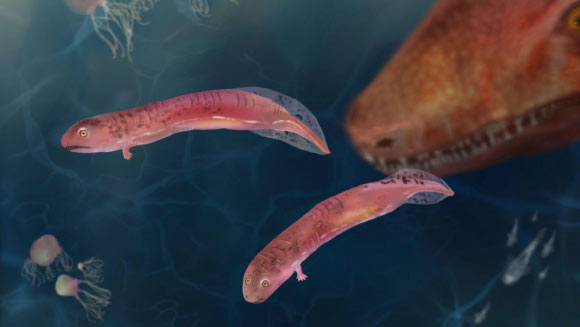
Paleontologists from the Field Museum of Natural History have described the fossilized remains of baby embolomeres, crocodile-like predators that prowled ancient rivers and swamps between 350 and 280 million years ago. The post Earth’s First Land Animals May Never Have Been Amphibian-Like After All appeared first on Sci.News: Breaking Science News.
19/06/2026 sci-news
Episode 175/176: Insect Gigantism
Carboniferous
Can respiration be key to understanding gigantism in Carboniferous insects
02/05/2026 palaeocast