96 image(s) · 3 Actualités
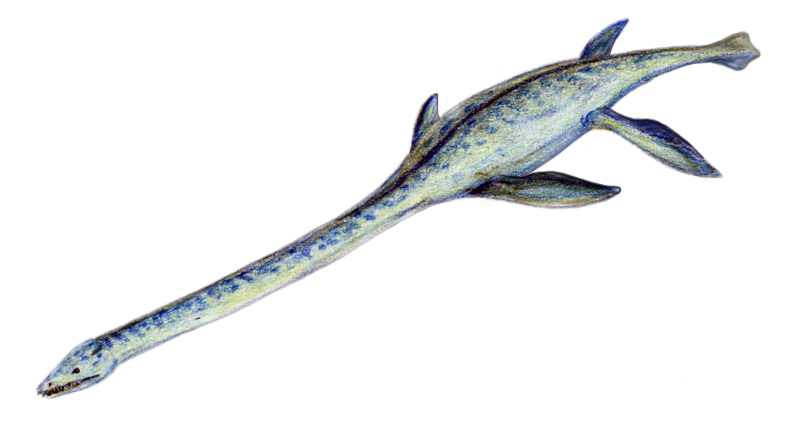
Californosaurus perrini, an ichthyosaur from the Late Triassic of North America, pencil drawing
a Skeletal reconstruction of A. greppini. Elements preserved in the material and therefore providing information for the skeletal reconstruction are marked in blue. Because much information is missing from the incomplete skeletal material, the dorsal vertebrae, the proportions and morphology of the cervical vertebrae and the skull were modified from Camarasaurus. b Scaled silhouette drawings of Cetiosauriscus stewarti (in black) and A. greppini (in grey) demonstrating the significant size difference between the two taxa. Scale bar is 1 m
Reconstruction of Tuebingosaurus maierfritzorum gen. et sp. nov. as a quadruped dinosaur, using the outline of Riojasaurus as a base ‒ next to the silhouette of Friedrich von Huene. The drawing of the bones is based on and modified from the original illustrations of specimen “GPIT IV” in von Huene (1932, pl. 38) that have been replicated in the literature. The right fibula is marked in grey as it was found nearby with similar measurements to the left fibula and has been assumed to be part of the same individual.
Skull of the new basal sauropodomorph Leyesaurus marayensis (PVSJ 706). Photograph of the skull (A) and interpretative drawing (B) in lateral view. Dark grey color represents matrix and light grey color represents foraminae. Abbreviations: a, angular; aoF, antorbital fenestra; aoFo; antorbital fossa; Apmx, ascending process of the maxilla; d, dentary; f, frontal; itF, infratemporal fenestra; j, jugal; l, lacrimal; laoFo; lacrimal antorbital fossa; mF, mandibular fenestra; mx, maxilla; n, nasal; O, orbit; p, parietal; pf, prefrontal; pm, premaxilla; po, postorbital; rug, platform-like rugosities; q, quadrate; qj, quadratejugal; Rmx, ridge of the ascending process of the maxilla; sa, surangular; snf, subnarial foramen. Scale bar equals 1cm.
Pantydraco caducus, a sauropodomorph from the Late Triassic or Early Jurassic of England, after Yates, 2003, pencil drawing, digital coloring
Digital drawing of the known skeletal remains of Nhandumirim waldsangae. Known elements represented in white and unknown in gray. This is an alternative version, reconstructing the elements based on early sauropodomorphs.
Figure description from paper: "A Cast of BES SC 999, the holotype of Besanosaurus leptorhynchus and (B) interpretative drawing (modified from Dal Sasso & Pinna, 1996). Foetal remains are highlighted with green lines. a astragalus, c calcaneum, Cl clavicle, Co coracoid, Fe femur, Fi Fibula, H humerus, i intermedium, Il Ilium, Is Ischium, P pubis, p pisiform, R radius, r radiale, S scapula, T Tibia, U Ulna, u ulnare; 2, 3, and 4, distal carpals and tarsals; II, III, IV, and V, metacarpals and metatarsals. The apostrophe (‘) indicates left elements. Scale bar represents 50 cm"
Skeleton of WGSC SPC V 1304 (juvenile Brevicaudosaurus jiyangshanensis). A, photograph of the specimen in dorsal view. B, interpretive drawing.
Eopteranodon lii holotype (BPV 078). (A) Counterpart; (B) main part. (C and D) Respective schematic drawings. Abbreviations: cv, cervical vertebra; co, coracoid; d1–d4, digits 1–4; fe, femur; fi, fibula; h, humerus; j, jugal; mand, mandible; mc, metacarpal; pmc, premaxillary crest; pe, pelvis; ph, phalanx; ti, tibia; ul, ulna; rad, radius. Scale bars: C, 50 mm; D, 10 mm.
Lonchodraco giganteus comb. n. Lectotype NHMUK PV 39412 (Cenomanian / Turonian, Chalk Formation). A–F articulated anterior parts of the rostrum and mandible A right lateral view B respective line drawing C left lateral view D respective line drawing E anterior view F respective line drawing G associated scapulocoracoid in posterior view. Abbreviations: ch – choanae, cor – coracoid, d – dentary, dcr – dentary crest, m – maxillae, pl – palatine, pm – premaxillae, pmcr – premaxillaery crest, prid – palatal ridge, sca – scapula. Arrows indicate alveoli or teeth. Scale bar = 10 mm. Photos courtesy of The Natural History Museum.
Skeleton of Yamaceratops dorngobiensis (MPC-D 100/553) in right dorsolateral view. (A) Photograph; (B) Interpretive drawing. Bones are bounded by solid lines and colored beige; the matrix is gray. Shaded areas represent the broken surface of bones. Abbreviations: cd, caudal vertebrae; dr, dorsal ribs; dv, dorsal vertebrae; f, femur; fi, fibula; h, humerus; L, bone on the left side; p, isolated parietal; pp, pedal phalanges; R, bone on the right side; ra, radius; sk, skull; sv, sacral vertebrae; ti, tibia; u, ulna; il, ilium; is, ischium.
Digital drawing of the known skeletal remains of Macrocollum itaquii. Known elements represented in white and unknown in gray.
Photographs and interpretive drawings of the titanosauroid Bonitasaura salgadoi Apesteguía, 2004 from the Upper Neuquén Group of Río Negro province, Patagonia, MPCA 460. A–D. Right dentary in dorsal (A), medial (B), ventral (C), and lateral (D) views. E. Isolated tooth in labial (E1) and lateral (E2) views; lingual view detail and schematic cross section showing hexagonal faceting (E3).