museum

Content type

496 image(s) · 24 News

Image gallery

Caudipteryx zoui, Skelett - Untere Kreide - Liaoning/China - aufgenommen im Museum am Löwentor, Stuttgart
Taxa Caudipterygidae

Caudipteryx zoui, Skelett - Untere Kreide - Liaoning/China - aufgenommen im Museum am Löwentor, Stuttgart

museum China Caudipterygidae Caudipteryx
The "Big Mama" Citipati osmolskae skeleton (IGM 100/979) on display at the American Museum of Natural History.

The "Big Mama" Citipati osmolskae skeleton (IGM 100/979) on display at the American Museum of Natural History.

museum Citipati skeleton
Falcarius skeleton reconstruction, Utah Museum of Natural History.

Falcarius skeleton reconstruction, Utah Museum of Natural History.

museum United States Falcarius skeleton
Lourinhanosaurus antunesi in Museum of Lourinhã

Lourinhanosaurus antunesi in Museum of Lourinhã

museum Lourinhã Lourinhanosaurus
Dracovenator on display at the Royal Ontario Museum.

Dracovenator on display at the Royal Ontario Museum.

museum Dracovenator
Achelousaurus horneri skull, collected in Glacier County, Montana, at the Museum of the Rockies in Bozeman, Montana.
The Ceratopsidae are those dinosaurs with head frills.  There are three large subgroups of Ceratopsidae: Centrosaurinae, Ceratopsinae, and Chasmosaurinae. The Triceratopsini are a "tribe" of the Chasmosaurinae -- a genus so vast that it gets the special name "tribe".  The Pachyrhinosaurini are a "tribe" within the Centrosaurinae.

Achelousaurus is a genus within the Pachyrhinosaurini.  So far, only three skulls and some limited skeletal remains have been collected anywhere in the world -- and all of them in Montana.  Their bony frills are quite similar to the Styracosaurus albertensis, although their other skull features (such as big bony bosses on the nose and behind the eyes) are not.

Achelousaurus horneri skull, collected in Glacier County, Montana, at the Museum of the Rockies in Bozeman, Montana. The Ceratopsidae are those dinosaurs with head frills. There are three large subgroups of Ceratopsidae: Centrosaurinae, Ceratopsinae, and Chasmosaurinae. The Triceratopsini are a "tribe" of the Chasmosaurinae -- a genus so vast that it gets the special name "tribe". The Pachyrhinosaurini are a "tribe" within the Centrosaurinae. Achelousaurus is a genus within the Pachyrhinosaurini. So far, only three skulls and some limited skeletal remains have been collected anywhere in the world -- and all of them in Montana. Their bony frills are quite similar to the Styracosaurus albertensis, although their other skull features (such as big bony bosses on the nose and behind the eyes) are not.

museum United States Achelousaurus Centrosaurinae +8
Skull cast of Liaoceratops yanzigouensis on display at the Baoding Natural History Museum.

Skull cast of Liaoceratops yanzigouensis on display at the Baoding Natural History Museum.

museum cast Liaoceratops skull
Photo of a skeletal mount of the incomplete holotype of the pachycephalosaur Homalocephale calathocercos in left lateral view, at the Mongolian Natural History Museum. Scan of physical photograph.
Taxa Homalocephale

Photo of a skeletal mount of the incomplete holotype of the pachycephalosaur Homalocephale calathocercos in left lateral view, at the Mongolian Natural History Museum. Scan of physical photograph.

museum holotype Homalocephale Homalocephalidae +1
Photo of a skeletal mount of the incomplete holotype of the pachycephalosaur Homalocephale calathocercos in left lateral view, at the Mongolian Natural History Museum. Scan of physical photograph.
Taxa Homalocephalidae

Photo of a skeletal mount of the incomplete holotype of the pachycephalosaur Homalocephale calathocercos in left lateral view, at the Mongolian Natural History Museum. Scan of physical photograph.

museum holotype Homalocephale Homalocephalidae +1
Photo: mounted skeleton of Qantassaurus intrepidus at the Australian Museum, Sydney.
Taxa Qantassaurus

Photo: mounted skeleton of Qantassaurus intrepidus at the Australian Museum, Sydney.

museum Qantassaurus skeleton
Holotype skull of Augustynolophus morrisi (LACM 2852) on display at the Natural History Museum of Los Angeles County.
Taxa Augustynolophus

Holotype skull of Augustynolophus morrisi (LACM 2852) on display at the Natural History Museum of Los Angeles County.

museum holotype Augustynolophus skull
Figure 1, 1a. Outer and oral aspects of the imperfect dentary bone of Sarcolestes Leedsi, from the Oxford Clay of Peterborough. 2/3 nat size. s = symphysis. Figure 1b. A single tooth of the former. 3/1 nat size. Figure 2, 2a. Outer aspect and quadratic cavity of the hinder region of the same jaw. 2/3 nat size. Figure 3. A single tooth of Priodontognathus Phillipsi, 3/1 nat size, shown for purposes of comparison. Specimen in the Woodwardian Museum, Cambridge.

Figure 1, 1a. Outer and oral aspects of the imperfect dentary bone of Sarcolestes Leedsi, from the Oxford Clay of Peterborough. 2/3 nat size. s = symphysis. Figure 1b. A single tooth of the former. 3/1 nat size. Figure 2, 2a. Outer aspect and quadratic cavity of the hinder region of the same jaw. 2/3 nat size. Figure 3. A single tooth of Priodontognathus Phillipsi, 3/1 nat size, shown for purposes of comparison. Specimen in the Woodwardian Museum, Cambridge.

bone tooth museum Oxford Clay +3
Skeletal mount of Gobisaurus domoculus on display at the Baoding Natural History Museum.

Skeletal mount of Gobisaurus domoculus on display at the Baoding Natural History Museum.

museum Gobisaurus
The holotype humerus (bottom) and coracoid (top) of Texasetes pleurohalio (USNM PAL337987)

The holotype humerus (bottom) and coracoid (top) of Texasetes pleurohalio (USNM PAL337987)

humerus museum holotype Texasetes
Datousaurus. Fossil in Shanghai Science & Technology Museum

Datousaurus. Fossil in Shanghai Science & Technology Museum

museum fossil Datousaurus
historická budova Národního muzea v Praze - západní dvorana s proskleným stropem a kostrou dinosaura / historic building of the National Museum in Prague - West hall with glass ceiling and dinosaur skeleton
location: Prague, Czech Republic
author: Jan Helebrant
www.juhele.blogspot.com

license CC0 Public Domain Dedication

historická budova Národního muzea v Praze - západní dvorana s proskleným stropem a kostrou dinosaura / historic building of the National Museum in Prague - West hall with glass ceiling and dinosaur skeleton location: Prague, Czech Republic author: Jan Helebrant www.juhele.blogspot.com license CC0 Public Domain Dedication

museum Czech Republic Amargasaurus Dinosauria +1
1 2 3 4 5 6 7 8 9 10 11 12 13 14 15 16 17 18 19 20 21 22 23 24 25 26 27 28 29 30 31

News

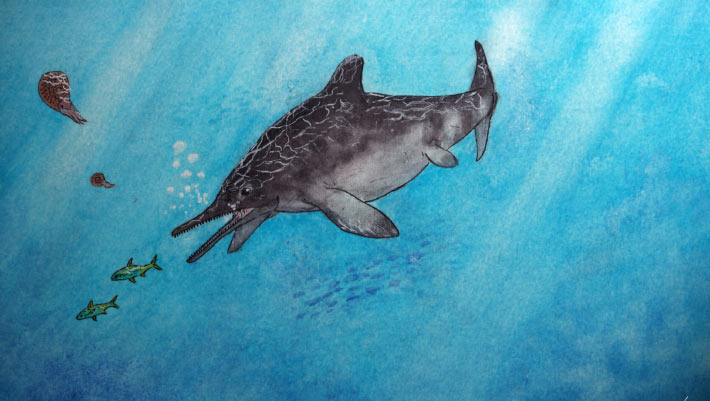
Germany’s Famous Fossil Beds Yield New Species of Jurassic Ichthyosaur
museum Germany Jurassic fossil Ichthyosauria Ichthyosaurus Jabalisaurus new species
Dr. Erin Maxwell from the Staatliches Museum für Naturkunde Stuttgart and colleagues have identified a second species from the German Plattenkalk limestone deposits: Jabalisaurus tethyensis. The post Germany’s Famous Fossil Beds Yield New Species of Jurassic Ichthyosaur appeared first on Sci.News: Breaking Science News.
11/08/2026 sci-news
Scientists rediscover lost Megalodon fossils—and reveal a 79-foot giant
vertebra museum fossil
Several enormous Megalodon vertebrae thought to have been destroyed in 1989 were found sitting unnoticed on a museum shelf. Their analysis strengthens evidence that the giant shark could exceed 24 meters (79 feet) in length and live for nearly a century. Researchers also estimate that its newborns may have measured an astonishing 3.6 meters (12 feet).
07/08/2026 sciencedaily
This school-bus-sized “terror croc” ate dinosaurs. Now it’s back
museum fossil Dinosauria Georgia skeleton
A massive crocodilian capable of attacking dinosaurs has been brought back to life as the first scientifically accurate mounted skeleton of Deinosuchus schwimmeri. The 31-foot replica at Georgia’s Tellus Science Museum was built from detailed fossil scans and more than 40 years of research by paleontologist Dr. David Schwimmer, for whom the species was named.
05/08/2026 sciencedaily
Seal Underwater Hearing Explained by New Research
museum evolution mammals study
A team of international scientists has uncovered the remarkable mechanism behind seal underwater hearing. A new study, led by researchers from the London Natural History Museum reveals how extant seals hear equally well in air and underwater. The findings help to explain a long-standing evolutionary mystery and could support future conservation efforts. The research, published
16/07/2026 everythingdinosaur
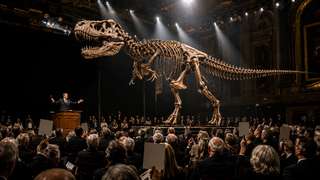
Il devient le dinosaure le plus cher du monde en 10 minutes : voici l’incroyable histoire de Gus
He becomes the most expensive dinosaur in the world in 10 minutes: here is Gus' incredible story
museum Dinosauria Tyrannosaurus skeleton
It spent 67 million years buried in the ground before shaking an auction house. The skeleton of Tyrannosaurus rex nicknamed “Gus” was sold for $50.13 million at Sotheby’s in New York. An absolute record for a dinosaur, which revives the debate on the privatization of...
15/07/2026 futura-terre ⚙ Auto-translated
1 2 3 4 5