museum

Content type

496 image(s) · 24 News

Image gallery

Title: The dinosaur book : the ruling reptiles and their relatives
Identifier: bookruli00colb (find matches)
Year: 1951 (1950s)
Authors: Colbert, Edwin H. (Edwin Harris), 1905-2001; Knight, Charles Robert, 1874-1953; American Museum of Natural History
Subjects: Dinosaurs; Reptiles, Fossil
Publisher: New York : Published for the American Museum of Natural History by McGraw-Hill
Contributing Library: American Museum of Natural History Library
Digitizing Sponsor: IMLS / LSTA / METRO

View Book Page: Book Viewer
About This Book: Catalog Entry
View All Images: All Images From Book
Click here to view book online to see this illustration in context in a browseable online version of this book.

Text Appearing Before Image: 
'
Text Appearing After Image: 
bone A typical example of the parts usually found fossilized: portions of the skeleton of a small dinosaur from Mongolia A.M.N.H. photographs One of the rarest fossils: a dino- saur egg over 60 million years old, compared with a hen's egg (left) and an alligator egg (right)

Note About Images

Please note that these images are extracted from scanned page images that may have been digitally enhanced for readability - coloration and appearance of these illustrations may not perfectly resemble the original work.
Taxa Oviraptor

Title: The dinosaur book : the ruling reptiles and their relatives Identifier: bookruli00colb (find matches) Year: 1951 (1950s) Authors: Colbert, Edwin H. (Edwin Harris), 1905-2001; Knight, Charles Robert, 1874-1953; American Museum of Natural History Subjects: Dinosaurs; Reptiles, Fossil Publisher: New York : Published for the American Museum of Natural History by McGraw-Hill Contributing Library: American Museum of Natural History Library Digitizing Sponsor: IMLS / LSTA / METRO View Book Page: Book Viewer About This Book: Catalog Entry View All Images: All Images From Book Click here to view book online to see this illustration in context in a browseable online version of this book. Text Appearing Before Image: ' Text Appearing After Image: bone A typical example of the parts usually found fossilized: portions of the skeleton of a small dinosaur from Mongolia A.M.N.H. photographs One of the rarest fossils: a dino- saur egg over 60 million years old, compared with a hen's egg (left) and an alligator egg (right) Note About Images Please note that these images are extracted from scanned page images that may have been digitally enhanced for readability - coloration and appearance of these illustrations may not perfectly resemble the original work.

bone museum Mongolia fossil +4
Title: The dinosaur book : the ruling reptiles and their relatives
Identifier: bookruli00colb (find matches)
Year: 1951 (1950s)
Authors: Colbert, Edwin H. (Edwin Harris), 1905-2001; Knight, Charles Robert, 1874-1953; American Museum of Natural History
Subjects: Dinosaurs; Reptiles, Fossil
Publisher: New York : Published for the American Museum of Natural History by McGraw-Hill
Contributing Library: American Museum of Natural History Library
Digitizing Sponsor: IMLS / LSTA / METRO

View Book Page: Book Viewer
About This Book: Catalog Entry
View All Images: All Images From Book
Click here to view book online to see this illustration in context in a browseable online version of this book.

Text Appearing Before Image: 
'
Text Appearing After Image: 
bone A typical example of the parts usually found fossilized: portions of the skeleton of a small dinosaur from Mongolia A.M.N.H. photographs One of the rarest fossils: a dino- saur egg over 60 million years old, compared with a hen's egg (left) and an alligator egg (right)

Note About Images

Please note that these images are extracted from scanned page images that may have been digitally enhanced for readability - coloration and appearance of these illustrations may not perfectly resemble the original work.
Taxa Fenestrosaurus

Title: The dinosaur book : the ruling reptiles and their relatives Identifier: bookruli00colb (find matches) Year: 1951 (1950s) Authors: Colbert, Edwin H. (Edwin Harris), 1905-2001; Knight, Charles Robert, 1874-1953; American Museum of Natural History Subjects: Dinosaurs; Reptiles, Fossil Publisher: New York : Published for the American Museum of Natural History by McGraw-Hill Contributing Library: American Museum of Natural History Library Digitizing Sponsor: IMLS / LSTA / METRO View Book Page: Book Viewer About This Book: Catalog Entry View All Images: All Images From Book Click here to view book online to see this illustration in context in a browseable online version of this book. Text Appearing Before Image: ' Text Appearing After Image: bone A typical example of the parts usually found fossilized: portions of the skeleton of a small dinosaur from Mongolia A.M.N.H. photographs One of the rarest fossils: a dino- saur egg over 60 million years old, compared with a hen's egg (left) and an alligator egg (right) Note About Images Please note that these images are extracted from scanned page images that may have been digitally enhanced for readability - coloration and appearance of these illustrations may not perfectly resemble the original work.

bone museum Mongolia fossil +4
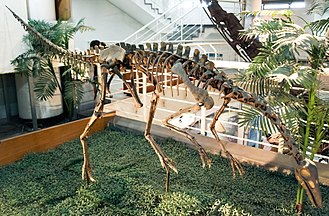
Skeleton identified as Nemegtomaia by Greg Funston.[1] Central Museum of Mongolian Dinosaurs, Ulaanbaatar. Complete indexed photo collection at WorldHistoryPics.com.
Taxa Nemegtomaia

Skeleton identified as Nemegtomaia by Greg Funston.[1] Central Museum of Mongolian Dinosaurs, Ulaanbaatar. Complete indexed photo collection at WorldHistoryPics.com.

museum Dinosauria Nemegtomaia skeleton
Teratophoneus curriei, adult (left) and juvenile (right), on display at the Natural History Museum of Utah, Salt Lake City.
Taxa Teratophoneus

Teratophoneus curriei, adult (left) and juvenile (right), on display at the Natural History Museum of Utah, Salt Lake City.

museum juvenile Teratophoneus
Mounted specimen of Archaeornithomimus asiaticus on display at the Paleozoological Museum of China.
Taxa Archaeornithomimus

Mounted specimen of Archaeornithomimus asiaticus on display at the Paleozoological Museum of China.

museum China specimen Archaeornithomimus
Reconstructed skull of Einiosaurus procurvicornis on display at the Natural History Museum of Los Angeles County.

Reconstructed skull of Einiosaurus procurvicornis on display at the Natural History Museum of Los Angeles County.

museum Einiosaurus skull
Montanoceratops cerorhynchus (Brown & Schlaikjer, 1942) - fossil ceratopsian dinosaur skeleton from the Cretaceous of Montana, USA. (MOR 542, Museum of the Rockies, Bozeman, Montana, USA)
The species name is sometimes incorrectly spelled "cerorhynchos".  The original publication spells it "cerorhynchus".  The genus name is sometimes incorrectly spelled "Montanaceratops".
Ceratopsians are the "horned dinosaurs".  They were large, quadrupedal, herbivorous dinosaurs having a beaked skull and a frill - an extension of bone behind the skull that partially covered the neck.  Ceratopsian dinosaurs are known from the Jurassic and Cretaceous.  The last members of the group died out at the Cretaceous-Tertiary boundary, 65 million years ago.
This is a partial skeleton of a juvenile Montanoceratops, a ceratopsian from the near-latest Cretaceous of western North America.  This type of ceratopsian lacked facial horns.


From exhibit signage:
Sixty-eight million years ago, when the horned dinosaurs Triceratops and Torosaurus inhabited the coastal plain near the inland ocean, primitive "horned" dinosaurs named Montanoceratops lived in uplands near the young Rocky Mountains.  These little protoceratopsians fed on plants with slicing teeth and narrow beaks similar to their giant three-horned relatives.


Classification: Animalia, Chordata, Vertebrata, Reptilia, Archosauria, Dinosauria, Ornithischia, Marginocephalia, Ceratopsia, Leptoceratopsidae
Stratigraphy: St. Mary River Formation, Maastrichtian Stage, Upper Cretaceous
Locality: Little Rocky Coulee, north of the town of Cut Bank, eastern Glacier County, northwestern Montana, USA


Info. at:

en.wikipedia.org/wiki/Montanoceratops
Taxa Montanoceratops

Montanoceratops cerorhynchus (Brown & Schlaikjer, 1942) - fossil ceratopsian dinosaur skeleton from the Cretaceous of Montana, USA. (MOR 542, Museum of the Rockies, Bozeman, Montana, USA) The species name is sometimes incorrectly spelled "cerorhynchos". The original publication spells it "cerorhynchus". The genus name is sometimes incorrectly spelled "Montanaceratops". Ceratopsians are the "horned dinosaurs". They were large, quadrupedal, herbivorous dinosaurs having a beaked skull and a frill - an extension of bone behind the skull that partially covered the neck. Ceratopsian dinosaurs are known from the Jurassic and Cretaceous. The last members of the group died out at the Cretaceous-Tertiary boundary, 65 million years ago. This is a partial skeleton of a juvenile Montanoceratops, a ceratopsian from the near-latest Cretaceous of western North America. This type of ceratopsian lacked facial horns. From exhibit signage: Sixty-eight million years ago, when the horned dinosaurs Triceratops and Torosaurus inhabited the coastal plain near the inland ocean, primitive "horned" dinosaurs named Montanoceratops lived in uplands near the young Rocky Mountains. These little protoceratopsians fed on plants with slicing teeth and narrow beaks similar to their giant three-horned relatives. Classification: Animalia, Chordata, Vertebrata, Reptilia, Archosauria, Dinosauria, Ornithischia, Marginocephalia, Ceratopsia, Leptoceratopsidae Stratigraphy: St. Mary River Formation, Maastrichtian Stage, Upper Cretaceous Locality: Little Rocky Coulee, north of the town of Cut Bank, eastern Glacier County, northwestern Montana, USA Info. at: en.wikipedia.org/wiki/Montanoceratops

bone museum United States Cretaceous +10
Skeletal mount of Archaeoceratops, housed in Tamba Dinosaur Museum
Taxa Archaeoceratops

Skeletal mount of Archaeoceratops, housed in Tamba Dinosaur Museum

museum Archaeoceratops Archaeoceratopsidae Dinosauria
Skeletal mount of Archaeoceratops, housed in Tamba Dinosaur Museum
Taxa Archaeoceratopsidae

Skeletal mount of Archaeoceratops, housed in Tamba Dinosaur Museum

museum Archaeoceratops Archaeoceratopsidae Dinosauria
Muttaburrasaurus
The plants, animals and climate of the Australian continent have changed dramatically over long periods of time. Imagine this giant creature roaming the luxuriant wet forests that covered parts of the continent in the Cretaceous period, about 100-110 million years ago. The Muttaburrasaurus ambled along on all four legs or stood on its hind legs. Its large teeth were well adapted to eat tough vegetation such as the leathery foliage of the evergreen forests of Araucaria trees, ancient relatives of the bunya pine of south-eastern Queensland.
In 1963, grazier Doug Langdon discovered the fossilised bones of a dinosaur on his property near Muttaburra in central-west Queensland. It was one of the most complete dinosaur skeletons found in Australia. The bones belonged to a new species of ornithopod and palaeontologists named it Muttaburrasaurus langdoni.

Cast of Muttaburresaurus langdoni 1987 made by Queensland Museum, Brisbane National Museum of Australia
Taxa Muttaburrasaurus

Muttaburrasaurus The plants, animals and climate of the Australian continent have changed dramatically over long periods of time. Imagine this giant creature roaming the luxuriant wet forests that covered parts of the continent in the Cretaceous period, about 100-110 million years ago. The Muttaburrasaurus ambled along on all four legs or stood on its hind legs. Its large teeth were well adapted to eat tough vegetation such as the leathery foliage of the evergreen forests of Araucaria trees, ancient relatives of the bunya pine of south-eastern Queensland. In 1963, grazier Doug Langdon discovered the fossilised bones of a dinosaur on his property near Muttaburra in central-west Queensland. It was one of the most complete dinosaur skeletons found in Australia. The bones belonged to a new species of ornithopod and palaeontologists named it Muttaburrasaurus langdoni. Cast of Muttaburresaurus langdoni 1987 made by Queensland Museum, Brisbane National Museum of Australia

bone museum Australia Cretaceous +5
Holotype of Fona herzogae NCSM 33548 at the w:North Carolina Museum of Natural Sciences
Taxa Fona

Holotype of Fona herzogae NCSM 33548 at the w:North Carolina Museum of Natural Sciences

museum holotype Fona
Holotype scapula of Tienshanosaurus chitaiensis on display at the Paleozoological Museum of China.
Taxa Tienshanosaurus

Holotype scapula of Tienshanosaurus chitaiensis on display at the Paleozoological Museum of China.

museum China holotype Tienshanosaurus
Nigersaurus - 01 (possibly National Museum of Nature and Science, Tokyo)
Taxa Nigersaurus

Nigersaurus - 01 (possibly National Museum of Nature and Science, Tokyo)

museum Nigersaurus
Yunguisaurus liae, Zhejiang Museum of Natural History (Hangzhou)
Taxa Yunguisaurus

Yunguisaurus liae, Zhejiang Museum of Natural History (Hangzhou)

museum Yunguisaurus
"Eric", a near-complete opalized specimen of the plesiosaur Umoonasaurus at the Australian Museum
Taxa Umoonasaurus

"Eric", a near-complete opalized specimen of the plesiosaur Umoonasaurus at the Australian Museum

museum specimen Plesiosauria Umoonasaurus
Paratype skull of Hamipterus tianshanensis on display at the Paleozoological Museum of China.
Taxa Hamipterus

Paratype skull of Hamipterus tianshanensis on display at the Paleozoological Museum of China.

museum China Hamipteridae Hamipterus +1
1 2 3 4 5 6 7 8 9 10 11 12 13 14 15 16 17 18 19 20 21 22 23 24 25 26 27 28 29 30 31

News

Germany’s Famous Fossil Beds Yield New Species of Jurassic Ichthyosaur
museum Germany Jurassic fossil Ichthyosauria Ichthyosaurus Jabalisaurus new species
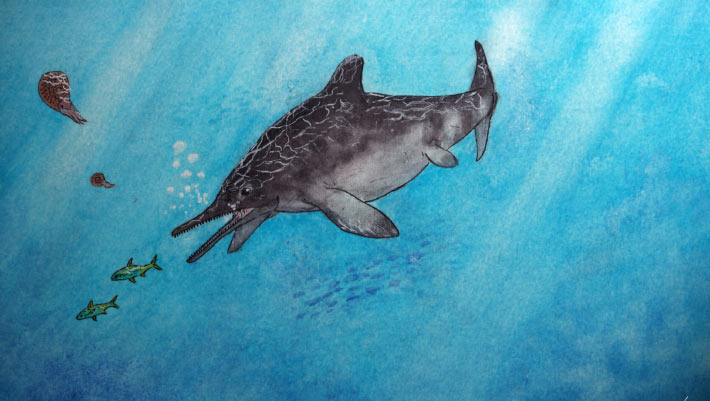
Dr. Erin Maxwell from the Staatliches Museum für Naturkunde Stuttgart and colleagues have identified a second species from the German Plattenkalk limestone deposits: Jabalisaurus tethyensis. The post Germany’s Famous Fossil Beds Yield New Species of Jurassic Ichthyosaur appeared first on Sci.News: Breaking Science News.
11/08/2026 sci-news
Scientists rediscover lost Megalodon fossils—and reveal a 79-foot giant
vertebra museum fossil
Several enormous Megalodon vertebrae thought to have been destroyed in 1989 were found sitting unnoticed on a museum shelf. Their analysis strengthens evidence that the giant shark could exceed 24 meters (79 feet) in length and live for nearly a century. Researchers also estimate that its newborns may have measured an astonishing 3.6 meters (12 feet).
07/08/2026 sciencedaily
This school-bus-sized “terror croc” ate dinosaurs. Now it’s back
museum fossil Dinosauria Georgia skeleton
A massive crocodilian capable of attacking dinosaurs has been brought back to life as the first scientifically accurate mounted skeleton of Deinosuchus schwimmeri. The 31-foot replica at Georgia’s Tellus Science Museum was built from detailed fossil scans and more than 40 years of research by paleontologist Dr. David Schwimmer, for whom the species was named.
05/08/2026 sciencedaily
Seal Underwater Hearing Explained by New Research
museum evolution mammals study
A team of international scientists has uncovered the remarkable mechanism behind seal underwater hearing. A new study, led by researchers from the London Natural History Museum reveals how extant seals hear equally well in air and underwater. The findings help to explain a long-standing evolutionary mystery and could support future conservation efforts. The research, published
16/07/2026 everythingdinosaur
Il devient le dinosaure le plus cher du monde en 10 minutes : voici l’incroyable histoire de Gus
He becomes the most expensive dinosaur in the world in 10 minutes: here is Gus' incredible story
museum Dinosauria Tyrannosaurus skeleton
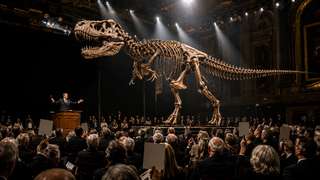
It spent 67 million years buried in the ground before shaking an auction house. The skeleton of Tyrannosaurus rex nicknamed “Gus” was sold for $50.13 million at Sotheby’s in New York. An absolute record for a dinosaur, which revives the debate on the privatization of...
15/07/2026 futura-terre ⚙ Auto-translated
1 2 3 4 5