mammifères

Thématique

1 image(s) · 41 Actualités

Galerie d'images

Identifier: waterreptilesofp1914will
Title: Water reptiles of the past and present
Year: 1914 (1910s)
Authors:  Williston, Samuel Wendell, 1851-1918
Subjects:  Aquatic reptiles
Publisher:  Chicago, Ill., The University of Chicago Press
Contributing Library:  Boston Public Library
Digitizing Sponsor:  Boston Public Library

View Book Page: Book Viewer
About This Book: Catalog Entry
View All Images: All Images From Book
Click here to view book online to see this illustration in context in a browseable online version of this book.

Text Appearing Before Image:
served and very complete skeletons ofdifferent species of ichthyosaurs from the Jurassic deposits ofWiirtemberg, in which remains of these animals occur in great 112 WATER REPTILES OF THE PAST AND PRESENT profusion. His researches, and those of several authors since then,supplementing and confirming or disproving those of the manyobservers made during the preceding seventy years, have finallydetermined almost perfectly the complete structure of the moretypical ichthyosaurs, enabling us to infer not a little as to theirhabits and distribution in the old Jurassic oceans. Within thepast few years the discoveries of Professor J. C. Merriam of Cali-fornia have likewise added greatly to our knowledge of the earlierichthyosaurs. It may now truthfully be said that of no group ofextinct reptiles do we have a more complete and satisfactory knowl-edge than of the ichthyosaurs. Nevertheless we have yet very much more to learn about theorder Ichthyosauria as a whole—whence they came and how they
Text Appearing After Image:
Fig. 52.—Ichthyosaurus quadricissus.museum, from Dr. Dreverman. Photograph of specimen in Senckenberg originated; what their nearest kin were among other reptiles; andespecially, more about the connecting links between them andterrestrial reptiles. They have, as an order, so isolated a position,are so widely separated from all other reptiles in structure, that theyhave long been a puzzle to paleontologists. Like the whales andother cetaceans among mammals, we know the ichthyosaurs wellin the plenitude of their power and the fulness of their development,but have yet only an imperfect knowledge of their earlier history,and none whatever of their earliest. However, as will be seenfarther on, the recent discoveries by Merriam have shed much lighton some of the stages of their evolution. So nearly perfectly wereall the later ichthyosaurs adapted to their life in the water that itwas believed by nearly all paleontologists until about a score of years ICHTHYOSAURIA 3 ago that they had desc

Note About Images

Please note that these images are extracted from scanned page images that may have been digitally enhanced for readability - coloration and appearance of these illustrations may not perfectly resemble the original work.
Taxons Stenopterygiidae

Identifier: waterreptilesofp1914will Title: Water reptiles of the past and present Year: 1914 (1910s) Authors: Williston, Samuel Wendell, 1851-1918 Subjects: Aquatic reptiles Publisher: Chicago, Ill., The University of Chicago Press Contributing Library: Boston Public Library Digitizing Sponsor: Boston Public Library View Book Page: Book Viewer About This Book: Catalog Entry View All Images: All Images From Book Click here to view book online to see this illustration in context in a browseable online version of this book. Text Appearing Before Image: served and very complete skeletons ofdifferent species of ichthyosaurs from the Jurassic deposits ofWiirtemberg, in which remains of these animals occur in great 112 WATER REPTILES OF THE PAST AND PRESENT profusion. His researches, and those of several authors since then,supplementing and confirming or disproving those of the manyobservers made during the preceding seventy years, have finallydetermined almost perfectly the complete structure of the moretypical ichthyosaurs, enabling us to infer not a little as to theirhabits and distribution in the old Jurassic oceans. Within thepast few years the discoveries of Professor J. C. Merriam of Cali-fornia have likewise added greatly to our knowledge of the earlierichthyosaurs. It may now truthfully be said that of no group ofextinct reptiles do we have a more complete and satisfactory knowl-edge than of the ichthyosaurs. Nevertheless we have yet very much more to learn about theorder Ichthyosauria as a whole—whence they came and how they Text Appearing After Image: Fig. 52.—Ichthyosaurus quadricissus.museum, from Dr. Dreverman. Photograph of specimen in Senckenberg originated; what their nearest kin were among other reptiles; andespecially, more about the connecting links between them andterrestrial reptiles. They have, as an order, so isolated a position,are so widely separated from all other reptiles in structure, that theyhave long been a puzzle to paleontologists. Like the whales andother cetaceans among mammals, we know the ichthyosaurs wellin the plenitude of their power and the fulness of their development,but have yet only an imperfect knowledge of their earlier history,and none whatever of their earliest. However, as will be seenfarther on, the recent discoveries by Merriam have shed much lighton some of the stages of their evolution. So nearly perfectly wereall the later ichthyosaurs adapted to their life in the water that itwas believed by nearly all paleontologists until about a score of years ICHTHYOSAURIA 3 ago that they had desc Note About Images Please note that these images are extracted from scanned page images that may have been digitally enhanced for readability - coloration and appearance of these illustrations may not perfectly resemble the original work.

livre musée Jurassique spécimen +7

Actualités

Fossil Evidence Pushes Back Origin of Live Birth by 90 Million Years
Les preuves fossiles repoussent l’origine des naissances vivantes de 90 millions d’années
reproduction Argentine fossile mammifères
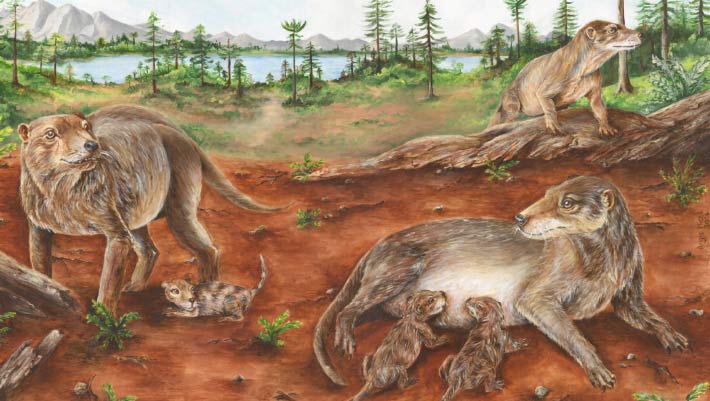
Les paléontologues étudiant un fossile de cynodonte d'Argentine vieux de 236 millions d'années affirment avoir trouvé la première preuve de viviparité (naissance vivante) dans la lignée évolutive qui mène aux mammifères, repoussant l'origine de cette stratégie de reproduction de 90 à 95 millions d'années. L'article Les preuves fossiles repoussent l'origine des naissances vivantes de 90 millions d'années est apparu en premier sur Sci.News : Breaking Science News.
13/08/2026 sci-news ⚙ Traduction automatique
Why Were There No Tiny Non-Avian Dinosaurs? Mammals May Have Been to Blame
Pourquoi n’y avait-il pas de petits dinosaures non aviaires ? Les mammifères pourraient être à blâmer
écologie prédateur reproduction Dinosauria évolution mammifères
Les dinosaures ont évolué pour devenir certains des plus grands animaux ayant jamais foulé la Terre, mais un nouveau modèle mathématique suggère que les premiers mammifères les auraient chassés des niches écologiques réservées aux plus petites créatures. Cet article, intitulé « Pourquoi n'y avait-il pas de minuscules dinosaures non aviens ? Les mammifères en seraient-ils responsables ? », a été initialement publié sur Sci.News: Breaking Science News.
10/08/2026 sci-news ⚙ Traduction automatique
Depuis 15 000 ans, les humains et les chiens se transforment
comportement évolution génétique Homo sapiens mammifères
Les chiens façonnent – ​​et sont façonnés par – les humains depuis environ 15 000 ans, passant du premier partenaire des chasseurs-cueilleurs à une gamme étonnante de compagnons spécialisés. Partout dans le monde, ils se sont adaptés aux côtés des humains à des environnements et à des besoins très différents, depuis les puissants chiens de traîneau arctiques et les chasseurs agiles de la forêt tropicale jusqu'aux chiens de haute altitude dotés de caractéristiques génétiques leur permettant de survivre dans les airs. Certains étaient même élevés pour la laine, tandis que d’autres jouaient d’importants rôles spirituels ou cérémoniaux.
10/08/2026 sciencedaily-fossils ⚙ Traduction automatique
Les dinosaures sont devenus des géants – alors pourquoi ne sont-ils jamais devenus minuscules ?
écologie croissance Dinosauria évolution mammifères
Les dinosaures ont conquis la terre à des tailles énormes, mais étrangement, ils n'ont presque jamais évolué pour devenir de véritables animaux minuscules. De nouvelles recherches suggèrent que la physiologie à elle seule ne peut pas expliquer cette extrémité miniature manquante du spectre des dinosaures et que les premiers mammifères pourraient en être en partie responsables. Alors que les dinosaures empêchaient les mammifères de devenir grands, les petits mammifères pourraient leur rendre la pareille en occupant des niches écologiques qui auraient autrement pu accueillir des dinosaures de la taille d'une souris.
09/08/2026 sciencedaily ⚙ Traduction automatique
La première cloaque synapside révélée par un fossile vieux de 294 millions d'années
Allemagne fossile empreintes découverte évolution mammifères
Une trace fossile remarquable provenant d’Allemagne a fourni la plus ancienne preuve connue d’un cloaque dans la lignée des mammifères. Cette découverte aide les paléontologues à mieux comprendre l’évolution des premiers vertébrés terrestres et comble une lacune importante dans les archives fossiles. Le fossile provient de la célèbre localité fossilifère de Bromacker en Thuringe (Allemagne). Parmi les empreintes et
20/07/2026 everythingdinosaur ⚙ Traduction automatique
1 2 3 4 5 6 7 8 9