feather

Anatomical part

14 image(s) · 9 News

Image gallery

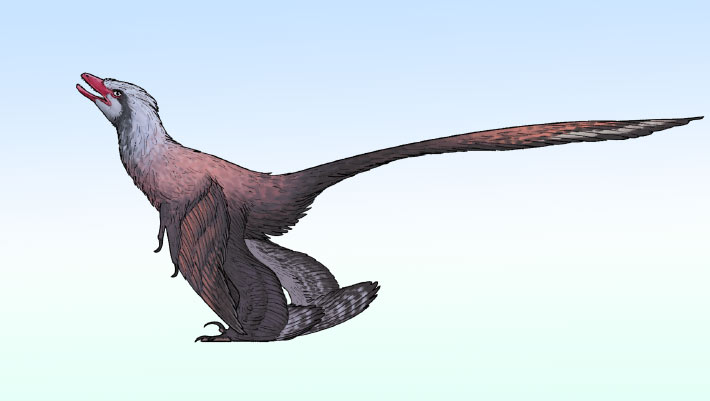
Atrociraptor marshalli restoration. Follows elements depicted in original description:[1] Unknown parts restored after relatives with preserved feathers, such as described in:[2]
Taxa Atrociraptor

Atrociraptor marshalli restoration. Follows elements depicted in original description:[1] Unknown parts restored after relatives with preserved feathers, such as described in:[2]

feather description Atrociraptor
Baminornis is the oldest known bird with a fused pygostyle, a skeletal feature that implies tail feathers. Its discovery pushed back current understanding of bird evolution and global distribution by 20 million years. Baminornis was about 15 cm in length, had many features in common with modern birds, including the capability for powered flight.
Taxa Baminornis

Baminornis is the oldest known bird with a fused pygostyle, a skeletal feature that implies tail feathers. Its discovery pushed back current understanding of bird evolution and global distribution by 20 million years. Baminornis was about 15 cm in length, had many features in common with modern birds, including the capability for powered flight.

feather flight Baminornis bird +2
Life reconstruction of Heyuannia yanshini, depicting a male with a tail-feather fan

Life reconstruction of Heyuannia yanshini, depicting a male with a tail-feather fan

feather Heyuannia Ingenia
Life reconstruction of Heyuannia yanshini, depicting a male with a tail-feather fan displaying for an onlooking female.

Life reconstruction of Heyuannia yanshini, depicting a male with a tail-feather fan displaying for an onlooking female.

feather Heyuannia Ingenia
Fujianvenator is an anchiornithid avialan from the Late Jurassic of China, whose discovery gave important insight to the evolution of birds. It had proportionately long legs, with the tibia twice the length of the femur. This suggests it may have been a strong runner, and possibly had a terrestrial or wading lifestyle. Fujianvenator was a small dinosaur, weighing about 640 g. As an avialan, it was almost certainly covered in feathers, though it does not seem likely to have been capable of flight.
Taxa Fujianvenator

Fujianvenator is an anchiornithid avialan from the Late Jurassic of China, whose discovery gave important insight to the evolution of birds. It had proportionately long legs, with the tibia twice the length of the femur. This suggests it may have been a strong runner, and possibly had a terrestrial or wading lifestyle. Fujianvenator was a small dinosaur, weighing about 640 g. As an avialan, it was almost certainly covered in feathers, though it does not seem likely to have been capable of flight.

feather flight China Jurassic +7
The "dromaeo-avemorphs", as they are informally known (Paul, 2002), represent a group of early paravian theropods with asymmetrical feathers and an Archaeopteryx-like body. According to Hartman et al. (2019), the animals shown in this image might, together, form a clade (monophyletic group) without modern birds.

The "dromaeo-avemorphs", as they are informally known (Paul, 2002), represent a group of early paravian theropods with asymmetrical feathers and an Archaeopteryx-like body. According to Hartman et al. (2019), the animals shown in this image might, together, form a clade (monophyletic group) without modern birds.

feather Archaeopteryx Paraves bird
Diuqin is an unenlagiine dinosaur from the Late Cretaceous of what is now Argentina. Unenlagiines, known exclusively from South America, are usually classified as dromaeosaurs though this is sometimes debated. Like dromaeosaurs, they were covered in feathers, carnivorous, and had the large sickle-like claw on the inner toe of each foot. Unique to unenlagiines is their elongated snout, suggesting a piscivorous diet. Diuqin was a medium-sized unenlagiine, at about 4 m in length.

Diuqin is an unenlagiine dinosaur from the Late Cretaceous of what is now Argentina. Unenlagiines, known exclusively from South America, are usually classified as dromaeosaurs though this is sometimes debated. Like dromaeosaurs, they were covered in feathers, carnivorous, and had the large sickle-like claw on the inner toe of each foot. Unique to unenlagiines is their elongated snout, suggesting a piscivorous diet. Diuqin was a medium-sized unenlagiine, at about 4 m in length.

claw feather Argentina Cretaceous +5
Simplified cladogram of Dinosauria with the distribution of feathers according to the fossil record. Despite its more ancient origin, it
was only in maniraptoriformes that modern-type feathers (pennaceous feathers) have arisen (Based in Xu & Guo, 2009; Clarke,

2013; Godefroit et al., 2013; Han et al., 2014; Koshchowitz et al., 2014).

Simplified cladogram of Dinosauria with the distribution of feathers according to the fossil record. Despite its more ancient origin, it was only in maniraptoriformes that modern-type feathers (pennaceous feathers) have arisen (Based in Xu & Guo, 2009; Clarke, 2013; Godefroit et al., 2013; Han et al., 2014; Koshchowitz et al., 2014).

feather fossil Dinosauria Maniraptoriformes +1
Caihong juji holotype specimen (PMoL-B00175). Photographs of the slab (a) and counter slab (b) and line drawing (c) of the specimen based on both slabs. Photograph (d) and line drawing (e) of a composite of the rostrum of the skull and mandible exposed on the counter slab and the post-rostrum cranium exposed on the slab. Arrows indicate lacrimal crests. Question mark indicates uncertain identification. Scale bars: 10 cm a–c, 1 cm d and e. aof antorbital fenestra, cav caudal vertebra, cev cervical vertebra, dr dorsal rib, dv dorsal vertebra, ect ectopterygoid, emf external mandibular fenestra, en external naris, f feather, fu furcula, ga gastralia, hy hyoid, il ilium, is ischium, la left angular, lar left articular, lc left coracoid, lcr lacrimal crest, ld left dentary, lf left, frontal, lfe left femur, lh left humerus, lj left jugal, ll left lacrimal, lma left maxilla, lm left manus, ln left nasal, lp left pes, lpa left palatine, lpo left postorbital, lq left quadrate, lqj left quadratojugal, lr left radius, ls left scapula, lsp left splenial, lsa left surangular, lsq left squamosal, lt left tibiotarsus, lu left ulna, ma mandible, mf maxillary fenestra, o orbit, p parietal, pm premaxilla, pt pterygoid, pu pubis, rar right articular, rc right coracoid, rd right dentary, rfe right femur, rh right humerus, rm right manus, rp right pes, rpra right prearticular, rq right quadrate, rr right radius, rs right scapula, rt right tibiotarsus, ru right ulna, scl sclerotic bones, sk skull, sy synsacrum
Taxa Caihong

Caihong juji holotype specimen (PMoL-B00175). Photographs of the slab (a) and counter slab (b) and line drawing (c) of the specimen based on both slabs. Photograph (d) and line drawing (e) of a composite of the rostrum of the skull and mandible exposed on the counter slab and the post-rostrum cranium exposed on the slab. Arrows indicate lacrimal crests. Question mark indicates uncertain identification. Scale bars: 10 cm a–c, 1 cm d and e. aof antorbital fenestra, cav caudal vertebra, cev cervical vertebra, dr dorsal rib, dv dorsal vertebra, ect ectopterygoid, emf external mandibular fenestra, en external naris, f feather, fu furcula, ga gastralia, hy hyoid, il ilium, is ischium, la left angular, lar left articular, lc left coracoid, lcr lacrimal crest, ld left dentary, lf left, frontal, lfe left femur, lh left humerus, lj left jugal, ll left lacrimal, lma left maxilla, lm left manus, ln left nasal, lp left pes, lpa left palatine, lpo left postorbital, lq left quadrate, lqj left quadratojugal, lr left radius, ls left scapula, lsp left splenial, lsa left surangular, lsq left squamosal, lt left tibiotarsus, lu left ulna, ma mandible, mf maxillary fenestra, o orbit, p parietal, pm premaxilla, pt pterygoid, pu pubis, rar right articular, rc right coracoid, rd right dentary, rfe right femur, rh right humerus, rm right manus, rp right pes, rpra right prearticular, rq right quadrate, rr right radius, rs right scapula, rt right tibiotarsus, ru right ulna, scl sclerotic bones, sk skull, sy synsacrum

crest feather humerus scale +7
Restoration of Lucianovenator bonoi based on images of known remains and related genera. Proto-feathers for insulation in coelophysids and other early theropods have been supported by this study:[1]
Taxa Lucianovenator

Restoration of Lucianovenator bonoi based on images of known remains and related genera. Proto-feathers for insulation in coelophysids and other early theropods have been supported by this study:[1]

feather Coelophysidae Lucianovenator study
Life restoration of Pampadromaeus barberenai based on known skeletal remains. Colours speculative, feathers based on presumed presence within all Ornithodira.

Life restoration of Pampadromaeus barberenai based on known skeletal remains. Colours speculative, feathers based on presumed presence within all Ornithodira.

feather Pampadromaeus
Anzu is a fairly large caenagnathid oviraptorosaurian dinosaur that grew to nearly 4 m in length, and weighed 200-300 kg. It was a bipedal dinosaur and was covered in feathers, with a large sloping crest atop its head. Typical of oviraptorosaurs, Anzu had a short toothless beak, an adaptation that suggests it was most likely herbivorous or possibly omnivorous.

Anzu is a fairly large caenagnathid oviraptorosaurian dinosaur that grew to nearly 4 m in length, and weighed 200-300 kg. It was a bipedal dinosaur and was covered in feathers, with a large sloping crest atop its head. Typical of oviraptorosaurs, Anzu had a short toothless beak, an adaptation that suggests it was most likely herbivorous or possibly omnivorous.

crest feather Anzu Caenagnathidae +2
Euryapteryx gravis restored based on skeletons and preserved moa feathers.
Taxa Ageroolithus

Euryapteryx gravis restored based on skeletons and preserved moa feathers.

feather Ageroolithus skeleton
The holotype of Microraptor gui, IVPP V 13352 under normal light.
This shows the preserved feathers (white arrow) and the 'halo' around the specimen where they appear to be absent (black arrows). Scale bar at 5 cm.
Taxa Microraptor

The holotype of Microraptor gui, IVPP V 13352 under normal light. This shows the preserved feathers (white arrow) and the 'halo' around the specimen where they appear to be absent (black arrows). Scale bar at 5 cm.

feather scale holotype specimen +2
The holotype of Microraptor gui, IVPP V 13352 under normal light.
This shows the preserved feathers (white arrow) and the 'halo' around the specimen where they appear to be absent (black arrows). Scale bar at 5 cm.
Taxa Microraptorinae

The holotype of Microraptor gui, IVPP V 13352 under normal light. This shows the preserved feathers (white arrow) and the 'halo' around the specimen where they appear to be absent (black arrows). Scale bar at 5 cm.

feather scale holotype specimen +2

News

New Feathered Dinosaur from China Had Peacock-Like Tail
feather China Cretaceous Early Cretaceous Changzhousaurus Dinosauria bird evolution new species
A new genus and species of four-winged pennaraptoran dinosaur from the Early Cretaceous of northern China is adding another twist to the story of how birds evolved from their dinosaur ancestors. The post New Feathered Dinosaur from China Had Peacock-Like Tail appeared first on Sci.News: Breaking Science News.
23/06/2026 sci-news
This four-winged dinosaur may have terrorized Earth's earliest birds
bone feather predator China Dinosauria Jian Velociraptor bird
A newly discovered feathered dinosaur called Jian changmaensis may be the missing predator responsible for mysterious piles of crushed prehistoric bird bones in China. The four-winged glider, a close cousin of Velociraptor, helps reveal how early birds and their dinosaur relatives shared the same ancient landscape.
23/06/2026 sciencedaily
Pterosaurs May Have Possessed Iridescent Pycnofibres
feather Pterosauria Tapejaridae behavior study
New research suggests that colourful tapejarid pterosaurs may have been even more spectacular than previously imagined. A recently published study proposes that some of these flying reptiles possessed iridescent pycnofibres that produced shimmering colours. As a result, these structures may have played an important role in visual signalling and display. The bodies of pterosaurs, the
19/06/2026 everythingdinosaur
New Four-winged Dinosaur from China Described
feather limb description China Cretaceous Early Cretaceous fossil Dinosauria Jian Microraptorinae new species partial
Palaeontologists have described a new species of microraptorine theropod from north-western China. Named Jian changmaensis, this small, feathered dinosaur probably glided on four wings. The fossil provides fresh insights into Early Cretaceous ecosystems and extends the known range of the Microraptorinae. The fossil material consists of an articulated partial left pectoral girdle and forelimb. It
08/06/2026 everythingdinosaur
Un vrai cauchemar volant : des chercheurs ont découvert un « dragon » préhistorique avec 4 ailes qui terrorisait les premiers oiseaux !
A true flying nightmare: researchers have discovered a prehistoric “dragon” with 4 wings that terrorized early birds!
feather hunting China Cretaceous fossil Dinosauria Jian bird study
Raptors, feathered dinosaurs from the Cretaceous period, could not fly despite their close relationship with birds. However, a new study carried out at a fossil site in China reveals that some of them would have been capable of gliding and hunting the first birds.
05/06/2026 futura-terre ⚙ Auto-translated
1 2