plume

Partie anatomique

20 image(s) · 9 Actualités

Galerie d'images

Restoration of Lucianovenator bonoi based on images of known remains and related genera. Proto-feathers for insulation in coelophysids and other early theropods have been supported by this study:[1]

Restoration of Lucianovenator bonoi based on images of known remains and related genera. Proto-feathers for insulation in coelophysids and other early theropods have been supported by this study:[1]

plume Coelophysidae Lucianovenator étude
Life restoration of Pampadromaeus barberenai based on known skeletal remains. Colours speculative, feathers based on presumed presence within all Ornithodira.

Life restoration of Pampadromaeus barberenai based on known skeletal remains. Colours speculative, feathers based on presumed presence within all Ornithodira.

plume Pampadromaeus
Anzu is a fairly large caenagnathid oviraptorosaurian dinosaur that grew to nearly 4 m in length, and weighed 200-300 kg. It was a bipedal dinosaur and was covered in feathers, with a large sloping crest atop its head. Typical of oviraptorosaurs, Anzu had a short toothless beak, an adaptation that suggests it was most likely herbivorous or possibly omnivorous.

Anzu is a fairly large caenagnathid oviraptorosaurian dinosaur that grew to nearly 4 m in length, and weighed 200-300 kg. It was a bipedal dinosaur and was covered in feathers, with a large sloping crest atop its head. Typical of oviraptorosaurs, Anzu had a short toothless beak, an adaptation that suggests it was most likely herbivorous or possibly omnivorous.

crête plume Anzu Caenagnathidae +2
Euryapteryx gravis restored based on skeletons and preserved moa feathers.
Taxons Ageroolithus

Euryapteryx gravis restored based on skeletons and preserved moa feathers.

plume Ageroolithus squelette
The holotype of Microraptor gui, IVPP V 13352 under normal light.
This shows the preserved feathers (white arrow) and the 'halo' around the specimen where they appear to be absent (black arrows). Scale bar at 5 cm.
Taxons Microraptor

The holotype of Microraptor gui, IVPP V 13352 under normal light. This shows the preserved feathers (white arrow) and the 'halo' around the specimen where they appear to be absent (black arrows). Scale bar at 5 cm.

plume écaille holotype spécimen +2
The holotype of Microraptor gui, IVPP V 13352 under normal light.
This shows the preserved feathers (white arrow) and the 'halo' around the specimen where they appear to be absent (black arrows). Scale bar at 5 cm.
Taxons Microraptorinae

The holotype of Microraptor gui, IVPP V 13352 under normal light. This shows the preserved feathers (white arrow) and the 'halo' around the specimen where they appear to be absent (black arrows). Scale bar at 5 cm.

plume écaille holotype spécimen +2
1 2

Actualités

New Feathered Dinosaur from China Had Peacock-Like Tail
Un nouveau dinosaure à plumes de Chine avait une queue semblable à celle d'un paon
plume Chine Crétacé Crétacé inférieur Dinosauria oiseau évolution nouvelle espèce
Un nouveau genre et une nouvelle espèce de dinosaure pennaraptoran à quatre ailes du Crétacé inférieur du nord de la Chine ajoutent une autre tournure à l'histoire de l'évolution des oiseaux à partir de leurs ancêtres dinosaures. L'article Un nouveau dinosaure à plumes de Chine avait une queue semblable à un paon est apparu en premier sur Sci.News : Breaking Science News.
23/06/2026 sci-news ⚙ Traduction automatique
Ce dinosaure à quatre ailes aurait terrorisé les premiers oiseaux de la Terre
os plume prédateur Chine Dinosauria Velociraptor oiseau
Un dinosaure à plumes récemment découvert appelé Jian changmaensis pourrait être le prédateur disparu responsable de mystérieux tas d'os d'oiseaux préhistoriques écrasés en Chine. Le planeur à quatre ailes, un proche cousin du vélociraptor, aide à révéler comment les lève-tôt et leurs parents dinosaures partageaient le même paysage ancien.
23/06/2026 sciencedaily ⚙ Traduction automatique
Les ptérosaures pourraient avoir possédé des pycnofibres irisées
plume Pterosauria Tapejaridae comportement étude
De nouvelles recherches suggèrent que les ptérosaures tapejaridés colorés pourraient avoir été encore plus spectaculaires qu’on ne l’imaginait auparavant. Une étude récemment publiée suggère que certains de ces reptiles volants possédaient des pycnofibres irisées produisant des couleurs chatoyantes. En conséquence, ces structures pourraient avoir joué un rôle important dans la signalisation visuelle et l’affichage. Les corps des ptérosaures, les
19/06/2026 everythingdinosaur ⚙ Traduction automatique
Description d'un nouveau dinosaure à quatre ailes en provenance de Chine
plume membre description Chine Crétacé Crétacé inférieur fossile Dinosauria Microraptorinae nouvelle espèce partiel
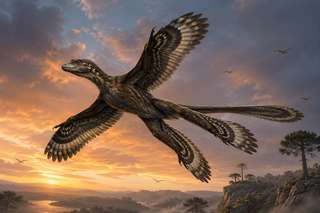
Les paléontologues ont décrit une nouvelle espèce de théropode microraptorine du nord-ouest de la Chine. Nommé Jian changmaensis, ce petit dinosaure à plumes planait probablement sur quatre ailes. Le fossile fournit de nouvelles informations sur les écosystèmes du Crétacé inférieur et étend l’aire de répartition connue des Microraptorinae. Le matériau fossile est constitué d'une ceinture pectorale gauche partielle articulée et d'un membre antérieur. Il
08/06/2026 everythingdinosaur ⚙ Traduction automatique
Un vrai cauchemar volant : des chercheurs ont découvert un « dragon » préhistorique avec 4 ailes qui terrorisait les premiers oiseaux !
plume chasse Chine Crétacé fossile Dinosauria oiseau étude
Les raptors, dinosaures à plumes du Crétacé, ne pouvaient pas voler malgré leur lien étroit avec les oiseaux. Une nouvelle étude menée sur un site fossilifère en Chine révèle toutefois que certains d’entre eux auraient été capables de planer et de chasser les premiers oiseaux.
05/06/2026 futura-terre
1 2