fossile

Nature du spécimen

183 image(s) · 112 Actualités

Galerie d'images

Original figure caption: .mw-parser-output .smallcaps{font-variant:small-caps}The Middletown Slab covered with the Footprints of Carnivorous Dinosaurs. The tracks are in high relief. Additional notes: Most if not all of these tridactylous (i.e. three-toed) footprints/tracks (but not the actual trackmaker!) are referred to as Grallator or as Grallator-type trace fossils. “High relief” means that these are actually casts of footprints forming a positive relief on the lower surface of the sandstone slab (so-called positive hyporelief). The material that originally formed the mud over which the dinosaurs walked was too friable to be recovered from the quarry in one piece. The slab consists of so called ‘brownstone’ which is the trading name of the sandstone quarried at Middletown, Connecticut. This sandstone belongs to the Lower Jurassic Portland Formation of the Hartford Basin (“Connecticut Valley”) and thus to the upper part of the Newark Supergroup. The trackmakers probably were relatively small ‘primitive’ theropod dinosaurs (coelophysoids) such as Podokesaurus the remains of which were recovered from Lower Jurassic deposits of the Hartford Basin.
Formations Portland

Original figure caption: .mw-parser-output .smallcaps{font-variant:small-caps}The Middletown Slab covered with the Footprints of Carnivorous Dinosaurs. The tracks are in high relief. Additional notes: Most if not all of these tridactylous (i.e. three-toed) footprints/tracks (but not the actual trackmaker!) are referred to as Grallator or as Grallator-type trace fossils. “High relief” means that these are actually casts of footprints forming a positive relief on the lower surface of the sandstone slab (so-called positive hyporelief). The material that originally formed the mud over which the dinosaurs walked was too friable to be recovered from the quarry in one piece. The slab consists of so called ‘brownstone’ which is the trading name of the sandstone quarried at Middletown, Connecticut. This sandstone belongs to the Lower Jurassic Portland Formation of the Hartford Basin (“Connecticut Valley”) and thus to the upper part of the Newark Supergroup. The trackmakers probably were relatively small ‘primitive’ theropod dinosaurs (coelophysoids) such as Podokesaurus the remains of which were recovered from Lower Jurassic deposits of the Hartford Basin.

Portland Jurassique moulage fossile +4
Locality map: Grand Staircase-Escalante National Monument, southern Utah.
Map showing the Nipple Butte area (indicated by yellow star) of Grand Staircase-Escalante National Monument (GSENM). GSENM is bounded by the red rectangle and silhouetted in dark gray on the inset of Utah and surrounding states (modified from [1]).

The original map has been modified to show the Nipple Butte area instead of the Machairoceratops fossil locality as in the original source. New location based on map in A New Macrovertebrate Assemblage from the Late Cretaceous (Campanian) of Southern Utah, page 601.

Locality map: Grand Staircase-Escalante National Monument, southern Utah. Map showing the Nipple Butte area (indicated by yellow star) of Grand Staircase-Escalante National Monument (GSENM). GSENM is bounded by the red rectangle and silhouetted in dark gray on the inset of Utah and surrounding states (modified from [1]). The original map has been modified to show the Nipple Butte area instead of the Machairoceratops fossil locality as in the original source. New location based on map in A New Macrovertebrate Assemblage from the Late Cretaceous (Campanian) of Southern Utah, page 601.

Campanien Crétacé Crétacé supérieur fossile +1
(A) Map of Queensland showing the extent of Cretaceous outcrop. (B) Map of the location of Dig Site Three (type locality of Haliskia), and numerous other sites in the area from which pterosaur fossils have been collected.
Formations Griman Creek

(A) Map of Queensland showing the extent of Cretaceous outcrop. (B) Map of the location of Dig Site Three (type locality of Haliskia), and numerous other sites in the area from which pterosaur fossils have been collected.

Crétacé fossile Haliskia Pterosauria
Eubrontes dinosaur track from the Jurassic of Connecticut, USA.
Trace fossils are any indirect evidence of ancient life.  They refer to features in rocks that do not represent parts of the body of a once-living organism.  Traces include footprints, tracks, trails, burrows, borings, and bitemarks.  Body fossils provide information about the morphology of ancient organisms, while trace fossils provide information about the behavior of ancient life forms.  Interpreting trace fossils and determination of the identity of a trace maker can be straightforward (for example, a dinosaur footprint represents walking behavior) or not.  Sediments that have trace fossils are said to be bioturbated.  Burrowed textures in sedimentary rocks are referred to as bioturbation.  Trace fossils have scientific names assigned to them, in the same style & manner as living organisms or body fossils.
This track was made by a theropod, a group of small to large, carnivorous, bipedal dinosaurs.  The specimen comes from a Triassic to Jurassic terrestrial sedimentary succession that filled up a half graben, many of which occur along America's eastern seaboard.  Such half-graben basins formed during the Triassic as the Pangaea supercontinent tried to rift apart, but failed.  Pangaea successfully broke apart during the Jurassic.
Stratigraphy: East Berlin Formation, Newark Supergroup, Lower Jurassic
Locality: unrecorded / undisclosed site at or near the town of Rocky Hill, central Connecticut, USA


Info. at:
mrdata.usgs.gov/geology/state/sgmc-unit.php?unit=CTJeb%3B0
and

en.wikipedia.org/wiki/Eubrontes

Eubrontes dinosaur track from the Jurassic of Connecticut, USA. Trace fossils are any indirect evidence of ancient life. They refer to features in rocks that do not represent parts of the body of a once-living organism. Traces include footprints, tracks, trails, burrows, borings, and bitemarks. Body fossils provide information about the morphology of ancient organisms, while trace fossils provide information about the behavior of ancient life forms. Interpreting trace fossils and determination of the identity of a trace maker can be straightforward (for example, a dinosaur footprint represents walking behavior) or not. Sediments that have trace fossils are said to be bioturbated. Burrowed textures in sedimentary rocks are referred to as bioturbation. Trace fossils have scientific names assigned to them, in the same style & manner as living organisms or body fossils. This track was made by a theropod, a group of small to large, carnivorous, bipedal dinosaurs. The specimen comes from a Triassic to Jurassic terrestrial sedimentary succession that filled up a half graben, many of which occur along America's eastern seaboard. Such half-graben basins formed during the Triassic as the Pangaea supercontinent tried to rift apart, but failed. Pangaea successfully broke apart during the Jurassic. Stratigraphy: East Berlin Formation, Newark Supergroup, Lower Jurassic Locality: unrecorded / undisclosed site at or near the town of Rocky Hill, central Connecticut, USA Info. at: mrdata.usgs.gov/geology/state/sgmc-unit.php?unit=CTJeb%3B0 and en.wikipedia.org/wiki/Eubrontes

États-Unis Jurassique Trias fossile +5
A trackway of the trace fossil Bifurculapes laqueatus (positive hyporelief, i.e. casts on the bottom surface of the bed) from the Early Jurassic East Berlin Formation (Hartford Basin) of Holyoke, Massachusetts (not the same specimen as this one). Scale is in cm.
Formations East Berlin

A trackway of the trace fossil Bifurculapes laqueatus (positive hyporelief, i.e. casts on the bottom surface of the bed) from the Early Jurassic East Berlin Formation (Hartford Basin) of Holyoke, Massachusetts (not the same specimen as this one). Scale is in cm.

écaille East Berlin Jurassique inférieur Jurassique +4
Fossil eggs of the oospecies Macroelongatoolithus carlylei (believed to be the eggs of giant oviraptorosaurs) from the Cedar Mountain Formation of North America. At the SECU Dinolab of the North Carolina Museum of Natural Sciences

Fossil eggs of the oospecies Macroelongatoolithus carlylei (believed to be the eggs of giant oviraptorosaurs) from the Cedar Mountain Formation of North America. At the SECU Dinolab of the North Carolina Museum of Natural Sciences

musée Cedar Mountain fossile Macroelongatoolithus +2
Paleogeography and paleoclimate of the Late Jurassic - 150 Ma with dinosaur fossil localities:
A = Tendaguru Formation, Tanzania
C1 =  Shishugou & Kalazha Formations, China
C2 =  Shangshaximiao (Upper Shaximiao) Formation, China
E1 =  Sables de Glos, Argiles d’Octeville, Marnes de Bléville, Kimmeridge Clay, Calcareous Grit, Corallian Oolite, Oxford Clay, Portland Stone, England & France
E2 = Villar del Arzobispo, Alcobaça, Guimarota, Sobral, Amoreira-Porto Novo, Bombarral, Freixial, Lourinhã Formations, Spain & Portugal
M1-6 = Morrison Formation, United States
S1 =  Toquí & Cañadón Calcáreo Formations, Chile & Argentina

Paleogeography and paleoclimate of the Late Jurassic - 150 Ma with dinosaur fossil localities: A = Tendaguru Formation, Tanzania C1 = Shishugou & Kalazha Formations, China C2 = Shangshaximiao (Upper Shaximiao) Formation, China E1 = Sables de Glos, Argiles d’Octeville, Marnes de Bléville, Kimmeridge Clay, Calcareous Grit, Corallian Oolite, Oxford Clay, Portland Stone, England & France E2 = Villar del Arzobispo, Alcobaça, Guimarota, Sobral, Amoreira-Porto Novo, Bombarral, Freixial, Lourinhã Formations, Spain & Portugal M1-6 = Morrison Formation, United States S1 = Toquí & Cañadón Calcáreo Formations, Chile & Argentina

Argentine Chili Chine France +19
A broken concretion with fossils inside; Late Cretaceous Pierre shale, near Ekalaka, Montana.
Formations Pierre Shale

A broken concretion with fossils inside; Late Cretaceous Pierre shale, near Ekalaka, Montana.

Pierre Shale Crétacé Crétacé supérieur fossile
The distictive banding of the Morrison Formation, a group of rock layers that occur throughout Dinosaur National Monument.  The formation originated as muds and sands laid down by ancient rivers, and some of its outcrops have been found to contain 150-million-year-old dinosaur fossils like those found at the monument's Dinosaur Quarry.
Formations Morrison

The distictive banding of the Morrison Formation, a group of rock layers that occur throughout Dinosaur National Monument. The formation originated as muds and sands laid down by ancient rivers, and some of its outcrops have been found to contain 150-million-year-old dinosaur fossils like those found at the monument's Dinosaur Quarry.

Morrison fossile Dinosauria formation
Bituminous claystone, Lower Jurassic, Hesselberg, Middle Franconia.
Sedimentary rock of very thin laminated layers (particles less than 0,0002 mm).

Rock formation is known for its rich fossil findings, ex. Ichthyosaur.
Formations Posidonia Shale

Bituminous claystone, Lower Jurassic, Hesselberg, Middle Franconia. Sedimentary rock of very thin laminated layers (particles less than 0,0002 mm). Rock formation is known for its rich fossil findings, ex. Ichthyosaur.

Jurassique fossile Ichthyosauria formation
Map of Cretaceous-aged dinosaur fossil localities of Mongolia.
Gobihadros mongoliensis was collected from Bayshin Tsav in Area C. Open squares indicate Late Cretaceous sites, solid squares represent Early Cretaceous localities. Abbreviations: A, Localities of Western Gobi Desert in Mongolia, mainly group of localities of Nemegtian age (early Maastrichtian), Late Cretaceous; B, Localities of Central Gobi Desert in Mongolia, mainly Djadokhtian age (Campanian), Late Cretaceous; C & D- Localities of Eastern Gobi Desert in Mongolia, mainly Baynshirenian age (Cenomanian-Santonian), Late Cretaceous. Figure has been modified from Tsogtbaatar et al. 2014, Figure 1 [24].
Formations Baynshire

Map of Cretaceous-aged dinosaur fossil localities of Mongolia. Gobihadros mongoliensis was collected from Bayshin Tsav in Area C. Open squares indicate Late Cretaceous sites, solid squares represent Early Cretaceous localities. Abbreviations: A, Localities of Western Gobi Desert in Mongolia, mainly group of localities of Nemegtian age (early Maastrichtian), Late Cretaceous; B, Localities of Central Gobi Desert in Mongolia, mainly Djadokhtian age (Campanian), Late Cretaceous; C & D- Localities of Eastern Gobi Desert in Mongolia, mainly Baynshirenian age (Cenomanian-Santonian), Late Cretaceous. Figure has been modified from Tsogtbaatar et al. 2014, Figure 1 [24].

Mongolie Campanien Cénomanien Crétacé +8
Fossil hunting at Dinosaur Park
Formations Arundel Clay

Fossil hunting at Dinosaur Park

chasse Dinosaur Park fossile Dinosauria
Figure 2: Fossil vertebrate locality of Eric the Red West.
Shore platform looking west, showing undulating erosive boundary (solid white line) between the top of the Anchor Sandstone (AS) and the base of the ETRW Sandstone (ES). White dashed lines indicate selected bedding surfaces. White scale in mid-ground (indicated by arrow) equals 1 m.
Formations Eumeralla

Figure 2: Fossil vertebrate locality of Eric the Red West. Shore platform looking west, showing undulating erosive boundary (solid white line) between the top of the Anchor Sandstone (AS) and the base of the ETRW Sandstone (ES). White dashed lines indicate selected bedding surfaces. White scale in mid-ground (indicated by arrow) equals 1 m.

écaille fossile
Fossil of Suevoleviathan- Took the picture at Museum am Lowentor, Stuttgart

Fossil of Suevoleviathan- Took the picture at Museum am Lowentor, Stuttgart

musée fossile Suevoleviathan
Fossil of Suevoleviathan- Took the picture at Museum am Lowentor, Stuttgart

Fossil of Suevoleviathan- Took the picture at Museum am Lowentor, Stuttgart

musée fossile Suevoleviathan
Fossil of Suevoleviathan, an extinct reptile- Took the picture at Museum of Paleontology at Tuebingen

Fossil of Suevoleviathan, an extinct reptile- Took the picture at Museum of Paleontology at Tuebingen

musée fossile Suevoleviathan
1 2 3 4 5 6 7 8 9 10 11 12

Actualités

Geosternbergia: Beast of the Week
Geosternbergia : la bête de la semaine
fossile Geosternbergia Pteranodon Pterosauria taxonomie
 Cette semaine, nous regardons un célèbre ptérosaure.  Découvrez Geosternbergia sterngergi !  Je vais commencer cet article en soulignant que Geosternbergia est considérée comme simplement une espèce distincte au sein du genre Pteranodon, par de nombreux experts, ce qui donnerait son nom Pteranodon sternbergi.  Ceci étant dit, puisque j'ai déjà fait un article sur Pteranodon longiceps, je choisis d'appeler ce ptérosaure Geosternbergia.  (la taxonomie est compliquée et également sujette à changement, notamment avec les fossiles)
31/05/2026 prehistoricbeastoftheweek ⚙ Traduction automatique
490-Million-Year-Old Arthropod Fossil Fills Puzzling Gap in Fossil Record
Un fossile d'arthropode vieux de 490 millions d'années comble une lacune déroutante dans les archives fossiles
Canada Cambrien Furongien fossile spécimen nouvelle espèce
Une nouvelle espèce d'arthropode corcoraniidé ayant vécu à l'époque furongienne, il y a entre 497 et 487 millions d'années, a été identifiée à partir d'un spécimen exceptionnellement préservé trouvé près de Québec, au Canada. L'article Un fossile d'arthropode vieux de 490 millions d'années comble une lacune déroutante dans les archives fossiles est apparu en premier sur Sci.News : Breaking Science News.
29/05/2026 sci-news ⚙ Traduction automatique
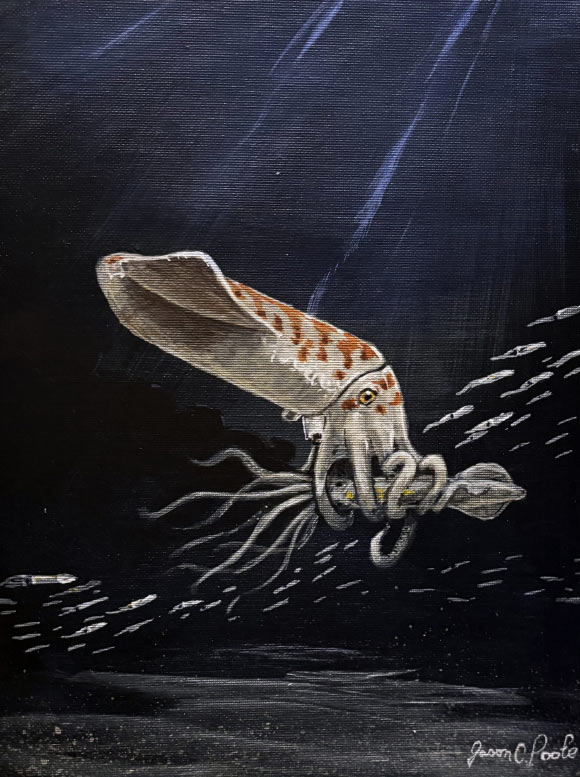
Encore plus redoutable que le T. rex : ce mosasaure géant, de la taille d'un bus, est le plus féroce jamais découvert
prédateur fossile Mosasaurus étude
Il régnait sur les mers il y a 80 millions d’années, mesurait plus de 13 mètres de long et semblait bien plus violent que les autres prédateurs marins de son époque. Une nouvelle étude vient de révéler l’existence d’un gigantesque mosasaure jusque-là mal identifié, dont les fossiles racontent...
26/05/2026 futura-terre
Une nouvelle espèce d’énorme mosasaure est décrite
prédateur Campanien Crétacé Crétacé supérieur fossile Mosasaurus Tylosaurus nouvelle espèce
Une espèce géante de Tylosaurus nouvellement nommée a été nommée par les chercheurs.  La nouvelle espèce de Tylosaurus a été érigée sur la base de fossiles trouvés dans le nord du Texas. Cet énorme prédateur régnait sur les mers anciennes il y a environ 80 millions d’années (stade faunique campanien du Crétacé supérieur).  L'article scientifique a été publié dans le Bulletin of the American
26/05/2026 everythingdinosaur ⚙ Traduction automatique
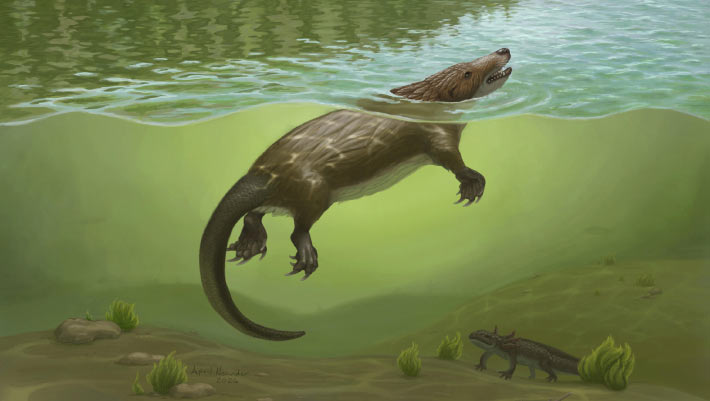
Rare Ostrich-Like Dinosaur Fossil Found on Canadian Island
Un rare fossile de dinosaure ressemblant à une autruche découvert sur une île canadienne
vertèbre Canada Colombie fossile Dinosauria Ornithomimosauria oiseau
Des paléontologues canadiens affirment avoir découvert une vertèbre caudale de dinosaure dans des roches marines vieilles de 75 à 80 millions d'années sur une petite île au large de la Colombie-Britannique, fournissant ainsi la preuve la plus claire à ce jour que des ornithomimosaures ressemblant à des oiseaux parcouraient autrefois l'ancienne côte du Pacifique de l'Amérique du Nord. L'article Un fossile rare de dinosaure ressemblant à une autruche trouvé sur une île canadienne est apparu en premier sur Sci.News : Breaking Science News.
25/05/2026 sci-news ⚙ Traduction automatique
1 2 3 4 5 6 7 8 9 10 11 12 13 14 15 16 17 18 19 20 21 22 23