←

formation

Thématique

191 image(s) · 17 Actualités

Galerie d'images

The productive layer of the Estonian oil shale deposit as seen in the Põhja-Kiviõli II opencast mine. The productive layer is made up of oil shale layers A through F1 together with the limestone layers in between. However, in some cases, layers F2, G and H (visible in the image, but not labeled) are also mined. The oil shale beds are marked on the image with capital letters, limestone layers are labeled with a combination of two capital letters, indicating at their location within the productive layer. Dashed lines indicate layer boundaries, which are harder to distinguish and are thus approximations.
Stratigraphy: the productive layer of the Estonian oil shale deposit is part of the Kiviõli Member of the Viivikonna Formation. The formation belongs to Upper-Ordovician Kukruse Regional Stage (global Sandbian Stage). 

(Source reference: Heikki Bauert and Olle Hints "XI Baltic Stratigraphical Conference. Abstracts and Field Guide", Stop 4: Põhja-Kiviõli II open-pit mine, page 85, figure 4.4).
Intervalles Sandbian

The productive layer of the Estonian oil shale deposit as seen in the Põhja-Kiviõli II opencast mine. The productive layer is made up of oil shale layers A through F1 together with the limestone layers in between. However, in some cases, layers F2, G and H (visible in the image, but not labeled) are also mined. The oil shale beds are marked on the image with capital letters, limestone layers are labeled with a combination of two capital letters, indicating at their location within the productive layer. Dashed lines indicate layer boundaries, which are harder to distinguish and are thus approximations. Stratigraphy: the productive layer of the Estonian oil shale deposit is part of the Kiviõli Member of the Viivikonna Formation. The formation belongs to Upper-Ordovician Kukruse Regional Stage (global Sandbian Stage). (Source reference: Heikki Bauert and Olle Hints "XI Baltic Stratigraphical Conference. Abstracts and Field Guide", Stop 4: Põhja-Kiviõli II open-pit mine, page 85, figure 4.4).

Ordovicien Sandbien formation stratigraphie
Shetwemys, Plastral remains of the podocnemidid turtle S. fajumensis (Erymnochelyini). (a–b) NHMUK R3435, anterior plastral lobe, in ventral (a) and dorsal (b) views. (c–d) NHMUK R8441, plaster cast of the specimen CGM C8509, anterior plastral lobe, in ventral (c) and dorsal (d) views. (e–f) AMNH 5093, articulated epiplastra and entoplastron, in ventral (e) and dorsal (f) views. (g–h) SMNS 11233/6, anterior plastral lobe, in ventral (g) and dorsal (h) views. (i–j) NHMUK R3103, partial anterior plastral lobe, in ventral (i) and dorsal (j) views. (k–l) SMNS 11233/5, right hypoplastron, in ventral (k) and dorsal (l) views. (m–n) SMNS 11233/3, articulated left hypoplastron and xiphiplastron, in dorsal (m) and ventral (n) views, and detail of the outer ornamental pattern (o). Gebel Quatrani Formation, Fayum depression, Egypt, Lower Oligocene (Rupelian)

Shetwemys, Plastral remains of the podocnemidid turtle S. fajumensis (Erymnochelyini). (a–b) NHMUK R3435, anterior plastral lobe, in ventral (a) and dorsal (b) views. (c–d) NHMUK R8441, plaster cast of the specimen CGM C8509, anterior plastral lobe, in ventral (c) and dorsal (d) views. (e–f) AMNH 5093, articulated epiplastra and entoplastron, in ventral (e) and dorsal (f) views. (g–h) SMNS 11233/6, anterior plastral lobe, in ventral (g) and dorsal (h) views. (i–j) NHMUK R3103, partial anterior plastral lobe, in ventral (i) and dorsal (j) views. (k–l) SMNS 11233/5, right hypoplastron, in ventral (k) and dorsal (l) views. (m–n) SMNS 11233/3, articulated left hypoplastron and xiphiplastron, in dorsal (m) and ventral (n) views, and detail of the outer ornamental pattern (o). Gebel Quatrani Formation, Fayum depression, Egypt, Lower Oligocene (Rupelian)

Égypte Oligocène Rupélien moulage +3
Shetwemys, Shell remains of the podocnemidid turtle S. fajumensis (Erymnochelyini). (a–c) SMNS 11233/2, partial carapace, in dorsal (a), ventral (b), and left lateral (c) views. (d) Ventral view of the anterior lobe the holotype of the species, currently lost, based on the fig. 2C in plate 8 of Andrews (1903). (e–g) SMNS 12647, plastron, in ventral (e), dorsal (f), and left lateral (g) views. (g’) corresponds to an enlarged photograph of the posterior plastral lobe, in left lateral view, in which the thickness in the regions close to the hypo-xiphiplastral suture (in blue), between the pelvic scars (in green), and at the level of the anal notch (in red), have been represented by arrows (h–i), SMNS 12646, plastron, in ventral (h) and dorsal (i) views. Gebel Quatrani Formation, Fayum depression, Egypt, Lower Oligocene (Rupelian)

Shetwemys, Shell remains of the podocnemidid turtle S. fajumensis (Erymnochelyini). (a–c) SMNS 11233/2, partial carapace, in dorsal (a), ventral (b), and left lateral (c) views. (d) Ventral view of the anterior lobe the holotype of the species, currently lost, based on the fig. 2C in plate 8 of Andrews (1903). (e–g) SMNS 12647, plastron, in ventral (e), dorsal (f), and left lateral (g) views. (g’) corresponds to an enlarged photograph of the posterior plastral lobe, in left lateral view, in which the thickness in the regions close to the hypo-xiphiplastral suture (in blue), between the pelvic scars (in green), and at the level of the anal notch (in red), have been represented by arrows (h–i), SMNS 12646, plastron, in ventral (h) and dorsal (i) views. Gebel Quatrani Formation, Fayum depression, Egypt, Lower Oligocene (Rupelian)

Égypte Oligocène Rupélien holotype +2
Shetwemys, Shell remains of the podocnemidid turtle S. fajumensis (Erymnochelyini). (a–f) AMNH 5087, carapace and partial plastron, in dorsal (a), ventral (b), anterior (c), posterior (d), left lateral (e), and right lateral (f) views. (g–h) SMNS 11233/1, partial carapace, in dorsal (g) and ventral (h) views. Gebel Quatrani Formation, Fayum depression, Egypt, Lower Oligocene (Rupelian)

Shetwemys, Shell remains of the podocnemidid turtle S. fajumensis (Erymnochelyini). (a–f) AMNH 5087, carapace and partial plastron, in dorsal (a), ventral (b), anterior (c), posterior (d), left lateral (e), and right lateral (f) views. (g–h) SMNS 11233/1, partial carapace, in dorsal (g) and ventral (h) views. Gebel Quatrani Formation, Fayum depression, Egypt, Lower Oligocene (Rupelian)

Égypte Oligocène Rupélien formation +1
Close up of the Eulithomyrmex rugosus holotype head.  Museum of Comparative Zoology  specimen UCM17019.
Priabonian; Florissant Formation, Colorado, USA

Close up of the Eulithomyrmex rugosus holotype head. Museum of Comparative Zoology specimen UCM17019. Priabonian; Florissant Formation, Colorado, USA

musée États-Unis Priabonien holotype +2
Formation d'âge Kimmeridgien (jaune orangé) et Tithonien (Barre tithonique, en gris sur la photo). On peut remarquer que les strates ont été plissées. L'âge des mouvements tectoniques ayant déformé la structure est donc plus jeune que le Tithonien.

Formation d'âge Kimmeridgien (jaune orangé) et Tithonien (Barre tithonique, en gris sur la photo). On peut remarquer que les strates ont été plissées. L'âge des mouvements tectoniques ayant déformé la structure est donc plus jeune que le Tithonien.

Tithonien formation tectonique
The GSSP for the Hirnantian stage in the ICS geological timescale (uppermost Ordovician stage), located in the Wangjiawan profile (an outcrop of black shale, brownishly weathered siliceous shale and chert layers of the Wufeng Formation) along the G241 road, about 40 km north of Yichang, Hubei, China. An exact golden spike is missing in the profile (2025) but a memorial plague marks the place. The GSSP occurs at the first appearance of fossils of the graptolite species Normalograptus extraordinarius. It was ratified in 2006.

The GSSP for the Hirnantian stage in the ICS geological timescale (uppermost Ordovician stage), located in the Wangjiawan profile (an outcrop of black shale, brownishly weathered siliceous shale and chert layers of the Wufeng Formation) along the G241 road, about 40 km north of Yichang, Hubei, China. An exact golden spike is missing in the profile (2025) but a memorial plague marks the place. The GSSP occurs at the first appearance of fossils of the graptolite species Normalograptus extraordinarius. It was ratified in 2006.

Chine Hirnantien Ordovicien fossile +1
Danian microflora - Lefipán Formation, Cañadón Asfalto Basin, Patagonia, Argentina

Danian microflora - Lefipán Formation, Cañadón Asfalto Basin, Patagonia, Argentina

Argentine Danien formation
Fossiliferous limestone of the Roca Formation (Danian) in Barda Norte, the type locality of the Roca Formation, General Roca, Río Negro, Patagonia, Argentina.
Intervalles Danian

Fossiliferous limestone of the Roca Formation (Danian) in Barda Norte, the type locality of the Roca Formation, General Roca, Río Negro, Patagonia, Argentina.

Argentine Danien formation
Quarry called “Ratssteinbruch” at Plauenscher Grund (gorge-like valley of the river Weißeritz nearby/in the city of Dresden, Saxony, Germany), Upper Carboniferous Monzonite (historically identified as Syenite) of the Meißen Massif (Paleozoic basement) unconformably overlain by Upper Cenomanian beds of the Dölzschen Formation, yellowish basal conglomerate and overlying bluish silty clay-marlstone (“plenus-Pläner”) of the Saxo-Bohemian Cretaceous Basin (Mesozoic platform).[1]

Quarry called “Ratssteinbruch” at Plauenscher Grund (gorge-like valley of the river Weißeritz nearby/in the city of Dresden, Saxony, Germany), Upper Carboniferous Monzonite (historically identified as Syenite) of the Meißen Massif (Paleozoic basement) unconformably overlain by Upper Cenomanian beds of the Dölzschen Formation, yellowish basal conglomerate and overlying bluish silty clay-marlstone (“plenus-Pläner”) of the Saxo-Bohemian Cretaceous Basin (Mesozoic platform).[1]

Allemagne Carbonifère Cénomanien Crétacé +3
Sandstones of the lower Kirtland Formation (Late Campanian), outcropping near Coal Creek. New Mexico. Photo by Nick Longrich

Sandstones of the lower Kirtland Formation (Late Campanian), outcropping near Coal Creek. New Mexico. Photo by Nick Longrich

Mexique Kirtland Campanien formation
A fossil tree from the Coal Creek region, Fruitland Formation, latest Cretaceous (Late Campanian), San Juan Basin, New Mexico

A fossil tree from the Coal Creek region, Fruitland Formation, latest Cretaceous (Late Campanian), San Juan Basin, New Mexico

Mexique Fruitland Campanien Crétacé +2
Holotype skull of the centrosaurine ceratopsian dinosaur Diabloceratops eatoni from the Late Cretaceous (Campanian) of the Wahweap Formation, Grand Staircase-Escalante National Monument, Utah. Photograph by Nick Longrich, 2023.

Holotype skull of the centrosaurine ceratopsian dinosaur Diabloceratops eatoni from the Late Cretaceous (Campanian) of the Wahweap Formation, Grand Staircase-Escalante National Monument, Utah. Photograph by Nick Longrich, 2023.

Campanien Crétacé Crétacé supérieur holotype +5
Outcrops of the Late Cretaceous (Campanian) aged Aguja Formation, Big Bend National Park, Texas, USA
Formations Aguja

Outcrops of the Late Cretaceous (Campanian) aged Aguja Formation, Big Bend National Park, Texas, USA

États-Unis Aguja Campanien Crétacé +2
Osgodby Formation (Middle Jurassic) exposed on the shore of Cayton Bay, North Yorkshire.

Osgodby Formation (Middle Jurassic) exposed on the shore of Cayton Bay, North Yorkshire.

Jurassique Jurassique moyen formation
Matmor Formation (Jurassic, Callovian) exposed in Makhtesh Gadol, Israel. (Electricity pylon for scale).

Matmor Formation (Jurassic, Callovian) exposed in Makhtesh Gadol, Israel. (Electricity pylon for scale).

écaille Israël Callovien Jurassique +1
1 2 3 4 5 6 7 8 9 10 11 12

Actualités

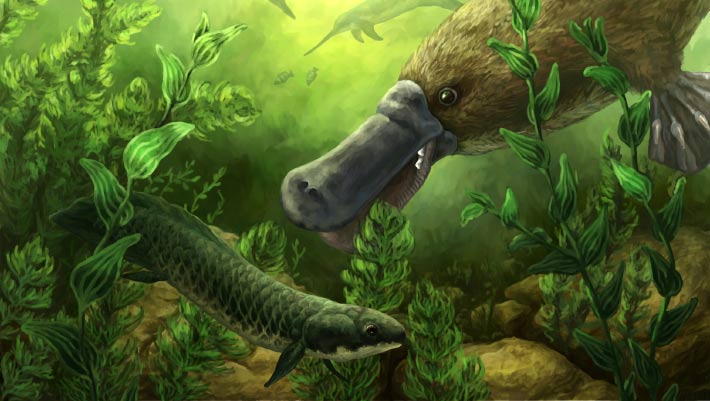
Early Platypuses Had Strong Teeth and Powerful Jaws, Fossils Show
Les premiers ornithorynques avaient des dents solides et des mâchoires puissantes, selon des fossiles
mâchoire dent Australie fossile formation
De nouveaux fossiles de la Formation de Namba, en Australie méridionale, révèlent qu'il y a 25 millions d'années, Obdurodon insignis prospérait dans les lacs intérieurs luxuriants aux côtés de dauphins d'eau douce et d'autres espèces aujourd'hui disparues. L'article Les premiers ornithorynques avaient des dents solides et des mâchoires puissantes, Fossils Show est apparu en premier sur Sci.News : Breaking Science News.
28/04/2026 sci-news ⚙ Traduction automatique
Des scientifiques viennent de découvrir que l’Afrique est plus proche de l’éclatement que nous le pensions
fossile formation
Sous le rift Turkana, en Afrique de l’Est, les scientifiques ont découvert que la croûte s’amincit jusqu’à atteindre un point critique, ce qui suggère que le continent se désagrège progressivement. Ce processus de « rétrécissement » marque un stade avancé de rifting qui pourrait éventuellement conduire à la formation d’un nouvel océan dans des millions d’années. Étonnamment, les mêmes forces géologiques qui divisent la terre peuvent également expliquer pourquoi la région détient un registre fossile si riche. Au lieu d'être le berceau de l'humanité, Turkana pourrait bien être simplement le lieu où
25/04/2026 sciencedaily-paleo ⚙ Traduction automatique
D’étranges roches en « peau d’éléphant » révèlent une vie ancienne dans l’océan sombre
Maroc fossile découverte formation
Une étrange formation rocheuse ridée au Maroc a amené les scientifiques à repenser l'endroit où pourraient vivre d'anciens microbes. Au lieu d’eaux peu profondes et ensoleillées, ces microbes pourraient avoir prospéré dans les profondeurs de l’océan, alimentés par les produits chimiques libérés par les glissements de terrain sous-marins. La découverte suggère que les environnements sombres et riches en nutriments ont abrité des écosystèmes prospères beaucoup plus tôt que prévu. Cela soulève également la possibilité que de nombreux fossiles similaires aient été négligés ou mal interprétés.
03/04/2026 sciencedaily-paleo ⚙ Traduction automatique
Épisode 173 : Forêt pétrifiée
États-Unis Chinle Trias supérieur Trias formation
Le parc national de la Forêt Pétrifiée, dans le nord-est de l'Arizona, aux États-Unis, est une plaque tournante de la paléontologie du Trias et présente des affleurements représentant 20 millions d'années de la formation Chinle du Trias supérieur. Les visiteurs s'émerveillent devant les arbres fossilisés colorés dont le parc tire son nom, mais toute une série d'animaux ont élu domicile dans ces forêts marécageuses il y a 225 millions d'années [&hellip
17/03/2026 palaeocast ⚙ Traduction automatique
Des fossiles de poissons vieux de 400 millions d'années révèlent comment la vie a commencé à s'installer sur terre
Australie Chine fossile formation crâne
Les scientifiques ont découvert de nouveaux indices sur certains des premiers poissons de la Terre, mettant ainsi en lumière les origines anciennes des vertébrés qui ont fini par s’installer sur terre. En réanalysant de mystérieux fossiles de la célèbre formation australienne Gogo et en étudiant un crâne de poisson-poumon récemment reconstruit, vieux de 410 millions d'années et provenant de Chine, les chercheurs révèlent comment ces créatures primitives ont évolué.
12/03/2026 sciencedaily ⚙ Traduction automatique
1 2 3 4