dating

Theme

2 image(s) · 8 News

Image gallery

Rates of skeletal character evolution in the skull and postcranial skeleton of hadrosauroids. Cladograms illustrate the results from branch likelihood tests for two morphological partitions: skull (cranium and mandible) (A) and postcranial skeleton (B). In both cladograms, results from the branch likelihood tests are summarized on a strict consensus tree derived from four separately analyzed MPTs, each with 100 dating replicates (a total of 400 Hedman-dated phylogenies). Pie charts on branches illustrate the proportion of dating replicates that showed significantly high rates (red), slow rates (blue), or nonsignificant average rates (white). No pie charts are plotted on branches that showed nonsignificant rates in 100% of dating replicates. Branches that showed high rates (red) in more than 50% of dating replicates are doubled in length. See the Supplementary Material for Hedman-based results plotted separately for each MPT (Supplementary Fig. S2) and for results using the MBL dating method (Supplementary Fig. S3). Silhouettes were created by Scott Hartman and were downloaded from http://phylopic.org (Creative Commons license CC BY 3.0).

Rates of skeletal character evolution in the skull and postcranial skeleton of hadrosauroids. Cladograms illustrate the results from branch likelihood tests for two morphological partitions: skull (cranium and mandible) (A) and postcranial skeleton (B). In both cladograms, results from the branch likelihood tests are summarized on a strict consensus tree derived from four separately analyzed MPTs, each with 100 dating replicates (a total of 400 Hedman-dated phylogenies). Pie charts on branches illustrate the proportion of dating replicates that showed significantly high rates (red), slow rates (blue), or nonsignificant average rates (white). No pie charts are plotted on branches that showed nonsignificant rates in 100% of dating replicates. Branches that showed high rates (red) in more than 50% of dating replicates are doubled in length. See the Supplementary Material for Hedman-based results plotted separately for each MPT (Supplementary Fig. S2) and for results using the MBL dating method (Supplementary Fig. S3). Silhouettes were created by Scott Hartman and were downloaded from http://phylopic.org (Creative Commons license CC BY 3.0).

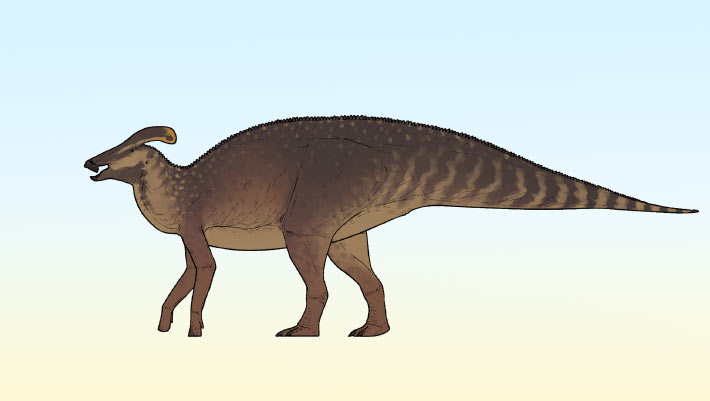
Protohadros dating evolution skeleton +1
Natural-colour satellite image of part of the Kaiparowits Basin (a central portion of Grand Staircase-Escalante). The branch-like shapes are networks of canyons carved by rivers that dried up millions of years ago. The ridge running roughly north-south through the scene is the Cockscomb, which is surrounded by distinct rock formations deposited at different times in the geologic past. West of the Cockscomb is the Navajo Sandstone, dating from the Triassic. East of the Cockscomb are two formations from the Cretaceous: the light-toned Wahweap and darker Kaiparowits.

Natural-colour satellite image of part of the Kaiparowits Basin (a central portion of Grand Staircase-Escalante). The branch-like shapes are networks of canyons carved by rivers that dried up millions of years ago. The ridge running roughly north-south through the scene is the Cockscomb, which is surrounded by distinct rock formations deposited at different times in the geologic past. West of the Cockscomb is the Navajo Sandstone, dating from the Triassic. East of the Cockscomb are two formations from the Cretaceous: the light-toned Wahweap and darker Kaiparowits.

Allen Kaiparowits Navajo Sandstone Cretaceous +3

News

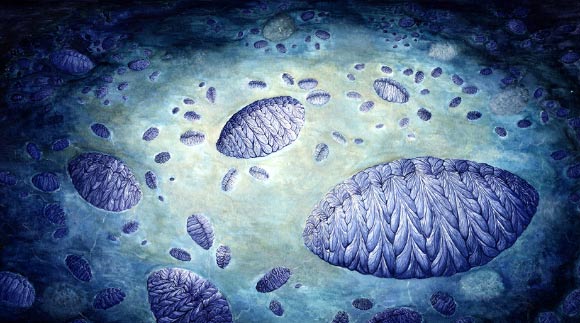
Earth’s Earliest Animals May Have Thrived Too Easily to Evolve
reproduction Ediacaran fossil dating evolution
Fossils from some of the oldest-known animals on Earth, dating from 574 million years ago (Ediacaran period), suggest that cloning, not competition, dominated the Ediacaran seas, slowing evolution until environmental stress helped drive the rise of sexual reproduction and a burst of biodiversity. The post Earth’s Earliest Animals May Have Thrived Too Easily to Evolve appeared first on Sci.News: Breaking Science News.
10/06/2026 sci-news
Une découverte en Chine bouscule l’histoire d’étranges animaux vieux de 520 millions d’années
A discovery in China shakes up the story of strange animals dating back 520 million years
China Cambrian fossil dating discovery
Discreet but omnipresent in today's oceans, bryozoans hide a much older history than previously thought. Exceptional fossils discovered in China show that 520 million years ago, these colonial animals were already complex structures, fully...
03/06/2026 futura-terre ⚙ Auto-translated
Incroyable découverte : des formes de vie ont survécu dans l’obscurité totale il y a 180 millions d’années
Incredible discovery: life forms survived in total darkness 180 million years ago
Morocco dating discovery
Researchers have uncovered, in the mountains of Morocco, biological traces dating back 180 million years buried in abyssal marine sediments. These structures, normally absent from such environments, call into question what we thought we knew about ecosystems...
08/05/2026 futura-terre ⚙ Auto-translated
This 275-million-year-old animal had a twisted jaw like nothing alive today
jaw Brazil fossil dating
Deep in a dried-up riverbed in Brazil, scientists uncovered a bizarre prehistoric mystery—twisted jawbones from a strange, long-lost animal unlike anything seen before. Dating back 275 million years, this creature, named Tanyka amnicola, belonged to an ancient lineage that should have already faded away, making it a kind of “living fossil” of its time.
01/05/2026 sciencedaily
Scientists found a rhino in the Arctic and it changes everything
fossil dating new species
Scientists have uncovered a new species of rhinoceros in the Canadian High Arctic, revealing that rhinos once lived far farther north than expected. The fossil, dating back 23 million years, is unusually complete and has helped reshape ideas about how these animals migrated between continents. Evidence suggests rhinos crossed from Europe to North America more recently than scientists once thought.
24/03/2026 sciencedaily
1 2