prédateur

Comportement & Physiologie

6 image(s) · 34 Actualités

Galerie d'images

Illustration of a juvenile Tyrannosaurus rex.
Most of this restoration is mostly inspired from the models of 1-year old Tyrannosaurus from the exhibition "T.rex: The Ultimate Predator" at American Museum of Natural History, New York (2019-2021).[1]
[2] and the juvenile Tarbosaurus MPC-D 107/7 (2-3 years old at death).[3]

References

↑ [1]

↑ [2]

↑ Tsuihiji T et.al (2011). "Cranial osteology of a juvenile specimen of Tarbosaurus bataar (Theropoda, Tyrannosauridae) from the Nemegt Formation (Upper Cretaceous) of Bugin Tsav, Mongolia". Journal of Vertebrate Paleontology 31(3): p. 497-517

Illustration of a juvenile Tyrannosaurus rex. Most of this restoration is mostly inspired from the models of 1-year old Tyrannosaurus from the exhibition "T.rex: The Ultimate Predator" at American Museum of Natural History, New York (2019-2021).[1] [2] and the juvenile Tarbosaurus MPC-D 107/7 (2-3 years old at death).[3] References ↑ [1] ↑ [2] ↑ Tsuihiji T et.al (2011). "Cranial osteology of a juvenile specimen of Tarbosaurus bataar (Theropoda, Tyrannosauridae) from the Nemegt Formation (Upper Cretaceous) of Bugin Tsav, Mongolia". Journal of Vertebrate Paleontology 31(3): p. 497-517

prédateur musée Mongolie Crétacé +8
Alioramus altai skull in the exhibit, T. rex, The Ultimate Predator, in the American Museum of Natural History (with permission by Ben Miller).
Taxons Alioramini

Alioramus altai skull in the exhibit, T. rex, The Ultimate Predator, in the American Museum of Natural History (with permission by Ben Miller).

prédateur musée Alioramini Alioramus +1
The theropod skull displays the distinctive features of this apex predator, including a long, robust snout, conical teeth, and strong jaw muscles adapted for gripping and tearing prey.
Taxons Rajasaurus

The theropod skull displays the distinctive features of this apex predator, including a long, robust snout, conical teeth, and strong jaw muscles adapted for gripping and tearing prey.

prédateur proie Rajasaurus crâne
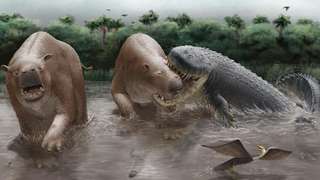
The Maastrichtian, Transylvanian giant azhdarchid pterosaur Hatzegopteryx sp. preys on the rhabdodontid iguanodontian Zalmoxes. Because large predatory theropods are unknown on Late Cretaceous Haţeg Island, giant azhdarchids may have played a key role as terrestrial predators in this community.

The Maastrichtian, Transylvanian giant azhdarchid pterosaur Hatzegopteryx sp. preys on the rhabdodontid iguanodontian Zalmoxes. Because large predatory theropods are unknown on Late Cretaceous Haţeg Island, giant azhdarchids may have played a key role as terrestrial predators in this community.

prédateur proie Crétacé Crétacé supérieur +8
Bones and remains of prehistoric animals
A massive marine lizard and apex predator, growing to length of 14 m (46 ft).[1]

Bones and remains of prehistoric animals A massive marine lizard and apex predator, growing to length of 14 m (46 ft).[1]

os prédateur Tylosaurus
Early Triassic marine vertebrate apex predators during the Griesbachian to Smithian interval (left) and the Spathian to Anisian interval (right). Predators not exactly to scale; see text and Tables S1–S2 for details on body size and stratigraphic occurrence. Marine vertebrate apex predators: 1, Wantzosaurus (trematosaurid ‘amphibian’); 2, Fadenia (eugeneodontiform chondrichthyan); 3, Saurichthys (actinopterygian ambush predator); 4, Rebellatrix (fork-tailed actinistian); 5, Hovasaurus (‘younginiform’ diapsid reptile); 6, Birgeria (fast-swimming predatory actinopterygian); 7, Aphaneramma (trematosaurid ‘amphibian’); 8, Bobasatrania (durophagous actinopterygian); 9, hybodontoid chondrichthyan with durophagous (e.g. Acrodus, Palaeobates) or tearing-type dentition (e.g. Hybodus); 10, e.g., Mylacanthus (durophagous actinistian); 11, Tanystropheus (protorosaurian reptile); 12, Corosaurus (sauropterygian reptile); 13, e.g., Ticinepomis (actinistian); 14, Mixosaurus (small ichthyosaur); 15, large cymbospondylid/shastasaurid ichthyosaur; 16, neoselachian chondrichthyan; 17, Omphalosaurus skeleton (possible durophagous ichthyosaur); 18, Placodus (durophagous sauropterygian reptile).
Taxons Corosaurus

Early Triassic marine vertebrate apex predators during the Griesbachian to Smithian interval (left) and the Spathian to Anisian interval (right). Predators not exactly to scale; see text and Tables S1–S2 for details on body size and stratigraphic occurrence. Marine vertebrate apex predators: 1, Wantzosaurus (trematosaurid ‘amphibian’); 2, Fadenia (eugeneodontiform chondrichthyan); 3, Saurichthys (actinopterygian ambush predator); 4, Rebellatrix (fork-tailed actinistian); 5, Hovasaurus (‘younginiform’ diapsid reptile); 6, Birgeria (fast-swimming predatory actinopterygian); 7, Aphaneramma (trematosaurid ‘amphibian’); 8, Bobasatrania (durophagous actinopterygian); 9, hybodontoid chondrichthyan with durophagous (e.g. Acrodus, Palaeobates) or tearing-type dentition (e.g. Hybodus); 10, e.g., Mylacanthus (durophagous actinistian); 11, Tanystropheus (protorosaurian reptile); 12, Corosaurus (sauropterygian reptile); 13, e.g., Ticinepomis (actinistian); 14, Mixosaurus (small ichthyosaur); 15, large cymbospondylid/shastasaurid ichthyosaur; 16, neoselachian chondrichthyan; 17, Omphalosaurus skeleton (possible durophagous ichthyosaur); 18, Placodus (durophagous sauropterygian reptile).

écaille prédateur Anisien Early Triassic +6
Early Triassic marine vertebrate apex predators during the Griesbachian to Smithian interval (left) and the Spathian to Anisian interval (right). Predators not exactly to scale; see text and Tables S1–S2 for details on body size and stratigraphic occurrence. Marine vertebrate apex predators: 1, Wantzosaurus (trematosaurid ‘amphibian’); 2, Fadenia (eugeneodontiform chondrichthyan); 3, Saurichthys (actinopterygian ambush predator); 4, Rebellatrix (fork-tailed actinistian); 5, Hovasaurus (‘younginiform’ diapsid reptile); 6, Birgeria (fast-swimming predatory actinopterygian); 7, Aphaneramma (trematosaurid ‘amphibian’); 8, Bobasatrania (durophagous actinopterygian); 9, hybodontoid chondrichthyan with durophagous (e.g. Acrodus, Palaeobates) or tearing-type dentition (e.g. Hybodus); 10, e.g., Mylacanthus (durophagous actinistian); 11, Tanystropheus (protorosaurian reptile); 12, Corosaurus (sauropterygian reptile); 13, e.g., Ticinepomis (actinistian); 14, Mixosaurus (small ichthyosaur); 15, large cymbospondylid/shastasaurid ichthyosaur; 16, neoselachian chondrichthyan; 17, Omphalosaurus skeleton (possible durophagous ichthyosaur); 18, Placodus (durophagous sauropterygian reptile).
Taxons Corosauridae

Early Triassic marine vertebrate apex predators during the Griesbachian to Smithian interval (left) and the Spathian to Anisian interval (right). Predators not exactly to scale; see text and Tables S1–S2 for details on body size and stratigraphic occurrence. Marine vertebrate apex predators: 1, Wantzosaurus (trematosaurid ‘amphibian’); 2, Fadenia (eugeneodontiform chondrichthyan); 3, Saurichthys (actinopterygian ambush predator); 4, Rebellatrix (fork-tailed actinistian); 5, Hovasaurus (‘younginiform’ diapsid reptile); 6, Birgeria (fast-swimming predatory actinopterygian); 7, Aphaneramma (trematosaurid ‘amphibian’); 8, Bobasatrania (durophagous actinopterygian); 9, hybodontoid chondrichthyan with durophagous (e.g. Acrodus, Palaeobates) or tearing-type dentition (e.g. Hybodus); 10, e.g., Mylacanthus (durophagous actinistian); 11, Tanystropheus (protorosaurian reptile); 12, Corosaurus (sauropterygian reptile); 13, e.g., Ticinepomis (actinistian); 14, Mixosaurus (small ichthyosaur); 15, large cymbospondylid/shastasaurid ichthyosaur; 16, neoselachian chondrichthyan; 17, Omphalosaurus skeleton (possible durophagous ichthyosaur); 18, Placodus (durophagous sauropterygian reptile).

écaille prédateur Anisien Early Triassic +6

Actualités

Le chasseur de Lucy révélé : un crocodile géant terrorisait les premiers ancêtres humains
prédateur Éthiopie origine humaine
Une espèce de crocodile nouvellement identifiée, surnommée « le chasseur de Lucy », rôdait dans les rivières éthiopiennes lorsque l’espèce de Lucy parcourait la Terre il y a plus de 3 millions d’années. Le prédateur géant était probablement l'animal le plus dangereux de l'écosystème et pouvait avoir régulièrement chassé les premiers parents humains.
13/06/2026 sciencedaily-paleo ⚙ Traduction automatique
Les cahiers disparus qui ont résolu un mystère fossile vieux de 55 millions d'années
prédateur Nouvelle-Zélande fossile découverte
Un poisson fossile spectaculaire découvert sur une falaise isolée en Nouvelle-Zélande il y a près de 30 ans a enfin révélé toute son histoire grâce à une découverte inattendue : les carnets de terrain du collectionneur original, perdus depuis longtemps. Le fossile de 1,2 mètre, conservé dans des détails tridimensionnels époustouflants, appartenait à un ancien prédateur ressemblant à un tarpon qui naviguait dans les eaux néo-zélandaises il y a environ 55 millions d'années.
12/06/2026 sciencedaily ⚙ Traduction automatique
Oubliez le T. rex : ce dinosaure géant aux bras monstrueux pourrait bien avoir été encore plus terrifiant
prédateur Dinosauria Joaquinraptor fouille
Découvert en Patagonie après trois saisons de fouilles, Joaquinraptor casali redistribue les cartes de la paléontologie. Ce prédateur d'une tonne aux bras démesurés faisait passer le T. rex pour un boxeur manchot. Et si la force brute n'était pas la meilleure arme de l'ère des dinosaures ?
07/06/2026 futura-terre
Ce rapace récemment découvert aurait chassé comme un héron géant
vertèbre prédateur Dinosauria Kank
Un dinosaure ressemblant à un rapace récemment découvert en Patagonie change la façon dont les scientifiques perçoivent les anciens prédateurs. Nommé Kank australis, ce dinosaure vieux de 70 millions d'années semble avoir chassé le poisson un peu comme les hérons modernes, en utilisant un cou long et flexible et des vertèbres spécialisées adaptées pour des mouvements rapides et précis.
29/05/2026 sciencedaily ⚙ Traduction automatique
Gigantesque et agressif : ce "T. rex" des mers était un terrifiant prédateur
prédateur Mosasaurus nouvelle espèce
Agressif, immense et doté de caractéristiques uniques : des chercheurs américains ont décrit une nouvelle espèce de mosasaure, le terrible Tylosaurus rex.
26/05/2026 sciencesetavenir
1 2 3 4 5 6 7