prédateur

Comportement & Physiologie

6 image(s) · 34 Actualités

Galerie d'images

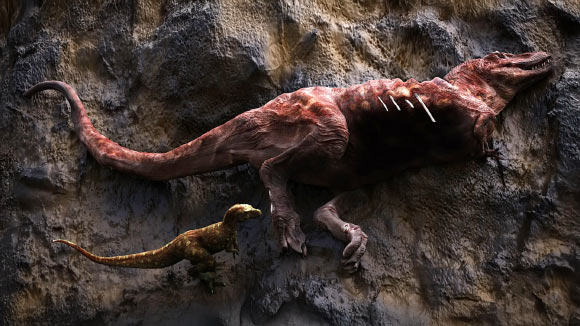
Illustration of a juvenile Tyrannosaurus rex.
Most of this restoration is mostly inspired from the models of 1-year old Tyrannosaurus from the exhibition "T.rex: The Ultimate Predator" at American Museum of Natural History, New York (2019-2021).[1]
[2] and the juvenile Tarbosaurus MPC-D 107/7 (2-3 years old at death).[3]

References

↑ [1]

↑ [2]

↑ Tsuihiji T et.al (2011). "Cranial osteology of a juvenile specimen of Tarbosaurus bataar (Theropoda, Tyrannosauridae) from the Nemegt Formation (Upper Cretaceous) of Bugin Tsav, Mongolia". Journal of Vertebrate Paleontology 31(3): p. 497-517

Illustration of a juvenile Tyrannosaurus rex. Most of this restoration is mostly inspired from the models of 1-year old Tyrannosaurus from the exhibition "T.rex: The Ultimate Predator" at American Museum of Natural History, New York (2019-2021).[1] [2] and the juvenile Tarbosaurus MPC-D 107/7 (2-3 years old at death).[3] References ↑ [1] ↑ [2] ↑ Tsuihiji T et.al (2011). "Cranial osteology of a juvenile specimen of Tarbosaurus bataar (Theropoda, Tyrannosauridae) from the Nemegt Formation (Upper Cretaceous) of Bugin Tsav, Mongolia". Journal of Vertebrate Paleontology 31(3): p. 497-517

prédateur musée Mongolie Crétacé +8
Alioramus altai skull in the exhibit, T. rex, The Ultimate Predator, in the American Museum of Natural History (with permission by Ben Miller).
Taxons Alioramini

Alioramus altai skull in the exhibit, T. rex, The Ultimate Predator, in the American Museum of Natural History (with permission by Ben Miller).

prédateur musée Alioramini Alioramus +1
The theropod skull displays the distinctive features of this apex predator, including a long, robust snout, conical teeth, and strong jaw muscles adapted for gripping and tearing prey.
Taxons Rajasaurus

The theropod skull displays the distinctive features of this apex predator, including a long, robust snout, conical teeth, and strong jaw muscles adapted for gripping and tearing prey.

prédateur proie Rajasaurus crâne
The Maastrichtian, Transylvanian giant azhdarchid pterosaur Hatzegopteryx sp. preys on the rhabdodontid iguanodontian Zalmoxes. Because large predatory theropods are unknown on Late Cretaceous Haţeg Island, giant azhdarchids may have played a key role as terrestrial predators in this community.

The Maastrichtian, Transylvanian giant azhdarchid pterosaur Hatzegopteryx sp. preys on the rhabdodontid iguanodontian Zalmoxes. Because large predatory theropods are unknown on Late Cretaceous Haţeg Island, giant azhdarchids may have played a key role as terrestrial predators in this community.

prédateur proie Crétacé Crétacé supérieur +8
Bones and remains of prehistoric animals
A massive marine lizard and apex predator, growing to length of 14 m (46 ft).[1]

Bones and remains of prehistoric animals A massive marine lizard and apex predator, growing to length of 14 m (46 ft).[1]

os prédateur Tylosaurus
Early Triassic marine vertebrate apex predators during the Griesbachian to Smithian interval (left) and the Spathian to Anisian interval (right). Predators not exactly to scale; see text and Tables S1–S2 for details on body size and stratigraphic occurrence. Marine vertebrate apex predators: 1, Wantzosaurus (trematosaurid ‘amphibian’); 2, Fadenia (eugeneodontiform chondrichthyan); 3, Saurichthys (actinopterygian ambush predator); 4, Rebellatrix (fork-tailed actinistian); 5, Hovasaurus (‘younginiform’ diapsid reptile); 6, Birgeria (fast-swimming predatory actinopterygian); 7, Aphaneramma (trematosaurid ‘amphibian’); 8, Bobasatrania (durophagous actinopterygian); 9, hybodontoid chondrichthyan with durophagous (e.g. Acrodus, Palaeobates) or tearing-type dentition (e.g. Hybodus); 10, e.g., Mylacanthus (durophagous actinistian); 11, Tanystropheus (protorosaurian reptile); 12, Corosaurus (sauropterygian reptile); 13, e.g., Ticinepomis (actinistian); 14, Mixosaurus (small ichthyosaur); 15, large cymbospondylid/shastasaurid ichthyosaur; 16, neoselachian chondrichthyan; 17, Omphalosaurus skeleton (possible durophagous ichthyosaur); 18, Placodus (durophagous sauropterygian reptile).
Taxons Corosaurus

Early Triassic marine vertebrate apex predators during the Griesbachian to Smithian interval (left) and the Spathian to Anisian interval (right). Predators not exactly to scale; see text and Tables S1–S2 for details on body size and stratigraphic occurrence. Marine vertebrate apex predators: 1, Wantzosaurus (trematosaurid ‘amphibian’); 2, Fadenia (eugeneodontiform chondrichthyan); 3, Saurichthys (actinopterygian ambush predator); 4, Rebellatrix (fork-tailed actinistian); 5, Hovasaurus (‘younginiform’ diapsid reptile); 6, Birgeria (fast-swimming predatory actinopterygian); 7, Aphaneramma (trematosaurid ‘amphibian’); 8, Bobasatrania (durophagous actinopterygian); 9, hybodontoid chondrichthyan with durophagous (e.g. Acrodus, Palaeobates) or tearing-type dentition (e.g. Hybodus); 10, e.g., Mylacanthus (durophagous actinistian); 11, Tanystropheus (protorosaurian reptile); 12, Corosaurus (sauropterygian reptile); 13, e.g., Ticinepomis (actinistian); 14, Mixosaurus (small ichthyosaur); 15, large cymbospondylid/shastasaurid ichthyosaur; 16, neoselachian chondrichthyan; 17, Omphalosaurus skeleton (possible durophagous ichthyosaur); 18, Placodus (durophagous sauropterygian reptile).

écaille prédateur Anisien Early Triassic +6
Early Triassic marine vertebrate apex predators during the Griesbachian to Smithian interval (left) and the Spathian to Anisian interval (right). Predators not exactly to scale; see text and Tables S1–S2 for details on body size and stratigraphic occurrence. Marine vertebrate apex predators: 1, Wantzosaurus (trematosaurid ‘amphibian’); 2, Fadenia (eugeneodontiform chondrichthyan); 3, Saurichthys (actinopterygian ambush predator); 4, Rebellatrix (fork-tailed actinistian); 5, Hovasaurus (‘younginiform’ diapsid reptile); 6, Birgeria (fast-swimming predatory actinopterygian); 7, Aphaneramma (trematosaurid ‘amphibian’); 8, Bobasatrania (durophagous actinopterygian); 9, hybodontoid chondrichthyan with durophagous (e.g. Acrodus, Palaeobates) or tearing-type dentition (e.g. Hybodus); 10, e.g., Mylacanthus (durophagous actinistian); 11, Tanystropheus (protorosaurian reptile); 12, Corosaurus (sauropterygian reptile); 13, e.g., Ticinepomis (actinistian); 14, Mixosaurus (small ichthyosaur); 15, large cymbospondylid/shastasaurid ichthyosaur; 16, neoselachian chondrichthyan; 17, Omphalosaurus skeleton (possible durophagous ichthyosaur); 18, Placodus (durophagous sauropterygian reptile).
Taxons Corosauridae

Early Triassic marine vertebrate apex predators during the Griesbachian to Smithian interval (left) and the Spathian to Anisian interval (right). Predators not exactly to scale; see text and Tables S1–S2 for details on body size and stratigraphic occurrence. Marine vertebrate apex predators: 1, Wantzosaurus (trematosaurid ‘amphibian’); 2, Fadenia (eugeneodontiform chondrichthyan); 3, Saurichthys (actinopterygian ambush predator); 4, Rebellatrix (fork-tailed actinistian); 5, Hovasaurus (‘younginiform’ diapsid reptile); 6, Birgeria (fast-swimming predatory actinopterygian); 7, Aphaneramma (trematosaurid ‘amphibian’); 8, Bobasatrania (durophagous actinopterygian); 9, hybodontoid chondrichthyan with durophagous (e.g. Acrodus, Palaeobates) or tearing-type dentition (e.g. Hybodus); 10, e.g., Mylacanthus (durophagous actinistian); 11, Tanystropheus (protorosaurian reptile); 12, Corosaurus (sauropterygian reptile); 13, e.g., Ticinepomis (actinistian); 14, Mixosaurus (small ichthyosaur); 15, large cymbospondylid/shastasaurid ichthyosaur; 16, neoselachian chondrichthyan; 17, Omphalosaurus skeleton (possible durophagous ichthyosaur); 18, Placodus (durophagous sauropterygian reptile).

écaille prédateur Anisien Early Triassic +6

Actualités

Un spinosaure géant à crête, le « héron de l'enfer », découvert dans le Sahara
crête prédateur Niger fossile Dinosauria Spinosauria
Au cœur du Sahara, des scientifiques ont découvert Spinosaurus mirabilis, un nouveau prédateur spectaculaire couronné d'une crête massive en forme de cimeterre qui aurait pu autrefois briller de couleurs sous le soleil du désert. Découvert dans des gisements de rivières intérieures isolées au Niger, le fossile réécrit ce que nous pensions savoir sur les dinosaures spinosaures, suggérant qu'ils n'étaient pas des chasseurs entièrement aquatiques mais de puissants échassiers traquant les poissons dans les cours d'eau boisés à des centaines de kilomètres de la mer.
23/02/2026 sciencedaily ⚙ Traduction automatique
Torvosaurus: Beast of the Week
Torvosaurus : Bête de la semaine
os prédateur Allemagne Portugal États-Unis Jurassique Jurassique supérieur Dinosauria Torvosaurus
Aujourd'hui, nous allons nous intéresser à un énorme dinosaure prédateur du Jurassique, Torvosaurus tanneri !  Torvosaurus vivait il y a environ 150 millions d’années à la fin du Jurassique. Ses ossements ont été découverts dans le Colorado, aux États-Unis, au Portugal et peut-être en Allemagne (l'Europe et l'Amérique du Nord n'étaient pas aussi éloignées à l'époque, rappelez-vous, donc beaucoup de dinosaures présents sur chacun d'eux partageaient des ancêtres récents).  Du nez à la queue, il mesurait jusqu'à 36 pieds (environ 11 m) et aurait été parmi les plus grands,
08/02/2026 prehistoricbeastoftheweek ⚙ Traduction automatique
Les bébés dinosaures étaient l'épine dorsale de la chaîne alimentaire jurassique
chasse prédateur proie Jurassique fossile Dinosauria
Bien qu’ils soient devenus les plus gros animaux ayant jamais marché sur terre, les sauropodes ont commencé leur vie petits, exposés et seuls. Les preuves fossiles suggèrent que leurs bébés étaient fréquemment mangés par de multiples prédateurs, ce qui en faisait un élément clé de la chaîne alimentaire jurassique. Cet approvisionnement constant en proies faciles peut expliquer pourquoi les premiers prédateurs ont prospéré sans avoir besoin d’adaptations extrêmes en matière de chasse. Les résultats offrent un rare aperçu du fonctionnement réel des écosystèmes de dinosaures.
02/02/2026 sciencedaily ⚙ Traduction automatique
La pire extinction de la Terre a été suivie par un retour incroyablement rapide des océans
prédateur fossile découverte extinction
Un spectaculaire trésor de fossiles sur l’île arctique du Spitzberg montre que la vie marine a fait un retour étonnant après la plus grande extinction de la Terre. Des dizaines de milliers de fossiles révèlent des reptiles entièrement aquatiques et des chaînes alimentaires complexes qui prospèrent à peine trois millions d'années plus tard. Certains prédateurs mesuraient plus de cinq mètres de long, remettant en question l’idée d’une récupération lente et progressive. La découverte réécrit les débuts de l’histoire des écosystèmes océaniques.
30/12/2025 sciencedaily ⚙ Traduction automatique
Des monstres marins géants vivaient dans les rivières à la fin de l'ère des dinosaures
dent alimentation prédateur Dinosauria Mosasaurus isotope
Les mosasaures géants, autrefois considérés comme des prédateurs strictement océaniques, ont peut-être passé leur dernier chapitre à rôder dans les rivières d'eau douce aux côtés de dinosaures et de crocodiles. Une dent massive trouvée dans le Dakota du Nord, analysée à l'aide de techniques isotopiques chimiques, révèle que certains mosasaures se sont adaptés aux systèmes fluviaux à mesure que les mers se rafraîchissaient progressivement vers la fin de l'ère des dinosaures. Ces énormes reptiles, peut-être aussi longs qu'un bus, semblent avoir chassé près de la surface, se nourrissant peut-être même de dinosaures noyés.
15/12/2025 sciencedaily ⚙ Traduction automatique
1 2 3 4 5 6 7