Trias

Intervalle géologique

51 image(s) · 24 Actualités

Voir la fiche

Galerie d'images

Nyasasaurus is a basal dinosauromorph that may be the earliest known dinosaur. It was a small bipedal animal at about 2-3 m in length. Nyasasaurus is difficult to classify due to inconclusive fossil evidence, but if it is a true dinosaur, it pushes the dinosaur lineage back about 12 million years to the Middle Triassic.
Taxons Nyasasaurus

Nyasasaurus is a basal dinosauromorph that may be the earliest known dinosaur. It was a small bipedal animal at about 2-3 m in length. Nyasasaurus is difficult to classify due to inconclusive fossil evidence, but if it is a true dinosaur, it pushes the dinosaur lineage back about 12 million years to the Middle Triassic.

Trias moyen Trias fossile Dinosauria +1
Schädel, vorderer Abschnitt der Wirbelsäule und Elemente des Schultergürtels von Paraplacodus broili (Exemplar-Nr. BSP 1953 XV 5) aus der Grenzbitumenzone (Mittel-Trias) des Monte San Giorgio (Tessin) in linksseitiger Ansicht, ausgestellt im Paläontologischen Museum München. Die Länge des Schädels beträgt ca. 12 cm.[1]
Taxons Paraplacodus

Schädel, vorderer Abschnitt der Wirbelsäule und Elemente des Schultergürtels von Paraplacodus broili (Exemplar-Nr. BSP 1953 XV 5) aus der Grenzbitumenzone (Mittel-Trias) des Monte San Giorgio (Tessin) in linksseitiger Ansicht, ausgestellt im Paläontologischen Museum München. Die Länge des Schädels beträgt ca. 12 cm.[1]

musée Trias Paraplacodus
Augustasaurus hagdorni, a pistosaur from the Middle Triassic of nevada. Digital.
Taxons Pistosauroidea

Augustasaurus hagdorni, a pistosaur from the Middle Triassic of nevada. Digital.

Trias moyen Trias Augustasaurus Pistosauria +2
Fossil samples – e.g. ‘primitive’ bony fish (1, 2), a skull of a temnospondyl ‘amphibian’ (probably a metoposauroid) in dorsal view (3), a skull of an archosaur of the crocodile lineage (probably a phytosaur) in palatal view (4), holotype of the “gliding reptile” Icarosaurus siefkeri [1] (5) and Atreipus-Grallator-type dinosaur tracks (bottom right) – from the Newark Supergroup, i.e. a series of mainly Late Triassic to Early Jurassic sedimentary rocks of eastern North America


↑ Edwin H. Colbert: A gliding reptile from the Triassic of New Jersey. American Museum Novitates, 2230. American Museum of Natural History, New York 1966, digitallibrary.amnh.org, cf. fig. 3 therein.
Taxons Atreipus

Fossil samples – e.g. ‘primitive’ bony fish (1, 2), a skull of a temnospondyl ‘amphibian’ (probably a metoposauroid) in dorsal view (3), a skull of an archosaur of the crocodile lineage (probably a phytosaur) in palatal view (4), holotype of the “gliding reptile” Icarosaurus siefkeri [1] (5) and Atreipus-Grallator-type dinosaur tracks (bottom right) – from the Newark Supergroup, i.e. a series of mainly Late Triassic to Early Jurassic sedimentary rocks of eastern North America ↑ Edwin H. Colbert: A gliding reptile from the Triassic of New Jersey. American Museum Novitates, 2230. American Museum of Natural History, New York 1966, digitallibrary.amnh.org, cf. fig. 3 therein.

musée Jurassique inférieur Jurassique Trias supérieur +9
Musango is a basal sauropodomorph dinosaur that lived during the Late Triassic period in what is now Zimbabwe. Typical of early sauropodomorphs, or "prosauropods," it was an obligate biped with a long neck, and a long tail for counterbalance. Musango grew to approximately 5 m in total body length.

Musango is a basal sauropodomorph dinosaur that lived during the Late Triassic period in what is now Zimbabwe. Typical of early sauropodomorphs, or "prosauropods," it was an obligate biped with a long neck, and a long tail for counterbalance. Musango grew to approximately 5 m in total body length.

Zimbabwe Trias supérieur Trias Dinosauria +1
Global and temporal distribution of silesaurids shown on a Middle and Late Triassic (Ladinian-Norian) map of the northern and southern regions of Pangea.
Taxons Soumyasaurus

Global and temporal distribution of silesaurids shown on a Middle and Late Triassic (Ladinian-Norian) map of the northern and southern regions of Pangea.

Ladinien Trias supérieur Norien Trias +2
A reconstruction of Erythrovenator jacuiensis based on a skeletal by Maurissauro. This basal theropod comes from the Late Triassic Candelária Formation of Brazil.
Taxons Erythrovenator

A reconstruction of Erythrovenator jacuiensis based on a skeletal by Maurissauro. This basal theropod comes from the Late Triassic Candelária Formation of Brazil.

Brésil Trias supérieur Trias Erythrovenator +1
Ahvaytum is a saturnaliid sauropodomorph from the Late Triassic of what is now Wyoming. It is the oldest known dinosaur from the northern continent of Laurasia, challenging previous hypotheses of dinosaur origins and dispersal. Typical of basal dinosaurs from the Triassic, Ahvaytum was a small slender biped, reaching about 1 m in body length.
Taxons Ahvaytum

Ahvaytum is a saturnaliid sauropodomorph from the Late Triassic of what is now Wyoming. It is the oldest known dinosaur from the northern continent of Laurasia, challenging previous hypotheses of dinosaur origins and dispersal. Typical of basal dinosaurs from the Triassic, Ahvaytum was a small slender biped, reaching about 1 m in body length.

Trias supérieur Trias Ahvaytum Dinosauria +1
Life restoration of the large, Middle Triassic Nevadan ichthyosaur Cymbopsondylus petrinus. This illustration is primarily based on specimen UCMP 9950, with much of the tail restored following UCMP 9947. The size of the eye was reconstructed based on UCMP 9954 and UCMP 9913. The unknown distal portions of the flippers, as well as some of the tail, was reconstructed after the related genus Xinminosaurus.
References
Merriam, J. C. (1908)       Triassic Ichthyosauria: With special reference to the American forms, Berkley, California:  Berkley: The University Press  
Klein, N.; Schmitz, L.; Wintrich, T.; Sander, P. M. (2020). "A new cymbospondylid ichthyosaur (Ichthyosauria) from the Middle Triassic (Anisian) of the Augusta Mountains, Nevada, USA". Journal of Systematic Palaeontology 18 (14): 1167-1191. DOI:10.1080/14772019.2020.1748132.
Jiang, D.; Motani, R.; Hao, W.; Schmitz, L.; Rieppel, O.; Sun, Y.; Sun, Z. (2008). "New primitive ichthyosaurian (Reptilia, Diapsida) from the Middle Triassic of Panxian, Guizhou, southwestern China and its position in the Triassic biotic recovery". Progress in Natural Science 18 (10): 1315. DOI:10.1016/j.pnsc.2008.01.039.
Taxons Xinminosaurus

Life restoration of the large, Middle Triassic Nevadan ichthyosaur Cymbopsondylus petrinus. This illustration is primarily based on specimen UCMP 9950, with much of the tail restored following UCMP 9947. The size of the eye was reconstructed based on UCMP 9954 and UCMP 9913. The unknown distal portions of the flippers, as well as some of the tail, was reconstructed after the related genus Xinminosaurus. References Merriam, J. C. (1908) Triassic Ichthyosauria: With special reference to the American forms, Berkley, California: Berkley: The University Press Klein, N.; Schmitz, L.; Wintrich, T.; Sander, P. M. (2020). "A new cymbospondylid ichthyosaur (Ichthyosauria) from the Middle Triassic (Anisian) of the Augusta Mountains, Nevada, USA". Journal of Systematic Palaeontology 18 (14): 1167-1191. DOI:10.1080/14772019.2020.1748132. Jiang, D.; Motani, R.; Hao, W.; Schmitz, L.; Rieppel, O.; Sun, Y.; Sun, Z. (2008). "New primitive ichthyosaurian (Reptilia, Diapsida) from the Middle Triassic of Panxian, Guizhou, southwestern China and its position in the Triassic biotic recovery". Progress in Natural Science 18 (10): 1315. DOI:10.1016/j.pnsc.2008.01.039.

Chine États-Unis Anisien Trias moyen +6
Life restoration of the Triassic ichthyosaur Callawayia neoscapularis. Three specimens of this ichthyosaur are known, the holotype, ROM 41993, and two referred specimens, TMP 94.380.11 and 94.382.2. The skull is primarily based on ROM 41993, cross-checked against TMP 94.380.11 and TMP 94.382.2. The vertebral column is based primarily on TMP 94.382.2 as it is the most complete of these specimens, while the ribs were based on ROM 41993. The forelimbs were mainly based on those of ROM 41993, with TMP 94.380.11 used to determine their breadth. The hindlimbs were based on TMP 94.380.11, especially the more complete right hindlimb.
ROM 41993 was cross-scaled with TMP 94.380.11 by the dimensions of the forelimb epipodials, which produced similar vertebral dimensions. The two TMP specimens were cross-scaled based on femoral length, also producing similar vertebral dimensions. Nicholls & Manabe (2001) stated that no wedge-shaped caudal centra supporting a tailbend were found and that there was no evidence of a bend being present, though considered that they might have existed in the gap in the preserved caudals. Since various other Triassic ichthyosaurs have since been found to have tail bends, one was illustrated here. A modest downturn of roughly 15° was illustrated, comparable to that in Guanlingsaurus, and the location of the bend within the gap in the preserved vertebrae matches well with the location of the bend in Guizhouichthyosaurus.

References
McGowan, C. (1994). "A new species of Shastasaurus (Reptilia: Ichthyosauria) from the Triassic of British Columbia: The most complete exemplar of the genus". Journal of Vertebrate Paleontology 14 (2): 168–179. DOI:10.1080/02724634.1994.10011550.
Nicholls, E. L.; Manabe, M. (2001). "A new genus of ichthyosaur from the Late Triassic Pardonet Formation of British Columbia: Bridging the Triassic-Jurassic gap". Canadian Journal of Earth Sciences 38 (6): 983–1002.
Ji, C.; Jiang, D.Y.; Hao, W.; Sun, Y. (2011). "True tailbend occurred in the Late Triassic: Evidence from ichthyosaur skeletons of South China". Acta Scientiarum Naturalium Universitatis Pekinensis 47 (2): 309–314.
Shang, Q. H.; Li, C. (2009). "On the occurrence of the ichthyosaur Shastasaurus in the Guanling biota (Late Triassic), Guizhou, China". Vertebrata PalAsiatica 47 (3): 178–193.
Taxons Guanlingsaurus

Life restoration of the Triassic ichthyosaur Callawayia neoscapularis. Three specimens of this ichthyosaur are known, the holotype, ROM 41993, and two referred specimens, TMP 94.380.11 and 94.382.2. The skull is primarily based on ROM 41993, cross-checked against TMP 94.380.11 and TMP 94.382.2. The vertebral column is based primarily on TMP 94.382.2 as it is the most complete of these specimens, while the ribs were based on ROM 41993. The forelimbs were mainly based on those of ROM 41993, with TMP 94.380.11 used to determine their breadth. The hindlimbs were based on TMP 94.380.11, especially the more complete right hindlimb. ROM 41993 was cross-scaled with TMP 94.380.11 by the dimensions of the forelimb epipodials, which produced similar vertebral dimensions. The two TMP specimens were cross-scaled based on femoral length, also producing similar vertebral dimensions. Nicholls & Manabe (2001) stated that no wedge-shaped caudal centra supporting a tailbend were found and that there was no evidence of a bend being present, though considered that they might have existed in the gap in the preserved caudals. Since various other Triassic ichthyosaurs have since been found to have tail bends, one was illustrated here. A modest downturn of roughly 15° was illustrated, comparable to that in Guanlingsaurus, and the location of the bend within the gap in the preserved vertebrae matches well with the location of the bend in Guizhouichthyosaurus. References McGowan, C. (1994). "A new species of Shastasaurus (Reptilia: Ichthyosauria) from the Triassic of British Columbia: The most complete exemplar of the genus". Journal of Vertebrate Paleontology 14 (2): 168–179. DOI:10.1080/02724634.1994.10011550. Nicholls, E. L.; Manabe, M. (2001). "A new genus of ichthyosaur from the Late Triassic Pardonet Formation of British Columbia: Bridging the Triassic-Jurassic gap". Canadian Journal of Earth Sciences 38 (6): 983–1002. Ji, C.; Jiang, D.Y.; Hao, W.; Sun, Y. (2011). "True tailbend occurred in the Late Triassic: Evidence from ichthyosaur skeletons of South China". Acta Scientiarum Naturalium Universitatis Pekinensis 47 (2): 309–314. Shang, Q. H.; Li, C. (2009). "On the occurrence of the ichthyosaur Shastasaurus in the Guanling biota (Late Triassic), Guizhou, China". Vertebrata PalAsiatica 47 (3): 178–193.

Chine Jurassique Trias supérieur Trias +12
Californosaurus perrini, an ichthyosaur from the Late Triassic of North America, pencil drawing
Taxons Californosaurus

Californosaurus perrini, an ichthyosaur from the Late Triassic of North America, pencil drawing

dessin Trias supérieur Trias Californosaurus +2
Life restoration of the German Jurassic ichthyosaur Suevoleviathan disinteger. The dorsal and caudal fins are loosely based on those of Stenopterygius.
References
Maisch, M.W. (2020). "The best-preserved skeleton of Suevoleviathan integer (Bronn, 1844)(Reptilia: Ichthyosauria) from the lower Jurassic of south-western Germany, with a discussion of the genus". Neues Jahrbuch für Geologie und Paläontologie, Abhandlungen 297 (2): 153–172.
Maisch, M.W. (1998). "A new ichthyosaur genus from the Posidonia Shale (Lower Toarcian, Jurassic) of Holzmaden, SW-Germany with comments on the phylogeny of post-Triassic ichthyosaurs". Neues Jahrbuch für Geologie und Paläontologie-Abhandlungen 209 (1): 47–78.

Life restoration of the German Jurassic ichthyosaur Suevoleviathan disinteger. The dorsal and caudal fins are loosely based on those of Stenopterygius. References Maisch, M.W. (2020). "The best-preserved skeleton of Suevoleviathan integer (Bronn, 1844)(Reptilia: Ichthyosauria) from the lower Jurassic of south-western Germany, with a discussion of the genus". Neues Jahrbuch für Geologie und Paläontologie, Abhandlungen 297 (2): 153–172. Maisch, M.W. (1998). "A new ichthyosaur genus from the Posidonia Shale (Lower Toarcian, Jurassic) of Holzmaden, SW-Germany with comments on the phylogeny of post-Triassic ichthyosaurs". Neues Jahrbuch für Geologie und Paläontologie-Abhandlungen 209 (1): 47–78.

Allemagne Posidonia Shale Jurassique Toarcien +6
Fossil samples – e.g. ‘primitive’ bony fish (1, 2), a skull of a temnospondyl ‘amphibian’ (probably a metoposauroid) in dorsal view (3), a skull of an archosaur of the crocodile lineage (probably a phytosaur) in palatal view (4), holotype of the “gliding reptile” Icarosaurus siefkeri [1] (5) and Atreipus-Grallator-type dinosaur tracks (bottom right) – from the Newark Supergroup, i.e. a series of mainly Late Triassic to Early Jurassic sedimentary rocks of eastern North America


↑ Edwin H. Colbert: A gliding reptile from the Triassic of New Jersey. American Museum Novitates, 2230. American Museum of Natural History, New York 1966, digitallibrary.amnh.org, cf. fig. 3 therein.

Fossil samples – e.g. ‘primitive’ bony fish (1, 2), a skull of a temnospondyl ‘amphibian’ (probably a metoposauroid) in dorsal view (3), a skull of an archosaur of the crocodile lineage (probably a phytosaur) in palatal view (4), holotype of the “gliding reptile” Icarosaurus siefkeri [1] (5) and Atreipus-Grallator-type dinosaur tracks (bottom right) – from the Newark Supergroup, i.e. a series of mainly Late Triassic to Early Jurassic sedimentary rocks of eastern North America ↑ Edwin H. Colbert: A gliding reptile from the Triassic of New Jersey. American Museum Novitates, 2230. American Museum of Natural History, New York 1966, digitallibrary.amnh.org, cf. fig. 3 therein.

musée Jurassique inférieur Jurassique Trias supérieur +8
Figure 1. Evolution of macroecological traits in Dinosauria. Large scale event in dinosaur evolution (a); the origin of dinosaurs (star), hyperthermals (volcano), the earliest fossil Avialae (bird), the earliest fossil angiosperm (flower), the Cretaceous/Palaeogene mass extinction (asteroid). Phylogeny of dinosaurs (b) redrawn from Sereno and adapted to the current consensus and upon which an ancestral state reconstruction of temperature niche (mean annual temperature) after Chiarenza et al. is plotted; Mesozoic palaeogeographies (c) for Triassic (T), Jurassic (J) and Cretaceous (K). Silhouette colours symbolize body mass for each of the taxa represented; information on dietary habits are plotted after Barrett and Zanno & Makovicky; numbers represent clades discussed through this study: 1, Ornithischia; 2, Thyreophora; 3, Ornithopoda; 4, Hadrosauroidea; 5, Marginocephalia; 6, Ceratopsia; 7, Saurischia; 8, Sauropodomorpha; 9, Sauropoda; 10, Theropoda; 11, Ceratosauria; 12, Tetanurae; 13, Coelurosauria; 14, Maniraptoriformes; 15, Maniraptora; 16, Deinonychosauria; 17, Avialae; 18, Ornithothoraces. Palaeogeographies modified from original plots via R package ‘mapast’ using plate models by Scotese.

Figure 1. Evolution of macroecological traits in Dinosauria. Large scale event in dinosaur evolution (a); the origin of dinosaurs (star), hyperthermals (volcano), the earliest fossil Avialae (bird), the earliest fossil angiosperm (flower), the Cretaceous/Palaeogene mass extinction (asteroid). Phylogeny of dinosaurs (b) redrawn from Sereno and adapted to the current consensus and upon which an ancestral state reconstruction of temperature niche (mean annual temperature) after Chiarenza et al. is plotted; Mesozoic palaeogeographies (c) for Triassic (T), Jurassic (J) and Cretaceous (K). Silhouette colours symbolize body mass for each of the taxa represented; information on dietary habits are plotted after Barrett and Zanno & Makovicky; numbers represent clades discussed through this study: 1, Ornithischia; 2, Thyreophora; 3, Ornithopoda; 4, Hadrosauroidea; 5, Marginocephalia; 6, Ceratopsia; 7, Saurischia; 8, Sauropodomorpha; 9, Sauropoda; 10, Theropoda; 11, Ceratosauria; 12, Tetanurae; 13, Coelurosauria; 14, Maniraptoriformes; 15, Maniraptora; 16, Deinonychosauria; 17, Avialae; 18, Ornithothoraces. Palaeogeographies modified from original plots via R package ‘mapast’ using plate models by Scotese.

écaille Crétacé Jurassique Mésozoïque +23
Tawa is an early theropod from the Late Triassic. The genus is named after the Hopi word for the Puebloan sun god. It was a bipedal carnivore, estimated around 2.5 m in length, and weighing about 15 kg. A basal theropod, Tawa shares physical characteristics with coelophysoids and herrerasaurids, and its discovery supports the theory that dinosaurs originated in the southern supercontinent of Gondwanna, before diversifying as Pangea split apart.

Tawa is an early theropod from the Late Triassic. The genus is named after the Hopi word for the Puebloan sun god. It was a bipedal carnivore, estimated around 2.5 m in length, and weighing about 15 kg. A basal theropod, Tawa shares physical characteristics with coelophysoids and herrerasaurids, and its discovery supports the theory that dinosaurs originated in the southern supercontinent of Gondwanna, before diversifying as Pangea split apart.

Trias supérieur Trias Dinosauria Herrerasauridae +2
Various fossils pertaining to the holotype of the Triassic ichthyosaur Toretocnemus (originally Leptocheirus, also Merriamia) zitteli. This image is derived from plate 23 in Merriam (1903), done by an uncredited artist. The arrangement of the individual figures has been modified from the original (most notably, figures 3 and 4 were swapped to minimize confusion).
Original description:
Leptocheirus zitteli n. gen. and sp.
Figures reproduced natural size from the type specimen.

Fig. 1.— Right side of skull.
Fig. 2. — Cross-section of posterior portion of the lower jaw, taken above the point marked A on the lateral view of the skull.
Fig. 3. — Cross-section of the upper and lower jaws, taken at the break immediately behind the point marked Sp on the lateral view of the skull.
Fig. 4. — Lateral view of an anterior caudal centrum.
Legend (modified from original):

Ar - articular
A - angular
D - dentary
J - jugal
L - lacrimal
Mx - maxilla
Po - postorbital
Sa - surangular
Se - sclerotic ring
Sp - spenial
T - cross-section of tooth
X - doubtful element

Various fossils pertaining to the holotype of the Triassic ichthyosaur Toretocnemus (originally Leptocheirus, also Merriamia) zitteli. This image is derived from plate 23 in Merriam (1903), done by an uncredited artist. The arrangement of the individual figures has been modified from the original (most notably, figures 3 and 4 were swapped to minimize confusion). Original description: Leptocheirus zitteli n. gen. and sp. Figures reproduced natural size from the type specimen. Fig. 1.— Right side of skull. Fig. 2. — Cross-section of posterior portion of the lower jaw, taken above the point marked A on the lateral view of the skull. Fig. 3. — Cross-section of the upper and lower jaws, taken at the break immediately behind the point marked Sp on the lateral view of the skull. Fig. 4. — Lateral view of an anterior caudal centrum. Legend (modified from original): Ar - articular A - angular D - dentary J - jugal L - lacrimal Mx - maxilla Po - postorbital Sa - surangular Se - sclerotic ring Sp - spenial T - cross-section of tooth X - doubtful element

description Trias fossile holotype +7
1 2 3 4

Actualités

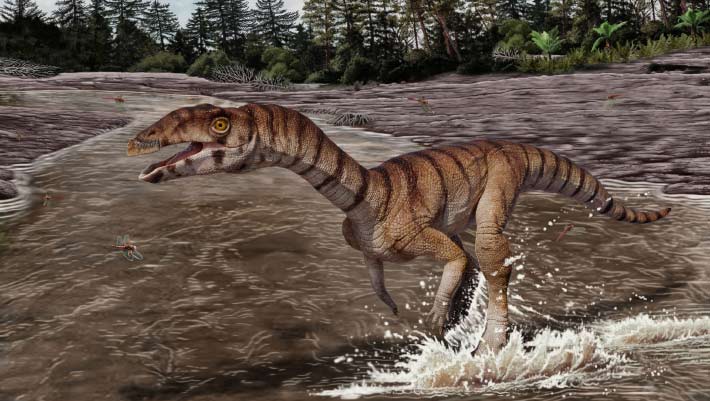
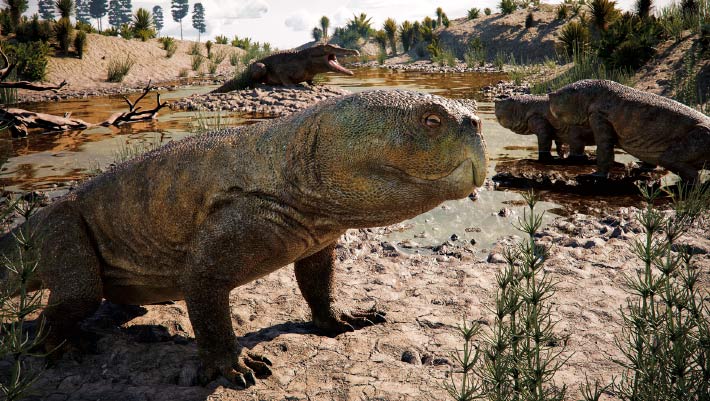
New Fossil from Brazil Reveals Unexpected Diversity among Pre-Dinosaur Herbivores
Un nouveau fossile du Brésil révèle une diversité inattendue parmi les herbivores pré-dinosaures
mâchoire Brésil Trias fossile Dinosauria nouvelle espèce partiel crâne
Des paléontologues du Brésil ont identifié un nouveau genre et une nouvelle espèce de rhynchosaure hyperodapédontique – une lignée éteinte de reptiles herbivores à bec – sur la base d'un crâne partiel et de mâchoires inférieures récupérés dans des roches du Trias. L'article Un nouveau fossile du Brésil révèle une diversité inattendue parmi les herbivores pré-dinosaures est apparu en premier sur Sci.News : Breaking Science News.
23/04/2026 sci-news ⚙ Traduction automatique
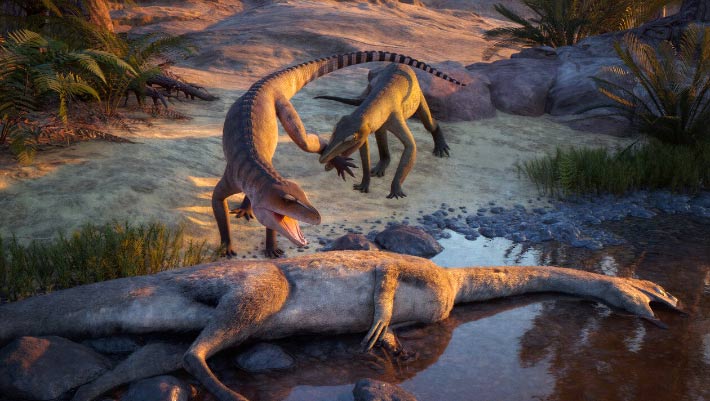
Museum Fossil Reveals Triassic Crocodile Cousin with Powerful Jaws
Un fossile de musée révèle un cousin crocodile du Trias doté de mâchoires puissantes
mâchoire musée Trias supérieur Trias fossile spécimen tomographie nouvelle espèce
Les tomodensitogrammes d'un spécimen vieux de plusieurs décennies du Musée d'histoire naturelle de Yale Peabody montrent une nouvelle espèce de crocodylomorphe au museau court et aux mâchoires inhabituellement fortes, offrant un instantané rare de la spécialisation écologique à l'époque du Trias supérieur. Le post Museum Fossil révèle un cousin crocodile du Trias doté de mâchoires puissantes est apparu en premier sur Sci.News: Breaking Science News.
20/04/2026 sci-news ⚙ Traduction automatique
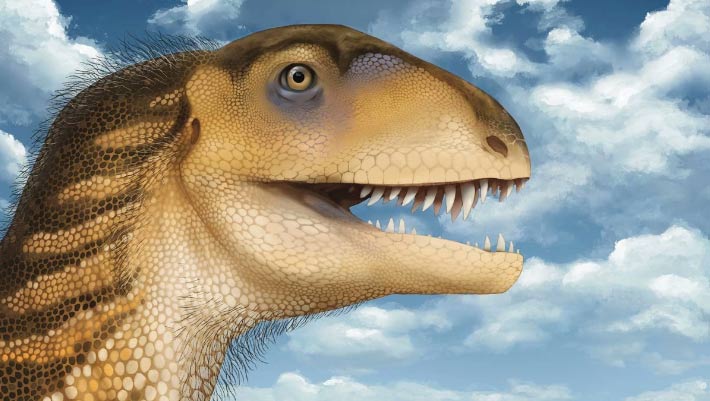
New Triassic Dinosaur Species Identified in New Mexico
De nouvelles espèces de dinosaures du Trias identifiées au Nouveau-Mexique
Mexique États-Unis Trias Dinosauria nouvelle espèce crâne
Un nouveau genre et une nouvelle espèce de dinosaure herrerasaurien carnivore ont été décrits à partir d'un crâne incomplet mais bien conservé trouvé dans le nord du Nouveau-Mexique, aux États-Unis. L'article Nouvelles espèces de dinosaures du Trias identifiées au Nouveau-Mexique est apparu en premier sur Sci.News : Breaking Science News.
17/04/2026 sci-news ⚙ Traduction automatique
Un fossile écrasé révèle un dinosaure qui n’aurait pas dû exister
Trias fossile Dinosauria découverte extinction nouvelle espèce crâne
Un crâne de dinosaure gravement mutilé, oublié dans un tiroir, s'est avéré être une découverte rare et importante. Reconstruit par un étudiant de Virginia Tech, il a révélé une nouvelle espèce de dinosaure carnivore primitif présentant des caractéristiques inhabituelles jamais vues auparavant. Le fossile suggère que certains groupes de dinosaures ont été anéantis lors de l’extinction de la fin du Trias, et pas seulement leurs rivaux. Il s’agit peut-être de l’un des derniers survivants d’une ancienne lignée de dinosaures.
15/04/2026 sciencedaily ⚙ Traduction automatique
Daemonosaurus: Beast of the Week
Démonosaure : la bête de la semaine
Mexique États-Unis Trias supérieur Trias Daemonosaurus Dinosauria crâne
 Cette semaine, nous allons découvrir un premier dinosaure au look unique avec un nom très cool.  Rencontrez Daemonosaurus chaoliodus ! Daemonosaurus était un petit dinosaure carnivore qui vivait dans ce qui est aujourd'hui le Nouveau-Mexique, aux États-Unis, à la fin du Trias, il y a environ 205 à 200 millions d'années.  Du nez à la queue, on estime qu'il mesurait environ 5 à 7 pieds (1,5 à 2,2 m).  Il s’agit d’estimations basées sur le fait que seuls le crâne et le cou ont été retrouvés.  Le nom du genre se traduit par "Demo
05/04/2026 prehistoricbeastoftheweek ⚙ Traduction automatique
1 2 3 4 5