Triassic

Geological interval

37 image(s) · 15 News

View page

Image gallery

Figure 1. Evolution of macroecological traits in Dinosauria. Large scale event in dinosaur evolution (a); the origin of dinosaurs (star), hyperthermals (volcano), the earliest fossil Avialae (bird), the earliest fossil angiosperm (flower), the Cretaceous/Palaeogene mass extinction (asteroid). Phylogeny of dinosaurs (b) redrawn from Sereno and adapted to the current consensus and upon which an ancestral state reconstruction of temperature niche (mean annual temperature) after Chiarenza et al. is plotted; Mesozoic palaeogeographies (c) for Triassic (T), Jurassic (J) and Cretaceous (K). Silhouette colours symbolize body mass for each of the taxa represented; information on dietary habits are plotted after Barrett and Zanno & Makovicky; numbers represent clades discussed through this study: 1, Ornithischia; 2, Thyreophora; 3, Ornithopoda; 4, Hadrosauroidea; 5, Marginocephalia; 6, Ceratopsia; 7, Saurischia; 8, Sauropodomorpha; 9, Sauropoda; 10, Theropoda; 11, Ceratosauria; 12, Tetanurae; 13, Coelurosauria; 14, Maniraptoriformes; 15, Maniraptora; 16, Deinonychosauria; 17, Avialae; 18, Ornithothoraces. Palaeogeographies modified from original plots via R package ‘mapast’ using plate models by Scotese.

Figure 1. Evolution of macroecological traits in Dinosauria. Large scale event in dinosaur evolution (a); the origin of dinosaurs (star), hyperthermals (volcano), the earliest fossil Avialae (bird), the earliest fossil angiosperm (flower), the Cretaceous/Palaeogene mass extinction (asteroid). Phylogeny of dinosaurs (b) redrawn from Sereno and adapted to the current consensus and upon which an ancestral state reconstruction of temperature niche (mean annual temperature) after Chiarenza et al. is plotted; Mesozoic palaeogeographies (c) for Triassic (T), Jurassic (J) and Cretaceous (K). Silhouette colours symbolize body mass for each of the taxa represented; information on dietary habits are plotted after Barrett and Zanno & Makovicky; numbers represent clades discussed through this study: 1, Ornithischia; 2, Thyreophora; 3, Ornithopoda; 4, Hadrosauroidea; 5, Marginocephalia; 6, Ceratopsia; 7, Saurischia; 8, Sauropodomorpha; 9, Sauropoda; 10, Theropoda; 11, Ceratosauria; 12, Tetanurae; 13, Coelurosauria; 14, Maniraptoriformes; 15, Maniraptora; 16, Deinonychosauria; 17, Avialae; 18, Ornithothoraces. Palaeogeographies modified from original plots via R package ‘mapast’ using plate models by Scotese.

scale Cretaceous Jurassic Mesozoic +23
Tawa is an early theropod from the Late Triassic. The genus is named after the Hopi word for the Puebloan sun god. It was a bipedal carnivore, estimated around 2.5 m in length, and weighing about 15 kg. A basal theropod, Tawa shares physical characteristics with coelophysoids and herrerasaurids, and its discovery supports the theory that dinosaurs originated in the southern supercontinent of Gondwanna, before diversifying as Pangea split apart.

Tawa is an early theropod from the Late Triassic. The genus is named after the Hopi word for the Puebloan sun god. It was a bipedal carnivore, estimated around 2.5 m in length, and weighing about 15 kg. A basal theropod, Tawa shares physical characteristics with coelophysoids and herrerasaurids, and its discovery supports the theory that dinosaurs originated in the southern supercontinent of Gondwanna, before diversifying as Pangea split apart.

Late Triassic Triassic Dinosauria Herrerasauridae +2
Various fossils pertaining to the holotype of the Triassic ichthyosaur Toretocnemus (originally Leptocheirus, also Merriamia) zitteli. This image is derived from plate 23 in Merriam (1903), done by an uncredited artist. The arrangement of the individual figures has been modified from the original (most notably, figures 3 and 4 were swapped to minimize confusion).
Original description:
Leptocheirus zitteli n. gen. and sp.
Figures reproduced natural size from the type specimen.

Fig. 1.— Right side of skull.
Fig. 2. — Cross-section of posterior portion of the lower jaw, taken above the point marked A on the lateral view of the skull.
Fig. 3. — Cross-section of the upper and lower jaws, taken at the break immediately behind the point marked Sp on the lateral view of the skull.
Fig. 4. — Lateral view of an anterior caudal centrum.
Legend (modified from original):

Ar - articular
A - angular
D - dentary
J - jugal
L - lacrimal
Mx - maxilla
Po - postorbital
Sa - surangular
Se - sclerotic ring
Sp - spenial
T - cross-section of tooth
X - doubtful element

Various fossils pertaining to the holotype of the Triassic ichthyosaur Toretocnemus (originally Leptocheirus, also Merriamia) zitteli. This image is derived from plate 23 in Merriam (1903), done by an uncredited artist. The arrangement of the individual figures has been modified from the original (most notably, figures 3 and 4 were swapped to minimize confusion). Original description: Leptocheirus zitteli n. gen. and sp. Figures reproduced natural size from the type specimen. Fig. 1.— Right side of skull. Fig. 2. — Cross-section of posterior portion of the lower jaw, taken above the point marked A on the lateral view of the skull. Fig. 3. — Cross-section of the upper and lower jaws, taken at the break immediately behind the point marked Sp on the lateral view of the skull. Fig. 4. — Lateral view of an anterior caudal centrum. Legend (modified from original): Ar - articular A - angular D - dentary J - jugal L - lacrimal Mx - maxilla Po - postorbital Sa - surangular Se - sclerotic ring Sp - spenial T - cross-section of tooth X - doubtful element

description Triassic fossil holotype +7
The shoulder girdle of the holotype of the Triassic ichthyosaur Toretocnemus (originally Leptocheirus, also Merriamia) zitteli. This image is derived from plate 21 in Merriam (1903), done by an uncredited artist. The arrangement of the individual figures has been slightly modified from the original.
Original description: Leptocheirus zitteli n. gen. and sp.
Figures reproduced natural size from the type specimen.

Fig. 1.—Clavicles (cl) and probable interelavicle (Ic and Ic')- The interclavicle has been separated into two fragments by a crack in the matrix.
Fig. 2.—Inner side of the coracoids and the left scapula.

The shoulder girdle of the holotype of the Triassic ichthyosaur Toretocnemus (originally Leptocheirus, also Merriamia) zitteli. This image is derived from plate 21 in Merriam (1903), done by an uncredited artist. The arrangement of the individual figures has been slightly modified from the original. Original description: Leptocheirus zitteli n. gen. and sp. Figures reproduced natural size from the type specimen. Fig. 1.—Clavicles (cl) and probable interelavicle (Ic and Ic')- The interclavicle has been separated into two fragments by a crack in the matrix. Fig. 2.—Inner side of the coracoids and the left scapula.

description Triassic holotype specimen +5
Forelimb and partial hindlimb of the holotype of the Triassic ichthyosaur Toretocnemus (originally Leptocheirus, also Merriamia) zitteli. This image is derived from plate 22 in Merriam (1903), done by an uncredited artist.
Original description: Leptocheirus zitteli n. gen. and sp.
Figures reproduced natural size from the type specimen.

Fig. 1. — Superior side of left anterior limb. r, radius.
Fig. 2. — Posterior limb. t, tibia.

Forelimb and partial hindlimb of the holotype of the Triassic ichthyosaur Toretocnemus (originally Leptocheirus, also Merriamia) zitteli. This image is derived from plate 22 in Merriam (1903), done by an uncredited artist. Original description: Leptocheirus zitteli n. gen. and sp. Figures reproduced natural size from the type specimen. Fig. 1. — Superior side of left anterior limb. r, radius. Fig. 2. — Posterior limb. t, tibia.

limb description Triassic holotype +7
Various fossils pertaining to the holotype of the Triassic ichthyosaur Toretocnemus californicus. This image is derived from plate 24 in Merriam (1903), done by an uncredited artist. The arrangement of the individual figures has been modified from the original.
Original description:
Toretocnemus californicus n. gen. and sp.
Figures reproduced natural size from the type specimen.

Fig. 1. — Inferior side of right posterior limb. t, tibia.
Fig. 2. — Right anterior limb. r, radius.
Fig. 3.— Pelvic arch.
Fig. 4. — Middle dorsal vertebrae and a rib from the same region.

Various fossils pertaining to the holotype of the Triassic ichthyosaur Toretocnemus californicus. This image is derived from plate 24 in Merriam (1903), done by an uncredited artist. The arrangement of the individual figures has been modified from the original. Original description: Toretocnemus californicus n. gen. and sp. Figures reproduced natural size from the type specimen. Fig. 1. — Inferior side of right posterior limb. t, tibia. Fig. 2. — Right anterior limb. r, radius. Fig. 3.— Pelvic arch. Fig. 4. — Middle dorsal vertebrae and a rib from the same region.

limb description Triassic fossil +6
Illustration of some anterior caudal vertebrae of the Californian ichthyosaur Torteocnemus californicus (specimen UCMP 8100), from Merriam's 1908 monograph on American Triassic ichthyosaurs. This illustration appeared as figure 4 of plate 14; it has been modified to remove the stamp placed on top of it. While Merriam credits two illustrators as having produced artwork for this publication, it is not clear which of them created this image.

Illustration of some anterior caudal vertebrae of the Californian ichthyosaur Torteocnemus californicus (specimen UCMP 8100), from Merriam's 1908 monograph on American Triassic ichthyosaurs. This illustration appeared as figure 4 of plate 14; it has been modified to remove the stamp placed on top of it. While Merriam credits two illustrators as having produced artwork for this publication, it is not clear which of them created this image.

Triassic specimen Ichthyosauria Merriamia +1
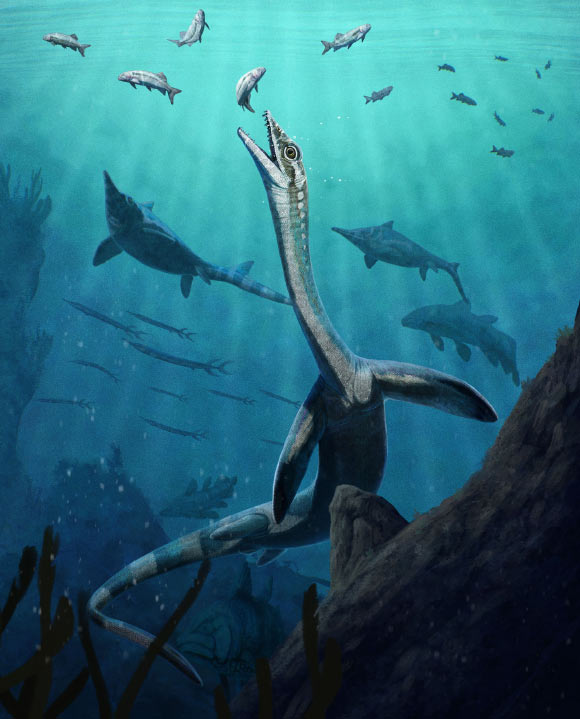
Life restoration of the Triassic ichthyosaur Qianichthyosaurus xingyiensis.
References
Motani, Ryosuke; Jiang, Da-yong; Tintori, Andrea; Ji, Cheng; Huang, Jian-dong (2017). "Pre- versus post-mass extinction divergence of Mesozoic marine reptiles dictated by time-scale dependence of evolutionary rates". Proceedings of the Royal Society B 284 (1854): 20170241. DOI:10.1098/rspb.2017.0241.

Life restoration of the Triassic ichthyosaur Qianichthyosaurus xingyiensis. References Motani, Ryosuke; Jiang, Da-yong; Tintori, Andrea; Ji, Cheng; Huang, Jian-dong (2017). "Pre- versus post-mass extinction divergence of Mesozoic marine reptiles dictated by time-scale dependence of evolutionary rates". Proceedings of the Royal Society B 284 (1854): 20170241. DOI:10.1098/rspb.2017.0241.

scale Mesozoic Triassic Ichthyosauria +3
Figure description from paper: "Figure 23: Early and Middle Triassic ichthyopterygian heads possessing longirostry.
Simplified outlines of four different Early and Middle Triassic ichthyopterygian heads possessing a long and slender rostrum. Specimens are at the same scale. (A) Utatsusaurus hataii (UHR 30691, Motani, Minoura & Ando, 1998); (B) Grippia longirostris (PMU R445, Motani, 2000); (C) Mixosaurus cornalianus (BES SC 1000, Renesto et al., 2020); (D) Besanosaurus leptorhynchus (PIMUZ T 4847, this paper); (E) Cymbospondylus buchseri (PIMUZ T 4351, Sander, 1989). Scale bar represents 10 cm."
References:

Bindellini, G.; Wolniewicz, A.S.; Miedema, F.; Scheyer, T.M.; Dal Sasso, C. (2021). "Cranial anatomy of Besanosaurus leptorhynchus Dal Sasso & Pinna, 1996 (Reptilia: Ichthyosauria) from the Middle Triassic Besano Formation of Monte San Giorgio, Italy/Switzerland: Taxonomic and palaeobiological implications". PeerJ 9: e11179. DOI:10.7717/peerj.11179.

Figure description from paper: "Figure 23: Early and Middle Triassic ichthyopterygian heads possessing longirostry. Simplified outlines of four different Early and Middle Triassic ichthyopterygian heads possessing a long and slender rostrum. Specimens are at the same scale. (A) Utatsusaurus hataii (UHR 30691, Motani, Minoura & Ando, 1998); (B) Grippia longirostris (PMU R445, Motani, 2000); (C) Mixosaurus cornalianus (BES SC 1000, Renesto et al., 2020); (D) Besanosaurus leptorhynchus (PIMUZ T 4847, this paper); (E) Cymbospondylus buchseri (PIMUZ T 4351, Sander, 1989). Scale bar represents 10 cm." References: Bindellini, G.; Wolniewicz, A.S.; Miedema, F.; Scheyer, T.M.; Dal Sasso, C. (2021). "Cranial anatomy of Besanosaurus leptorhynchus Dal Sasso & Pinna, 1996 (Reptilia: Ichthyosauria) from the Middle Triassic Besano Formation of Monte San Giorgio, Italy/Switzerland: Taxonomic and palaeobiological implications". PeerJ 9: e11179. DOI:10.7717/peerj.11179.

scale description Italy Switzerland +12
Besanosaurus leptorhynchus referred specimen PIMUZ T 4376, preserved on the same slab as a specimen of the smaller Mixosaurus. Scale bar represents 50 cm (1.6 ft). Figure 3C of Bindellini et al. (2021).
References:

Bindellini, G.; Wolniewicz, A.S.; Miedema, F.; Scheyer, T.M.; Dal Sasso, C. (2021). "Cranial anatomy of Besanosaurus leptorhynchus Dal Sasso & Pinna, 1996 (Reptilia: Ichthyosauria) from the Middle Triassic Besano Formation of Monte San Giorgio, Italy/Switzerland: Taxonomic and palaeobiological implications". PeerJ 9: e11179. DOI:10.7717/peerj.11179.

Besanosaurus leptorhynchus referred specimen PIMUZ T 4376, preserved on the same slab as a specimen of the smaller Mixosaurus. Scale bar represents 50 cm (1.6 ft). Figure 3C of Bindellini et al. (2021). References: Bindellini, G.; Wolniewicz, A.S.; Miedema, F.; Scheyer, T.M.; Dal Sasso, C. (2021). "Cranial anatomy of Besanosaurus leptorhynchus Dal Sasso & Pinna, 1996 (Reptilia: Ichthyosauria) from the Middle Triassic Besano Formation of Monte San Giorgio, Italy/Switzerland: Taxonomic and palaeobiological implications". PeerJ 9: e11179. DOI:10.7717/peerj.11179.

scale Italy Switzerland Middle Triassic +8
Modified version of figure 23 of Bindellini et al. (2021) showing just the ichthyosaurs from the Besano Formation: Besanosaurus leptorhynchus (A), Mixosaurus cornalianus (B), and Cymbospondylus buchseri (C). The original figure was uploaded unmodified here: File:Early to Middle Triassic Longirostrine Ichthyopterygians.png
References:

Bindellini, G.; Wolniewicz, A.S.; Miedema, F.; Scheyer, T.M.; Dal Sasso, C. (2021). "Cranial anatomy of Besanosaurus leptorhynchus Dal Sasso & Pinna, 1996 (Reptilia: Ichthyosauria) from the Middle Triassic Besano Formation of Monte San Giorgio, Italy/Switzerland: Taxonomic and palaeobiological implications". PeerJ 9: e11179. DOI:10.7717/peerj.11179.

Modified version of figure 23 of Bindellini et al. (2021) showing just the ichthyosaurs from the Besano Formation: Besanosaurus leptorhynchus (A), Mixosaurus cornalianus (B), and Cymbospondylus buchseri (C). The original figure was uploaded unmodified here: File:Early to Middle Triassic Longirostrine Ichthyopterygians.png References: Bindellini, G.; Wolniewicz, A.S.; Miedema, F.; Scheyer, T.M.; Dal Sasso, C. (2021). "Cranial anatomy of Besanosaurus leptorhynchus Dal Sasso & Pinna, 1996 (Reptilia: Ichthyosauria) from the Middle Triassic Besano Formation of Monte San Giorgio, Italy/Switzerland: Taxonomic and palaeobiological implications". PeerJ 9: e11179. DOI:10.7717/peerj.11179.

Italy Switzerland Middle Triassic Triassic +7
Utatsusaurus hataii, an Early Triassic Ichthyosaur from Japan, pencil drawing
Taxa Grippiidae

Utatsusaurus hataii, an Early Triassic Ichthyosaur from Japan, pencil drawing

drawing Japan Early Triassic Triassic +4
Augustasaurus hagdorni, a pistosaur from the Middle Triassic of nevada. Digital.
Taxa Pistosauroidea

Augustasaurus hagdorni, a pistosaur from the Middle Triassic of nevada. Digital.

Middle Triassic Triassic Augustasaurus Pistosauria +2
Augustasaurus hagdorni, a pistosaur from the Middle Triassic of nevada. Digital.
Taxa Pistosauria

Augustasaurus hagdorni, a pistosaur from the Middle Triassic of nevada. Digital.

Middle Triassic Triassic Augustasaurus Pistosauria +2
Nothosaurus mirabilis, a Nothosaur from the Triassic of Europe, North Africa and Russia, pencil drawing
Taxa Nothosauria

Nothosaurus mirabilis, a Nothosaur from the Triassic of Europe, North Africa and Russia, pencil drawing

drawing Russia Triassic Nothosauria +2
Nothosaurus mirabilis, a Nothosaur from the Triassic of Europe, North Africa and Russia, pencil drawing
Taxa Nothosauroidea

Nothosaurus mirabilis, a Nothosaur from the Triassic of Europe, North Africa and Russia, pencil drawing

drawing Russia Triassic Nothosauria +2
1 2 3

News

Ancient Oceans Began Losing Oxygen Millions of Years before End-Triassic Mass Extinction
Triassic extinction
Chemical traces preserved in ancient rocks indicate that marine environments were deteriorating long before the catastrophe that wiped out vast numbers of species at the end of the Triassic period, around 201 million years ago. The post Ancient Oceans Began Losing Oxygen Millions of Years before End-Triassic Mass Extinction appeared first on Sci.News: Breaking Science News.
02/06/2026 sci-news
New English Crocodylomorph Honours Welsh Teacher
Late Triassic Triassic fossil new species
Scientists have identified a new species of ancient crocodylomorph from Upper Triassic rocks in southwest England. The newly named species, Galahadosuchus jonesi, lived around 215 million years ago and it represents the second species of non-crocodyliform crocodylomorph described from the Late Triassic–aged fissures of the Bristol Channel area. Non-crocodyliform crocodylomorph fossil material is known from
01/06/2026 everythingdinosaur
Voici la « sorcière crocodile », une créature édentée du Trias, vieille de 212 millions d'années, qui marchait sur deux jambes
Meet the “Crocodile Witch,” a 212-million-year-old toothless creature from the Triassic that walked on two legs
tooth Triassic
More than 200 million years ago, long before modern crocodiles, a strange creature already roamed the Earth on two legs. Its appearance defies everything we imagine about these formidable reptiles. Without teeth, with a beak and a silhouette more reminiscent of certain...
30/05/2026 futura-terre ⚙ Auto-translated
This bizarre crocodile relative from the Triassic looked like an ostrich dinosaur
limb Triassic Dinosauria
Scientists have discovered Labrujasuchus expectatus, a bizarre crocodile relative that looked more like an ostrich-like dinosaur than anything resembling a modern crocodile. It walked on two legs, had tiny arms, and sported a toothless beak—an unexpected combination for a member of the crocodile lineage.
29/05/2026 sciencedaily
Toothless, Bipedal Crocodile Relative Lived in New Mexico 212 Million Years Ago
Mexico Triassic new species
Paleontologists have described a new species of bipedal shuvosaurid archosaur from New Mexico, shedding light on a group of creatures that roamed North America during the Triassic period, more than 200 million years ago. The post Toothless, Bipedal Crocodile Relative Lived in New Mexico 212 Million Years Ago appeared first on Sci.News: Breaking Science News.
27/05/2026 sci-news
1 2 3