Triassic

Geological interval

51 image(s) · 24 News

View page

Image gallery

Fossil with teeth of Macroplacus raeticus from Triassic of Germany, on display at the Museo Civico di Storia Naturale di Milano
Taxa Macroplacus

Fossil with teeth of Macroplacus raeticus from Triassic of Germany, on display at the Museo Civico di Storia Naturale di Milano

Germany Triassic fossil Macroplacus
Laurasia during the closure of the Iapetus Ocean at 430 Ma.
Made using GPlates:  Citations:

Golonka, J. (2007), Late Triassic and Early Jurassic palaeogeography of the world, Palaeogeography, Palaeoclimatology, Palaeoecology, 244(1-4), 297-307.
Müller, R., M. Sdrolias, C. Gaina, and W. Roest (2008), Age, spreading rates, and spreading asymmetry of the world's ocean crust, Geochemistry, Geophysics, Geosystems, 9(Q04006), 19.
Seton, M., R. Müller, S. Zahirovic, C. Gaina, T. Torsvik, G. Shephard, A. Talsma, M. Gurnis, M. Turner, and M. Chandler (2012), Global continental and ocean basin reconstructions since 200 Ma, Earth-Science Reviews, 113(3-4), 212-270.
Torsvik, T., and R. Van de Voo (2002), Refining Gondwana and Pangea Palaeogeography: Estimates of Phanerozoic non dipole (octupole) fields, Geophysical Journal International, 151(3), 771-794.
Wright, N., S. Zahirovic, R. D. Müller, and M. Seton (2013), Towards community-driven, open-access paleogeographic reconstructions: integrating open-access paleogeographic and paleobiology data with plate tectonics, Biogeosciences, 10, 1529-1541
Intervals Sheinwoodian

Laurasia during the closure of the Iapetus Ocean at 430 Ma. Made using GPlates: Citations: Golonka, J. (2007), Late Triassic and Early Jurassic palaeogeography of the world, Palaeogeography, Palaeoclimatology, Palaeoecology, 244(1-4), 297-307. Müller, R., M. Sdrolias, C. Gaina, and W. Roest (2008), Age, spreading rates, and spreading asymmetry of the world's ocean crust, Geochemistry, Geophysics, Geosystems, 9(Q04006), 19. Seton, M., R. Müller, S. Zahirovic, C. Gaina, T. Torsvik, G. Shephard, A. Talsma, M. Gurnis, M. Turner, and M. Chandler (2012), Global continental and ocean basin reconstructions since 200 Ma, Earth-Science Reviews, 113(3-4), 212-270. Torsvik, T., and R. Van de Voo (2002), Refining Gondwana and Pangea Palaeogeography: Estimates of Phanerozoic non dipole (octupole) fields, Geophysical Journal International, 151(3), 771-794. Wright, N., S. Zahirovic, R. D. Müller, and M. Seton (2013), Towards community-driven, open-access paleogeographic reconstructions: integrating open-access paleogeographic and paleobiology data with plate tectonics, Biogeosciences, 10, 1529-1541

Early Jurassic Jurassic Late Triassic Phanerozoic +2
Laurasia during the closure of the Iapetus Ocean at 430 Ma.
Made using GPlates:  Citations:

Golonka, J. (2007), Late Triassic and Early Jurassic palaeogeography of the world, Palaeogeography, Palaeoclimatology, Palaeoecology, 244(1-4), 297-307.
Müller, R., M. Sdrolias, C. Gaina, and W. Roest (2008), Age, spreading rates, and spreading asymmetry of the world's ocean crust, Geochemistry, Geophysics, Geosystems, 9(Q04006), 19.
Seton, M., R. Müller, S. Zahirovic, C. Gaina, T. Torsvik, G. Shephard, A. Talsma, M. Gurnis, M. Turner, and M. Chandler (2012), Global continental and ocean basin reconstructions since 200 Ma, Earth-Science Reviews, 113(3-4), 212-270.
Torsvik, T., and R. Van de Voo (2002), Refining Gondwana and Pangea Palaeogeography: Estimates of Phanerozoic non dipole (octupole) fields, Geophysical Journal International, 151(3), 771-794.
Wright, N., S. Zahirovic, R. D. Müller, and M. Seton (2013), Towards community-driven, open-access paleogeographic reconstructions: integrating open-access paleogeographic and paleobiology data with plate tectonics, Biogeosciences, 10, 1529-1541
Intervals Homerian

Laurasia during the closure of the Iapetus Ocean at 430 Ma. Made using GPlates: Citations: Golonka, J. (2007), Late Triassic and Early Jurassic palaeogeography of the world, Palaeogeography, Palaeoclimatology, Palaeoecology, 244(1-4), 297-307. Müller, R., M. Sdrolias, C. Gaina, and W. Roest (2008), Age, spreading rates, and spreading asymmetry of the world's ocean crust, Geochemistry, Geophysics, Geosystems, 9(Q04006), 19. Seton, M., R. Müller, S. Zahirovic, C. Gaina, T. Torsvik, G. Shephard, A. Talsma, M. Gurnis, M. Turner, and M. Chandler (2012), Global continental and ocean basin reconstructions since 200 Ma, Earth-Science Reviews, 113(3-4), 212-270. Torsvik, T., and R. Van de Voo (2002), Refining Gondwana and Pangea Palaeogeography: Estimates of Phanerozoic non dipole (octupole) fields, Geophysical Journal International, 151(3), 771-794. Wright, N., S. Zahirovic, R. D. Müller, and M. Seton (2013), Towards community-driven, open-access paleogeographic reconstructions: integrating open-access paleogeographic and paleobiology data with plate tectonics, Biogeosciences, 10, 1529-1541

Early Jurassic Jurassic Late Triassic Phanerozoic +2
Natural-colour satellite image of part of the Kaiparowits Basin (a central portion of Grand Staircase-Escalante). The branch-like shapes are networks of canyons carved by rivers that dried up millions of years ago. The ridge running roughly north-south through the scene is the Cockscomb, which is surrounded by distinct rock formations deposited at different times in the geologic past. West of the Cockscomb is the Navajo Sandstone, dating from the Triassic. East of the Cockscomb are two formations from the Cretaceous: the light-toned Wahweap and darker Kaiparowits.

Natural-colour satellite image of part of the Kaiparowits Basin (a central portion of Grand Staircase-Escalante). The branch-like shapes are networks of canyons carved by rivers that dried up millions of years ago. The ridge running roughly north-south through the scene is the Cockscomb, which is surrounded by distinct rock formations deposited at different times in the geologic past. West of the Cockscomb is the Navajo Sandstone, dating from the Triassic. East of the Cockscomb are two formations from the Cretaceous: the light-toned Wahweap and darker Kaiparowits.

Allen Kaiparowits Navajo Sandstone Cretaceous +3
Eubrontes dinosaur track from the Jurassic of Connecticut, USA.
Trace fossils are any indirect evidence of ancient life.  They refer to features in rocks that do not represent parts of the body of a once-living organism.  Traces include footprints, tracks, trails, burrows, borings, and bitemarks.  Body fossils provide information about the morphology of ancient organisms, while trace fossils provide information about the behavior of ancient life forms.  Interpreting trace fossils and determination of the identity of a trace maker can be straightforward (for example, a dinosaur footprint represents walking behavior) or not.  Sediments that have trace fossils are said to be bioturbated.  Burrowed textures in sedimentary rocks are referred to as bioturbation.  Trace fossils have scientific names assigned to them, in the same style & manner as living organisms or body fossils.
This track was made by a theropod, a group of small to large, carnivorous, bipedal dinosaurs.  The specimen comes from a Triassic to Jurassic terrestrial sedimentary succession that filled up a half graben, many of which occur along America's eastern seaboard.  Such half-graben basins formed during the Triassic as the Pangaea supercontinent tried to rift apart, but failed.  Pangaea successfully broke apart during the Jurassic.
Stratigraphy: East Berlin Formation, Newark Supergroup, Lower Jurassic
Locality: unrecorded / undisclosed site at or near the town of Rocky Hill, central Connecticut, USA


Info. at:
mrdata.usgs.gov/geology/state/sgmc-unit.php?unit=CTJeb%3B0
and

en.wikipedia.org/wiki/Eubrontes

Eubrontes dinosaur track from the Jurassic of Connecticut, USA. Trace fossils are any indirect evidence of ancient life. They refer to features in rocks that do not represent parts of the body of a once-living organism. Traces include footprints, tracks, trails, burrows, borings, and bitemarks. Body fossils provide information about the morphology of ancient organisms, while trace fossils provide information about the behavior of ancient life forms. Interpreting trace fossils and determination of the identity of a trace maker can be straightforward (for example, a dinosaur footprint represents walking behavior) or not. Sediments that have trace fossils are said to be bioturbated. Burrowed textures in sedimentary rocks are referred to as bioturbation. Trace fossils have scientific names assigned to them, in the same style & manner as living organisms or body fossils. This track was made by a theropod, a group of small to large, carnivorous, bipedal dinosaurs. The specimen comes from a Triassic to Jurassic terrestrial sedimentary succession that filled up a half graben, many of which occur along America's eastern seaboard. Such half-graben basins formed during the Triassic as the Pangaea supercontinent tried to rift apart, but failed. Pangaea successfully broke apart during the Jurassic. Stratigraphy: East Berlin Formation, Newark Supergroup, Lower Jurassic Locality: unrecorded / undisclosed site at or near the town of Rocky Hill, central Connecticut, USA Info. at: mrdata.usgs.gov/geology/state/sgmc-unit.php?unit=CTJeb%3B0 and en.wikipedia.org/wiki/Eubrontes

United States Jurassic Triassic fossil +5
Life restoration of the German Jurassic ichthyosaur Suevoleviathan disinteger. The dorsal and caudal fins are loosely based on those of Stenopterygius.
References
Maisch, M.W. (2020). "The best-preserved skeleton of Suevoleviathan integer (Bronn, 1844)(Reptilia: Ichthyosauria) from the lower Jurassic of south-western Germany, with a discussion of the genus". Neues Jahrbuch für Geologie und Paläontologie, Abhandlungen 297 (2): 153–172.
Maisch, M.W. (1998). "A new ichthyosaur genus from the Posidonia Shale (Lower Toarcian, Jurassic) of Holzmaden, SW-Germany with comments on the phylogeny of post-Triassic ichthyosaurs". Neues Jahrbuch für Geologie und Paläontologie-Abhandlungen 209 (1): 47–78.
Taxa Suevoleviathan

Life restoration of the German Jurassic ichthyosaur Suevoleviathan disinteger. The dorsal and caudal fins are loosely based on those of Stenopterygius. References Maisch, M.W. (2020). "The best-preserved skeleton of Suevoleviathan integer (Bronn, 1844)(Reptilia: Ichthyosauria) from the lower Jurassic of south-western Germany, with a discussion of the genus". Neues Jahrbuch für Geologie und Paläontologie, Abhandlungen 297 (2): 153–172. Maisch, M.W. (1998). "A new ichthyosaur genus from the Posidonia Shale (Lower Toarcian, Jurassic) of Holzmaden, SW-Germany with comments on the phylogeny of post-Triassic ichthyosaurs". Neues Jahrbuch für Geologie und Paläontologie-Abhandlungen 209 (1): 47–78.

Germany Posidonia Shale Jurassic Toarcian +6
Plate XII(XIX).
Fig. 1. Coelophysis bauri COPE. Sacrum, consisting of three vertebrae and last dorsal vertebra. COPE’s original. Triassic, New Mexico. Preserved in American Museum of Natural History, New York. Nat. size, from a cast in Tübingen. a, right lateral view; b, left lateral view; c, ventral view.
Fig. 2. Thecodontosaurus skirtopodus SEELEY sp. Right humerus. Original in Vienna Hofmuseum (Coll. ADLER 1886). Upper Karroo, Cape Colony, South Africa. 1/2 nat. size, from a cast in Tübingen.
Fig. 3. Same. Ditto. Proximal end of a right humerus in posterior view. 1/2 nat. size (the lateral part is missing).
Fig. 4. Same. Ditto. Distal end of a left humerus in anterior view. 1/2 nat. size.
Fig. 5. Same. Ditto. Distal end of a left femur in posterior view. 1/2 nat. size.
Fig. 6. Same. Ditto. Proximal end of a left tibia, lateral view. 1/2 nat. size.
Fig. 7. Thecodontosaurus browni SEELEY sp. Left femur in posterior view. SEELEY’s original. From the Stormberg Beds of the Telle River near Aliwal North, Cape Colony, South Africa. (From casts in the British Museum and Tübingen.) 1/2 nat. size.

Fig. 8. Same. Ditto. Right femur, medial view.

Plate XII(XIX). Fig. 1. Coelophysis bauri COPE. Sacrum, consisting of three vertebrae and last dorsal vertebra. COPE’s original. Triassic, New Mexico. Preserved in American Museum of Natural History, New York. Nat. size, from a cast in Tübingen. a, right lateral view; b, left lateral view; c, ventral view. Fig. 2. Thecodontosaurus skirtopodus SEELEY sp. Right humerus. Original in Vienna Hofmuseum (Coll. ADLER 1886). Upper Karroo, Cape Colony, South Africa. 1/2 nat. size, from a cast in Tübingen. Fig. 3. Same. Ditto. Proximal end of a right humerus in posterior view. 1/2 nat. size (the lateral part is missing). Fig. 4. Same. Ditto. Distal end of a left humerus in anterior view. 1/2 nat. size. Fig. 5. Same. Ditto. Distal end of a left femur in posterior view. 1/2 nat. size. Fig. 6. Same. Ditto. Proximal end of a left tibia, lateral view. 1/2 nat. size. Fig. 7. Thecodontosaurus browni SEELEY sp. Left femur in posterior view. SEELEY’s original. From the Stormberg Beds of the Telle River near Aliwal North, Cape Colony, South Africa. (From casts in the British Museum and Tübingen.) 1/2 nat. size. Fig. 8. Same. Ditto. Right femur, medial view.

humerus vertebra museum Mexico +8
Original figure caption: Trackway S1 (Eosauropus sp.), here attributed to a sauropod trackmaker based on pedal synapomorphies; trackmaker is moving towards the south-west. Two consequtive pes impressions of a tridactyl Grallator [i.e. a theropod] trackway can be seen left to the S1 trackway.
Note: The tracks are preserved on a bedding plane of a thin siltstone bed of the Late Triassic Fleming Fjord Formation of East Greenland. A) shows a photograph of the trackway(s) as preserved on the bedding plane (i.e. as concave epireliefs); B) shows a color shaded relief map based on a high-resolution photogrammetric 3D-model of the bedding plane; C) is an interpretative outline drawing of the S1 trackway; abbreviations: LM = left manus (i.e. forefoot), LP = left pes (i.e. hindfoot), RM = right manus, RP = right pes, numbers increase in walking direction.

Original figure caption: Trackway S1 (Eosauropus sp.), here attributed to a sauropod trackmaker based on pedal synapomorphies; trackmaker is moving towards the south-west. Two consequtive pes impressions of a tridactyl Grallator [i.e. a theropod] trackway can be seen left to the S1 trackway. Note: The tracks are preserved on a bedding plane of a thin siltstone bed of the Late Triassic Fleming Fjord Formation of East Greenland. A) shows a photograph of the trackway(s) as preserved on the bedding plane (i.e. as concave epireliefs); B) shows a color shaded relief map based on a high-resolution photogrammetric 3D-model of the bedding plane; C) is an interpretative outline drawing of the S1 trackway; abbreviations: LM = left manus (i.e. forefoot), LP = left pes (i.e. hindfoot), RM = right manus, RP = right pes, numbers increase in walking direction.

drawing Greenland Late Triassic Triassic +4
Californosaurus perrini, an ichthyosaur from the Late Triassic of North America, pencil drawing
Taxa Barracudasaurus

Californosaurus perrini, an ichthyosaur from the Late Triassic of North America, pencil drawing

drawing Late Triassic Triassic Barracudasaurus +4
Californosaurus perrini, an ichthyosaur from the Late Triassic of North America, pencil drawing
Taxa Toretocnemidae

Californosaurus perrini, an ichthyosaur from the Late Triassic of North America, pencil drawing

drawing Late Triassic Triassic Barracudasaurus +4
Lower Triassic fossil footprint (ichnite) of the ichnogenus Chirotherium, probably caused by an early archosaur, and first discovered 1833 in Hildburghausen (Thuringia, Germany). This specimen, however, ist from the Helsby Sandstone of the Storeton Quarry near Liverpool. Its species name is Chirotherium storetonense.[1]
Taxa Abelichnus

Lower Triassic fossil footprint (ichnite) of the ichnogenus Chirotherium, probably caused by an early archosaur, and first discovered 1833 in Hildburghausen (Thuringia, Germany). This specimen, however, ist from the Helsby Sandstone of the Storeton Quarry near Liverpool. Its species name is Chirotherium storetonense.[1]

Germany Triassic fossil specimen +9
Lower Triassic fossil footprint (ichnite) of the ichnogenus Chirotherium, probably caused by an early archosaur, and first discovered 1833 in Hildburghausen (Thuringia, Germany). This specimen, however, ist from the Helsby Sandstone of the Storeton Quarry near Liverpool. Its species name is Chirotherium storetonense.[1]
Taxa Anticheiropus

Lower Triassic fossil footprint (ichnite) of the ichnogenus Chirotherium, probably caused by an early archosaur, and first discovered 1833 in Hildburghausen (Thuringia, Germany). This specimen, however, ist from the Helsby Sandstone of the Storeton Quarry near Liverpool. Its species name is Chirotherium storetonense.[1]

Germany Triassic fossil specimen +9
Lower Triassic fossil footprint (ichnite) of the ichnogenus Chirotherium, probably caused by an early archosaur, and first discovered 1833 in Hildburghausen (Thuringia, Germany). This specimen, however, ist from the Helsby Sandstone of the Storeton Quarry near Liverpool. Its species name is Chirotherium storetonense.[1]
Taxa Argoides

Lower Triassic fossil footprint (ichnite) of the ichnogenus Chirotherium, probably caused by an early archosaur, and first discovered 1833 in Hildburghausen (Thuringia, Germany). This specimen, however, ist from the Helsby Sandstone of the Storeton Quarry near Liverpool. Its species name is Chirotherium storetonense.[1]

Germany Triassic fossil specimen +9
Lower Triassic fossil footprint (ichnite) of the ichnogenus Chirotherium, probably caused by an early archosaur, and first discovered 1833 in Hildburghausen (Thuringia, Germany). This specimen, however, ist from the Helsby Sandstone of the Storeton Quarry near Liverpool. Its species name is Chirotherium storetonense.[1]
Taxa Delatorrichnus

Lower Triassic fossil footprint (ichnite) of the ichnogenus Chirotherium, probably caused by an early archosaur, and first discovered 1833 in Hildburghausen (Thuringia, Germany). This specimen, however, ist from the Helsby Sandstone of the Storeton Quarry near Liverpool. Its species name is Chirotherium storetonense.[1]

Germany Triassic fossil specimen +9
Lower Triassic fossil footprint (ichnite) of the ichnogenus Chirotherium, probably caused by an early archosaur, and first discovered 1833 in Hildburghausen (Thuringia, Germany). This specimen, however, ist from the Helsby Sandstone of the Storeton Quarry near Liverpool. Its species name is Chirotherium storetonense.[1]
Taxa Dinehichnus

Lower Triassic fossil footprint (ichnite) of the ichnogenus Chirotherium, probably caused by an early archosaur, and first discovered 1833 in Hildburghausen (Thuringia, Germany). This specimen, however, ist from the Helsby Sandstone of the Storeton Quarry near Liverpool. Its species name is Chirotherium storetonense.[1]

Germany Triassic fossil specimen +9
Lower Triassic fossil footprint (ichnite) of the ichnogenus Chirotherium, probably caused by an early archosaur, and first discovered 1833 in Hildburghausen (Thuringia, Germany). This specimen, however, ist from the Helsby Sandstone of the Storeton Quarry near Liverpool. Its species name is Chirotherium storetonense.[1]
Taxa Dromaeosauripus

Lower Triassic fossil footprint (ichnite) of the ichnogenus Chirotherium, probably caused by an early archosaur, and first discovered 1833 in Hildburghausen (Thuringia, Germany). This specimen, however, ist from the Helsby Sandstone of the Storeton Quarry near Liverpool. Its species name is Chirotherium storetonense.[1]

Germany Triassic fossil specimen +9
1 2 3 4

News

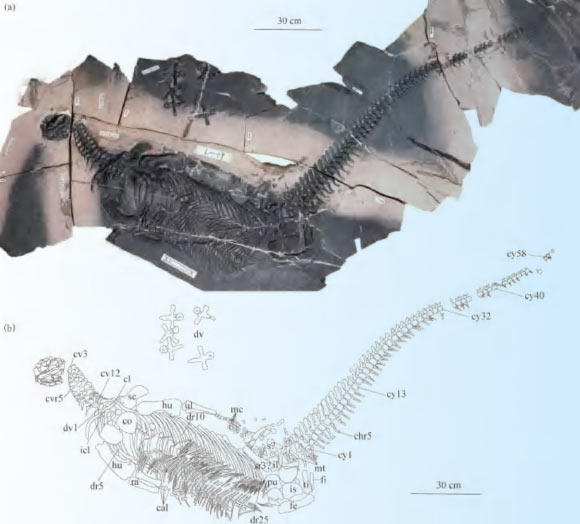
Spoon-Toothed, Short-Headed Marine Reptile Unearthed in China
tooth China Triassic Sauropterygia new species skeleton
A new genus and species of sauropterygian reptile that lived during the Triassic period, some 245 million years ago, has been identified from a nearly complete skeleton found in China. The post Spoon-Toothed, Short-Headed Marine Reptile Unearthed in China appeared first on Sci.News: Breaking Science News.
20/08/2026 sci-news
240-million-year-old reptile fossil reveals a lost chapter before dinosaurs and crocodiles
predator Brazil Triassic fossil Dinosauria evolution other reptiles
A 240-million-year-old reptile discovered in Brazil is revealing what evolution looked like just before the rise of dinosaurs and crocodiles. The small predator had unusually positioned legs that may have allowed it to move more efficiently than many earlier reptiles. Its close relatives were previously known mostly from other continents, suggesting these ancient animals spread much farther across the Triassic world than scientists realized.
10/08/2026 sciencedaily
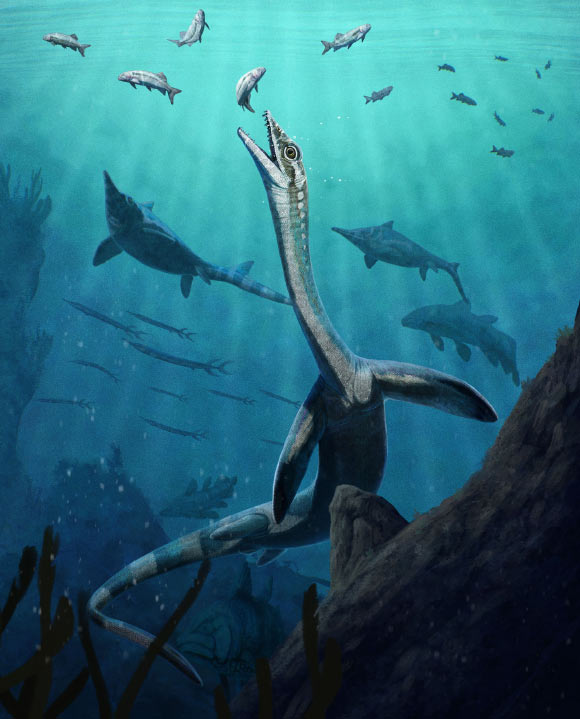
244-Million-Year-Old Fossil Preserves Earliest Reptilian Digestive System
China Triassic fossil specimen
An exquisitely preserved specimen of Austronaga minuta, a small, long-necked marine reptile from the Triassic of China, contains a fossilized stomach, liver and intestines, offering paleontologists their oldest detailed glimpse yet of how early reptiles digested food. The post 244-Million-Year-Old Fossil Preserves Earliest Reptilian Digestive System appeared first on Sci.News: Breaking Science News.
04/08/2026 sci-news
A forgotten fossil just revealed a new Triassic predator from 210 million years ago
jaw predator prey Mexico Triassic fossil skull
A fossil overlooked for nearly 80 years has revealed a previously unknown crocodile relative that lived 210 million years ago in what is now New Mexico. Named Eosphorosuchus lacrimosa, the jackal-sized predator had a reinforced skull, powerful jaw muscles, and a short snout built for tackling larger prey.
30/07/2026 sciencedaily
New Species of Triassic Dinosaur Discovered on Shores of Zimbabwe’s Lake Kariba
Zimbabwe Late Triassic Triassic Dinosauria Musango discovery new species
An international team of paleontologists has identified a new species of early sauropodomorph dinosaur in Zimbabwe, adding to growing evidence that southern Africa hosted a richer diversity of dinosaurs during the Late Triassic epoch than previously recognized. The post New Species of Triassic Dinosaur Discovered on Shores of Zimbabwe’s Lake Kariba appeared first on Sci.News: Breaking Science News.
29/07/2026 sci-news
1 2 3 4 5