Trias supérieur

Intervalle géologique

27 image(s) · 9 Actualités

Voir la fiche

Galerie d'images

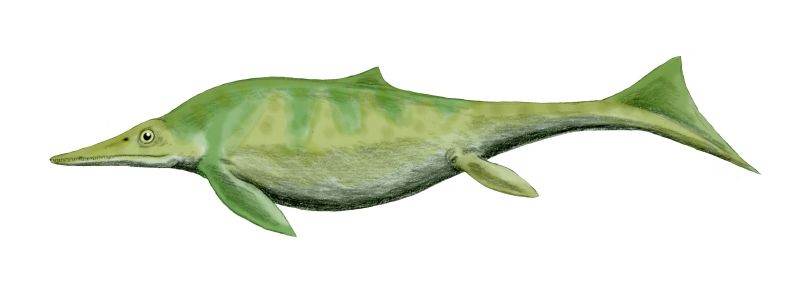
Life restoration of the Triassic ichthyosaur Callawayia neoscapularis. Three specimens of this ichthyosaur are known, the holotype, ROM 41993, and two referred specimens, TMP 94.380.11 and 94.382.2. The skull is primarily based on ROM 41993, cross-checked against TMP 94.380.11 and TMP 94.382.2. The vertebral column is based primarily on TMP 94.382.2 as it is the most complete of these specimens, while the ribs were based on ROM 41993. The forelimbs were mainly based on those of ROM 41993, with TMP 94.380.11 used to determine their breadth. The hindlimbs were based on TMP 94.380.11, especially the more complete right hindlimb.
ROM 41993 was cross-scaled with TMP 94.380.11 by the dimensions of the forelimb epipodials, which produced similar vertebral dimensions. The two TMP specimens were cross-scaled based on femoral length, also producing similar vertebral dimensions. Nicholls & Manabe (2001) stated that no wedge-shaped caudal centra supporting a tailbend were found and that there was no evidence of a bend being present, though considered that they might have existed in the gap in the preserved caudals. Since various other Triassic ichthyosaurs have since been found to have tail bends, one was illustrated here. A modest downturn of roughly 15° was illustrated, comparable to that in Guanlingsaurus, and the location of the bend within the gap in the preserved vertebrae matches well with the location of the bend in Guizhouichthyosaurus.

References
McGowan, C. (1994). "A new species of Shastasaurus (Reptilia: Ichthyosauria) from the Triassic of British Columbia: The most complete exemplar of the genus". Journal of Vertebrate Paleontology 14 (2): 168–179. DOI:10.1080/02724634.1994.10011550.
Nicholls, E. L.; Manabe, M. (2001). "A new genus of ichthyosaur from the Late Triassic Pardonet Formation of British Columbia: Bridging the Triassic-Jurassic gap". Canadian Journal of Earth Sciences 38 (6): 983–1002.
Ji, C.; Jiang, D.Y.; Hao, W.; Sun, Y. (2011). "True tailbend occurred in the Late Triassic: Evidence from ichthyosaur skeletons of South China". Acta Scientiarum Naturalium Universitatis Pekinensis 47 (2): 309–314.
Shang, Q. H.; Li, C. (2009). "On the occurrence of the ichthyosaur Shastasaurus in the Guanling biota (Late Triassic), Guizhou, China". Vertebrata PalAsiatica 47 (3): 178–193.

Life restoration of the Triassic ichthyosaur Callawayia neoscapularis. Three specimens of this ichthyosaur are known, the holotype, ROM 41993, and two referred specimens, TMP 94.380.11 and 94.382.2. The skull is primarily based on ROM 41993, cross-checked against TMP 94.380.11 and TMP 94.382.2. The vertebral column is based primarily on TMP 94.382.2 as it is the most complete of these specimens, while the ribs were based on ROM 41993. The forelimbs were mainly based on those of ROM 41993, with TMP 94.380.11 used to determine their breadth. The hindlimbs were based on TMP 94.380.11, especially the more complete right hindlimb. ROM 41993 was cross-scaled with TMP 94.380.11 by the dimensions of the forelimb epipodials, which produced similar vertebral dimensions. The two TMP specimens were cross-scaled based on femoral length, also producing similar vertebral dimensions. Nicholls & Manabe (2001) stated that no wedge-shaped caudal centra supporting a tailbend were found and that there was no evidence of a bend being present, though considered that they might have existed in the gap in the preserved caudals. Since various other Triassic ichthyosaurs have since been found to have tail bends, one was illustrated here. A modest downturn of roughly 15° was illustrated, comparable to that in Guanlingsaurus, and the location of the bend within the gap in the preserved vertebrae matches well with the location of the bend in Guizhouichthyosaurus. References McGowan, C. (1994). "A new species of Shastasaurus (Reptilia: Ichthyosauria) from the Triassic of British Columbia: The most complete exemplar of the genus". Journal of Vertebrate Paleontology 14 (2): 168–179. DOI:10.1080/02724634.1994.10011550. Nicholls, E. L.; Manabe, M. (2001). "A new genus of ichthyosaur from the Late Triassic Pardonet Formation of British Columbia: Bridging the Triassic-Jurassic gap". Canadian Journal of Earth Sciences 38 (6): 983–1002. Ji, C.; Jiang, D.Y.; Hao, W.; Sun, Y. (2011). "True tailbend occurred in the Late Triassic: Evidence from ichthyosaur skeletons of South China". Acta Scientiarum Naturalium Universitatis Pekinensis 47 (2): 309–314. Shang, Q. H.; Li, C. (2009). "On the occurrence of the ichthyosaur Shastasaurus in the Guanling biota (Late Triassic), Guizhou, China". Vertebrata PalAsiatica 47 (3): 178–193.

Chine Jurassique Trias supérieur Trias +12
Californosaurus perrini, an ichthyosaur from the Late Triassic of North America, pencil drawing

Californosaurus perrini, an ichthyosaur from the Late Triassic of North America, pencil drawing

dessin Trias supérieur Trias Californosaurus +2
Fossil samples – e.g. ‘primitive’ bony fish (1, 2), a skull of a temnospondyl ‘amphibian’ (probably a metoposauroid) in dorsal view (3), a skull of an archosaur of the crocodile lineage (probably a phytosaur) in palatal view (4), holotype of the “gliding reptile” Icarosaurus siefkeri [1] (5) and Atreipus-Grallator-type dinosaur tracks (bottom right) – from the Newark Supergroup, i.e. a series of mainly Late Triassic to Early Jurassic sedimentary rocks of eastern North America


↑ Edwin H. Colbert: A gliding reptile from the Triassic of New Jersey. American Museum Novitates, 2230. American Museum of Natural History, New York 1966, digitallibrary.amnh.org, cf. fig. 3 therein.

Fossil samples – e.g. ‘primitive’ bony fish (1, 2), a skull of a temnospondyl ‘amphibian’ (probably a metoposauroid) in dorsal view (3), a skull of an archosaur of the crocodile lineage (probably a phytosaur) in palatal view (4), holotype of the “gliding reptile” Icarosaurus siefkeri [1] (5) and Atreipus-Grallator-type dinosaur tracks (bottom right) – from the Newark Supergroup, i.e. a series of mainly Late Triassic to Early Jurassic sedimentary rocks of eastern North America ↑ Edwin H. Colbert: A gliding reptile from the Triassic of New Jersey. American Museum Novitates, 2230. American Museum of Natural History, New York 1966, digitallibrary.amnh.org, cf. fig. 3 therein.

musée Jurassique inférieur Jurassique Trias supérieur +8
Tawa is an early theropod from the Late Triassic. The genus is named after the Hopi word for the Puebloan sun god. It was a bipedal carnivore, estimated around 2.5 m in length, and weighing about 15 kg. A basal theropod, Tawa shares physical characteristics with coelophysoids and herrerasaurids, and its discovery supports the theory that dinosaurs originated in the southern supercontinent of Gondwanna, before diversifying as Pangea split apart.

Tawa is an early theropod from the Late Triassic. The genus is named after the Hopi word for the Puebloan sun god. It was a bipedal carnivore, estimated around 2.5 m in length, and weighing about 15 kg. A basal theropod, Tawa shares physical characteristics with coelophysoids and herrerasaurids, and its discovery supports the theory that dinosaurs originated in the southern supercontinent of Gondwanna, before diversifying as Pangea split apart.

Trias supérieur Trias Dinosauria Herrerasauridae +2
Thalattosaurus alexandrae (left) and Nectosaurus halinus (right) of Late Triassic California

Thalattosaurus alexandrae (left) and Nectosaurus halinus (right) of Late Triassic California

Trias supérieur Trias Nectosaurus
Laurasia during the closure of the Iapetus Ocean at 430 Ma.
Made using GPlates:  Citations:

Golonka, J. (2007), Late Triassic and Early Jurassic palaeogeography of the world, Palaeogeography, Palaeoclimatology, Palaeoecology, 244(1-4), 297-307.
Müller, R., M. Sdrolias, C. Gaina, and W. Roest (2008), Age, spreading rates, and spreading asymmetry of the world's ocean crust, Geochemistry, Geophysics, Geosystems, 9(Q04006), 19.
Seton, M., R. Müller, S. Zahirovic, C. Gaina, T. Torsvik, G. Shephard, A. Talsma, M. Gurnis, M. Turner, and M. Chandler (2012), Global continental and ocean basin reconstructions since 200 Ma, Earth-Science Reviews, 113(3-4), 212-270.
Torsvik, T., and R. Van de Voo (2002), Refining Gondwana and Pangea Palaeogeography: Estimates of Phanerozoic non dipole (octupole) fields, Geophysical Journal International, 151(3), 771-794.
Wright, N., S. Zahirovic, R. D. Müller, and M. Seton (2013), Towards community-driven, open-access paleogeographic reconstructions: integrating open-access paleogeographic and paleobiology data with plate tectonics, Biogeosciences, 10, 1529-1541
Intervalles Sheinwoodian

Laurasia during the closure of the Iapetus Ocean at 430 Ma. Made using GPlates: Citations: Golonka, J. (2007), Late Triassic and Early Jurassic palaeogeography of the world, Palaeogeography, Palaeoclimatology, Palaeoecology, 244(1-4), 297-307. Müller, R., M. Sdrolias, C. Gaina, and W. Roest (2008), Age, spreading rates, and spreading asymmetry of the world's ocean crust, Geochemistry, Geophysics, Geosystems, 9(Q04006), 19. Seton, M., R. Müller, S. Zahirovic, C. Gaina, T. Torsvik, G. Shephard, A. Talsma, M. Gurnis, M. Turner, and M. Chandler (2012), Global continental and ocean basin reconstructions since 200 Ma, Earth-Science Reviews, 113(3-4), 212-270. Torsvik, T., and R. Van de Voo (2002), Refining Gondwana and Pangea Palaeogeography: Estimates of Phanerozoic non dipole (octupole) fields, Geophysical Journal International, 151(3), 771-794. Wright, N., S. Zahirovic, R. D. Müller, and M. Seton (2013), Towards community-driven, open-access paleogeographic reconstructions: integrating open-access paleogeographic and paleobiology data with plate tectonics, Biogeosciences, 10, 1529-1541

Jurassique inférieur Jurassique Trias supérieur Phanérozoïque +2
Laurasia during the closure of the Iapetus Ocean at 430 Ma.
Made using GPlates:  Citations:

Golonka, J. (2007), Late Triassic and Early Jurassic palaeogeography of the world, Palaeogeography, Palaeoclimatology, Palaeoecology, 244(1-4), 297-307.
Müller, R., M. Sdrolias, C. Gaina, and W. Roest (2008), Age, spreading rates, and spreading asymmetry of the world's ocean crust, Geochemistry, Geophysics, Geosystems, 9(Q04006), 19.
Seton, M., R. Müller, S. Zahirovic, C. Gaina, T. Torsvik, G. Shephard, A. Talsma, M. Gurnis, M. Turner, and M. Chandler (2012), Global continental and ocean basin reconstructions since 200 Ma, Earth-Science Reviews, 113(3-4), 212-270.
Torsvik, T., and R. Van de Voo (2002), Refining Gondwana and Pangea Palaeogeography: Estimates of Phanerozoic non dipole (octupole) fields, Geophysical Journal International, 151(3), 771-794.
Wright, N., S. Zahirovic, R. D. Müller, and M. Seton (2013), Towards community-driven, open-access paleogeographic reconstructions: integrating open-access paleogeographic and paleobiology data with plate tectonics, Biogeosciences, 10, 1529-1541
Intervalles Homerian

Laurasia during the closure of the Iapetus Ocean at 430 Ma. Made using GPlates: Citations: Golonka, J. (2007), Late Triassic and Early Jurassic palaeogeography of the world, Palaeogeography, Palaeoclimatology, Palaeoecology, 244(1-4), 297-307. Müller, R., M. Sdrolias, C. Gaina, and W. Roest (2008), Age, spreading rates, and spreading asymmetry of the world's ocean crust, Geochemistry, Geophysics, Geosystems, 9(Q04006), 19. Seton, M., R. Müller, S. Zahirovic, C. Gaina, T. Torsvik, G. Shephard, A. Talsma, M. Gurnis, M. Turner, and M. Chandler (2012), Global continental and ocean basin reconstructions since 200 Ma, Earth-Science Reviews, 113(3-4), 212-270. Torsvik, T., and R. Van de Voo (2002), Refining Gondwana and Pangea Palaeogeography: Estimates of Phanerozoic non dipole (octupole) fields, Geophysical Journal International, 151(3), 771-794. Wright, N., S. Zahirovic, R. D. Müller, and M. Seton (2013), Towards community-driven, open-access paleogeographic reconstructions: integrating open-access paleogeographic and paleobiology data with plate tectonics, Biogeosciences, 10, 1529-1541

Jurassique inférieur Jurassique Trias supérieur Phanérozoïque +2
Original figure caption: Trackway S1 (Eosauropus sp.), here attributed to a sauropod trackmaker based on pedal synapomorphies; trackmaker is moving towards the south-west. Two consequtive pes impressions of a tridactyl Grallator [i.e. a theropod] trackway can be seen left to the S1 trackway.
Note: The tracks are preserved on a bedding plane of a thin siltstone bed of the Late Triassic Fleming Fjord Formation of East Greenland. A) shows a photograph of the trackway(s) as preserved on the bedding plane (i.e. as concave epireliefs); B) shows a color shaded relief map based on a high-resolution photogrammetric 3D-model of the bedding plane; C) is an interpretative outline drawing of the S1 trackway; abbreviations: LM = left manus (i.e. forefoot), LP = left pes (i.e. hindfoot), RM = right manus, RP = right pes, numbers increase in walking direction.

Original figure caption: Trackway S1 (Eosauropus sp.), here attributed to a sauropod trackmaker based on pedal synapomorphies; trackmaker is moving towards the south-west. Two consequtive pes impressions of a tridactyl Grallator [i.e. a theropod] trackway can be seen left to the S1 trackway. Note: The tracks are preserved on a bedding plane of a thin siltstone bed of the Late Triassic Fleming Fjord Formation of East Greenland. A) shows a photograph of the trackway(s) as preserved on the bedding plane (i.e. as concave epireliefs); B) shows a color shaded relief map based on a high-resolution photogrammetric 3D-model of the bedding plane; C) is an interpretative outline drawing of the S1 trackway; abbreviations: LM = left manus (i.e. forefoot), LP = left pes (i.e. hindfoot), RM = right manus, RP = right pes, numbers increase in walking direction.

dessin Groenland Trias supérieur Trias +4
Californosaurus perrini, an ichthyosaur from the Late Triassic of North America, pencil drawing
Taxons Barracudasaurus

Californosaurus perrini, an ichthyosaur from the Late Triassic of North America, pencil drawing

dessin Trias supérieur Trias Barracudasaurus +4
Californosaurus perrini, an ichthyosaur from the Late Triassic of North America, pencil drawing
Taxons Toretocnemidae

Californosaurus perrini, an ichthyosaur from the Late Triassic of North America, pencil drawing

dessin Trias supérieur Trias Barracudasaurus +4
Californosaurus perrini, an ichthyosaur from the Late Triassic of North America, pencil drawing
Taxons Californosaurus

Californosaurus perrini, an ichthyosaur from the Late Triassic of North America, pencil drawing

dessin Trias supérieur Trias Barracudasaurus +4
Left maxilla of the silesaurid Agnosphitys cromhallensis from the Late Triassic (Rhaetian) of England.

Left maxilla of the silesaurid Agnosphitys cromhallensis from the Late Triassic (Rhaetian) of England.

Trias supérieur Rhétien Trias Agnosphitys +1
Pantydraco caducus, a sauropodomorph from the Late Triassic or Early Jurassic of England, after Yates, 2003, pencil drawing, digital coloring

Pantydraco caducus, a sauropodomorph from the Late Triassic or Early Jurassic of England, after Yates, 2003, pencil drawing, digital coloring

dessin Jurassique inférieur Jurassique Trias supérieur +3
Photograph of Museo civico di scienze naturali di Bergamo (MCSNB) 2888, the holotype specimen of Eudimorphodon ranzii ZAMBELLI 1973, a basal pterosaur from the Norian (middle Upper Triassic) of the Italian Alps.[1]


↑ see fig. 8A in Silvio Renesto (2006): A reappraisal of the diversity and biogeographic significance of the Norian (Late Triassic) reptiles from the Calcare di Zorzino. In: Jerry D. Harris, Spencer G. Lucas, Justin A. Spielmann, Martin G. Lockley, Andrew R.C. Milner, James I. Kirkland (eds.): The Triassic-Jurassic Terrestrial Transition. New Mexico Museum of Natural History and Science Bulletin 37:445–456 (online)

Photograph of Museo civico di scienze naturali di Bergamo (MCSNB) 2888, the holotype specimen of Eudimorphodon ranzii ZAMBELLI 1973, a basal pterosaur from the Norian (middle Upper Triassic) of the Italian Alps.[1] ↑ see fig. 8A in Silvio Renesto (2006): A reappraisal of the diversity and biogeographic significance of the Norian (Late Triassic) reptiles from the Calcare di Zorzino. In: Jerry D. Harris, Spencer G. Lucas, Justin A. Spielmann, Martin G. Lockley, Andrew R.C. Milner, James I. Kirkland (eds.): The Triassic-Jurassic Terrestrial Transition. New Mexico Museum of Natural History and Science Bulletin 37:445–456 (online)

musée Mexique Jurassique Trias supérieur +6
Partial skull of Shastasaurus pacificus (UCMP 9017) from the Late Triassic of California, USA, in (A) lateral, (B) dorsal, and (C) anterolateral view.

Based on this skull, Shastasaurus has repeatedly been reconstructed with a long, tooth-bearing rostrum. However, note the slenderness of the lower jaw (B, C) and the strong anterior taper of the snout (B), both of which are more consistent with the abbreviated and toothless snout of Shastasaurus liangae comb. nov. than with the traditional long-snouted reconstruction of this skull (as, e.g., in references [22] and [23]).
Taxons Euichthyosauria

Partial skull of Shastasaurus pacificus (UCMP 9017) from the Late Triassic of California, USA, in (A) lateral, (B) dorsal, and (C) anterolateral view. Based on this skull, Shastasaurus has repeatedly been reconstructed with a long, tooth-bearing rostrum. However, note the slenderness of the lower jaw (B, C) and the strong anterior taper of the snout (B), both of which are more consistent with the abbreviated and toothless snout of Shastasaurus liangae comb. nov. than with the traditional long-snouted reconstruction of this skull (as, e.g., in references [22] and [23]).

dent États-Unis Trias supérieur Trias +5
Coelophysis bauri (Cope, 1887) theropod dinosaur from the Triassic of New Mexico, USA.
This is a remarkable complete skeleton of the small early theropod Coelophysis.  It comes from a nearly monospecific concentration of numerous complete to disarticulated skeletons in reddish-colored fluvial siltstones, often called a "Coelophysis graveyard".  This occurrence has been interpreted as a carcass-jammed channel filling following mass mortality of dinosaurs by regional drought (see Schwartz & Gillette, 1994).
Stratigraphy: Rock Point Member, Chinle Formation, Upper Triassic
Locality: Whitaker Quarry (Coelophysis Quarry), Ghost Ranch, Rio Arriba County, northern New Mexico, USA


Some info. from:
Hunt, A.P. & S.G. Lucas.  1991.  Rioarribasaurus, a new name for a Late Triassic dinosaur from New Mexico (USA).  Paläontologische Zeitschrift  65: 191-198.
Schwartz, H.L. & D.D. Gillette.  1994.  Geology and taphonomy of the Coelophysis Quarry, Upper Triassic Chinle Formation, Ghost Ranch, New Mexico.  Journal of Paleontology 68: 1118-1130.


Theropod were small to large, bipedal dinosaurs.  Almost all known members of the group were carnivorous (predators and/or scavengers).  They represent the ancestral group to the birds, and some theropods are known to have had feathers.  Some of the most well known dinosaurs to the general public are theropods, such as Tyrannosaurus, Allosaurus, and Spinosaurus.
Taxons Coelophysidae

Coelophysis bauri (Cope, 1887) theropod dinosaur from the Triassic of New Mexico, USA. This is a remarkable complete skeleton of the small early theropod Coelophysis. It comes from a nearly monospecific concentration of numerous complete to disarticulated skeletons in reddish-colored fluvial siltstones, often called a "Coelophysis graveyard". This occurrence has been interpreted as a carcass-jammed channel filling following mass mortality of dinosaurs by regional drought (see Schwartz & Gillette, 1994). Stratigraphy: Rock Point Member, Chinle Formation, Upper Triassic Locality: Whitaker Quarry (Coelophysis Quarry), Ghost Ranch, Rio Arriba County, northern New Mexico, USA Some info. from: Hunt, A.P. & S.G. Lucas. 1991. Rioarribasaurus, a new name for a Late Triassic dinosaur from New Mexico (USA). Paläontologische Zeitschrift 65: 191-198. Schwartz, H.L. & D.D. Gillette. 1994. Geology and taphonomy of the Coelophysis Quarry, Upper Triassic Chinle Formation, Ghost Ranch, New Mexico. Journal of Paleontology 68: 1118-1130. Theropod were small to large, bipedal dinosaurs. Almost all known members of the group were carnivorous (predators and/or scavengers). They represent the ancestral group to the birds, and some theropods are known to have had feathers. Some of the most well known dinosaurs to the general public are theropods, such as Tyrannosaurus, Allosaurus, and Spinosaurus.

Mexique États-Unis Chinle Trias supérieur +12
1 2

Actualités

New Species of Triassic Dinosaur Discovered on Shores of Zimbabwe’s Lake Kariba
Une nouvelle espèce de dinosaure du Trias découverte sur les rives du lac Kariba au Zimbabwe
Zimbabwe Trias supérieur Trias Dinosauria Musango découverte nouvelle espèce
Une équipe internationale de paléontologues a identifié une nouvelle espèce de dinosaure sauropodomorphe au Zimbabwe, confirmant ainsi les preuves croissantes selon lesquelles l'Afrique australe abritait une diversité de dinosaures plus riche à la fin du Trias qu'on ne le pensait auparavant. L'article Nouvelle espèce de dinosaure du Trias découvert sur les rives du lac Kariba au Zimbabwe est apparu en premier sur Sci.News : Breaking Science News.
29/07/2026 sci-news ⚙ Traduction automatique
Sauropodomorphe nouvellement décrit du Trias supérieur du Zimbabwe
Zimbabwe Trias supérieur Norien Trias fossile Dinosauria
Une équipe de chercheurs internationaux a décrit un nouveau dinosaure à partir de fossiles trouvés au Zimbabwe. Ce sauropodomorphe nouvellement décrit nommé Musango matusadonaensis vivait à la fin du Trias (stade faunique norien), il y a environ 210 millions d'années. Musango est le cinquième dinosaure à être nommé d'après des fossiles découverts au Zimbabwe. De plus, ces fossiles soutiennent davantage le
29/07/2026 everythingdinosaur ⚙ Traduction automatique
Le nouveau crocodylomorphe anglais rend hommage à un professeur de gallois
Trias supérieur Trias fossile nouvelle espèce
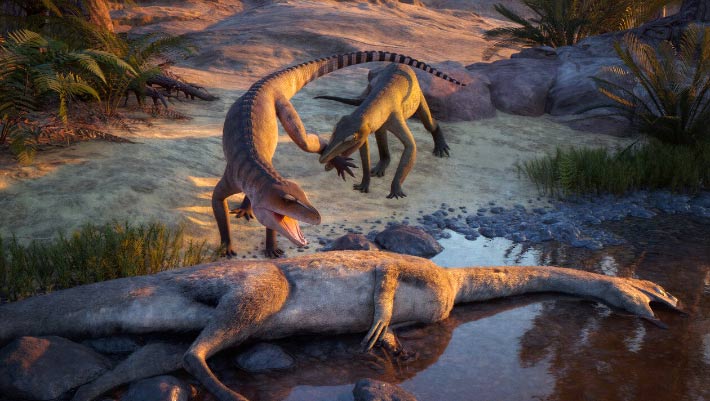
Les scientifiques ont identifié une nouvelle espèce d'ancien crocodylomorphe dans les roches du Trias supérieur du sud-ouest de l'Angleterre. L'espèce nouvellement nommée, Galahadosuchus jonesi, vivait il y a environ 215 millions d'années et représente la deuxième espèce de crocodylomorphe non crocodyliforme décrite dans les fissures du Trias supérieur de la région du canal de Bristol. Du matériel fossile de crocodylomorphe non crocodyliforme est connu de
01/06/2026 everythingdinosaur ⚙ Traduction automatique
Un nouveau dinosaure carnivore du Trias identifié à Ghost Ranch
États-Unis Trias supérieur Trias fossile spécimen Coelophysis Dinosauria Ptychotherates nouvelle espèce crâne
Des chercheurs de Virginia Tech (Virginie, États-Unis) ont identifié une nouvelle espèce de dinosaure du Trias supérieur.  Le dinosaure a été nommé Ptychotherates bucculentus.  Ce nouveau taxon de dinosaure carnivore a été érigé sur la base de l'examen détaillé d'un fossile de crâne incomplet, bien conservé mais mélangé (numéro de spécimen CM 31368).  Le crâne provient de la Coelophysis de renommée mondiale
11/05/2026 everythingdinosaur ⚙ Traduction automatique
Museum Fossil Reveals Triassic Crocodile Cousin with Powerful Jaws
Un fossile de musée révèle un cousin crocodile du Trias doté de mâchoires puissantes
mâchoire musée Trias supérieur Trias fossile spécimen tomographie nouvelle espèce
Les tomodensitogrammes d'un spécimen vieux de plusieurs décennies du Musée d'histoire naturelle de Yale Peabody montrent une nouvelle espèce de crocodylomorphe au museau court et aux mâchoires inhabituellement fortes, offrant un instantané rare de la spécialisation écologique à l'époque du Trias supérieur. Le post Museum Fossil révèle un cousin crocodile du Trias doté de mâchoires puissantes est apparu en premier sur Sci.News: Breaking Science News.
20/04/2026 sci-news ⚙ Traduction automatique
1 2