Spain

Country

23 image(s) · 4 News

Image gallery

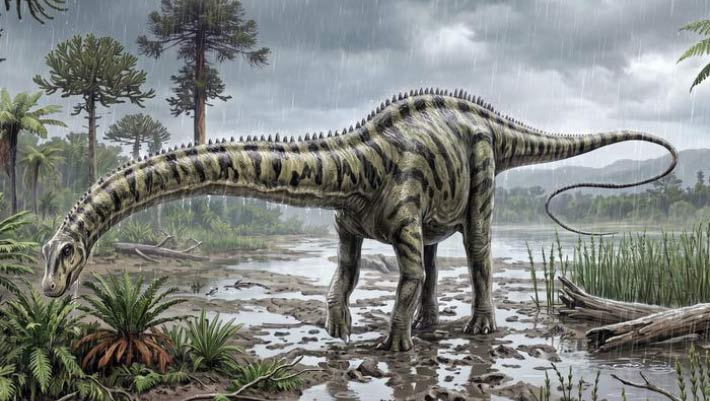
Qunkasaura is a titanosaurian sauropod dinosaur that lived approximately 75 million years ago in the Late Cretaceous of what is now Spain. Specifically, it is a saltasaurid titanosaur, and its discovery marks the first instance of two distinct lineages of this group present in the same locality. In the Late Cretaceous, Europe was a large archipelago, and the coexistence of these differing lineages indicates that saltasaurids arrived in the Iberian Peninsula much later than other groups of dinosaurs.

Qunkasaura is a titanosaurian sauropod dinosaur that lived approximately 75 million years ago in the Late Cretaceous of what is now Spain. Specifically, it is a saltasaurid titanosaur, and its discovery marks the first instance of two distinct lineages of this group present in the same locality. In the Late Cretaceous, Europe was a large archipelago, and the coexistence of these differing lineages indicates that saltasaurids arrived in the Iberian Peninsula much later than other groups of dinosaurs.

Spain Cretaceous Late Cretaceous Dinosauria +4
Aalenian GSSP (Lower-Middle Jurassic boundary). Golden spike ceremony: July, 28th 2016. Fuentelsaz, Guadalajara, Spain
Intervals Aalenian

Aalenian GSSP (Lower-Middle Jurassic boundary). Golden spike ceremony: July, 28th 2016. Fuentelsaz, Guadalajara, Spain

Spain Aalenian Jurassic Middle Jurassic
Detail of the stratigraphic section of the El Castellar dinosaur footprints site, Teruel, Spain.

Detail of the stratigraphic section of the El Castellar dinosaur footprints site, Teruel, Spain.

Spain El Castellar Dinosauria
Dryolestidan mammal Crusafontia amoae sp. nov., MPZ CC2−1 M4 or M5, holotype, from the site of Cuesta Corrales 2, Colladico Blanco level, El Castellar Formation, Galve, Teruel, Spain in, occlusal (A), mesial (B), labial (C), distal (D), and lingual (E) views. The schematic drawing of C. amoae, in the box in the lower left−hand corner shows the main anatomical elements of the occlusal surface of a dryolestidan.
Formations El Castellar

Dryolestidan mammal Crusafontia amoae sp. nov., MPZ CC2−1 M4 or M5, holotype, from the site of Cuesta Corrales 2, Colladico Blanco level, El Castellar Formation, Galve, Teruel, Spain in, occlusal (A), mesial (B), labial (C), distal (D), and lingual (E) views. The schematic drawing of C. amoae, in the box in the lower left−hand corner shows the main anatomical elements of the occlusal surface of a dryolestidan.

drawing Spain El Castellar holotype +1
Paleogeography and paleoclimate of the Late Jurassic - 150 Ma with dinosaur fossil localities:
A = Tendaguru Formation, Tanzania
C1 =  Shishugou & Kalazha Formations, China
C2 =  Shangshaximiao (Upper Shaximiao) Formation, China
E1 =  Sables de Glos, Argiles d’Octeville, Marnes de Bléville, Kimmeridge Clay, Calcareous Grit, Corallian Oolite, Oxford Clay, Portland Stone, England & France
E2 = Villar del Arzobispo, Alcobaça, Guimarota, Sobral, Amoreira-Porto Novo, Bombarral, Freixial, Lourinhã Formations, Spain & Portugal
M1-6 = Morrison Formation, United States
S1 =  Toquí & Cañadón Calcáreo Formations, Chile & Argentina

Paleogeography and paleoclimate of the Late Jurassic - 150 Ma with dinosaur fossil localities: A = Tendaguru Formation, Tanzania C1 = Shishugou & Kalazha Formations, China C2 = Shangshaximiao (Upper Shaximiao) Formation, China E1 = Sables de Glos, Argiles d’Octeville, Marnes de Bléville, Kimmeridge Clay, Calcareous Grit, Corallian Oolite, Oxford Clay, Portland Stone, England & France E2 = Villar del Arzobispo, Alcobaça, Guimarota, Sobral, Amoreira-Porto Novo, Bombarral, Freixial, Lourinhã Formations, Spain & Portugal M1-6 = Morrison Formation, United States S1 = Toquí & Cañadón Calcáreo Formations, Chile & Argentina

Argentina Chile China France +19
The geological park of Aliaga (Teruel, Spain) is one of the most interesting geological zones of Aragon, a viewpoint of the last 200 million years of Earth's history.

The geological park of Aliaga (Teruel, Spain) is one of the most interesting geological zones of Aragon, a viewpoint of the last 200 million years of Earth's history.

Spain
Stratigraphy, Tremp Formation in Spain.

Stratigraphy, Tremp Formation in Spain.

Spain formation stratigraphy
Drawings of Dryolestida left upper−molar, modified from the original descriptions. A–C, Kimmeridgian; D–F, Tithonian–Berriasian; G–H, early Barremian; I, late Barremian. A. Left M4 or M5 of Comotherium richi Prothero, 1981, from the Upper Jurassic Morrison Formation, Como Bluff locality, Wyoming, USA. B. Right M5, reversed, of Dryolestes leiriensis Martin, 1999, from Guimarota, Portugal.C. Left M6 of Krebsotherium lusitanicum Martin, 1999, from Guimarota, Portugal. D. Right M4 or M 6 (reversed) of Portopinheirodon asymmetricus Martin, 1999, Porto Pinheiro, Lourinha, Portugal. E. Right M5 (reversed) of Laolestes andresi Martin, 1999, from Porto Pinheiro, Lourinha, Portugal. F. Right upper molar of Donodon perscriptoris Sigogneau−Russell, 1991, Anoual, Morocco.G. Left M4 orM5 of Crusafontia amoae sp. nov., holotype, Cuesta Corrales 2, El Castellar Formation, Galve, Teruel, Spain. H. Right M6 orM7 (reversed) of Crusafontia amoae sp. nov., first described as upper molar of Crusafontia cuencana by Krebs (1993), P−2 H4 Pelejón 2, Galve, Teruel, Spain. I. Left M2 or M3, of Crusafontia cuencana Henkel and Krebs, 1969, Uña, La Huérguina Formation, Cuenca, Spain, (from Krebs 1993). Scale bars 1 mm.

Drawings of Dryolestida left upper−molar, modified from the original descriptions. A–C, Kimmeridgian; D–F, Tithonian–Berriasian; G–H, early Barremian; I, late Barremian. A. Left M4 or M5 of Comotherium richi Prothero, 1981, from the Upper Jurassic Morrison Formation, Como Bluff locality, Wyoming, USA. B. Right M5, reversed, of Dryolestes leiriensis Martin, 1999, from Guimarota, Portugal.C. Left M6 of Krebsotherium lusitanicum Martin, 1999, from Guimarota, Portugal. D. Right M4 or M 6 (reversed) of Portopinheirodon asymmetricus Martin, 1999, Porto Pinheiro, Lourinha, Portugal. E. Right M5 (reversed) of Laolestes andresi Martin, 1999, from Porto Pinheiro, Lourinha, Portugal. F. Right upper molar of Donodon perscriptoris Sigogneau−Russell, 1991, Anoual, Morocco.G. Left M4 orM5 of Crusafontia amoae sp. nov., holotype, Cuesta Corrales 2, El Castellar Formation, Galve, Teruel, Spain. H. Right M6 orM7 (reversed) of Crusafontia amoae sp. nov., first described as upper molar of Crusafontia cuencana by Krebs (1993), P−2 H4 Pelejón 2, Galve, Teruel, Spain. I. Left M2 or M3, of Crusafontia cuencana Henkel and Krebs, 1969, Uña, La Huérguina Formation, Cuenca, Spain, (from Krebs 1993). Scale bars 1 mm.

description drawing Morocco Portugal +11
The titanosaurian sauropod Lirainosaurus astibiae Sanz, Powell, Le Loeuff, Martínez, and Pereda Suberbiola, 1999 from the Late Cretaceous of Laño (northern Spain), paratypic braincase (MCNA 7439). Right lateral, left lateral, posterior, and anterior views.

The titanosaurian sauropod Lirainosaurus astibiae Sanz, Powell, Le Loeuff, Martínez, and Pereda Suberbiola, 1999 from the Late Cretaceous of Laño (northern Spain), paratypic braincase (MCNA 7439). Right lateral, left lateral, posterior, and anterior views.

Spain Cretaceous Late Cretaceous Lirainosaurus +1
1 2

News

125-Million-Year-Old Crocodile Relative Reveals Its True Colors
scale skin Spain Cretaceous Early Cretaceous other reptiles
Exceptionally preserved skin of Montsecosuchus depereti, an extinct crocodylomorph no larger than a house cat that prowled the tropical wetlands of Early Cretaceous Spain, has allowed paleontologists to reconstruct details of its scales, sensory organs and even possible banded markings along its tail. The post 125-Million-Year-Old Crocodile Relative Reveals Its True Colors appeared first on Sci.News: Breaking Science News.
18/06/2026 sci-news
New Species of Ancient Bear-Dog Identified in Spain
pelvis Spain fossil specimen mammals new species
Paleontologists have identified a previously unknown species of amphicyonid -- the extinct family of carnivorous mammals popularly known as bear-dogs -- from two specimens unearthed at a rich fossil site in the Vallès-Penedès Basin near Barcelona, Spain. The post New Species of Ancient Bear-Dog Identified in Spain appeared first on Sci.News: Breaking Science News.
11/06/2026 sci-news
Half-Ton Cattle Relatives Roamed Europe 4 Million Years Ago
Spain Pliocene mammals skeleton
Near-complete bovine skeletons unearthed the Early Pliocene site of Camp dels Ninots in northeastern Spain reveal that the ancestors of today’s buffalo and cattle were already growing to impressive sizes long before humans arrived on the continent. The post Half-Ton Cattle Relatives Roamed Europe 4 Million Years Ago appeared first on Sci.News: Breaking Science News.
05/06/2026 sci-news
Bronze Age mines discovered in Spain may explain Scandinavian metal mystery
Spain discovery
Archaeologists have uncovered six previously unknown Bronze Age mines in southwestern Spain, offering a striking new clue about where the metal in ancient Scandinavian artifacts may have come from. Found near Cabeza del Buey, the sites include everything from small extraction zones to larger mining operations—one even packed with around 80 stone axes used to crush ore. These mines contain copper, lead, and silver, key materials that powered trade networks thousands of years ago.
29/04/2026 sciencedaily-fossils