Dinosauria

Taxon

412 image(s) · 210 Actualités

Voir la fiche

Galerie d'images

An Ankylosaurus head (cast of specimen AMNH 5214), on display at the Museum of the Rockies in Bozeman, Montana.  This is from a specimen collected in Custer County, Montana.
The Ankylosauria were armored dinosaurs that lived from 122 million years ago to 66 million years ago in western North America, Europe, and East Asia.  There were two subgroups:  The Nodosauridae and Ankylosauridae. 
The Ankylosauridae contained six species, and a single subfamily -- the Ankylosaurinae.  There 18 genus within the subfamily, of which Ankylosaurus is the best known.  Ankylosaurus as the last of these, and lived 65.5 to 66.5 million years ago.
Ankylosaurus was about 20.5 feet long, 5 feet wide, and 5.5 feet tall at the hip.  It walked on all fours, with the rear legs longer than the front ones.  They ripped vegetation, and swallowed it whole.  Their defining feature was their armor.  They body was covered in thick, heavy bony plates, and most of the plates were fused together to make them even stronger.  Embedded in the skin were more knobs of bone, and the outer skin above these knobs covered in keratin (the same stuff fingernails are made of).  Ankylosaurus had a tail club, which consisted of several large osteoderms fused to the last few tail vertebrae.

Ankylosaurus was discovered in 1908.
Taxons Ankylosaurus

An Ankylosaurus head (cast of specimen AMNH 5214), on display at the Museum of the Rockies in Bozeman, Montana. This is from a specimen collected in Custer County, Montana. The Ankylosauria were armored dinosaurs that lived from 122 million years ago to 66 million years ago in western North America, Europe, and East Asia. There were two subgroups: The Nodosauridae and Ankylosauridae. The Ankylosauridae contained six species, and a single subfamily -- the Ankylosaurinae. There 18 genus within the subfamily, of which Ankylosaurus is the best known. Ankylosaurus as the last of these, and lived 65.5 to 66.5 million years ago. Ankylosaurus was about 20.5 feet long, 5 feet wide, and 5.5 feet tall at the hip. It walked on all fours, with the rear legs longer than the front ones. They ripped vegetation, and swallowed it whole. Their defining feature was their armor. They body was covered in thick, heavy bony plates, and most of the plates were fused together to make them even stronger. Embedded in the skin were more knobs of bone, and the outer skin above these knobs covered in keratin (the same stuff fingernails are made of). Ankylosaurus had a tail club, which consisted of several large osteoderms fused to the last few tail vertebrae. Ankylosaurus was discovered in 1908.

armure os peau musée +7
The "Dinosaurs in Their Time" exhibit at the Carnegie Museum of Natural History.
Pictures from some of my free time during the Project Zero Perspectives conference (#PZPGH) in Pittsburg, Pennsylvania - May 2017.
Taxons Corythosaurus

The "Dinosaurs in Their Time" exhibit at the Carnegie Museum of Natural History. Pictures from some of my free time during the Project Zero Perspectives conference (#PZPGH) in Pittsburg, Pennsylvania - May 2017.

musée Corythosaurus Dinosauria
Holotype specimen (CRILAR-Pv 151) of Huayracursor jaguensis, a long-necked dinosaur that lived approximately 230 million years ago, placed in approximate anatomical articulation.

Holotype specimen (CRILAR-Pv 151) of Huayracursor jaguensis, a long-necked dinosaur that lived approximately 230 million years ago, placed in approximate anatomical articulation.

holotype spécimen Dinosauria Huayracursor
Musango is a basal sauropodomorph dinosaur that lived during the Late Triassic period in what is now Zimbabwe. Typical of early sauropodomorphs, or "prosauropods," it was an obligate biped with a long neck, and a long tail for counterbalance. Musango grew to approximately 5 m in total body length.

Musango is a basal sauropodomorph dinosaur that lived during the Late Triassic period in what is now Zimbabwe. Typical of early sauropodomorphs, or "prosauropods," it was an obligate biped with a long neck, and a long tail for counterbalance. Musango grew to approximately 5 m in total body length.

Zimbabwe Trias supérieur Trias Dinosauria +1
Uragasaurus is a sauropod dinosaur, and the first mamenchisaurid known from Thailand. Mamenchisaurids exhibit the basic sauropod body plan, processing their herbivorous diet in their large gut. Uniquely, mamenchisaurid necks, like that of Uragasaurus, are proportionately long, even by sauropod standards.

Uragasaurus is a sauropod dinosaur, and the first mamenchisaurid known from Thailand. Mamenchisaurids exhibit the basic sauropod body plan, processing their herbivorous diet in their large gut. Uniquely, mamenchisaurid necks, like that of Uragasaurus, are proportionately long, even by sauropod standards.

Thaïlande Dinosauria Mamenchisauridae Uragasaurus
Brontotholus is a relatively large pachycephalosaurian dinosaur. Like all pachycephalosaurs, it was bipedal and sported the characteristic bony dome on top of its skull. Brontotholus grew to nearly 4 m in length, making it one of the largest known pachycephalosaurs, and the largest from the Campanian age.

Brontotholus is a relatively large pachycephalosaurian dinosaur. Like all pachycephalosaurs, it was bipedal and sported the characteristic bony dome on top of its skull. Brontotholus grew to nearly 4 m in length, making it one of the largest known pachycephalosaurs, and the largest from the Campanian age.

Campanien Brontotholus Dinosauria Pachycephalosauria +1
Restored profile of the oviraptorid dinosaur Heyuannia yanshini by Matt Martyniuk.

Restored profile of the oviraptorid dinosaur Heyuannia yanshini by Matt Martyniuk.

Dinosauria Heyuannia Ingenia Oviraptoridae
Reconstruction of Bissektipelta archibaldi an ankylosaurid dinosaur from the Late Cretaceous of Uzbekistan

Reconstruction of Bissektipelta archibaldi an ankylosaurid dinosaur from the Late Cretaceous of Uzbekistan

Ouzbékistan Crétacé Crétacé supérieur Ankylosauridae +2
Huaxiazhoulong is a fairly large ankylosaurid dinosaur, at around 6 m in length. It was a robust quadruped with a beak and teeth adapted for processing its herbivorous diet. Huaxiazhoulong had an armor of osteoderms, and the characteristic ankylosaurid tail club which was likely used in defense against predators, as well as intraspecific combat.

Huaxiazhoulong is a fairly large ankylosaurid dinosaur, at around 6 m in length. It was a robust quadruped with a beak and teeth adapted for processing its herbivorous diet. Huaxiazhoulong had an armor of osteoderms, and the characteristic ankylosaurid tail club which was likely used in defense against predators, as well as intraspecific combat.

armure défense prédateur Ankylosauridae +2
Calvarius is a genus of styracosternan ornithopod from the Late Cretaceous of Spain. The name alludes to its chronostratigraphic proximity to the extinction event that wiped out the non-avian dinosaurs at the end of the Cretaceous. The highly modified metatarsal that is known from shows an example of convergent evolution, as it is more similar to non-iguanodontian ornithopods than to other styracosternans. It is thought that this is due to fulfilling a niche in its island habitat, resulting in Calvarius becoming a small-bodied animal, capable of rapid locomotion.

Calvarius is a genus of styracosternan ornithopod from the Late Cretaceous of Spain. The name alludes to its chronostratigraphic proximity to the extinction event that wiped out the non-avian dinosaurs at the end of the Cretaceous. The highly modified metatarsal that is known from shows an example of convergent evolution, as it is more similar to non-iguanodontian ornithopods than to other styracosternans. It is thought that this is due to fulfilling a niche in its island habitat, resulting in Calvarius becoming a small-bodied animal, capable of rapid locomotion.

locomotion Espagne Crétacé Crétacé supérieur +6
Astigmasaura is a medium-sized rebbachisaurid sauropod dinosaur from the Late Cretaceous period of what is now Argentina. Rebbachisaurids had highly pneumatized bones that helped them to hold their weight on their four pillar-like legs, and extremely long tails. Astigmasaura was likely a ground-level browsing herbivore.

Astigmasaura is a medium-sized rebbachisaurid sauropod dinosaur from the Late Cretaceous period of what is now Argentina. Rebbachisaurids had highly pneumatized bones that helped them to hold their weight on their four pillar-like legs, and extremely long tails. Astigmasaura was likely a ground-level browsing herbivore.

os Argentine Crétacé Crétacé supérieur +3
Rebbachisaurids are the latest known sauropod dinosaurs outside the titanosaur lineage. Cienciargentina is a rebbachisaurid from the Late Cretaceous, making it among the most recent. It had many hollow bones, and likely had batteries of teeth used for chewing, a rebbachisaurid feature unique among sauropods.

Rebbachisaurids are the latest known sauropod dinosaurs outside the titanosaur lineage. Cienciargentina is a rebbachisaurid from the Late Cretaceous, making it among the most recent. It had many hollow bones, and likely had batteries of teeth used for chewing, a rebbachisaurid feature unique among sauropods.

os Crétacé Crétacé supérieur Cienciargentina +3
Original caption: "Calibrated phylogeny of Neosauropoda. Summarized strict consensus tree showing the relationships among neosauropod dinosaurs and the phylogenetic position of Tapuiasaurus macedoi gen. n. sp. n. The support values (Bremer/Bootstrap) for the nodes labelled in the figure are: Neosauropoda (1/-), Somphospondyli (2/68), Titanosauria (2/58), Lithostrotia (3/68), “advanced titanosaurians” (3/65), Nemegtosauridae (1/-), Saltasauridae (1/-). See Figure S4 for a complete strict consensus tree including all sauropod terminal taxa used in the analysis. Age of first appearance for taxa used in the calibrated phylogeny are given in Text S4."

Original caption: "Calibrated phylogeny of Neosauropoda. Summarized strict consensus tree showing the relationships among neosauropod dinosaurs and the phylogenetic position of Tapuiasaurus macedoi gen. n. sp. n. The support values (Bremer/Bootstrap) for the nodes labelled in the figure are: Neosauropoda (1/-), Somphospondyli (2/68), Titanosauria (2/58), Lithostrotia (3/68), “advanced titanosaurians” (3/65), Nemegtosauridae (1/-), Saltasauridae (1/-). See Figure S4 for a complete strict consensus tree including all sauropod terminal taxa used in the analysis. Age of first appearance for taxa used in the calibrated phylogeny are given in Text S4."

Dinosauria Lithostrotia Nemegtosauridae Neosauropoda +6
Dzharacursor is an ornithomimid theropod dinosaur from the Late Cretaceous of what is now Uzbekistan. Ornithomimids like Dzharacursor are known for their long legs lending to a cursorial, or running, lifestyle. They had a feathered covering, and were likely omnivorous, or possibly herbivorous. Adult Dzharacursor could grow to approximately 3.5 m in length.

Dzharacursor is an ornithomimid theropod dinosaur from the Late Cretaceous of what is now Uzbekistan. Ornithomimids like Dzharacursor are known for their long legs lending to a cursorial, or running, lifestyle. They had a feathered covering, and were likely omnivorous, or possibly herbivorous. Adult Dzharacursor could grow to approximately 3.5 m in length.

Ouzbékistan Crétacé Crétacé supérieur Dinosauria +2
Ahvaytum is a saturnaliid sauropodomorph from the Late Triassic of what is now Wyoming. It is the oldest known dinosaur from the northern continent of Laurasia, challenging previous hypotheses of dinosaur origins and dispersal. Typical of basal dinosaurs from the Triassic, Ahvaytum was a small slender biped, reaching about 1 m in body length.

Ahvaytum is a saturnaliid sauropodomorph from the Late Triassic of what is now Wyoming. It is the oldest known dinosaur from the northern continent of Laurasia, challenging previous hypotheses of dinosaur origins and dispersal. Typical of basal dinosaurs from the Triassic, Ahvaytum was a small slender biped, reaching about 1 m in body length.

Trias supérieur Trias Ahvaytum Dinosauria +1
Huashanosaurus is a basal sauropod dinosaur that lived from the Early to Middle Jurassic periods of what is now China. It was a long-necked herbivore which still exhibited many basal traits of the earlier sauropodomorphs, while transitioning to obligate quardupedality. Huashanosaurus grew to approximately 12 m in length, and weighed around 10 t.

Huashanosaurus is a basal sauropod dinosaur that lived from the Early to Middle Jurassic periods of what is now China. It was a long-necked herbivore which still exhibited many basal traits of the earlier sauropodomorphs, while transitioning to obligate quardupedality. Huashanosaurus grew to approximately 12 m in length, and weighed around 10 t.

Chine Jurassique Jurassique moyen Dinosauria +1
1 2 3 4 5 6 7 8 9 10 11 12 13 14 15 16 17 18 19 20 21 22 23 24 25 26

Actualités

Un nouveau dinosaure sauropode du Crétacé inférieur du Brésil
Brésil Crétacé Crétacé inférieur Dasosaurus Dinosauria
Un nouveau genre de dinosaure sauropode a été nommé au Brésil.  Il élargit la diversité connue des sauropodes du Crétacé inférieur dans la partie nord de l'Amérique du Sud. En outre, le nouveau dinosaure Dasosaurus tocantinensis fournit de nouvelles preuves de la dispersion des dinosaures entre l’Europe, l’Afrique et l’Amérique du Sud. L'article scientifique décrivant le nouveau taxon a été
15/05/2026 everythingdinosaur ⚙ Traduction automatique
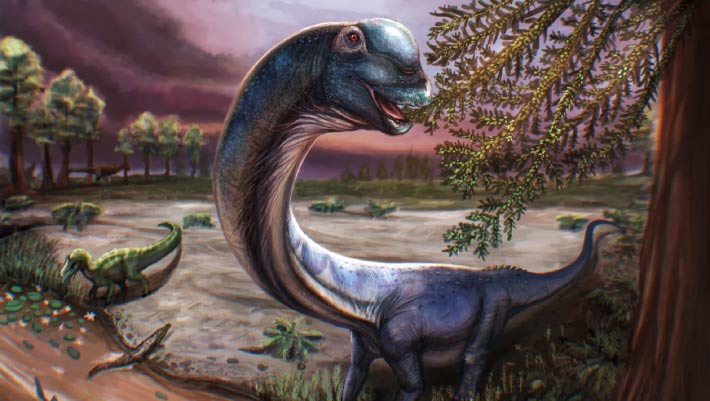
Giant New Dinosaur Species Discovered in Thailand Reveals Hidden Diversity of Asian Titans
Une nouvelle espèce de dinosaure géant découverte en Thaïlande révèle la diversité cachée des titans asiatiques
os Thaïlande Crétacé Crétacé inférieur Dinosauria Somphospondyli Titanosauriformes découverte nouvelle espèce
Les paléontologues ont identifié un nouveau genre et une nouvelle espèce de dinosaure titanosauriforme somphospondylan - le plus grand jamais découvert en Asie du Sud-Est - à partir d'ossements fossilisés trouvés en Thaïlande, offrant ainsi une nouvelle preuve que la région abritait un groupe étonnamment diversifié d'énormes herbivores au début du Crétacé. L'article Une nouvelle espèce de dinosaure géant découverte en Thaïlande révèle la diversité cachée des titans asiatiques apparaît en premier sur Sci.News : Breaking Science News.
14/05/2026 sci-news ⚙ Traduction automatique
Sue s'exprimant à DinoCon – Un aperçu unique de l'industrie du modèle de dinosaures
Dinosauria
C'est vrai!  Sue s'exprimant à la DinoCon 2026 !  Nous l'avons teasé sur les réseaux sociaux et aujourd'hui nous pouvons confirmer que Sue Judd de Everything Dinosaur fera une présentation à la DinoCon de cette année. Sa présentation offre un rare aperçu des coulisses de la création du premier modèle de dinosaure interne de l’entreprise. La conférence s'intitule « Il faut
14/05/2026 everythingdinosaur ⚙ Traduction automatique
La paléontologie secouée par la découverte de molécules organiques dans des os de dinosaures vieux de 66 millions d'années
os collagène protéine fossile Dinosauria Edmontosaurus découverte
Les scientifiques ont découvert des preuves irréfutables selon lesquelles les fossiles de dinosaures peuvent encore contenir des traces de leurs protéines d'origine, renversant ainsi une croyance de longue date selon laquelle la fossilisation détruit toute matière organique. Dans un fossile d'Edmontosaurus remarquablement bien conservé du Dakota du Sud, les chercheurs ont détecté des restes de collagène – la principale protéine présente dans les os – à l'aide de techniques avancées, notamment la spectrométrie de masse et le séquençage des protéines.
14/05/2026 sciencedaily ⚙ Traduction automatique
Cet étrange dinosaure géant pourrait changer ce que nous savons sur les titans du Jurassique
Argentine Jurassique fossile Bicharracosaurus Brachiosauria Brachiosauridae Dinosauria Diplodocia évolution
Un étrange nouveau dinosaure géant découvert en Argentine donne aux paléontologues un nouveau regard sur l'évolution des titans du Jurassique dans l'hémisphère sud. Bicharracosaurus dionidei s'étendait sur environ 20 mètres de long et présentait un étrange mélange de caractéristiques observées chez les parents du Diplodocus et du Brachiosaurus. Les scientifiques pensent qu’il pourrait s’agir du premier brachiosaure du Jurassique connu d’Amérique du Sud, contribuant ainsi à combler une lacune majeure dans les archives fossiles de dinosaures.
12/05/2026 sciencedaily ⚙ Traduction automatique
1 2 3 4 5 6 7 8 9 10 11 12 13 14 15 16 17 18 19 20 21 22 23 24 25 26 27 28 29 30 31 32 33 34 35 36 37 38 39 40 41 42